

Aantal spelers: 1-4
Speelduur: 20-30 minuten
Leeftijd: Vanaf 8 jaar
Auteur: Jules Messaud
Uitgever: Geronimo Games
Jaar: 2022
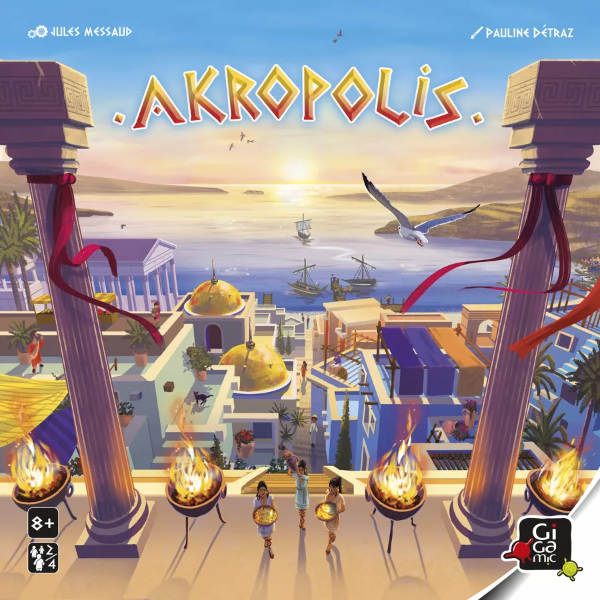

Dit is een herpublicatie van een review die ik eerder schreef voor bordspelwereld.nl
Eigenlijk heeft dit spel een hoop waardoor je zou denken dat ik het geen leuk spel zou vinden. De eeuwige hexagon, cliché gebruik van primaire kleuren, aangevuld met wit, groen en paars. De zoveelste tegellegger (vooruit, dat vind ik leuk), en ook nog de zoveelste tegellegger waarbij we ook de lucht in gaan en in lagen gaan werken, zoals bijvoorbeeld in Lamaland. En stiekem is het gewoon een polyomino met zeshoeken. Klinkt niet echt als een recept waar je dol enthousiast van wordt, want we hebben het nu wel gezien, niet waar? En toch ben ik wél enthousiast!
Stiekem ben ik namelijk dol op polyomino’s. Maar als ik dat meteen roep, haken er lezers af. Niet doen, even blijven hangen! Want hij is echt leuk en je kan elkaar wel degelijk dwars zitten en er is ruimte voor strategie en voor het beïnvloeden van het spel van je medespelers.
Ook in Akropolis is het zo dat je aan je eigen gebied gaat bouwen, waarbij je tegels kiest uit een beschikbare markt. Ja, ook dit is het zoveelste spel waarbij een startspeler rouleert waardoor iedereen om en om de eerste keuze heeft uit diezelfde markt. Door het slim combineren en plaatsen van tegels scoor je punten, de speler met de meeste punten wint. Niets nieuws onder de zon. En toch is dit door wat kleine twists een leuke simpele abstracte puzzel en filler. Het is namelijk zo klaar gezet en zó gespeeld en het prikkelt je brein precies genoeg om er veel plezier aan te beleven.
Hoe wordt Akropolis gespeeld?
In je beurt kies je een tegel uit de markt. Wie als eerste uit de markt mag kiezen rouleert. Niet alle tegels zijn gratis, sommige kosten blokjes. Wanneer een tegel uit de markt wordt genomen en er nog duurdere tegels aanwezig waren, schuiven deze door en worden goedkoper voor de volgende speler. Er is altijd een gratis tegel beschikbaar.
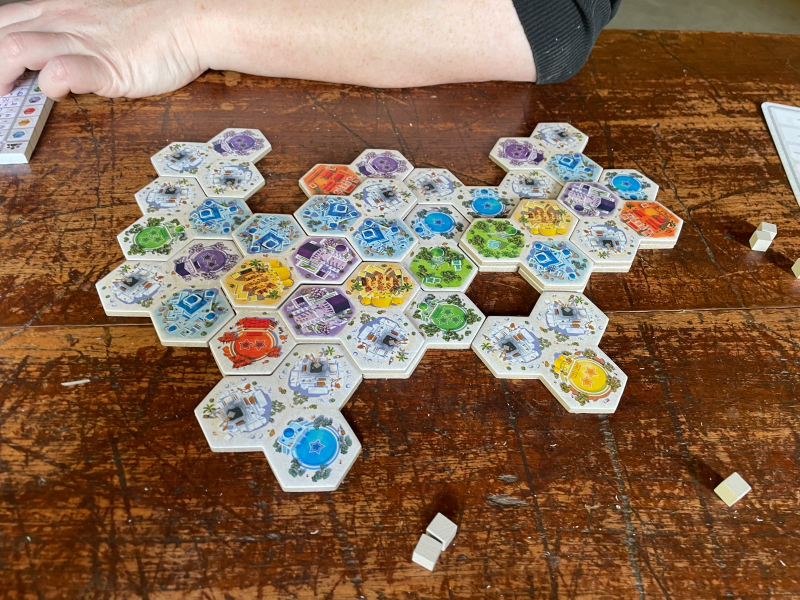
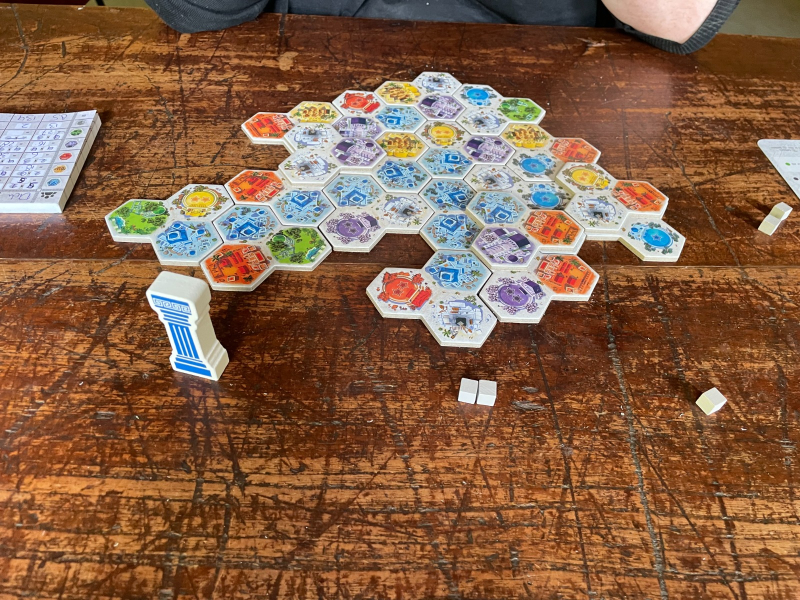
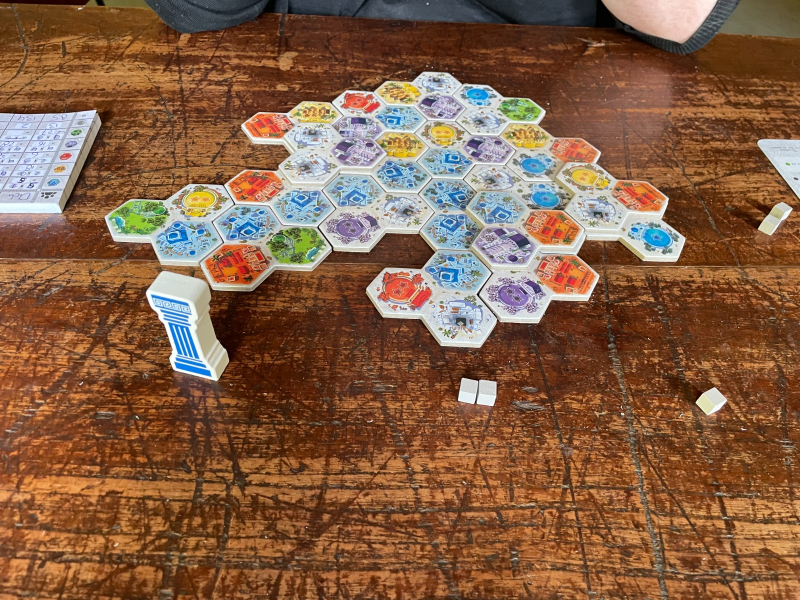
De te verzamelen tegels zijn drie geschakelde hexagons in verschillende kleuren, welke je steeds aan of óp je bestaande gebied legt, welke start met een starttegel. Dit doe je natuurlijk niet zomaar willekeurig. Er zijn een vijftal kleuren te spelen met ieder hun eigen functie, die scoren wanneer je ze met de sterren weet te combineren. De score van het aantal zichtbare tegels (districten) x het aantal sterren (pleinen) is je score per kleur. De sterren spreken voor zich, je telt gewoon het aantal, maar hoe de districten scoren scheelt per kleur.
De functies per kleur:
- Rode districten scoren wanneer zij aan de rand liggen.
- Gele districten scoren wanneer zij geen ander geel district aanraken.
- Paarse districten scoren wanneer zij volledig ombouwd zijn.
- Blauwe districten scoren in groepen. De grootste groep aangrenzende blauwe districten gaat x het aantal pleinen (sterren).
- Groen heeft geen plaatsingseisen en mag je overal leggen.
Nou is er natuurlijk wel een reden waarom dit spel Akropolis heet. We kunnen in meerdere lagen bouwen om zo de berg en dito bebouwing naar de Akropolis uit te beelden. Veelomvattender is de vergelijking niet. Hoewel de titel en de vergelijking dus een beetje een wassen neus zijn, legt dat bouwen in lagen geen windeieren. Het district heeft namelijk de waarde van de laag waarop hij is gebouwd. Het bouwen op de tweede laag heeft daarnaast als voordeel dat wanneer je witte districten bebouwd, je de blokjes krijgt waarmee je in de markt kan betalen. In lagen bouwen is dus belangrijk! Met de blokjes kun je waardevolle tegels uit de markt kopen en ben je niet afhankelijk van de gratis tegels. Bovendien kun je zien op welke kleuren de tegenstanders zich focussen dus kan het erg lucratief zijn om tegels met veel sterren in hun focuskleur weg te halen. Levert jou misschien niet veel op, maar het voorkomt wellicht een heleboel punten bij een van je medespelers.
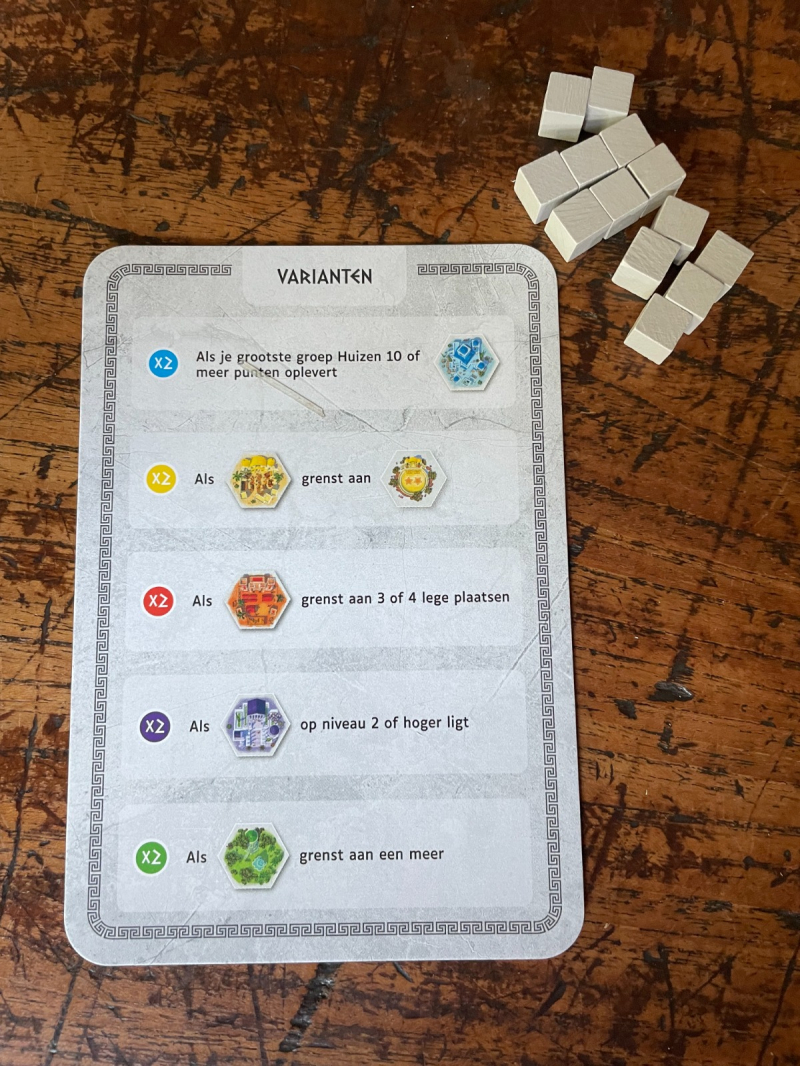
Wanneer je het spel onder de knie hebt is er ruimte voor varianten. Het spel raadt aan de varianten (die per kleur worden aangeboden) af te wisselen en niet allemaal tegelijk te spelen, maar de gevorderde spelers kunnen direct instappen op een spel met alle varianten. Zeker wanneer je bekend bent met polyomino’s en andere (abstracte) puzzelspellen. De basisregels per kleur zoals hier boven beschreven blijven bij deze variant in tact, maar er worden extra scoringsmogelijkheden aan toegevoegd, te weten:
- De waarde van een rood district verdubbelt wanneer minstens drie van de zes zijdes niet bebouwt zijn.
- Gele districten verdubbelen wanneer een plein tegen een district is aangebouwd.
- Paarse districten verdubbelen zodra ze op een hogere laag worden gebouwd.
- De groep met blauwe districten verdubbelt zodra hij uit tien of meer districten bestaat.
- Groene districten verdubbelen wanneer zij aan een meer liggen. Hier mee wordt een volledig ombouwde lege zeshoek bedoeld.
Wat vind ik er van?
Persoonlijk speel ik niet meer zonder de varianten, tenzij ik iemand het spel leer. Toegegeven, de basisvariant kan afhankelijk van de ervarenheid van spelers snel saai worden. Maar ergens is dat juist een goed punt. Want het spel is vrij makkelijk naar smaak en kunnen aan te passen. De eenvoud van de basis staat zo sterk dat je ook zelf allerlei varianten kan bedenken. Zo speel ik, zoals op BGA ook mogelijk is, ook bij twee spelers graag met alle tegels, in plaats van met een selectie. Daarnaast ontstonden er aan tafel al een hoop varianten op de markt en hoe je deze zou kunnen laten werken. De keuze is reuze evenals de herspeelbaarheid.
Dat het thema een wassen neus is en eigenlijk gewoon een kapstokje om het mechanisme aan op te hangen, vergeef ik de makers. Vaak zie ik graag meer verbinding met het thema, maar eigenlijk zit de kracht van het spel juist in het simplistische van de vormgeving en in de repeterende handelingen. Deze maken het een rustgevende puzzel. En dat horen puzzels ook te zijn. Die zijn recht toe recht aan.
Het solistische karakter waar polyomino’s vaak op bekritiseerd worden kan ik natuurlijk niet in zijn geheel wegnemen of bestrijden, dat heeft dit spel ook. Dus als dat niet je cup of tea is, snap ik dat je sceptisch bent, maar persoonlijk speel ik dit spel juist erg met het oog op de tegenstanders. Mijn marktkeuzes zijn niet louter gebaseerd op wat mijn gebied nou het beste zou dienen, want dat is niet persee de definitie van winst. Een blauw gebied van meer dan tien tegels kan bij de gevorderde variant ineens heel hard gaan, dus dan kaap ik graag de blauwe sterren uit de markt weg. Die gebruik ik dan wel om een laagje hoger op te komen en wat witte tegels te bedekken. Als mijn tegenstander ze maar niet krijgt. Je manier van aanleggen is zeer bepalend voor het spel. De tegels passen per definitie mooi in elkaar, het hoeft geen perfect vullend patroon te worden die je in elkaar moet Tetrissen zoals bij Patchwork, Isle of Cats of bijvoorbeeld Planet Unknown. Wel moet je, net zoals bij twee laatstgenoemde goed kijken hoe je tegels combineert omdat dit invloed heeft om de scores. Dit omdat ze dus allemaal hun eigen scoringsmechanisme hebben. Zo liggen bij de gevorderde varianten groen en paars elkaar enorm in de weg, omdat de één juist een leeg meer vereist en de ander volledig ombouwd moet worden. En dat ombouwen is leuk, maar kijk uit dat je blauw niet per ongeluk ook ombouwt, want daar wil je juist een lange reeks mee maken, dus altijd aanlegmogelijkheden behouden! Zo is elke tegel een afweging en soms is het dus ook: kill your darlings.
Wat ik erg leuk vind aan deze variant is de eindtelling. Het is bij dit spel tot het einde erg moeilijk exact in te schatten wie er gaat winnen, hoe goed je het ook in de gaten houdt. Je moet wel een erg goede rekenaar zijn om continu inzichtelijk te hebben wat ieders gebied waard is. Dat lijk je soms te kunnen zien, maar slechts een paar paarse districten op een hogere laag, met een hoop pleinen, kunnen zomaar meer opleveren dan een immens groot blauw gebied op de begaande grond, met maar één plein. Je bent met twee parameters tegelijk aan het werk en dat in verschillende kleuren. Die kunnen ook nog weer veranderen wanneer je een district bebouwt met andere kleuren op een volgende laag. Het is continu in beweging. Menig potje dacht ik grandioos te winnen en ging ik toch roemloos ten onder. Ik vind het dan ook leuk dat je bij de online variant de live telling uit kan zetten!
Sowieso is BGA een zeer goede plek om dit spel eens uit te proberen en de puntentelling onder de knie te krijgen. Schaf daarna vooral het echte spel aan. Het is heerlijk om te spelen als je gewoon even een snel spel tussendoor wilt doen. Maar ook als je strategisch bezig wilt zijn en houdt van puzzelen is dit koren op je molen. Niet te zwaar, niet te licht. Nee, het is geen hoogvlieger, maar wel eentje die echt leuk en prima is om er bij te hebben!
Last but not least is het echte spel ook nog eens van een fijne kwaliteit, met dikke stevige tegels en met in de doos een goede handige insert. Dus we kunnen mopperen over de ietwat saaie vormgeving en gebrek aan originaliteit en verbinding met de thematiek, maar voor de rest sprokkelt dit spel met stevige duidelijke basis voor mij dermate veel pluspunten dat het zeker vaker op tafel komt!

Akropolis
Players: 1-4
Time: 20-30 minutes
Age: 8+
Author: Jules Messaud
Publisher: Gigamic
Year: 2022
Actually, there’s a lot about this game that might make you think I wouldn’t enjoy it. The eternal hexagon, the cliché use of primary colors, supplemented with white, green, and purple. The umpteenth tile layer (okay, I like that), and also the umpteenth tile layer where we also go up in the air and work in layers, like in Lamaland. And secretly, it’s just a polyomino with hexagons. Doesn’t really sound like a recipe to get excited about, because we’ve seen it all, right? And yet, I am!
Secretly, I love polyominoes. But if I say that right away, readers will tune out. Don’t do it, stick around! Because it’s really fun, and you can definitely mess with each other, and there’s room for strategy and influencing your fellow players’ play.
In Acropolis, too, you build your own area, choosing tiles from an available market. Yes, this is yet another game where a starting player rotates, giving everyone alternate choices from the same market. By cleverly combining and placing tiles, you score points; the player with the most points wins. Nothing new under the sun. And yet, with a few small twists, this is a fun, simple, abstract puzzle and filler. It’s quick to set up and play, and it stimulates your brain just enough to make it a lot of fun.
How is Acropolis played?
On your turn, you choose a tile from the market. Whoever gets to choose first rotates. Not all tiles are free; some cost tiles. If a tile is removed from the market and there were more expensive tiles present, they move on and become cheaper for the next player. There is always a free tile available.
The tiles to collect are three connected hexagons in different colors, which you place on or next to your existing area, which starts with a starting tile. Of course, you don’t just do this randomly. There are five colors to play, each with its own function, which score when you combine them with the stars. The score of the number of visible tiles (districts) x the number of stars (squares) is your score for each color. The stars are self-explanatory; you simply count them, but the districts’ scores vary by color.
The functions per color:
Red districts score when they are on the edge.
Yellow districts score when they do not touch another yellow district.
Purple districts score when they are fully built.
Blue districts score in groups. The largest group of adjacent blue districts scores x the number of squares (stars).
Green has no placement requirements and can be placed anywhere.
Now, there’s a reason this game is called Acropolis. We can build in multiple layers to represent the mountain and its buildings on the Acropolis. The comparison couldn’t be more comprehensive. Although the title and the comparison are a bit of a sham, building in layers is quite effective. The district has the value of the layer on which it is built. Building on the second layer also has the advantage that when you build white districts, you receive the tiles you need to pay for them at the market. Building in layers is therefore important! You can use the tiles to buy valuable tiles from the market and are not dependent on free tiles. Moreover, you can see which colors your opponents are focusing on, so removing tiles with many stars in their focus color can be very lucrative. It might not yield much for you, but it could save one of your fellow players a lot of points.
Once you’ve mastered the game, there’s room for variations. The game recommends alternating between the variations (offered by color) and not playing them all at once, but advanced players can jump right into a game with all the variations, especially if you’re familiar with polyominoes and other (abstract) puzzle games. The basic rules for each color, as described above, remain intact in this variant, but additional scoring options are added, namely:
The value of a red district doubles when at least three of its six sides are undeveloped.
Yellow districts double when a square is built against a district.
Purple districts double when they are built on a higher level.
The group of blue districts doubles when it consists of ten or more districts.
Green districts double when they are adjacent to a lake. This refers to a fully developed empty hexagon.
What do I think?
Personally, I no longer play without the variants, unless I’m teaching someone the game. Admittedly, the basic variant can quickly become boring depending on the players’ experience. But in a way, that’s a good thing, because the game is quite easy to customize to your liking and abilities.
The simplicity of the base is so strong that you can even come up with all sorts of variations yourself. For example, as is also possible on BGA, I also like to play with all tiles in a two-player game, instead of a selection. Moreover, a lot of variations have already emerged on the market at the table, and how you could make them work. The choice is enormous, as is the replayability.
I forgive the developers that the theme is a sham and really just a framework for the mechanism. I often prefer to see more connection with the theme, but the game’s strength lies precisely in the simplicity of the design and the repetitive actions. These make it a relaxing puzzle. And that’s what puzzles should be. They should be straightforward.
Of course, I can’t entirely eliminate or counter the solo nature that polyominoes are often criticized for; this game has that too. So if that’s not your cup of tea, I understand your skepticism, but personally, I play this game with the opponents in mind. My market choices aren’t based solely on what would best serve my territory, because that’s not necessarily the definition of winning. A blue territory of more than ten tiles can suddenly become very popular in the advanced variant, so I like to steal the blue stars from the market. I use them to move up a level and cover some white tiles. As long as my opponent doesn’t get them. Your placement method is crucial to the game. The tiles fit together perfectly by definition; it doesn’t have to be a perfectly filling pattern that you have to Tetris together like in Patchwork, Isle of Cats, or Planet Unknown, for example. However, just like with the latter two, you do have to pay close attention to how you combine tiles, as this affects the scores. This is because they each have their own scoring mechanism. For example, in the advanced variants, green and purple tiles interfere enormously, because one requires an empty lake, while the other requires complete reconstruction. And that rebuilding is fun, but be careful not to accidentally rebuild blue as well, because you want to create a long series of them, so always preserve building possibilities! So every tile is a trade-off, and sometimes it’s a matter of: kill your darlings.
What I really like about this variant is the final scoring. It’s very difficult to accurately estimate who will win until the very end, no matter how closely you keep an eye on it. You have to be a very good mathematician to constantly have insight into the value of everyone’s territory. You sometimes seem to be able to see it, but just a few purple districts on a higher level, with lots of squares, can easily yield more than a huge blue area on the ground floor, with just one square. You’re working with two parameters simultaneously, and in different colors. These can also change again when you build a district with different colors on a subsequent level. It’s constantly evolving. Many a game I thought I’d won magnificently, only to go down ingloriously. I also like that you can turn off the live scoring in the online version!
In any case, BGA is a great place to try out this game and get the hang of the scoring. Afterward, definitely buy the physical version. It’s great to play if you just want a quick game in between. But it’s also grist for your mill if you like to be strategic and enjoy puzzles. Not too heavy, not too light. No, it’s not a high-flyer, but it’s really fun and great to have around!
Last but not least, the physical version is also of excellent quality, with thick, sturdy tiles and a handy insert in the box. So we can complain about the somewhat dull design and lack of originality and connection to the theme, but otherwise, this game with its solid, clear foundation garners so many positives for me that it will definitely be playing more often!