

Aantal spelers: 2-4
Speelduur: 20 minuten
Leeftijd: Vanaf 10 jaar
Auteur: Luc Rémond
Uitgever: Helvetiq
Jaar: 2024
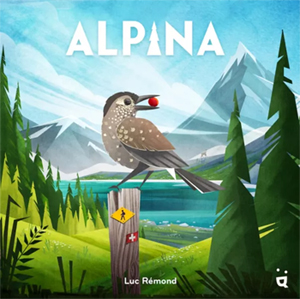

Dit is een herpublicatie van een review die ik eerder schreef voor bordspelwereld.nl
In Alpina probeer je met een aantal wandelaars punten te scoren met het ontdekken van dieren en landschappen. Spot jij de interessantste dieren en landschappen? Dan win je Alpina!
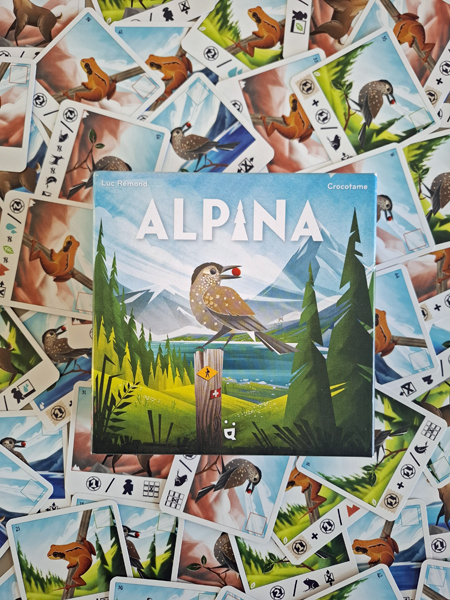
Alpina speelt zich af in het “Parc Naziunal Svizzer” oftewel het Zwitsers Nationaal Park. Dit enige nationale park van Zwitserland ligt in het zuidoosten van het land. Het heeft een oppervlakte van ca. 175 km² en is hiermee het grootste beschermde natuurgebied van Zwitserland. Het maakt deel uit van het UNESCO Biosfeer Reservaten netwerk. Het park werd opgericht in 1914 en was het eerste nationale park in de Alpen. Het heeft bergtoppen van boven de 3000m en is voor een derde bedekt met bos. Er komen duizenden planten en dieren voor, waaronder gems, ree, bruine beer, steenbok en alpenmarmot. Het symbool van dit park is een vogel: de notenkraker, die ook terug te vinden is op de boxcover.
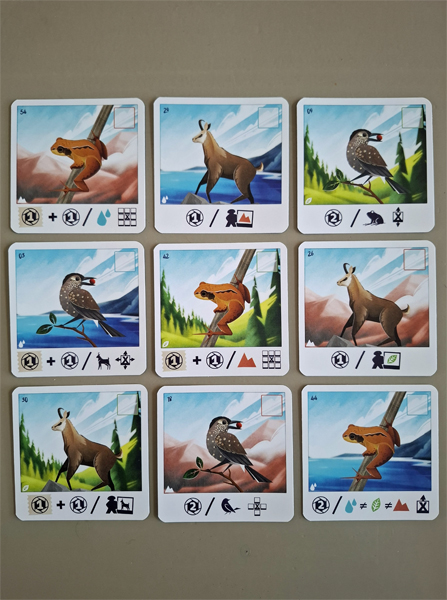
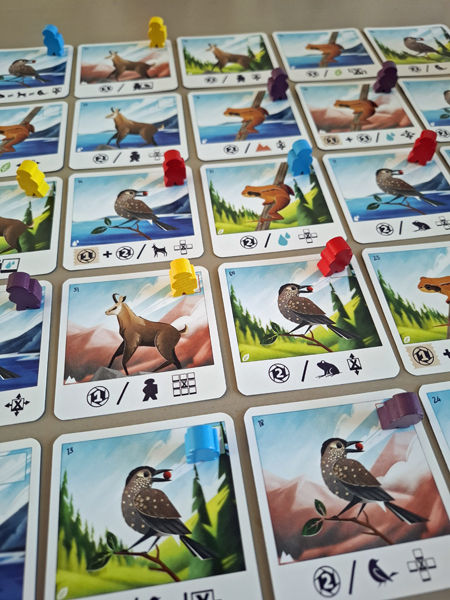
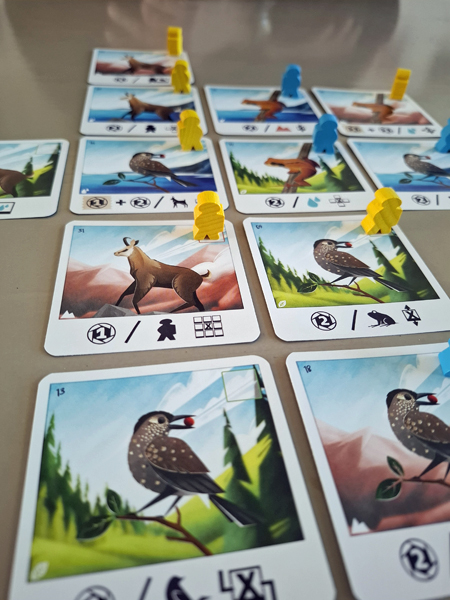
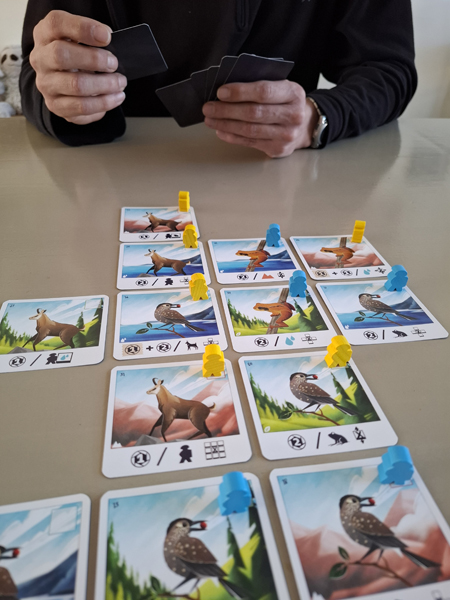
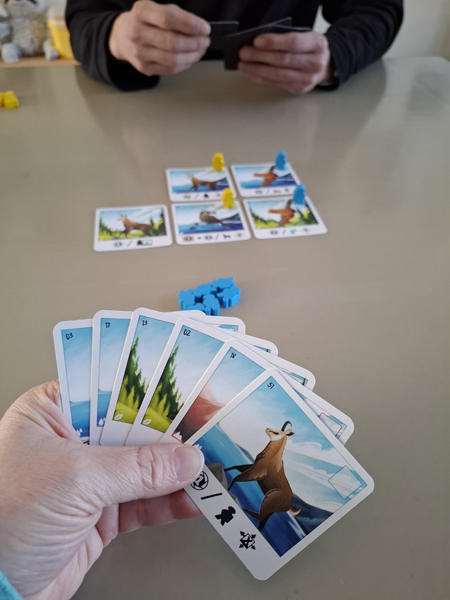
Alpina wordt gespeeld met 56 kaarten. Op elke kaart staat 1 van de 3 diersoorten (gems, kikker of notenkraker) en 1 van de 3 landschappen (berg, bos of meer) afgebeeld. Op elke kaart staat ook hoe je met deze kaart punten kan scoren als je er een wandelaar op zou zetten. Aan het begin van het spel wordt 1 willekeurige gemskaart in het midden van de tafel gelegd. Dit is het begin van wat uiteindelijk een gemeenschappelijk 5×5 raster van kaarten dient te worden. Elke speler krijgt 6 kaarten. De resterende kaarten vormen een trekstapel. Iedereen krijgt ook een aantal wandelaars in zijn spelerskleur (het aantal is afhankelijk van het aantal spelers). Te beginnen met de startspeler zijn de spelers om de beurt aan zet. Wanneer je aan de beurt bent, doe je de volgende 3 zaken in deze volgorde:
1. een kaart spelen (verplicht): speel een kaart uit je hand in het raster op tafel. De kaart die je speelt, moet orthogonaal grenzen aan een reeds gespeelde kaart. Leg alle kaarten in dezelfde richting. Je mag hierbij geen 6e rij of kolom vormen, vermits je uiteindelijk een 5×5 raster moet bekomen.
2. een wandelaar plaatsen (optioneel): je mag 1 van je wandelaars plaatsen op de kaart die je net gelegd hebt of op een hieraan orthogonaal aangrenzende kaart. Op elke kaart mag slechts 1 wandelaar staan.
3. een kaart trekken (verplicht): trek een kaart van de trekstapel zodat je er weer 6 op handen hebt voor je volgende beurt.
Alpina eindigt wanneer de 25e kaart in het raster is gelegd. Nu worden de scores bepaald. In de spelregels staat heel duidelijk vermeld hoe je met welke kaart punten scoort. De iconografie is hierin heel duidelijk. De notenkraker scoort steeds punten voor andere dierkaarten in het raster. De gems scoort punten op basis van wandelaars. En de kikker scoort punten op basis van landschapskaarten in het raster. Tel de punten van elk van je wandelaars bij elkaar op. De speler met de hoogste totaalscore wint Alpina!
Mijn mening over Alpina?
In Alpina mag je vooral niet te snel willen zijn, zeker niet wanneer je het spel met 2 speelt. En dan bedoel ik snel zijn met het inzetten van je wandelaars. Het aantal spelers bepaalt hoeveel wandelaars je hebt om in te zetten. Met 2 spelers zijn dat er 8, met 4 spelers zit je al maar aan slechts 4 meer. Denk dus goed na vooraleer je een wandelaar inzet, want ze zijn sneller op dan je denkt! Je kan naar het einde van het spel toe uiteraard nog kaarten toevoegen aan het raster, die dan nog extra punten opleveren voor je reeds geplaatste wandelaars. Maar dat zien de andere spelers ook en zij kunnen dan net het tegenovergestelde doen. Een verrassingsaanval is uitgesloten als je al je wandelaars al in het begin op het speelveld hebt geplaatst. Probeer met het plaatsen van wandelaars een beetje gelijke tred te houden met je tegenspelers.
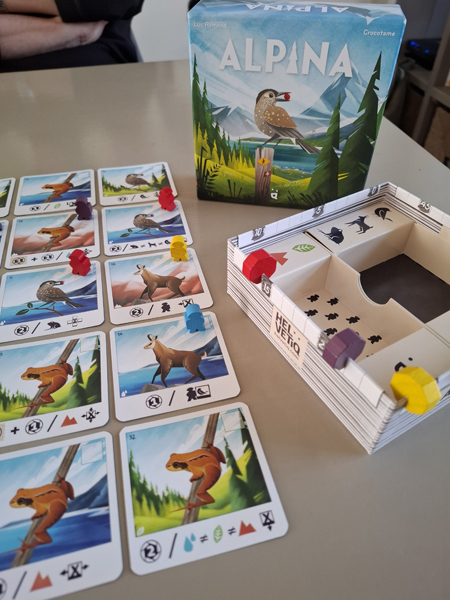
Verder is Alpina een heel vlot, eenvoudig te begrijpen spel. What you see is what you get. Niet te veel regels, geen uitzonderingen, gewoon rechttoe rechtaan. Hier moet ook gezegd worden dat het spel heel vlot speelt omdat de iconografie zo overduidelijk is. Chapeau hiervoor, want dat is niet in elk spel het geval. Het artwork had op zich wat aantrekkelijker gekund door mooie, unieke tekeningen van de notenkraker, de bruine kikker en de gems te gebruiken in plaats van de 3 simplistische, gestileerde tekeningen die nu telkens terugkomen. Op zich is dat niet storend voor het spel, maar het is gewoon minder aantrekkelijk hierdoor. Het oog wil toch ook wat, niet? Wel een leuk folietje: de rand van het doosje fungeert als scorebord!
Zoals bij zoveel spellen, zorgt een verschillend spelersaantal ook voor een andere dynamiek. Met 2 spelers is het sowieso die ene andere tegenspeler die je helpt of dwarszit. Maar bij 3 of 4 spelers, kan je er bewust voor kiezen wie je gaat helpen of wie je gaat dwarszitten. Daarbij moet steeds de overweging gemaakt worden of het nu best is om iets te doen waardoor je zelf punten scoort of om er eerder voor te zorgen dat een bepaalde andere speler dat dan net niet kan doen. Hierbij sluit het ene het andere niet uit: dat zijn de beste zetten! Het feit dat je meer tegenspelers hebt om deze keuze te bepalen, maakt Alpina met 3 of 4 spelers wel een heel stuk boeiender. Ook het feit dat je dus dan slechts 5 of 4 wandelaars hebt in plaats van 8, maakt het spel ook meteen een stuk tactischer. Alpina is dus een leuk tussendoortje, maar liefst met 3 of 4 spelers in plaats van

Alpina
Players: 2-4
Time: 20 minutes
Age: 10+
Author: Luc Rémond
Publisher: Helvetiq
Year: 2024
In Alpina, you and a number of hikers are trying to score points by discovering animals and landscapes. Can you spot the most interesting animals and landscapes? Then you win Alpina!
Alpina is set in the ‘Parc Naziunal Svizzer’, or Swiss National Park. Switzerland’s only national park is located in the southeast of the country. It covers an area of approximately 175 km², making it Switzerland’s largest protected nature reserve. It is part of the UNESCO Biosphere Reserves network. The park was founded in 1914 and was the first national park in the Alps. It has mountain peaks over 3000 metres high and about a third is covered by forest. Thousands of plants and animals live here, including chamois, roe deer, brown bears, ibex and alpine marmots. The symbol of this park is a bird: the nutcracker, which can also be found on the box cover.
Alpina is played with 56 cards. Each card depicts one of the three animal species (chamois, frog or nutcracker) and one of the three landscapes (mountain, forest or lake). Each card also shows how you can score points with this card if you were to place a hiker on it. At the start of the game, one random chamois card is placed in the middle of the table. This is the start of what will eventually become a common 5×5 grid of cards. Each player receives six cards. The remaining cards form a draw pile. Each player also receives a number of hikers in their player colour (the number depends on the number of players). Starting with the first player, players take turns clockwise. When it is your turn, you do the following three things in this order:
1. Play a card (mandatory): play a card from your hand in the grid on the table. The card you play must be orthogonally adjacent to an already played card. Lay all cards in the same direction. You may not form a 6th row or column, as you must eventually achieve a 5×5 grid.
2. Place a hiker (optional): you may place one of your hikers on the card you have just placed or on a card orthogonally adjacent to it. There may only be one hiker on each card.
3. Draw a card (mandatory): draw a card from the draw pile so that you have 6 cards in hand again for your next turn.
Alpina ends when the 25th card is placed in the grid. Now the scores are determined. The rulebook clearly states how you score points for each card. The iconography is very clear in this. The nutcracker always scores points for other animal cards in the grid. The chamois scores points based on hikers. And the frog scores points based on landscape cards in the grid. Add up the points of each of your hikers. The player with the highest total score wins Alpina!
My opinion on Alpina?
In Alpina, you should not be too hasty, especially when playing with two people. And by that I mean being quick to place your hikers. The number of players determines how many hikers you can use. With 2 players there are 8, with 4 players you only have 4. So think carefully before you place a hiker, because they are used up faster than you might think! Towards the end of the game you can of course still add cards to the grid, which will earn you extra points for your already placed hikers. But the other players will see this too and they can do the exact opposite of what you are trying to achieve. A surprise attack is impossible if you have already placed all your hikers on the playing field in the beginning. Try to place your hikers at the same pace as your opponents.
Other than that, Alpina is a very smooth, easy-to-understand game. What you see is what you get. Not too many rules, no exceptions, just straightforward. It should also be said that the game plays very smoothly because the iconography is so clear. Hats off for that, because that is not the case in every game. The artwork itself could have been a bit more appealing by using beautiful, unique drawings of the nutcracker, the brown frog and the chamois instead of the 3 simplistic, stylised drawings that keep recurring. That does not disturb the game, but it is simply less appealing. We all want to look our best, don’t we? A nice little extra: the edge of the box acts as a scoreboard!
As with many games, a different number of players also creates a different dynamic. With two players, it is always the same one other player you help or hinder. But with 3 or 4 players, you can consciously choose who you are going to help or who you are going to hinder. In addition, you always have to consider whether it is best to do something that will score you points or to make sure that a certain other player cannot do just that. The one does not exclude the other: those are the best moves! The fact that you have more opponents to make this choice makes Alpina with 3 or 4 players a lot more interesting. The fact that you only have 5 or 4 walkers instead of 8 also makes the game a lot more tactical. So Alpina is a fun filler, but preferably with 3 or 4 players instead of 2!