
Aantal spelers: 1-5
Speelduur: 90-120 minuten
Leeftijd: Vanaf 14 jaar
Auteur: Dani Garcia
Uitgever: Alley Cat Games
Jaar: 2023

Dit is een herpublicatie van een review die ik eerder schreef voor Bordspelwereld.nl.
Waan je in de wereld van Arborea waarbij je Patron Spirit een vergane wereld opnieuw probeert op te bouwen. Nadat er niets overbleef is het aan jou om een nieuw Ecosysteem te creëren en nieuwe dieren aan te trekken. En zo het rijk opnieuw op te laten floreren. Weet je je diertjes slim in je Ecosysteem te plaatsen, leveren ze extra veel punten op en het is aan jezelf om te zorgen dat je de doelen zo vaak mogelijk scoort door te klimmen op de vermenigvuldigingsladder.
Arborea is een echte worker-placement en puntensalade, die zich onderscheidt door zijn mechanisme met bewegende pilgrim-tracks en gedeelde grondstoffen (Biomes). Als je niet uit kijkt leg je punten en mogelijkheden voor de ander klaar, wat dit spel een echte wolf in schaapskleren maakt.
De Biomes heb je nodig om de kaarten te kunnen spelen die je Ecosysteem vormen. Die kaarten moet je wel eerst mogen pakken. De diertjes voor op je Ecosysteem moeten eerst aangetrokken worden naar een algemene voorraad en je moet maar net zorgen dat je de actie weet te bemachtigen om je diertjes ook daadwerkelijk in je Ecosysteem te mogen plaatsen. Oh en dan heb je ook nog allemaal verschillende werkertjes (Villagers) met allemaal hun eigen functie. En allerlei bonusacties als je de wijzen offers brengt.
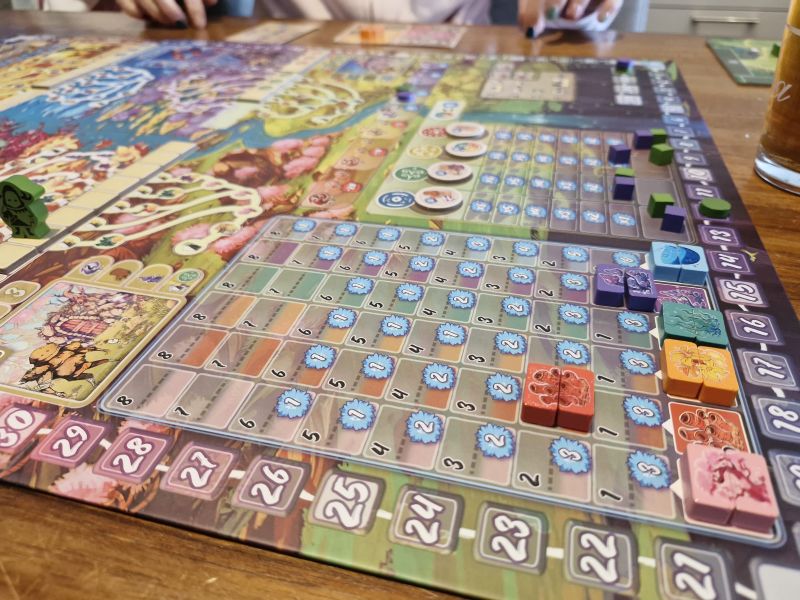
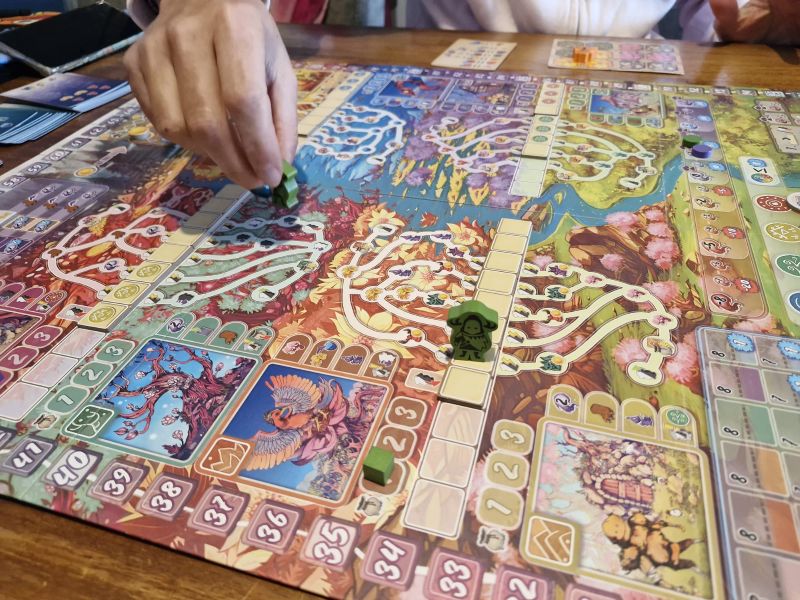
Nu al duizelig? Wacht dan maar tot je het hysterische bord ziet van deze heerlijke vrolijke interactieve breinbreker waar ik geen genoeg van kan krijgen. (Dan weet je dat maar vast).
Hoe werkt het spel
Zo ingewikkeld als het klinkt. Zo makkelijk en overzichtelijk zijn eigenlijk je acties in je beurt (heus waar!). Het denkwerk zit hem echt in het optimaliseren van je beurt en op het juiste moment de juiste keuzes maken. Hiervoor moet je als eerst snappen wat je allemaal ziet op het bord.
Het algemene speelbord
Gebieden en Pilgrim-tracks
Het bord van Arborea bestaat uit 8 verschillende gebieden, waar jij met je werkertjes acties en grondstoffen gaat verzamelen, om zo de meeste punten te verzamelen en het spel te winnen. Deze 8 gebieden zijn verdeeld over 4 (bewegende) wandelpaden/sporen (pilgrimtracks) waarbij je kan kiezen (wanneer dit volgens de regels mag) af/uit te stappen aan één van beide kanten van het spoor. Zodra je afstapt wandel je vanaf die plek over een wandelpad/zijspoor naar het einde van dat pad om na een bezoek aan de Wijze je villager weer naar huis te sturen. Tijdens deze wandeling kom je allerlei acties tegen die je mag uitvoeren en je gaan helpen bij het creëren van je eigen Ecosysteem.
De soorten acties die je kan tegenkomen op elk pad scheelt enorm. Sommige gebieden gaan je grondstoffen op leveren, sommige gebieden gaan je dieren opleveren, andere gebieden her activeren Villagers of geven je kaarten. Maar denk ook aan het verkrijgen van extra acties, het plaatsen van dieren of het verhogen van de waarde van je doelen en het uitdelen van giften aan Wijzen door het plaatsen of verhogen van blokjes. etc. Hoe verder je komt op de spoortjes, hoe groter de opbrengst. Het duurt dan wel een aantal beurten om daar te komen. Dus ook daar: slim kiezen. Grote stappen snel thuis, of rustig wachten op het juiste moment. We komen er nog op terug waar deze acties allemaal voor nodig zijn.
Aan het eind van het pad kom je altijd langs het activeren van de giften. Als je in een eerdere beurt (door middel van het mogen plaatsen van een blokje) een gift hebt gedaan aan de Wijze die bij het gebied hoort waar je wandelt, mag je aan het einde van het pad een extra actie kiezen specifiek uit dat gebied. Elk gebied heeft zijn eigen acties. Het blokje komt op een klein spoortje bij dat gebied, want ook die kan je vermeerderen en verbeteren. Zo zie je altijd hoeveel giften je hebt gedaan en dus hoeveel extra acties je aan het einde van het pad mag activeren.
Het spirit-spoor
Op het bord vind je nog een aantal sporen: namelijk het spirit-spoor. Je spirit zorgt ervoor dat je bepaalde acties kan uitvoeren, door middel van het betalen van spirit. Zie het als geld. Aan het einde van het spel krijg je punten voor je overgebleven spirit (welke je op allerlei manieren kan behalen, maar ook verliezen), dit kunnen ook minpunten zijn wanneer je spirit in de min eindigt.
Biomes
De grondstoffenvoorraad bevindt zich ook op het bord. Deze is voor algemeen gebruik en wordt ook per grondstof bijgehouden op een spoor. Dit zijn allemaal mooie planten en flora (Biomes) die kunnen groeien in je Ecosysteem. Verkrijg jij in je beurt grondstoffen, maar gebruik je ze niet, leveren ze weliswaar punten op (waarbij de ene grondstof waardevoller dan de andere is), maar kan je medespeler deze grondstoffen in een volgende beurt gebruiken.
Creatures
De dierenvoorraad (of eigenlijk Creatures) wordt ook bijgehouden op het bord. Deze zijn namelijk niet onbeperkt beschikbaar en pas bruikbaar als ze het spel in zijn gespeeld. Iets wat punten oplevert (afhankelijk van welk dier en het hoeveelste dier), maar die net als bij de grondstoffen ook ten goede kan vallen aan je medespeler, want: algemeen gebruik.
Doelen
Op het bord vind je daarnaast ook de vier doelen die je kan behalen. Deze doelen worden per spel blind getrokken en variëren van bonuspunten voor een bepaald soort dier in je Ecosysteem tot bijvoorbeeld punten voor het aantal giften die je hebt gebracht aan de Wijzen. Deze doelen leveren allemaal maximaal 8 punten op, maar kun je aan het einde van het spel vermenigvuldigen, afhankelijk van waar je ook op deze spoortjes/tracks allemaal bent geëindigd. Ook deze spoortjes kun je tijdens het spel op verschillende manieren verhogen (als bonus voor het spelen van een kaart, op het spoor, als bonus bij een van de Wijzen, etc).
Beurtenspoor/ Suntrack
Last but not least zie je een spoor die beurten bijhoudt. Elke keer als er een dier het spel in wordt gebracht schuift de zon een plaatsje op, tot hij uiteindelijk het einde van het spel inluidt.
Persoonlijk Speelbord
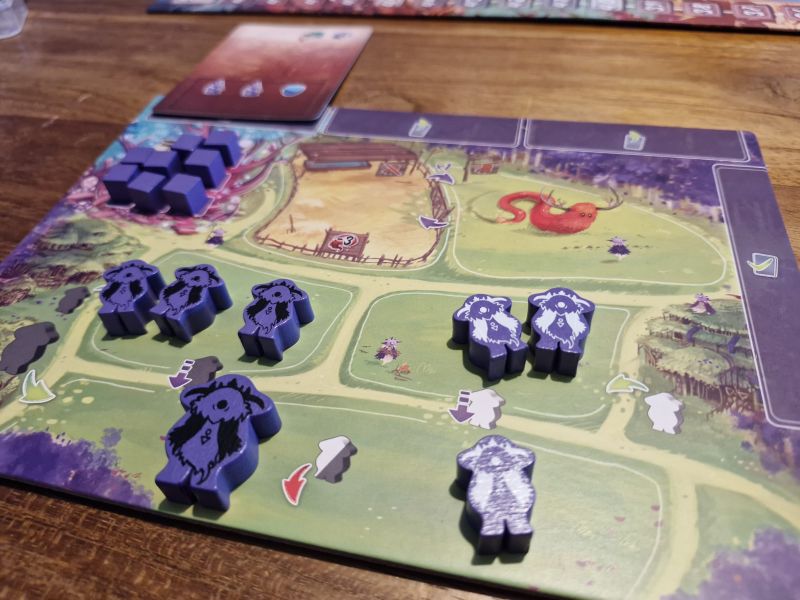
Om het nog ingewikkelder te maken (het wordt makkelijker, beloofd!) Heb je ook nog je persoonlijke bordje waar je je kaarten op verzamelt voor je ze kan spelen in je eigen Ecosysteem, je je beestjes in de schuur in gevangenschap kan houden als je ze nog niet in je Ecosysteem kan plaatsen, maar ook waar je voorraad Villagers op staan. Je zal zien dat er verschillende werkertjes zijn, met verschillende bijzonderheden en die na gebruik niet allemaal zondermeer terug komen in het spel. Zij zullen eerst geactiveerd moeten worden op het algemene speelbord, nadat ze eerst even hebben mogen rusten van hun eerdere pelgrimstocht.
Een beurt
Iedere beurt in Arborea is in beginsel erg overzichtelijk. Je hebt een vast aantal stappen die je in een vaste volgorde uitvoert. En ook de acties op de sporen doe je in de volgorde dat je ze tegen komt.
- 1. Verschuif één van de pilgrimtracks of plaats een Villager op een track.
Deze actie doe je éénmalig. Maar tegen betaling van spirit, mag je één van de twee acties nogmaals uitvoeren.
Zodra er een pilgrimtrack verplaatst mogen Villagers die er opstaan afstappen en aan het begin van een pad gaan staan. Deze kunnen in een latere beurt geactiveerd worden. Je kan met meerdere Villagers aan het begin van een pad staan. Als je er af springt mag je altijd terug springen naar een eerder pad, nooit naar een later pad. (Medespelers op dezelfde track mogen er ook afspringen, wat betekent dat je zelf dus ook van een track kan springen zodra deze in andermans beurt beweegt). - 2. Activeren van je Villagers. Villagers die aan het begin van een pad stad, kunnen worden geactiveerd. Je mag twee Villagers activeren en tegen betaling van spirit een derde. De Villagers bewandelen het pad en voeren de acties uit die zij op het pad tegen komen.
- 3. Je mag een kaart in de Ecosysteem spelen, mits er genoeg grondstoffen beschikbaar zijn. Je betaalt het aantal grondstoffen op de kaart en krijgt hierbij de bonussen die op de kaart zijn aangegeven.
- 4. Je ontvangt punten voor grondstoffen die je deze beurt hebt verzameld, maar niet hebt gebruikt. Hierna schuiven alle tracks waar jij met een Pelgrim op staat op. Waarbij je soms meer stapjes verschuift afhankelijk van het soort en aantal Pelgrims.
Soorten acties
Om alle acties te ontdekken moet je het spel vooral zelf gaan spelen. Maar eigenlijk is het wel een logische cyclus.
Want je wilt kaarten bouwen in je Ecosysteen. Hiervoor moet je
• Kaarten halen
• Grondstoffen verzamelen
• Kaarten spelen
• Soms de markt vernieuwen
Op deze kaarten wil je de Creatures hebben. Dus dat betekent:
- Creatures naar de voorraad spelen
Creatures vanuit de voorraad naar je Ecosysteem halen
Om alle acties te kunnen doen moet je
- Rustende Villagers activeren
Om extra bonus acties te mogen doen wil je
- De Wijzen een gift brengen
Als je zoveel mogelijk punten voor je doelen wilt halen dan
- Wil je zorgen dat je stijgt op de tracks van de doelen.
De kunst zit hem in de volgordelijkheid van je beurten en acties. Je zult merken dat je de cyclus niet altijd kan uitvoeren in deze logische volgorde!
Wat vind ik er van
Arborea staat op dit moment hoog op mijn lievelings-lijst. Er zit zo veel in en het speelveld verandert continu. De hoeveelheid aan keuzes, de balans tussen verschillende facetten van de puntensalade, het zit allemaal precies goed in elkaar. Het spel is enorm gelaagd. En hoewel het bord en deze uitleg er natuurlijk uit ziet als heel veel, is het in feite erg overzichtelijk. Punten scoren in het spel middels de grondstoffen en scoren aan het einde van het spel met je spirit, de waarde van je doelen en het belangrijkste: de dieren in je Ecosysteem. Het doel is helder en je bent, hoewel je de eerste paar potjes het idee hebt dat je op veel tegelijk moet focussen, word je niet overladen met focuspunten. Zodra je het spel onder de knie hebt wordt dat een kwestie van uitkienen wanneer aan de juiste knoppen te draaien.
Wat ik als worker-placement fan vaak merk is dat het in dit type spel heel makkelijk is om langs elkaar heen te werken. Je kan elkaar dwars zitten door een plek bezet te houden of een doel eerder te halen, maar verder kun je redelijk je eigen spel spelen. Je zit elkaar enkel indirect dwars. Zo is dat bij Arborea niet. Je zult je moeten bezig houden met wat je medespelers doen. Vanwege de gedeelde grondstoffen, de gedeelde Creatures-voorraad bijvoorbeeld. Ik kom er in dit soort type spellen vaak mee weg door te observeren wat mijn tegenstander doet, om met de tegenovergestelde strategie op de loop te gaan. In praktijk betekent dit vaak dat mijn medespelers gaan voor scoren ín het spel en ik aan het einde nog een inhaalrace doe omdat ik scoor op de lange termijn doelen. Die split focus kán bij Arborea simpelweg niet. Ik kwam al snel bedrogen uit. Dure kaarten voor je Ecosysteem aantrekken kan enkel met dure grondstoffen. Die overleven alleen niet zo makkelijk een hele speelronde, en als ze er al wel liggen heeft een medespeler ze waarschijnlijk voor je neergelegd, ze dus niet zelf gebruikt en er dus heel veel punten en voorsprong mee verdiend. Dus zal je willen proberen in dezelfde beurt én dure grondstoffen te krijgen én ze direct te gebruiken. Maar dát kost vaak spirit en je loopt de punten mis van de grondstoffen…
Ook het bord en de verdeling van de acties en de gebieden zit ingenieus in elkaar. Het dwingt je soms om te kiezen voor tracks die je totaal niet gaan geven wat je nodig hebt, maar waar je heen zal moeten om Villagers te kunnen her activeren of om kaarten te gaan halen. Die tracks zijn noodzakelijk, maar leveren verder relatief weinig op en voelen daardoor nog wel eens als een verloren beurt. Elke voordeel komt in dit spel met een nadeel en andersom, waardoor je continue moet afwegen: wat is wijsheid?
Ga je met je Villager een track op waar je niets te zoeken hebt, maar wel drie extra acties kan doen omdat je daar veel giften aan de Wijze hebt gedaan en die wel interessant zijn? Stap je vroeg af om een medespeler voor te zijn en een Creature uit de voorraad te kunnen halen, terwijl dit veel minder acties oplevert op een pad? Ga je grondstoffen halen die heel veel punten opleveren, maar jouw buurman daarna de mogelijkheid geeft een hele dure kaart te spelen in diens Ecosysteem? Wanneer zet ik mijn spirit in voor extra acties? Maar ook: in welke volgorde activeer ik mijn Villagers. Soms heb je de opbrengst van de ene Villager nodig om de wandeling van de ándere Villager nóg vruchtbaarder te maken. De keuzes die je maakt zijn door de veelzijdigheid en het aantal te verkrijgen acties zo veel meer dan alleen: ik stap af en wandel.
De herspeelbaarheid van Arborea is ook enorm. De tracks worden elk spel random geplaatst, de doelen worden per spel gekozen, je krijgt elk spel een andere Biome-kaart om mee starten. Er liggen elke keer nieuwe bonustegels met extra acties op de plekken waar de Creatures in het spel komen, wat kan beïnvloeden welk dier je als eerste in het spel brengt. Er is gewoon niet één strategie die het beste werkt. Je zult elk spel opnieuw moeten kijken hoe je de machine het beste kan laten draaien.
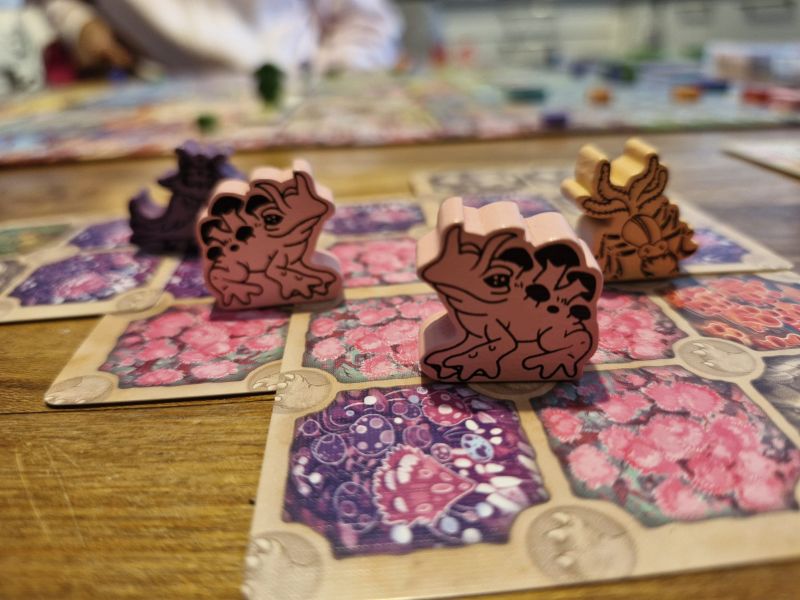
Toegegeven, je moet fan zijn van het art-work. Gelukkig ben ik dat en wordt ik helemaal blij van de vormgeving. De vormgeving is in mijn ogen prachtig. Je moet tegen de drukte kunnen. Deze is in eerste instantie overwhelming, maar wordt een kunstzinnig hoogstandje zodra je het spel kent en dus betekenis kan geven aan de overvloed aan afbeeldingen.
Dit is zo’n spel die heel lang in mijn kast blijft!

Arborea
Players: 1-5
Time: 90-120 minutes
Age: 14+
Author: Dani Garcia
Publisher: Alley Cat Games
Year: 2023
Imagine yourself in the world of Arborea, where your Patron Spirit is trying to rebuild a lost world. After nothing remains, it’s up to you to create a new ecosystem and attract new animals, thus making the realm flourish again. If you can place your animals cleverly within your ecosystem, they’ll earn you extra points, and it’s up to you to ensure you achieve the goals as often as possible by climbing the multiplication ladder.
Arborea is a true worker placement and point salad, distinguished by its mechanics of moving pilgrim tracks and shared resources (Biomes). If you’re not careful, you’ll be laying off points and opportunities for others, making this game a true wolf in sheep’s clothing.
You need the Biomes to play the cards that form your ecosystem. You have to draw these cards first, though. The animals for your Ecosystem first have to be attracted to a general supply, and you just have to make sure you get the action to actually place your animals in your Ecosystem. Oh, and then there are all sorts of different workers (Villagers), each with their own function. And all sorts of bonus actions when you make offerings to the wise ones.
Dizzy already? Just wait until you see the hysterical board of this wonderfully cheerful interactive brain teaser that I can’t get enough of. (So you already know).
How does the game work?
As complicated as it sounds, your actions during your turn are actually that simple and clear (really!). The brainwork really lies in optimizing your turn and making the right choices at the right time. To do this, you first have to understand everything you see on the board.
The Main Game Board
Areas and Pilgrim Tracks
The Arborea board consists of eight different areas, where you and your workers will collect actions and resources to gain the most points and win the game. These eight areas are divided into four (moving) pilgrim tracks, where you can choose (if permitted by the rules) to disembark at either end of the track. Once you disembark, you walk from that spot along a side track to the end of the track, where you can send your villager home after visiting the Wise One. During this walk, you’ll encounter all sorts of actions you can perform, helping you create your own ecosystem.
The types of actions you can encounter on each path vary considerably. Some areas will yield resources, some will provide animals, and others will reactivate villagers or award cards. But also consider gaining additional actions, placing animals, increasing the value of your goals, and distributing gifts to Wise Men by placing or raising blocks, etc. The further you progress along the tracks, the greater the reward. It does take a number of turns to get there, though. So, here too: choose wisely. Take big steps to get home quickly, or wait patiently for the right moment. We’ll come back to what all these actions are for.
At the end of the path, you always pass the activation of gifts. If you made a gift to the Wise Men in the area you’re walking in on a previous turn (by placing a block), you can choose an additional action specific to that area at the end of the path. Each area has its own actions. The block lands on a small track in that area, because you can also increase and improve that area. This way, you always see how many gifts you’ve made and therefore how many additional actions you can activate at the end of the path.
The Spirit Track
On the board, you’ll find several other tracks: the spirit track. Your spirit allows you to perform certain actions by paying spirit. Think of it like money. At the end of the game, you receive points for your remaining spirit (which you can gain in various ways, but also lose). These can also be negative points if your spirit ends up in a negative balance.
Biomes
The resource supply is also on the board. This is for general use and is tracked per resource on a track. These are all beautiful plants and flora (Biomes) that can grow in your ecosystem. If you acquire resources during your turn but don’t use them, they still yield points (with some resources being more valuable than others), but your opponent can use these resources in a subsequent turn.
Creatures
The animal supply (or rather, Creatures) is also tracked on the board. These are limited and only usable once they have been played into the game. Something that gives you points (depending on which animal and how many animals), but which, just like with the raw materials, can also benefit your fellow player, because: generally use.
Objectives
On the board, you’ll also find the four objectives you can achieve. These objectives are drawn randomly each game and range from bonus points for a specific animal type in your Ecosystem to points for the number of gifts you’ve brought to the Wise Men. These objectives each yield a maximum of 8 points, but you can multiply them at the end of the game depending on where you end up on these tracks. These tracks can also be increased in various ways during the game (as a bonus for playing a card, on the track, as a bonus for one of the Wise Men, etc.).
Turn Track/Sun Track
Last but not least, you’ll see a track that keeps track of your turns. Each time an animal is brought into play, the sun moves up one space, until it finally signals the end of the game.
Personal Game Board
To make things even more complicated (it gets easier, I promise!), you also have your personal board where you collect your cards before you can play them in your own Ecosystem, where you can keep your creatures captive in the barn if you can’t place them in your Ecosystem yet, and where your stock of Villagers is kept. You’ll see that there are various workers, each with different special characteristics, and not all of them automatically return to the game after use. They first have to be activated on the main game board after they’ve had a rest from their previous pilgrimage.
A Turn
Each turn in Arborea is initially very straightforward. You have a fixed number of steps that you perform in a fixed order. You also perform the actions on the tracks in the order you encounter them.
1. Move one of the pilgrim tracks or place a Villager on a track.
You perform this action only once. However, for a fee of spirit, you can perform one of the two actions again. As soon as a pilgrim track moves, any Villagers on it may dismount and move to the beginning of a path. These can be activated on a later turn. You can have multiple Villagers at the beginning of a path. If you jump off, you can always jump back to an earlier path, never to a later one. (Other players on the same track may also jump off, meaning you can also jump off a track as soon as it moves during someone else’s turn.)
2. Activating your Villagers. Villagers who are at the beginning of a path can be activated. You may activate two Villagers and, for a fee, a third. The Villagers walk the path and perform the actions they encounter along the way.
3. You may play a card in the Ecosystem, provided there are enough resources available. You pay the number of resources on the card and receive the bonuses indicated on the card.
4. You receive points for resources you collected but not used this turn. After this, all tracks you’re on with a Pilgrim will shift. Depending on the type and number of Pilgrims, you’ll sometimes move more steps.
Types of Actions
To discover all the actions, you’ll mainly have to play the game yourself. But it’s actually a logical cycle.
You want to build cards in your Ecosystem. To do this, you need to:
• Collect cards
• Collect resources
• Play cards
• Sometimes renew the market
You want the Creatures on these cards. So that means:
Play Creatures to the supply
Remove Creatures from the supply to your Ecosystem
To be able to perform all the actions, you need to:
Activate Resting Villagers
To be able to perform extra bonus actions, you need to:
Bring a Gift to the Wise Men
If you want to get as many points as possible for your goals, then:
You want to make sure you climb the goal tracks.
The trick is in the order of your turns and actions. You’ll find that you can’t always perform the cycle in this logical order!
What do I think?
Arborea is currently high on my favorite list. There’s so much to it, and the playing field is constantly changing. The sheer number of choices, the balance between different facets of the point system—it’s all perfectly structured. The game is incredibly layered. And while the board and this explanation might look like a lot, it’s actually very clear. You score points in the game through resources, and at the end of the game, you score points with your spirit, the value of your goals, and most importantly: the animals in your ecosystem. The goal is clear, and although you might feel like you have to focus on many things at once in the first few games, you’re not overwhelmed with focus points. Once you get the hang of it, it becomes a matter of figuring out when to push the right buttons.
What I often notice as a worker-placement fan is that it’s very easy to work past each other in this type of game. You can hinder each other by holding down a spot or to reach a goal earlier, but otherwise, you can play your own game fairly well. You only interfere indirectly. That’s not the case with Arborea. You have to focus on what your fellow players are doing. Because of the shared resources, the shared Creatures supply, for example. In these types of games, I often get away with observing what my opponent is doing and then running with the opposite strategy. In practice, this often means my fellow players focus on scoring during the game, while I play catch-up at the end because I score on the long-term goals. That split focus simply isn’t possible with Arborea. I was quickly disappointed. Attracting expensive cards for your Ecosystem is only possible with expensive resources. These don’t easily survive an entire round, and if they are already there, another player has probably placed them before you, so they haven’t used them themselves, thus gaining a lot of points and a head start. So you’ll want to try to acquire expensive resources and use them immediately in the same turn. But that often costs spirit, and you miss out on the points from the resources…
The board and the distribution of actions and areas are also ingenious. It sometimes forces you to choose tracks that won’t give you what you need at all, but where you’ll have to go to reactivate Villagers or collect cards. These tracks are necessary, but otherwise yield relatively little and therefore sometimes feel like a wasted turn. Every advantage in this game comes with a disadvantage, and vice versa, forcing you to constantly weigh the pros and cons: what’s wisest?
Do you take your Villager on a track where you have no business, but can take three extra actions because you’ve made many gifts to the Sage there, and those are worthwhile? Do you step off early to beat another player and get a Creature from the supply, even though this yields far fewer actions on a path? Do you collect resources that yield a lot of points, but then give your neighbor the opportunity to play a very expensive card in their Ecosystem? When do I use my spirit for extra actions? But also: in what order do I activate my Villagers? Sometimes you need the yield from one Villager to make the other’s walk even more fruitful. The choices you make, thanks to the versatility and the number of actions available, are so much more than just “I get off and walk.”
Arborea’s replayability is also enormous. The tracks are randomly placed each game, the objectives are chosen each game, and you get a different Biome card to start with each game. There are new bonus tiles with additional actions each time where the Creatures come into play, which can influence which animal you bring into play first. There simply isn’t one strategy that works best. You’ll have to rethink every game to see how best to run the engine.
Granted, you have to be a fan of the artwork. Fortunately, I am, and I absolutely love the design. In my opinion, the design is beautiful. You have to be able to handle the crowds. This one is overwhelming at first, but it becomes an artistic masterpiece once you get to know the game and can make sense of the abundance of images.
This is one of those games that will stay on my shelf for a long time!