

Aantal spelers: 2-4
Speelduur: 90-110 minuten
Leeftijd: Vanaf 14 jaar
Auteur: Germán P. Millán
Uitgever: Devir
Jaar: 2023

Deze review is een herpublicatie van een review die ik schreef voor Bordspelwereld.nl.
Al dagen geleden probeerde ik het prachtig mooie spel Bamboo uit. Al die dagen zoek ik nog naar woorden voor een goede review. Ik heb wat andere reviews gelezen en die hebben op één of andere manier een soort van twee sporen gecreëerd in mijn hoofd.
Het ene spoor waarbij ik enorm genoten heb van het spelen, waarbij ik zat te jubelen, het een tamelijk briljant spel vond en qua cijfer een 8,5 of zelfs een 9 zou willen geven. Het andere spoor is het spoor waarbij ik de gelezen kritieken erg goed begrijp, snap wat er voor anderen niet werkt, en het daarom misschien “maar een 6,5 of 7” zou moeten zijn. Ik zal dit mysterie al schrijvend met jullie proberen te ontrafelen en ben daarna heel benieuwd bij welke categorie jullie (denken te) horen en wat voor cijfer jullie dit Devir-spel, dat samen met Bitoku en Silk onderdeel is van de Kemushi Saga, zouden geven.
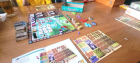
In Bamboo ga je vier jaar lang proberen happinesspunten te scoren om jouw gezin zo blij mogelijk te maken. Wie aan het einde van het spel het meest happy is, die wint. Happy staat in Bamboo voor: evenwichtig en gebalanceerd. Elk jaar bestaat uit 4 rondes, de 4 seizoenen, in totaal dus 16 rondes. Elk seizoen heeft zijn eigen functie en mogelijkheden tot het spelen en scoren van happinesspunten en door de keuzes die je zelf kan maken heb je ook nog invloed op welke functies van een seizoen je uit kan voeren. Ondertussen verzamel je op je spelerstableau verbeteringen aan je huis en leefomgeving, die weer punten scoren als je die in de juiste combinatie weet neer te leggen volgens de scoringstegel die je hebt verzameld. Dit met de moeilijkheid dat niet elke verbetering op elke plek op je spelerstableau terecht mag komen en de verschillende kanten van je tableau in evenwicht moeten blijven om aan het einde van het spel geen minpunten op te leveren. Want: Balans = Geluk. Dan hebben de verbeteringen soms ook nog comfortpunten, niet te verwarren met de te behalen happinesspunten, en moet je niet alleen bepaalde verbeteringen verzamelen, maar moeten deze opgeteld ook nog een bepaalde waarde vertegenwoordigen, de comfortpunten dus. Ondertussen verzamel je ook nog eten, want als je na afloop van een jaar je familie geen eten kan geven heb je minpunten te pakken, want van honger word je natuurlijk niet happy. Dit verzamel je mondjesmaat gedurende de seizoenen. Hoe meer verbeteringen jij in je leven hebt aangebracht, hoe meer eten je nodig hebt. Gelukkig zijn er ook nog “Spirits of the Forest” te vergaren, die je hierbij kunnen helpen. Deze verdien je weer door tempels te bezoeken, en wierrook in te zetten in die tempel. Die inzet is belangrijk, want die refereert ook weer aan de Bamboo die jij hebt vergaard, in de kleur van de tempel. De Bamboo in de kleur van de tempel moet je namelijk allemaal inleveren en bevatten allemaal een eigen functie. Je mag het aantal functies daadwerkelijk uitvoeren gelijk aan het aantal wierrook dat je ingezet hebt op de tempel. Sommige Bamboo is dan dus waardeloos, wanneer je meer Bamboo bezit dan dat je ingezet hebt in de tempel. Gelukkig speel je door het spelen van Bamboo wel weer nieuwe Bamboo vrij op het speelbord!
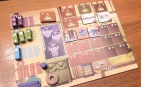
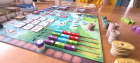
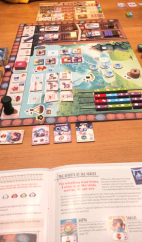
Klinkt als veel, ingewikkeld en onsamenhangend, nietwaar? Helemaal omdat het speelbord en het spelerstableau relatief klein zijn en daarmee alle spullen die je kan vergaren ook, wat het geheel wellicht wat hysterisch en onoverzichtelijk maakt. Dit is ook direct de meest gelezen kritiek en ik snap ‘m wel. Men mist samenhang, zowel in acties, in hoe deze zich tot elkaar verhouden en in de thematiek. Thema’s lijken ietwat random gekozen om de mechanismes aan op te hangen, waardoor er geen logisch verhalend geheel ontstaat. Althans voor de meeste mensen.
Toch is er als we de verschillende seizoenen doorlopen, en alles even uit elkaar trekken, meer verband dan je denkt en zijn de stappen enigszins logisch, zo lang je ze maar weet. De onsamenhangendheid voelden wij vooral het eerste jaar, waarin je alle acties voor het eerst doet en totaal geen idee hebt waarom, wat ze je in de toekomst opleveren en hoe je de mogelijkheden dus het beste voor je kan laten werken. Dus hoewel ik de kritiek snap, denk ik ook: ‘Even doorbijten! Het is de moeite waard.’ Daarnaast is het wel zaak om de logica van de mechanismes niet één op één te plakken op het thema. Sommige acties zijn als thema wel logisch maar als mechanisme niet, en soms andersom. C’est la vie. Persoonlijk denk ik dan: ‘Kom uit die welbekende comfortzone/box, of welke hippe zelfontwikkelingsterm dan ook, en laat je gewoon lekker overladen met de wondere wereld die zich afspeelt in het brein van de makers van dit spel en waarin blijkbaar niet alles verklaarbaar is.’ Persoonlijk genoot ik er van als er wéér een gek zijspoor bleek te zijn. Hoe verzinnen ze het? En hoe leuk is het als de mogelijkheden eindeloos zijn? Ik ga daar dus enorm van aan zoals je merkt. Maar ik snap dat een meer lineair en tegelijkertijd een wat minder holistisch brein hier volledig op afhaakt. Dan is dit spel duidelijk niet voor jou.
Laten we de seizoenen even doorfietsen en kijken of het lukt of ik de logica enigszins vorm kan geven.
Fase 1: De lente
- Hierin krijgt iedere speler een wierrookstokje (deze gebruik je straks om tempels te bezoeken en in te zetten op de “Spirits of the Forest”) en
- Je krijgt een “Gift from the Forest” Dit is één van de functies op het speelbord die je alvast een keer mag uitvoeren voordat de zomer begint. Je snapt het, om happy te worden ben je dikke vrienden met de natuur, dus ook het bos en alles wat er leeft!
Fase 2: Zomer
- Je bezoekt in het bos een van de tempels (rood, blauw, groen of paars), afhankelijk van de Spirit of the Forest die in de herfst te verzamelen zijn in de tempel en afhankelijk van de kleuren Bamboo die je per kleur op je spelerstableau hebt liggen en waarvan je de functies wilt spelen. (In het 1e jaar krijg je een startvoorraad). Je kan geen tempel bezoeken als je in de corresponderende kleur geen Bamboo bezit. In de Tempels vereer je je voorvaderen die net zo goed voor hun families hebben gezorgd als jij nu doet in dit spel.
- Je plaatst het aantal sticks wierrook (ook hiervan heb je een startvoorraad) op een van de tempels, gelijk aan het aantal Bamboo dat je bezit in de kleur van de tempel.
- Je verwijdert de Bamboo van de juiste kleur van je spelerstableau en legt deze op het algemene speelbord in het zogehete “stalk field”.
- Op de Bamboo staan functies afgebeeld. Je mag zoveel functies activeren als het aantal stokjes je in de tempel hebt gelegd. (Het kan zijn dat je minder stokjes had dan Bamboo, in dat geval activeer je dus niet alle Bamboo en mag je kiezen welke functies/Bamboo je wilt gebruiken).
De mogelijke functies zijn:
- Balance: Hier kun je scoringskaartjes met opdrachten kopen voor op je eigen spelerstableau die later happinesspunten gaan opleveren als je aan de opdracht hebt voldaan. Het kopen levert ook al punten op. Addertje onder het gras: niet alle kaartjes kunnen op elk gedeelte van je tableau en ook de combinatie van improvements op het kaartje moeten in het corresponderende gedeelte van je tableau behaald worden en niet elders op je tableau! Wie denkt slim te kunnen scoren met scoringkaartjes met soortgelijke opdrachten komt dus bedrogen uit.
- Improve your home: Je kan improvements kopen voor op je spelerstableau. Deze mag je plaatsen waar je wilt. Deze improvements corresponderen met de Balance opdrachten. Je mag de improvements vrij plaatsen op de daarvoor bestemde plekken op je spelerstableau. Maar het is dus zaak goed in de gaten te houden waar dit moet volgens de scoringskaartjes én dat de improvements aan de juiste hoeveelheid comfortpunten voldoen. Daarnaast moeten je improvements in balans zijn. Het verschil in het totaal aantal comfortpunten aan zowel de linker als rechter zijde van je tableau, leveren bij de eindtelling minpunten op. Want je weet: Balans = Geluk! Is er geen balans, dan neemt je geluk dus af!
- Cook: Er is een markt met eten in de vorm van tokens met een bepaalde waarde. Deze kun je pakken en gebruiken aan het einde van het jaar om je familie te eten te geven. De waarde van het token staat voor het aantal mensen/improvements dat je er mee kan voeden.
- Geld: Je ontvangt twee munten
- Joker: Kies zelf welke van bovenstaande acties je doet.
Wanneer je alle acties hebt uitgevoerd, sluit je de gebruikte Bamboo onderaan aan in een van de vier rijen met voorraad op het spelersbord, het stalk field dus. Hierdoor wordt de bovenste Bamboo in de rij vrijgespeeld. Deze verplaats je naar je spelerstableau bij de Bamboo voorraad van de corresponderende kleur. Bij het pakken van nieuwe Bamboo is het goed uitkienen welke kleur nieuwe Bamboo je nodig hebt en welke te spelen actie er op de Bamboo staat. Op deze manier plan en voorzie je jezelf van je eigen acties! Let dus goed op in welke rij je je gespeelde Bamboo aflegt, dit bepaalt je toekomst.
Wanneer je alle stappen hebt doorlopen, is/zijn je tegenstander(s). Het is toegestaan dat de tegenstanders naar dezelfde Tempel gaan. Deze acties herhalen zich om en om tot alle wierrookstokjes op zijn en alle spelers moeten passen. Let op: Er is maar één manier om aan meer wierook te komen, en dat is de start van een nieuwe lente. Je mag niet 2x achter elkaar dezelfde tempel bezoeken, daar moeten een ander tempelbezoek tussen zitten. Als iedereen heeft gepast, breekt de herfst aan!
Fase 3: Herfst
- De Spirits of the Forest worden uitgedeeld. Dit zijn kaartjes met extra voordeeltjes (kortingen, extra acties etc) die in de tempels liggen. Wanneer jij in de zomer de meeste wierrook bij een tempel hebt weten te leggen, is de Spirit voor jou. Bij een gelijk spel is de spirit voor degene die als laatste de tempel heeft bezocht. De Spirit blijft het hele spel bij je en is vaker inzetbaar. (Na gebruik gaat hij wel even slapen, want genoeg slaap zorgt voor meer balans en happiness. In de Winter kun je jouw Spirits weer wakker maken middels het betalen van geld, om ze later weer opnieuw te kunnen gebruiken).
- Je haalt al je stokjes terug uit de tempels en legt deze weer in je voorraad.
- Er worden nieuwe Spirits in de tempels geplaatst.
Fase 4: Winter
- Je mag je Spirits wakker maken!
- Je geeft je familie te eten! Het aantal eten dat je nodig hebt is gelijk aan het aantal Improvements die je op je eigen spelerstableau hebt liggen. Kom je voedsel tekort? Per stuk kost je dit een punt!
- De startspeler-marker verplaatst met de klok mee.
- De Balance en Improvement markten worden aangevuld.
- De Foodmarket wordt aangevuld.
En een nieuw jaar begint!
Je zult merken dat je elk jaar sterker wordt. Meer wierrook, dus meer te spelen Bamboo en dus meer acties! Ik grap in mijn review steeds over balans, maar dit is wel waar het om draait. Het is echt goed uitkienen wanneer je de juiste improvements koopt (als de markten bijgevuld worden in de winter schuiven de overgebleven improvements bijvoorbeeld op, waardoor zowel kosten als opbrengst veranderen). Wanneer ga je verbeteren? Wanneer ga je scoren? En hoe zorg je dat je op tijd te eten hebt? Wat is het juiste moment om je Spirit in te zetten? In welke rij plaats ik mijn bestede Bamboo, zodat ik er de meest gunstige voor terugkrijg? Hoe zorg ik dat mijn improvements in balans blijven? Aan welke kant kan ik mijn improvement het best leggen?
Zoveel mechanismes die allemaal invloed op elkaar (kunnen) hebben. Ik merk dat ik al schrijvend blijf vinden dat ondanks de gebrekkige samenhang in thema, ik de samenhang in mechanismes meesterlijk op elkaar vind werken. Je moet altijd meer stappen vooruit denken en keuzes maken die zorgen voor evenwicht. Dit is ten opzichte van soortgelijke spellen vernieuwend, omdat je daar vaak ziet dat je één van de mechanismes uit kan buiten of één specifiek mechanisme of functie veel meer of minder sterk is dan de ander. Als een speler die dan te pakken heeft gekregen, kun je het verdere verloop en winst op de helft/twee derde al wel uittekenen. Hier kan dat niet. Je kan in dit spel niet inzetten op het volledig masteren van één van de functies, gebieden en/of mechanismes, want dan is de balans zoek en scoor je minpunten. Dit houdt het spel spannend en maakt het spel zowel letterlijk als figuurlijk veel uitdagender en evenwichtiger dan zijn soortgenoten.
Natuurlijk kunnen we er over discussiëren of het spel Bamboo had moeten heten. Vooral omdat juist dat onderdeel van het spel inwisselbaar is door elk ander te produceren Oosters handelswaar, wat evenredig goed in het thema had gepast. Rijst bijvoorbeeld. Het had in principe geen afbreuk gedaan aan het geheel of het spel. Wel is het zo dat de Bamboo, waar nu eenmaal voor gekozen is, het meeste gewicht in de schaal legt gedurende het spel. Zonder Bamboo geen acties. Ook zit in het verkrijgen en gebruiken van de Bamboo jouw invloed. De improvements, balance tokens, Spirits en het voedsel worden random getrokken.
Al het gegeven goed kun jij masteren door het slim spelen van je Bamboo. In die zin is het meer dan terecht dat Bamboo de titeldrager van het spel is geworden en daarom heb ik het dus ook consequent de hele review in het Engels en met hoofdletter geschreven.
De overdaad aan improvements, acties, scoringsmogelijkheden en combinaties van Spirits zal dit spel tot in den treure herspeelbaar maken. Ik waan mij een soort kwispelende panda die niet kan wachten om verder te spelen, waardoor ik al schrijvend en reviewend gewoon weer terugkom bij die 8,5. Een grotere doos, zodat alles er normaal in past had het een 9 kunnen maken.
En nee, kwispelende panda’s bestaan niet. Maar als je je die niet kon inbeelden tijdens het lezen, is dit spel misschien dus ook niet voor jou!

Bamboo
Players: 2-4
Time: 90-110 minutes
Age: 14+
Author: Germán P. Millán
Publisher: Devir
Year: 2023
Days ago, I tried out the beautiful game Bamboo. All these days, I’m still searching for the words for a good review. I’ve read some other reviews, and they’ve somehow created two tracks in my mind.
One track, where I thoroughly enjoyed playing, where I was jubilant, thought it was a rather brilliant game, and would give it an 8.5 or even a 9. The other track is the one where I completely understand the reviews I’ve read, understand what doesn’t work for others, and therefore perhaps it should only be a 6.5 or 7. I’ll try to unravel this mystery with you as I write, and afterward, I’m very curious to know which category you (think you) belong to and what grade you would give this Devir game, which, along with Bitoku and Silk, is part of the Kemushi Saga.
In Bamboo, you spend four years trying to earn happiness points to make your family as happy as possible. Whoever is happiest at the end of the game wins. In Bamboo, “Happy” means: balanced and well-balanced. Each year consists of four rounds, the four seasons, for a total of 16 rounds. Each season has its own function and opportunities for playing and scoring happiness points, and through your choices, you also influence which functions of a season you can perform. Meanwhile, you collect improvements to your house and living environment on your player board, which score points if you manage to place them in the right combination according to the scoring tile you’ve collected. The challenge here is that not every improvement can go everywhere on your player board, and the different sides of your board must remain balanced to avoid negative points at the end of the game. Because: Balance = Happiness. Sometimes, the improvements also have comfort points, not to be confused with the happiness points you can earn. You not only have to collect certain improvements, but these must also total a certain value—the comfort points. Meanwhile, you’re also collecting food, because if you can’t feed your family at the end of a year, you’ll suffer negative points, as hunger doesn’t make you happy. You collect this gradually throughout the seasons. The more improvements you’ve made in your life, the more food you’ll need. Fortunately, there are also “Spirits of the Forest” to collect, which can help you with this. You earn these by visiting temples and using incense in them. This use is important because it refers to the Bamboo you’ve collected, which is colored according to the temple. You have to turn in all the Bamboo in the temple’s color, and each one has its own function. You can actually perform a number of functions equal to the amount of incense you’ve used on the temple. Some Bamboo is therefore worthless if you have more Bamboo than you’ve used in the temple. Fortunately, by playing Bamboo, you unlock new Bamboo on the game board!
Sounds like a lot, complicated, and incoherent, doesn’t it? Especially since the game board and player board are relatively small, as are all the items you can collect, which can make the whole thing a bit hysterical and confusing. This is also the most common criticism, and I understand it. There’s a lack of coherence, both in the actions, how they relate to each other, and in the theme. Themes seem somewhat randomly chosen to hang the mechanisms on, which prevents a logical narrative from forming. At least for most people.
Yet, if we go through the different seasons and dissect everything, there’s more connection than you might think, and the steps are somewhat logical, as long as you know them. We felt the incoherence most during the first year, when you perform all the actions for the first time and have absolutely no idea why, what they’ll yield in the future, or how to best make the possibilities work for you. So while I understand the criticism, I also think: “Just hang in there! It’s worth it.” Furthermore, it’s important not to simply superimpose the logic of the mechanisms onto the theme. Some actions make sense thematically but not as a mechanism, and sometimes the other way around. C’est la vie. Personally, I think: ‘Get out of that well-known comfort zone/box, or whatever hip self-development term, and just let yourself be overwhelmed by the wonderful world that plays out in the minds of the creators of this game and in which apparently not everything can be explained.’ Personally, I enjoyed it when there turned out to be yet another crazy side track. How do they come up with that? And how much fun is it when the possibilities are endless? So, as you can see, I really rely on that. But I understand that a more linear and at the same time less holistic mind would completely lose interest in this. Then this is clearly not for you.
Let’s cycle through the seasons and see if I can get some logic into place.
Phase 1: Spring
Each player receives an incense stick (you’ll use these later to visit temples and use the “Spirits of the Forest”) and
You receive a “Gift from the Forest.” This is one of the functions on the game board that you can perform once before summer begins. You get it, to be happy, you have to be good friends with nature, including the forest and everything that lives there!
Phase 2: Summer
You visit one of the temples in the forest (red, blue, green, or purple), depending on the Spirit of the Forest that can be collected in the temple in autumn and depending on the Bamboo colors you have on your player board and whose functions you want to play. (In the first year, you receive a starting supply.) You cannot visit a temple if you do not have Bamboo in the corresponding color. In the temples, you honor your ancestors, who cared for their families just as well as you do in this game.
You place the number of sticks of incense (which you also have a starting supply of) on one of the temples, equal to the number of Bamboo you have in the temple’s color.
You remove the Bamboo of the corresponding color from your player board and place it on the general game board in the so-called “stalk field.”
Functions are depicted on the Bamboo. You may activate as many functions as the number of sticks you have placed in the temple. (You may have fewer sticks than Bamboo, in which case you do not activate all the Bamboo and can choose which functions/Bamboo you want to use.)
The possible functions are:
Balance: Here you can buy scoring cards with tasks for your own player boardau, which will later earn happiness points if you complete the task. Buying them also earns points. A catch: not all cards can be placed in every section of your tableau, and the combination of improvements on a card must be achieved in the corresponding section of your tableau, not elsewhere! Anyone thinking they can score cleverly by using scoring cards with similar tasks will be disappointed.
Improve your home: You can buy improvements for your player’s tableau. You can place them wherever you like. These improvements correspond to the Balance tasks. You can freely place the improvements in the designated places on your player’s tableau. However, it’s important to pay close attention to where these should be placed according to the scoring cards and that the improvements provide the correct amount of comfort points. Furthermore, your improvements must be balanced. The difference in the total number of comfort points on both the left and right sides of your tableau results in negative points in the final scoring. Because you know: Balance = Happiness! If there’s no balance, your happiness decreases!
Cook: There’s a market with food in the form of tokens with a certain value. You can take these and use them at the end of the year to feed your family. The token’s value represents the number of people/improvements you can feed with it.
Money: You receive two coins.
Joker: Choose which of the above actions you perform.
When you have completed all actions, place the used Bamboo at the bottom of one of the four supply rows on the player board, the stalk field. This unlocks the top Bamboo in the row. Move this Bamboo to your player board, along with the Bamboo supply of the corresponding color. When taking new Bamboo, carefully consider which color you need and which action is printed on the Bamboo to play. This way, you plan and provide your own actions! So pay close attention to which row you discard your played Bamboo, as this determines your future.
When you have completed all steps, your opponent(s) are/are. It is permitted for opponents to go to the same Temple. These actions are repeated alternately until all incense sticks are gone and all players must pass. Note: There is only one way to get more incense, and that is the start of a new spring. You cannot visit the same temple twice in a row; you must visit another temple in between. Once everyone has passed, autumn begins!
Phase 3: Autumn
The Spirits of the Forest are distributed. These are cards with extra benefits (discounts, extra promotions, etc.) that are located in the temples. If you managed to place the most incense at a temple in the summer, the Spirit is yours. In the event of a tie, the Spirit goes to the last person who visited the temple. The Spirit stays with you for the entire game and can be used more often. (After use, it does go to sleep for a while, as sufficient sleep ensures more balance and happiness.) In the winter, you can reawaken your Spirits by paying money, and then use them again later.
You retrieve all your sticks from the temples and return them to your supply.
New Spirits are placed in the temples.
Phase 4: Winter
You may awaken your Spirits!
You feed your family! The amount of food you need is equal to the number of Improvements you have on your own player board. Running out of food? Each one costs you one point!
The starting player marker moves clockwise.
The Balance and Improvement markets are replenished.
The Food Market is replenished.
And a new year begins!
You’ll notice that you become stronger every year. More incense, which means more Bamboo to play, and therefore more actions! I keep joking about balance in my review, but this is the crux of the matter. It really comes down to careful consideration when to buy the right improvements (for example, if the markets are replenished in winter, the remaining improvements shift, changing both costs and revenue). When will you improve? When will you score? And how do you make sure you have food on time? When is the right time to use your Spirit? Which row should I place my spent Bamboo in to get the most favorable return? How do I ensure my improvements remain balanced? Which side is best to place my improvement on?
So many mechanisms that all (can) influence each other. As I write, I keep finding that despite the lack of coherence in the theme, I find the coherence of the mechanisms to work together masterfully. You always have to think several steps ahead and make choices that ensure balance. This is innovative compared to similar games, because there you often see that you can exploit one of the mechanisms, or one specific mechanism or function is much stronger or weaker than the other. If a player has mastered that, you can already map out the further course and victory at half or two-thirds. That’s not possible here. In this game, you can’t focus on fully mastering one of the functions, areas, and/or mechanisms, because then the balance is off and you score negative points. This keeps the game exciting and makes it both literally and figuratively much more challenging and balanced than its counterparts.
Of course, we can debate whether the game should have been called Bamboo. Especially since that element of the game is interchangeable with any other Eastern commodity, which would have fit the theme equally well. Rice, for example. It wouldn’t have detracted from the overall gameplay. However, the Bamboo, which was chosen, carries the most weight throughout the game. Without Bamboo, there are no actions. Obtaining and using Bamboo also plays a significant role in your influence. The improvements, balance tokens, Spirits, and food are randomly drawn.
You can master all the given assets by cleverly playing your Bamboo. In that sense, it’s more than fitting that Bamboo became the game’s title, and that’s why I’ve consistently capitalized it throughout the review.
The abundance of improvements, moves, scoring possibilities, and Spirit combinations will make this game replayable indefinitely. I feel like a wagging panda, eager to continue playing, which is why, while writing and reviewing, I’m simply returning to that 8.5. A bigger box, so everything fits properly, could have made it a 9.
And no, wagging pandas don’t exist. But if you couldn’t picture them while reading, maybe this game isn’t for you!