
Aantal spelers: 1-4
Speelduur: 30-45 minuten
Leeftijd: Vanaf 10 jaar
Auteur: Randy Flynn
Uitgever: White Goblin Games
Jaar: 2021

Deze review verscheen eerder op een andere reviewwebsite.
Het feit dat ik niet eerder de tijd had deze week om iets te schrijven, maakt dat ik me de hele week al loop op te vreten. Afgelopen weekend deed ik Cascadia met mijn familie.
Voor mij de tweede keer, voor hen de eerste. Lees: Ik speelde het spel, werd verliefd, kocht het, en deed tijdens het familieweekend een poging om mijn familie te indoctrineren met het tile-placement-virus. We komen er zo op waarom ik me sinds dat weekend op loop te vreten. Maar eerst beginnen bij het begin.
Cascadia is geen nieuw spel. White Goblin games gaf het in 2022 al uit en het won meteen de prijs in de categorie Familie bij de Nederlandse spellenprijs. Ik zal straks uit den doeken doen waarom dit geheel terecht is naar mijn mening. Cascadia is een spel van Randy Flynn. Ik moest de beste man even door de google machine halen, en zover ik kan zien is Cascadia zijn debuut. De echt kenners mogen me corrigeren. Het belooft veel goeds voor de toekomst wanneer dit je binnenkomer in spellenwereld is.
In Cascadia kan je punten scoren door hexagon-tegels op een slimme manier aan elkaar te plaatsen en zo te scoren met combinaties van zowel dieren als de leefgebieden van de dieren. Elke beurt heb je de keuze uit een combinatie van een tegel (met daarop zowel verschillende leefgebieden als één of meerdere dieren afgebeeld) en een dierenfiche. De dierenfiches plaats je op tegels waarop dit dier afgebeeld staat. Enkel alleen daarop mag het dier liggen. Dit kan zowel op de zojuist aangelegde tegel als op een eerder gelegde tegel waarop het dier is afgebeeld.
Doordat je begint met een starttegel bestaande uit drie aaneengesloten tegels heb je gedurende het spel dus altijd vier tegels waarop je een dierenfiche mogelijk kwijt kan. Je kunt dus alleen een combinatie van een tegel en dierenfiche kiezen als je een vrije tegel hebt waar het dier uit de gekozen combinatie op staat. Je moet het dier kwijt kunnen. Op elke tegel komt maar één dierenfiche te liggen, ook wanneer er wel meer dieren op de tegel afgebeeld staan. Je scoort punten met de combinatie van dierenfiches en door de grootte van verschillende soorten gebieden die je vormt met je tegels. Per soort gebied krijg je ook nog bonuspunten als je bij de eindtelling het grootste gebied blijkt te hebben. Hoeveel dit is hangt af van het aantal spelers.
De verschillende leefgebieden zijn draslanden, rivieren, bergen, prairies en bossen. Er zijn geen plaatsingsregels voor deze gebieden. Elk gebied mag tegen elk gebied, maar dat is natuurlijk niet slim als je punten wilt scoren, want bij de eindtelling score je enkel van elke gebiedssoort, je grootste gebied. Je scoort dan een punt per tegel, waar het gebied uit bestaat.
De scoring van de dierenfiches zit wat vernuftiger in elkaar en is tamelijk briljant als je het mij vraagt. In het spel zijn er een vijftal soorten dieren: De grizzlybeer, de Roosevelt-Wapiti (oftewel: een hert), de Chinookzalm, De Roodstaartbuizerd en de Rode Vos. Hoe deze dieren scoren hangt af van de scoringskaarten die je voorafgaand aan het spel trekt. Voor elk dier zijn er vier verschillende scoringskaarten aanwezig. Waardoor er 20 verschillende scoringsscenario’s/combinaties zijn. De scoringkaarten hebben verschillende scoringsmechanismes en ook daarin zit dus nog variatie.
In mijn eerste twee spellen hebben we de in de spelregels aangeraden scenario’s gespeeld, dat is het uitgangspunt van deze review, maar dus zeker niet de enige juiste of bestaande combi, zie het als voorbeeld.
De grizzly beer scoort punten door steeds twee grizzly beren naast elkaar te plaatsen. Een derde of vierde beer maakt de combinatie waardeloos. Hoe meer van deze combinaties, hoe meer ze waard worden.
De herten scoor je door ze in rechte lijnen naast elkaar te plaatsen. Hoe langer de rij, hoe meer punten. Je kan bij de eindtelling meerdere rijen hebben, maar elk hert mag maar meetellen in één rij. Van de Chinook-zalm maak je een zo lang mogelijke slinger, dit hoeft geen rechte lijn te zijn, maar ze moeten wel aan elkaar grenzen. Er mogen nooit 3 zalmen aan elkaar grenzen, dus je kan geen scherpe bocht maken. Hoe langer je slinger zalmen, hoe meer punten, en dat kan aardig oplopen! De buizerd is de moeilijkste niet. Die mag gewoon simpelweg niet aan een andere buizerd grenzen. Hoe meer buizerds, hoe meer ze per stuk waard worden. Voor de vos scoor je maximaal 6 punten. Voor elk verschillende diersoort waarmee je hem omringt een punt. De vos zelf telt ook mee.
Het spel verloop is vrij simpel: tegel/fiche combinatie kiezen en aanleggen. Hiervan liggen er steeds vier klaar en deze worden na een beurt direct bijgevuld. Echter, zo simpel als het lijkt, zo goed moet je nadenken over je keuzes. Want soms zoek je een bepaald dier, maar ligt deze niet bij de juiste landtegel, of precies andersom. En focus je in het spel op het vormen van de grootste gebieden, of wil je je dieren optimaal laten scoren? En op welk dier zet je dan voornamelijk in? Het kan namelijk niet allemaal tegelijk. Sommige combinaties zijn namelijk lastig te leggen. Want hoe omring je een vos met zoveel mogelijk dieren, als je van het hert ook nog een rij wil maken, van de beer een combinatie en van de zalm een slinger? Dat moet maar net lukken. Tegelijkertijd houd je ook in de gaten wat je buurman aan het doen is. Als die aan het scoren is op herten, kan het lonen die voor zijn neus weg te grissen, en wanneer je ziet dat je tegenstander bepaalde leefgebieden links laat liggen, kun jij juist die gaan kiezen om aan het einde bonussen te gaan scoren voor je grootste gebied.
Nou hoor ik in de verte de eerste critici al roepen: “je moet maar net geluk hebben met wat er komt te liggen. De geluksfactor is te groot!” Dat klopt niet helemaal. Op een groot deel van de tegels staat namelijk naast een dier ook nog een dennenappel afgebeeld. Wanneer je een dierenfiche hebt geplaatst op een tegel met een dennenappel, krijg je direct een natuurfiche. Deze fiches zijn aan het einde van het spel een punt waard, maar zijn in het spel zelf nog veel waardevoller. Tegen inlevering van zo’n natuurfiche, mag je namelijk uit de vier combinaties willekeurig kiezen en hoef je je dus niet te houden aan de combinaties zoals deze klaar liggen. Je mag gewoon pakken wat je hebben wilt. Ook mag je wanneer er drie dezelfde dierenfiches zijn klaar gelegd de dierenfiches gratis vervangen voor nieuwe fiches en dus meer keuzemogelijkheden. Hier hoef je geen natuurfiche te betalen.
Aan het einde van de spel scoor je de dieren volgens de gekozen dierenkaarten, de verschillende leefgebieden, de bonussen voor de grootste leefgebieden en de overgebleven natuurfiches. De speler met de meeste punten wint.
Cascadia scoort niet voor niets in de categorie familiespellen. Het op het oog zeer simpele mechanisme is geschikt vanaf jonge leeftijden. Het aanleggen en combineren is op zich simpel en goed te doen. Tegelijkertijd bieden de verschillende scoringsmechanismes uitdaging voor de gevorderde spelers. Hoe combineer je leefgebieden en dieren optimaal? Hoe plaats je je tegels voor het hoogste rendement? En welke strategie kies je om je tegenstander te slim af te zijn? Ook kun je de moeilijkheidsgraad aan passen door voor andere scoringskaarten te kiezen en door daarin combinaties te maken die het spel moeilijker maken doordat dieren elkaar bijvoorbeeld in de weg gaan zitten. Je kunt er ook voor kiezen om een van de prestaties en scenario’s uit de handleiding te kiezen. Je speelt dan niet gewoon het spel, je bent dan ook nog bepaalde targets en doelen aan het halen. Hierdoor wordt het meer een wedstrijd en spel tegen elkaar. Dit is top voor de mensen die een hekel hebben aan spellen waarbij je voornamelijk met je eigen bordje bezig bent en niet samen op één! Ineens aas je met de doelen op dezelfde combinaties en wordt het een stuk spannender. Tegelijkertijd kun je jezelf ook nog regelbeperkingen opleggen om het spannender en moeilijker te maken. Denk bijvoorbeeld aan het niet aan elkaar mogen grenzen van bepaalde leefgebieden en dieren.
Je ziet, de mogelijkheden en keuzes zijn eindeloos. En dat maakt ook waarom ik het zo’n briljant spel vind. Iedere spelliefhebber kan het naar zijn eigen hand en niveau zetten. Wie denkt dat dit even een simpel spelletjes is, waar je als domino gewoon stukjes aan elkaar legt, komt bedrogen uit. Er zit heel veel diepgang én variatie achter, waarvan ik nu al weet dat het me eindeloos speelplezier gaat bezorgen.
Dit brengt me ook meteen op het punt waar ik me over op loop te vreten. Mijn familie was net zo enthousiast als ik. Enkel mijn zus die liep wat te mopperen tijdens het spel. “Ik snap het niet, eigenlijk best wel moeilijk, je moet op zoveel tegelijk letten”. Het zal je niet verbazen: mevrouw won dik. Nou is dat niet waar ik zuur over ben. Maar wel over de woorden die volgde op haar winst: “Ja, nu heb ik ‘m wel door, eigenlijk is het gewoon Kingdomino met hexagons”. Een soort plaatsvervangende woede maakte zich meester van mij. Dit spel op dergelijke manier afschilderen kan echt niet. Het is vloeken in de spelletjeskerk. Het doet dit spel op alle fronten te kort!
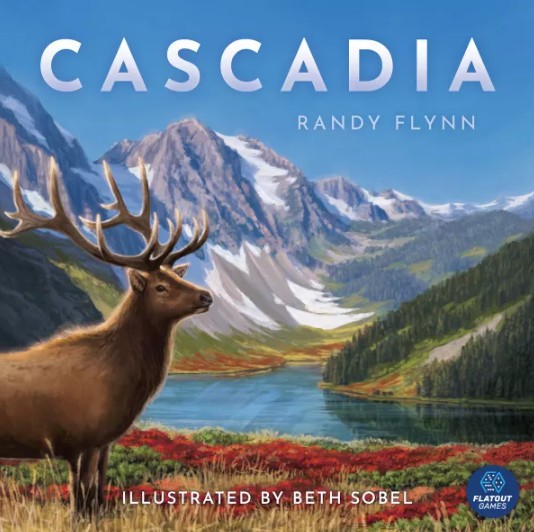
Eerlijkheid gebied me te zeggen: ik snap de overeenkomst: je creëert verschillende gebieden en verzamelt symbooltjes in gebieden, om gebieden meer waard te laten zijn en je moet uit voorgeselecteerde tegels kiezen. Maar echt lieve mensen, daar houdt de vergelijking echt wel op. Begrijp me niet verkeerd, ik kan ook genieten van een snel potje Kingdomino tussendoor, niets ten nadele van dat spel, maar Cascadia heeft veel meer klasse, mogelijkheden en laten we die ook nog even noemen: een prachtige vormgeving. Het is werkelijk waar een feestje en genot voor je oog als voor je neus een steeds groter natuurgebied de tafel vult. De stijl, het kleurgebruik, de afbeeldingen van de dieren: het is allemaal even prachtig. Hiermee heeft meneer Flynn toch echt wel een droom debuut te pakken als je het mij vraagt.
Ik ben fan! Groot fan!

Cascadia
Players: 1-4
Time: 30-45 minutes
Age: 10+
Author: Randy Flynn
Publisher: Flatout Games
Year: 2021
The fact that I didn’t have time to write anything earlier this week has been eating me up all week. Last weekend I played Cascadia with my family.
Cascadia front: Second time for me, first for them. Read: I played the game, fell in love, bought it, and during the family weekend, attempted to indoctrinate my family with the tile-placement virus. We’ll get to why I’ve been eating me up ever since that weekend. But first, let’s start at the beginning.
Cascadia isn’t a new game. White Goblin Games published it in 2022, and it immediately won the Family category award at the Dutch Games Award. I’ll explain later why this is entirely justified, in my opinion. Cascadia is a game by Randy Flynn. I had to Google the guy, and as far as I can tell, Cascadia is his debut. True experts are welcome to correct me. It bodes well for the future if this is your entry into the world of gaming.
In Cascadia, you can score points by cleverly connecting hexagon tiles, scoring with combinations of both animals and their habitats. Each turn, you choose a combination of a tile (depicting both different habitats and one or more animals) and an animal token. Place the animal tokens on tiles depicting the animal. The animal may only be placed on these tiles. This can be on either the newly placed tile or a previously placed tile depicting the animal.
Because you start with a starting tile consisting of three adjacent tiles, you always have four tiles on which you can potentially place an animal token throughout the game. You can only choose a combination of a tile and animal token if you have a free tile containing the animal from the chosen combination. You must be able to place the animal. Only one animal token can be placed on each tile, even if it depicts more than one animal. You score points by combining animal tokens and by the size of the different types of areas you form with your tiles. You also receive bonus points for each type of area if you have the largest area at the final scoring. The number of points depends on the number of players.
The different habitats are wetlands, rivers, mountains, prairies, and forests. There are no placement rules for these areas. Any area can be placed against any other area, but that’s obviously not a smart move if you want to score points, because at the final scoring, you only score for each area type, your largest area. You then score one point for each tile that makes up the area.
The scoring of the animal tokens is a bit more ingenious and, in my opinion, quite brilliant. There are five animal types in the game: the grizzly bear, the Roosevelt elk (aka deer), the Chinook salmon, the red-tailed hawk, and the red fox. How these animals score depends on the scoring cards you draw before the game. There are four different scoring cards for each animal, resulting in 20 different scoring scenarios/combinations. The scoring cards have different scoring mechanisms, so there’s still variation there.
In my first two games, we played the scenarios recommended in the rules; that’s the starting point for this review, but certainly not the only correct or existing combination. Consider this as an example. The grizzly bear scores points by placing two grizzly bears adjacent to each other. A third or fourth bear makes the combination worthless. The more of these combinations, the more valuable they become.
You score the deer by placing them in straight lines adjacent to each other. The longer the line, the more points. You can have multiple lines at the final score, but each deer can only count in one line. For the Chinook salmon, you create the longest possible loop. It doesn’t have to be a straight line, but they must be adjacent. Three salmon can never be adjacent, so you can’t make a sharp turn. The longer your salmon string, the more points you earn, and that can really add up! The buzzard isn’t the hardest to score. It simply can’t be adjacent to another buzzard. The more buzzards you have, the more they each become worth. You score a maximum of 6 points for the fox. One point for each different animal species you surround it with. The fox itself also counts.
The game is quite simple: choose a tile/token combination and place it. Four of these are always ready, and these are refilled immediately after a turn. However, as simple as it seems, you have to think carefully about your choices. Because sometimes you’re looking for a specific animal, but it’s not on the right land tile, or vice versa. And do you focus on forming the largest areas, or do you want to maximize your animals’ scores? And which animal do you primarily focus on? You can’t do it all at once.
Some combinations are tricky to make. How do you surround a fox with as many animals as possible, if you also want to make a row of the deer, a combination of the bear, and a sling of the salmon? It’s a close call. At the same time, you also have to keep an eye on what your neighbor is doing. If they’re scoring on deer, it might be worthwhile to snatch them right in front of them, and if you see your opponent ignoring certain habitats, you can choose those instead, scoring bonuses for your largest territory at the end.
Now, I can already hear the first critics shouting in the distance: “You just have to be lucky with what you end up with. The luck factor is too great!” That’s not entirely true. Many of the tiles depict a pine cone in addition to an animal. If you place an animal token on a tile with a pine cone, you immediately receive a nature token. These tokens are worth one point at the end of the game, but are much more valuable during the game itself. In exchange for a nature token, you can choose any of the four combinations, so you don’t have to stick to the combinations already available. You can simply take what you want. If you have three identical animal tokens, you can also replace them with new tokens for free, thus increasing the number of choices. You don’t have to pay for a nature token in this case.
At the end of the game, you score the animals according to the animal cards you chose, the different habitats, the bonuses for the largest habitats, and the remaining nature tokens. The player with the most points wins.
Cascadia is a family game winner for good reason. The seemingly simple mechanism is suitable for young players. The layout and combinations themselves are simple and easy to do. At the same time, the various scoring mechanisms offer challenges for advanced players. How do you optimally combine habitats and animals? How do you place your tiles for the highest return? And which strategy do you choose to outsmart your opponent? You can also adjust the difficulty by choosing different scoring cards and creating combinations that make the game more difficult, for example, by making animals get in each other’s way. You can also choose one of the achievements and scenarios from the manual. In this case, you’re not just playing the game; you’re also working towards certain targets and objectives. This makes it more of a competition and a game against each other. This is great for people who hate games where you’re mainly focused on your own board and not on one together! Suddenly, you’re aiming for the same combinations with the objectives, and it becomes much more exciting. At the same time, you can also impose rule restrictions on yourself to make it more exciting and difficult. For example, think of certain habitats and animals not being allowed to be adjacent to each other.
You see, the possibilities and choices are endless. And that’s also why I think it’s such a brilliant game. Every gaming enthusiast can tailor it to their own taste and skill level. Anyone who thinks this is just a simple game where you simply connect pieces like dominoes will be disappointed. There’s a lot of depth and variety behind it, which I already know will give me endless fun.
This also brings me to the point I’m really getting worked up about. My family was just as enthusiastic as I was. Only my sister grumbled a bit during the game. “I don’t get it, it’s actually quite difficult, you have to pay attention to so many things at once.” You won’t be surprised: my wife won big. Now, that’s not what I’m soured about. But I am so upset about the words that followed her victory: “Yes, now I get it, it’s actually just Kingdomino with hexagons.” A kind of vicarious anger gripped me. Describing this game like that is simply unacceptable. It’s blasphemy in the church of games. It does the game a disservice on all fronts!
Honestly, I understand the similarities: you create different areas and collect symbols in areas to increase their value, and you have to choose from pre-selected tiles. But honestly, that’s where the comparison really ends. Don’t get me wrong, I also enjoy a quick game of Kingdomino every now and then, no offense to that game, but Cascadia has much more class, features, and let’s just mention it: beautiful design. It’s truly a feast for the eyes as an ever-expanding natural landscape fills the table before your eyes. The style, the use of color, the animal illustrations: it’s all equally stunning. Mr. Flynn has truly delivered a dream debut, if you ask me.
I’m a fan! Huge fan!