
Aantal spelers: 2-4
Speelduur: 30 minuten
Leeftijd: 8+
Auteur: Gareth Edwards
Uitgever: Outset Media / Cheatwell Games
Jaar: 2026
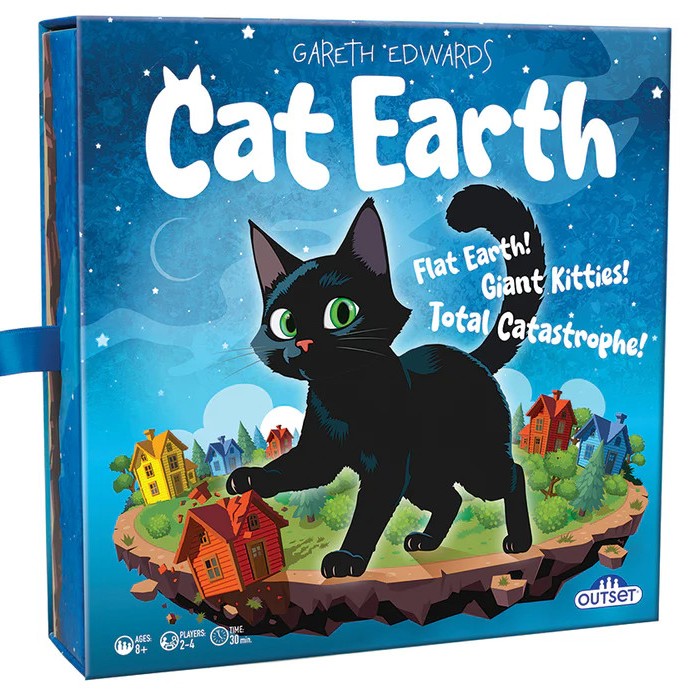

Stel je eens voor: de aarde was plat… wat zouden katten dan doen?
Precies. Spullen van de rand afduwen.
Dat is eigenlijk precies waar Cat Earth om draait: gigantische, ondeugende katten die op een platte wereld huisjes de afgrond in duwen.
Een eerste kennismaking met Cat Earth
Toen ik de aankondiging van Cat Earth voorbij zag komen, was ik eigenlijk meteen enthousiast. Op het eerste gezicht een niet al te moeilijk abstract spel, maar dan wel met een grappig thema. Dat doet het hier thuis over het algemeen goed.
Abstracte spellen zijn echt Mikolaj’s ding. Leuke thema’s hebben Leonore’s voorkeur en zelf kan ik beide wel waarderen.
Deze moest dus uitgeprobeerd worden. Superleuk dus dat wij een reviewexemplaar kregen om te spelen.
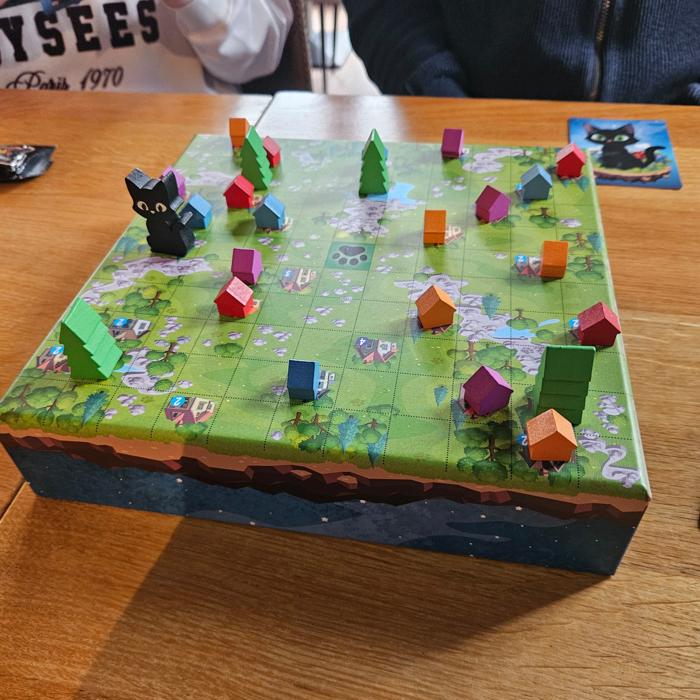
De doos ziet er in het echt nog leuker uit dan op de foto’s. Het is namelijk geen doos met deksel, zoals we die kennen van de meeste andere spellen, maar een uitschuifdoos. Niet alleen origineel gevonden, maar ook super-praktisch. Op de onderkant van het uitschuifbare deel staat namelijk het speelbord afgebeeld.
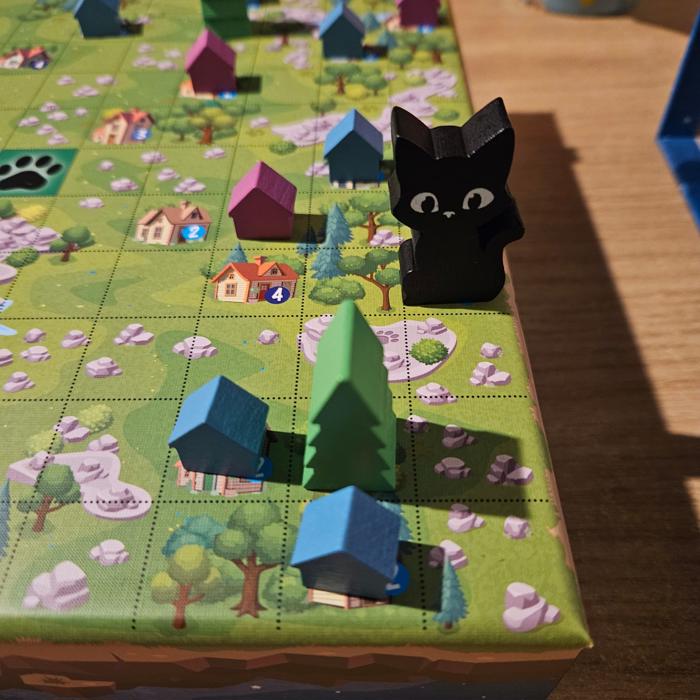
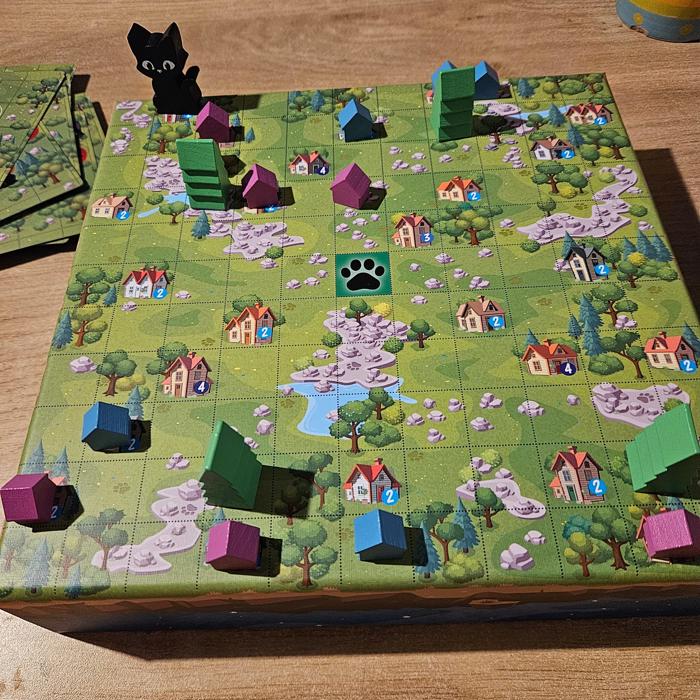
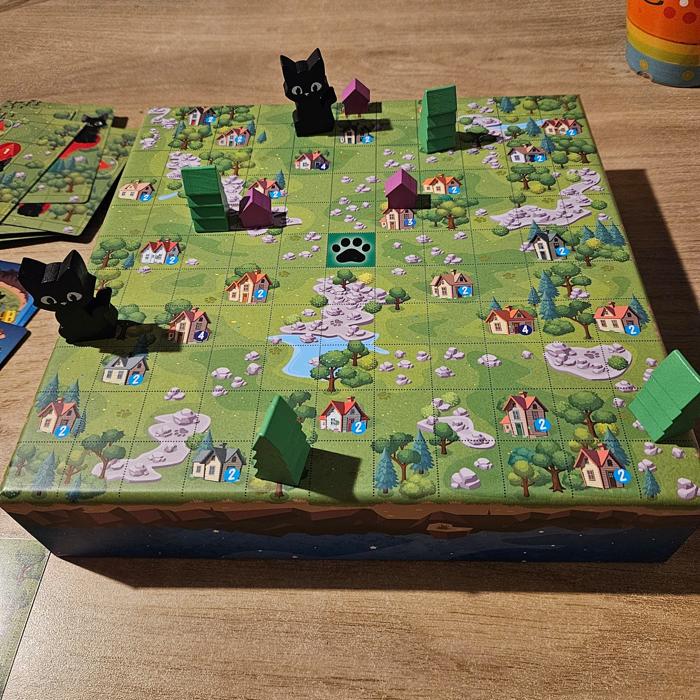
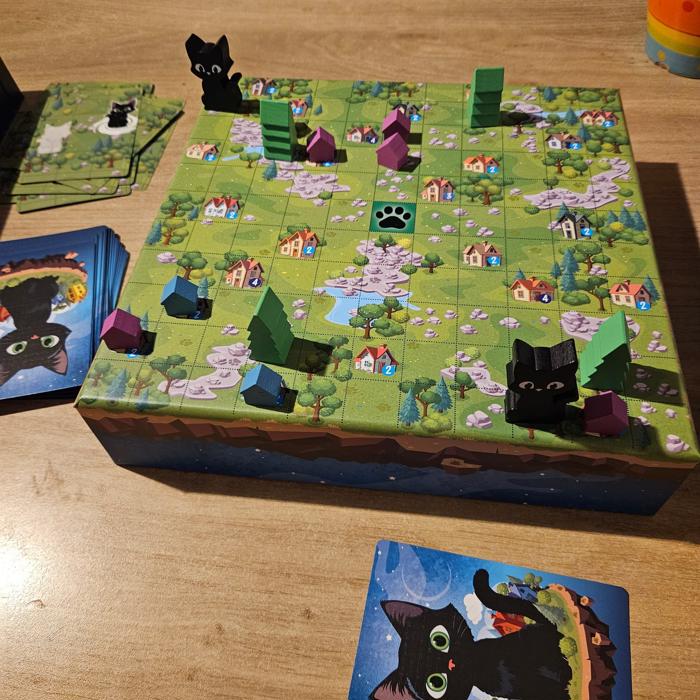
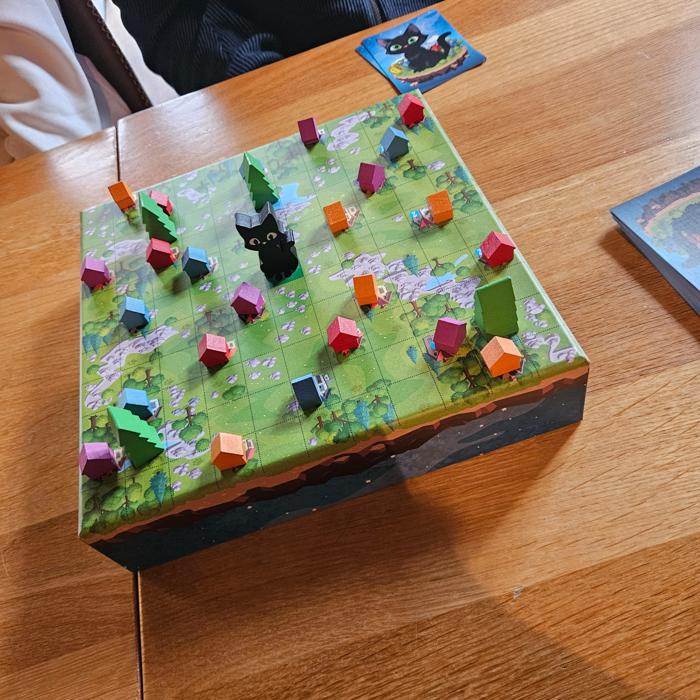
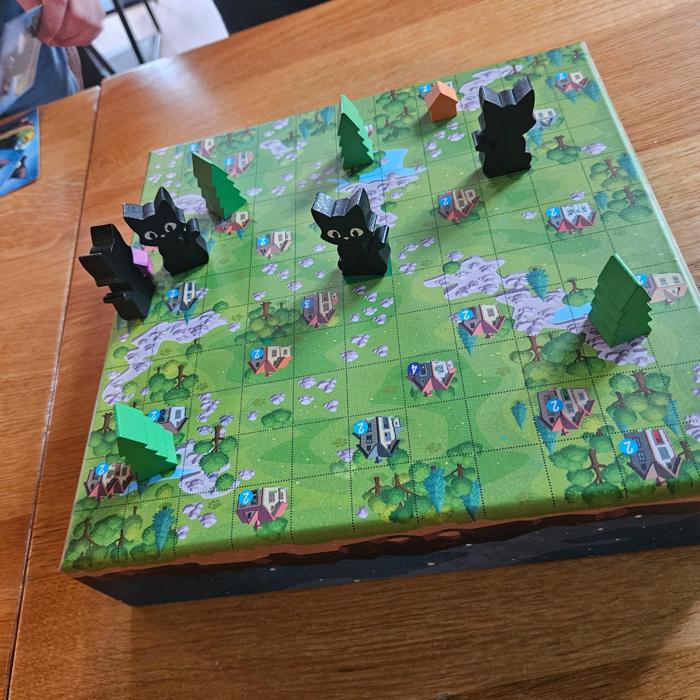
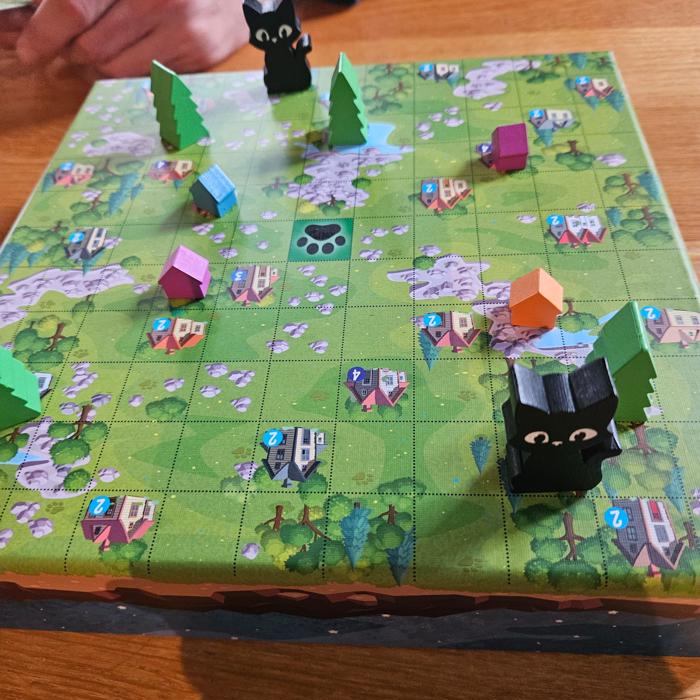
De rest van het spel ziet er ook superschattig uit: kleine houten huisjes en – in vergelijking met die huisjes – gigantische katten, ook van hout.
Er zijn relatief weinig spelonderdelen en de spelregels zijn dermate eenvoudig dat het spel snel opgezet en uitgelegd is.
Hoe wordt Cat Earth gespeeld?
Elke speler kiest een kleur en om beurten plaatsen de spelers hun huisjes op het speelbord, totdat alle huisjes geplaatst zijn.
Op dezelfde manier worden vervolgens ook de bomen geplaatst.
De kat wordt in het midden van het bord gezet en elke speler krijgt twee kaarten.
Dan kan het spel beginnen.
Wanneer je aan de beurt bent, pak je eerst één kaart van de stapel. Vervolgens mag je kaarten uitspelen. Je kunt 0, 1, 2, 3 of 4 kaarten spelen. Let op: je mag nooit meer dan vier kaarten op hand hebben.
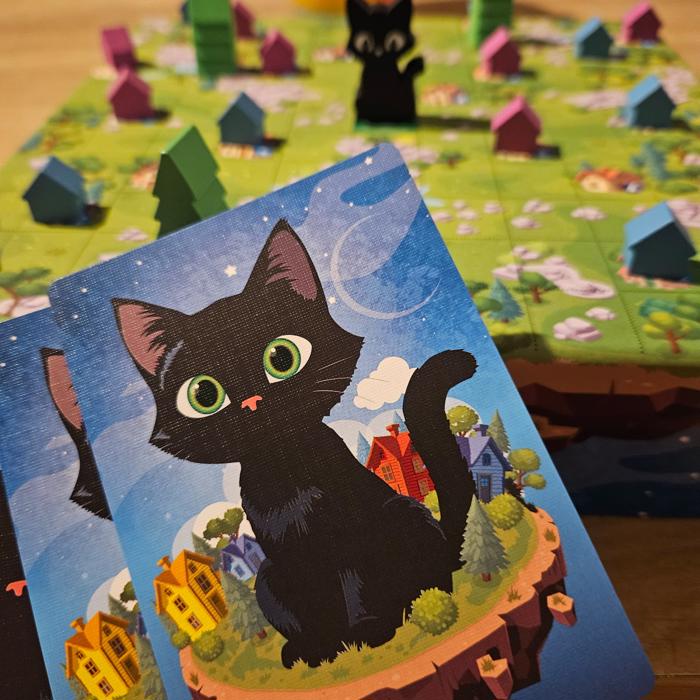
Veruit de meeste kaarten zorgen ervoor dat de kat verplaatst. Dit gebeurt volgens de ‘route’ die op de kaart staat aangegeven. De kaart mag je draaien, zodat je de beweging in verschillende richtingen kunt uitvoeren.
De bedoeling is om de huisjes van de andere speler(s) van het bord te duwen.
Wanneer een huis van de aarde wordt geduwd, verdwijnt het in de doos en komt het niet meer terug.
Dit gebeurt altijd door de verplaatsing van de kat: tijdens zijn beweging duwt de kat alle huisjes die op zijn route liggen.
Naast de verplaatsingskaarten zijn er ook nog drie speciale kaarten. Daarmee kun je de kat laten teleporteren naar de startpositie of naar een willekeurige plek op het bord, of je kunt twee huisjes op het bord met elkaar verwisselen.
De speler die als laatste nog één of meer huisjes op het bord heeft staan, wint Cat Earth.
Wat vinden we van Cat Earth?
Cat Earth is wat mij betreft een prima spel, al moet het type spel je wel liggen. Het is namelijk een vrij abstract spel. Bij ons thuis kunnen we daar erg van genieten, maar het is niet voor iedereen. Als je graag spellen speelt met een duidelijk verhaal of sterk thema, dan voelt dit misschien wat kaal.
Het spel speelt wat mij betreft het beste met twee spelers. Zodra één speler gewonnen heeft, is het spel meteen afgelopen. Je kunt het ook met drie of vier spelers spelen, maar dan verandert het eigenlijk in een afvalrace. Wie er als eerste uit ligt, moet wachten tot de rest uitgespeeld is en dat kan soms best lang duren. Met z’n tweeën speelt het daarom wat lekkerder door.
De regels zijn simpel. Daardoor is het ook heel geschikt als gezinsspel. Het verplaatsen van de kat vraagt wel een beetje ruimtelijk inzicht. In het begin moesten wij daar even aan wennen, maar we kwamen er al snel achter dat het enorm helpt om de kaarten gewoon even te draaien. Door ze letterlijk (fysiek dus) te draaien zie je meteen beter welke beweging de kat maakt.
Tijdens het spelen doet het spel een beetje denken aan schaken of dammen. Je probeert namelijk stukken van je tegenstander van het bord te krijgen, totdat je uiteindelijk wint. Het is natuurlijk niet hetzelfde spel, maar door het bord met vierkantjes en de manier waarop je over het bord beweegt, voelt het soms wel een beetje zo. Ook de eenvoudige regels dragen daaraan bij.
Wat Cat Earth wat minder bijzonder maakt, is dat het spel zelf niet heel vernieuwend is. De ideeën erachter voelen best vertrouwd. Tegelijkertijd is het spel wel in een leuk jasje gestoken. Het katten-thema is grappig uitgewerkt en het design ziet er verzorgd uit. Dat geeft het spel toch iets eigens.
Alles bij elkaar vind ik het een leuk spel voor af en toe, maar geen spel dat heel vernieuwend aanvoelt. Daarom kom ik uit op een 6,5 uit 10.
Voor gezinnen die een toegankelijk spel zoeken en het niet erg vinden dat het wat abstract is, kan Cat Earth zeker een leuke toevoeging aan de kast zijn. Maar als je niet zo van abstracte spellen houdt, dan is de kans groot dat dit spel ook niet helemaal jouw ding is.

Cat Earth
Players: 2-4
Time: 30 minutes
Age: 8+
Author: Gareth Edwards
Publisher: Outset Media / Cheatwell Games
Year: 2026
Imagine this: the Earth was flat… what would cats do?
Exactly. Push things off the edge.
That’s basically what Cat Earth is all about: gigantic, mischievous cats living on a flat world, pushing little houses into the abyss.
A first look at Cat Earth
When I first saw the announcement for Cat Earth, I was immediately intrigued. At first glance it looked like a fairly simple abstract game, but with a funny theme. That combination usually works well in our household.
Abstract games are really Mikolaj’s thing. Leonore prefers games with fun themes, and I personally enjoy both.
So this was definitely a game we wanted to try. We were very happy to receive a review copy to play.
The box actually looks even nicer in real life than in the photos. Instead of the typical lift-off lid you see on most board games, it uses a sliding box. Not only is that a nice original touch, it’s also very practical. The bottom of the sliding part actually shows the game board.
The rest of the components look super cute as well: small wooden houses and – compared to those houses – gigantic wooden cats.
There are relatively few components, and the rules are simple enough that the game can be set up and explained very quickly.
How do you play Cat Earth?
Each player chooses a color and players take turns placing their houses on the board until all houses have been placed.
The trees are then placed in the same way.
The cat is placed in the middle of the board and each player receives two cards.
Then the game can begin.
On your turn, you first draw one card from the deck. After that, you may play cards. You can play 0, 1, 2, 3, or 4 cards. Keep in mind that you may never have more than four cards in your hand.
Most cards move the cat. The movement follows the ‘route’ shown on the card. You can rotate the card, allowing you to perform the movement in different directions.
The goal is to push the houses of the other player(s) off the board.
When a house is pushed off the Earth, it disappears into the box and does not return.
This always happens through the movement of the cat: as the cat moves, it pushes any houses that lie along its path.
Besides the movement cards, there are also three special cards. These allow you to teleport the cat back to the starting position, move it to any space on the board, or swap two houses on the board.
The player who is the last to still have one or more houses on the board wins Cat Earth.
What do we think of Cat Earth?
In my opinion, Cat Earth is a solid game, although you do have to enjoy this type of game. It is quite an abstract game. In our household we enjoy that, but it’s definitely not for everyone. If you prefer games with a strong story or theme, this might feel a bit bare.
Personally, I think the game works best with two players. As soon as one player has lost and the other has won, the game ends immediately. You can also play with three or four players, but in that case it becomes more of an elimination game. The first player to be knocked out has to wait for the others to finish, and that can sometimes take quite a while. With two players, the game flows much better.
The rules are simple, which also makes it a good family game. Moving the cat does require a bit of spatial thinking. At first we had to get used to that, but we quickly discovered that it helps a lot to physically rotate the cards. Turning the cards makes it much easier to see exactly how the cat will move.
While playing, the game somewhat reminds me of chess or checkers. You try to remove your opponent’s pieces from the board until you eventually win. Of course it’s not the same type of game, but the square grid and the way you move across the board give it a similar feel. The relatively simple rules add to that impression.
What makes Cat Earth a little less remarkable is that the gameplay itself isn’t very innovative. The ideas behind it feel quite familiar. At the same time, the game is presented in a very charming way. The cat theme is nicely implemented and the design looks polished. That gives the game its own personality.
All in all, I think it’s a fun game to bring to the table occasionally, but not one that feels particularly groundbreaking. That’s why I’d rate it a 6.5 out of 10.
For families looking for an accessible game and who don’t mind something a bit abstract, Cat Earth could certainly be a nice addition to the shelf. But if abstract games aren’t really your thing, there’s a good chance this one won’t be either.