

Aantal spelers: 1-4
Speelduur: 35 minuten
Leeftijd: Vanaf 12 jaar
Auteur: Giampaolo Razzino
Uitgever: Little Rocket Games
Jaar: 2024


Dit is een herpublicatie van een review die ik eerder schreef voor Bordspelwereld.nl.
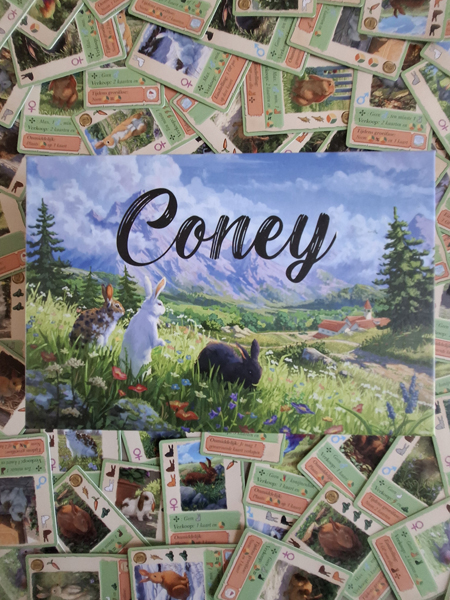
In Coney run je een konijnenboerderij en moet je proberen om de konijnen zodanig te plaatsen dat ze geen ruzie maken en een mooi harmonieus geheel vormen. Wie daar het best in slaagt, wint Coney!
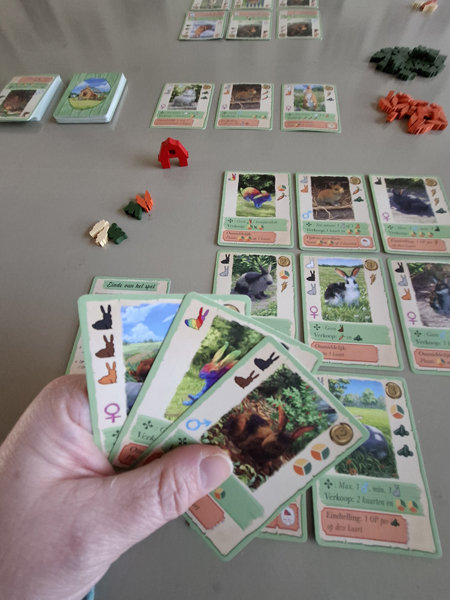
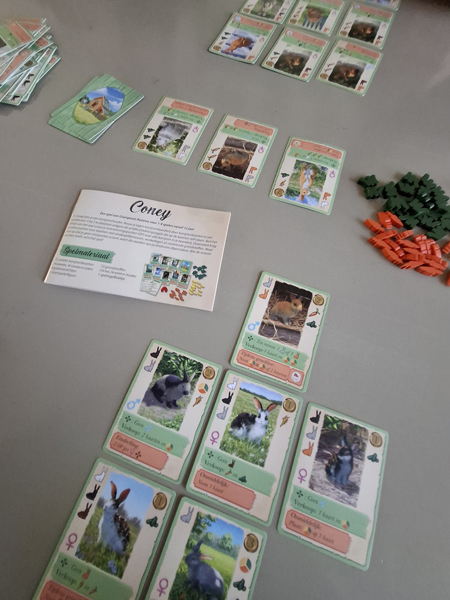
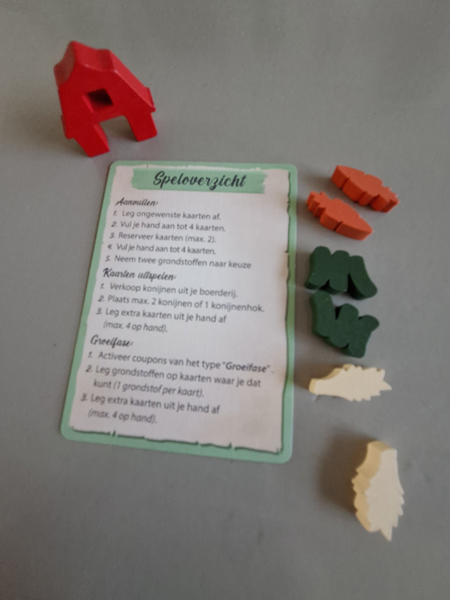
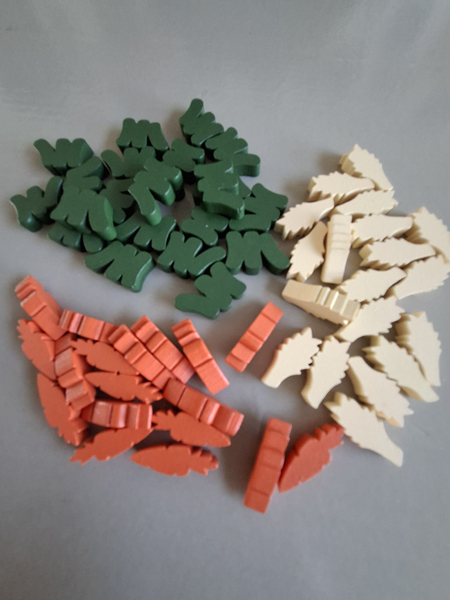
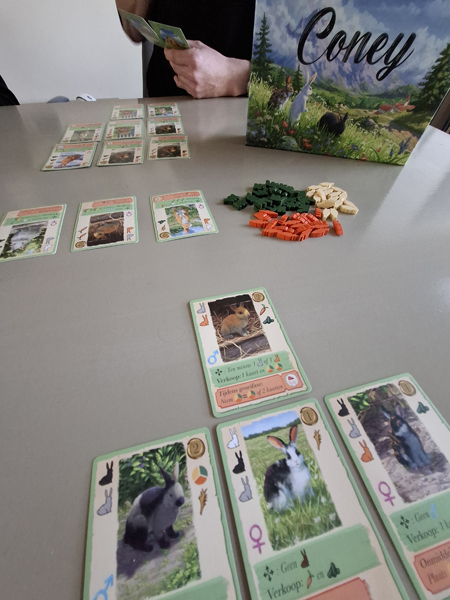
Het doel van Coney is om 9 konijnenkaarten in een raster van 3 bij 3 te plaatsen volgens de geldende plaatsingsregels en daar zoveel mogelijk punten mee te scoren. Aan het begin van het spel heeft elke speler 4 konijnenkaarten en 1 van elke grondstof (wortel, hooi en pellets). In het midden van de tafel liggen 3 kaarten open die de markt vormen. De resterende kaarten vormen een trekstapel. De resterende grondstoffen vormen de algemene grondstoffenvoorraad. Wanneer je aan de beurt bent, moet je 1 van volgende acties kiezen en uitvoeren:
1. aanvullen:
Eerst mag je ongewenste kaarten uit je hand afleggen op de aflegstapel. Daarna vul je je hand weer aan tot 4 kaarten door kaarten te trekken van de trekstapel of kaarten te nemen uit de markt. Dan mag je maximaal 2 kaarten uit je hand reserveren (leg ze open voor je neer; je mag deze konijnen later uitspelen in je boerderij) en mag je opnieuw je hand weer aanvullen tot 4 kaarten. Hierna mag je 2 grondstoffen uit de algemene voorraad nemen en aan je persoonlijke voorraad toevoegen. Vul daarna pas de markt weer aan tot 3 kaarten.
2. konijnenkaarten uitspelen:
Eerst mag je konijnenkaarten die al in je boerderij liggen, verkopen. Je ontvangt hiervoor de inkomsten die op de verkochte kaarten staan. Daarna mag je maximaal 2 konijnenkaarten (of 1 konijnenhok) uitspelen in je boerderij door de kosten die op de kaarten staan, te betalen. Houd hierbij rekening met de plaatsingsregels van het konijn dat je legt én van de konijnen waar je de kaart naast legt. Eventuele onmiddellijke bonussen voer je direct uit. Als je daarna meer dan 4 kaarten in je hand zou hebben, dan leg je kaarten naar keuze op de aflegstapel tot je er slechts 4 overhoudt. Vul daarna de markt weer aan tot 3 kaarten.
3. groeien:
Eerst activeer je alle bonussen van het type “tijdens groeifase” van de kaarten in je boerderij. Daarna mag je grondstoffen uit je persoonlijke voorraad op kaarten leggen die daar bij de eindtelling punten voor opleveren (per groeifase mag je slechts 1 grondstof op elke kaart die in aanmerking komt, leggen). Als je aan het einde van je beurt meer dan 4 kaarten in je hand zou hebben, dan leg je kaarten naar keuze op de aflegstapel tot je er slechts 4 overhoudt. Vul daarna de markt weer aan tot 3 kaarten.
Wanneer een speler op het einde van zijn beurt zijn raster van 9 kaarten heeft voltooid, dan wordt de eindfase van het spel ingezet. Er wordt verder gespeeld tot aan de startspeler zodat iedereen uiteindelijk evenveel beurten heeft gehad. Daarna worden de punten geteld en wint de speler met de meeste punten Coney. Punten kan je als volgt verdienen:
Punten voor alle konijnen in je boerderij (rechtsboven op de kaarten in je boerderij).
Punten voor de bonussen van het type “eindtelling” op de kaarten in je boerderij.
Punten voor de winkellogo’s op de kaarten in je boerderij.
Punten voor de resterende grondstoffen in je persoonlijke voorraad.
Minpunten voor de nog ongebruikte gereserveerde kaarten die je vóór je hebt liggen.
Mijn mening over Coney?
Ik vond Coney in eerste instantie een beetje een frustrerend spelletje. De plaatsingsregels zijn eenvoudig te begrijpen, maar niet eenvoudig toe te passen. Kijk dus goed naar de plaatsingsregels wanneer je kaarten moet kiezen die je later in je boerderij wil plaatsen. Meer kaarten werden slecht dan bruikbaar bevonden, dus de trekstapel ging er goed vandoor.
Ik vond het ook niet vanzelfsprekend om aan de nodige grondstoffen te geraken om konijnen uit te spelen. Daarenboven zou je punten kunnen scoren door grondstoffen op kaarten te verzamelen, maar dat zijn dezelfde grondstoffen als waar je konijnenkaarten mee kan uitspelen. En omdat de grondstoffen al zo schaars zijn, had bij ons dus uiteindelijk nooit iemand grondstoffen op kaarten liggen. Je kan ook kaarten uit je boerderij verkopen om aan grondstoffen te geraken. Maar daar is dan weer het frustrerende dat, wanneer 1 speler dat niet doet, deze speler gegarandeerd 9 kaarten in zijn speelveld heeft liggen en het spel zo beëindigt nog vóór jij nog maar in de buurt van een volle boerderij komt.
Het spel ligt helemaal in dezelfde lijn als “Hens”, met dat verschil dat Hens minder frustrerend werkt en een heel pak vlotter speelt. Bij Coney had ik ook veel meer het gevoel dat je echt in je eigen wereldje zit en op je eigen boerderij bezig bent om 100 keer na te kijken of die ene kaart daar toch zeker wel mag liggen. Bij Hens had ik dat gevoel veel minder. Ook omdat je bij Hens kaarten kan trekken van elkaars aflegstapel, dus daar houd je veel meer rekening met wat de anderen aan het doen zijn en welke kaarten je dan best wel of net niet weglegt. De interactie bij Hens is dus wel een stuk groter dan bij Coney.
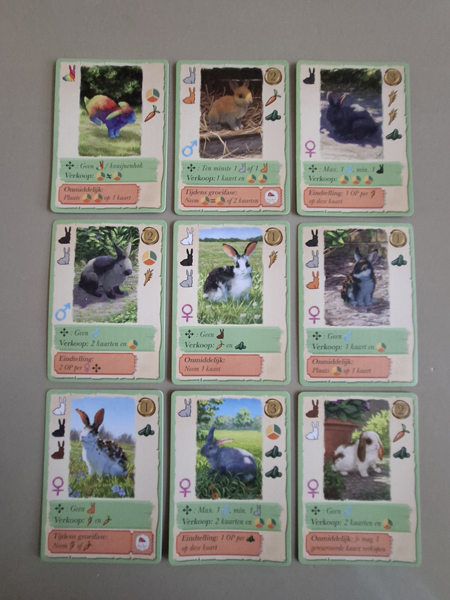
Coney en Hens zijn 2 spellen van dezelfde bedenker. Op zich heb ik niets tegen deze spellenbedenker, want zijn spel “Fall” vind ik echt prima spelen! Mijn conclusie is dat Coney zeker geen flauw afkooksel is van Hens, maar een, voor mij althans, eerder overbodige opvolger. Ik zou ze dus zeker niet allebei in huis halen en mijn voorkeur gaat uit naar Hens. Tenzij je natuurlijk een fervente konijnenliefhebber bent, want de tekeningen op de konijnenkaarten zijn wel heel mooi en schattig!


Coney
Players: 1-4
Time: 35 minutes
Age: 12+
Author: Giampaolo Razzino
Publisher: Little Rocket Games
Year: 2024
This is a republication of a review I wrote for Bordspelwereld.nl.
In Coney, you run a rabbit farm and must try to place the rabbits in such a way that they do not quarrel and form a nice harmonious entity. Whoever succeeds best in doing so wins Coney!
The aim of Coney is to place 9 rabbit cards in a 3-by-3 grid according to the applicable placement rules and score as many points as possible in doing so. At the beginning of the game, each player has 4 rabbit cards and 1 of each resource (carrot, hay and pellets). In the centre of the table, 3 cards lie face-up forming the market. The remaining cards form a draw pile. The remaining resources form the general resource stock. When it is your turn, you must choose and perform 1 of the following actions:
1. replenish:
First, you may discard unwanted cards from your hand to the discard pile. Then you replenish your hand to 4 cards by drawing cards from the draw pile or taking cards from the market. Then you may reserve up to 2 cards from your hand (put them face-up in front of you; you may play these rabbits in your farm later) and may again replenish your hand to 4 cards. After this, you may take 2 resources from the general supply and add them to your personal supply. Only then replenish the market to 3 cards again.
2. Playing rabbit cards:
First, you may sell rabbit cards already in your farm. For this, you receive the income shown on the sold cards. Then you may play up to 2 rabbit cards (or 1 rabbit hutch) in your farm by paying the cost shown on the cards. When doing so, take into account the placement rules of the rabbit you place as well as the rabbits you place the card next to. Any immediate bonuses are executed immediately. If you would then have more than 4 cards in your hand, you put cards of your choice on the discard pile until you have only 4 left. Then replenish the market to 3 cards.
3. Grow:
First, you activate all bonuses of the type ‘during growth phase’ from the cards in your farm. Then you may place resources from your personal supply on cards that score points for them at the end of the game (per growth phase, you may only place 1 resource on each eligible card). If you would have more than 4 cards in your hand at the end of your turn, you place cards of your choice on the discard pile until you are left with only 4. Then replenish the market to 3 cards.
When a player completes his grid of 9 cards at the end of his turn, the final phase of the game begins. Play continues down to the starting player so that everyone has had the same number of turns in the end . After that, the points are counted and the player with the most points wins Coney. Points can be earned as follows:
Points for all the rabbits in your farm (top right of the cards in your farm).
Points for end-count type bonuses on the cards in your farm.
Points for the shop logos on the cards in your farm.
Points for the remaining resources in your personal supply.
Minus points for the unused reserved cards you have before you.
My opinion on Coney?
I initially found Coney to be a bit of a frustrating game. The placement rules are easy to understand, but not easy to apply. So look carefully at the placement rules when you have to choose cards to place in your farm later. More cards were found to be bad than useful, so the draw pile went down quickly.
I also found it not easy to get the necessary resources to play out rabbits. On top of that, you could score points by collecting resources on cards, but those are the same resources you can play rabbit cards with. And because resources are already scarce, no one ever ended up with resources on cards. You can also sell cards from your farm to get resources. But then again, the frustrating thing is that if one player doesn’t do this, this player is guaranteed to have 9 cards in his play area, ending the game before you even get close to a full farm.
The game is completely along the same lines as ‘Hens’, except that Hens is less frustrating and plays a whole lot smoother. With Coney, I also had the feeling that you are really in your own little world and are busy on your own farm checking 100 times whether that one card is allowed there. With Hens, I had that feeling much less. Also because in Hens you can draw cards from each other’s discard pile, so there you take much more into account what the others are doing and which cards you should or should not discard. So there’s a lot more interaction going on in Hens than in Coney.
Coney and Hens are two games by the same creator. In itself, I have nothing against this game designer, because his game ‘Fall’ plays really nice! My conclusion is that Coney is certainly not a bland copy of Hens, but a, for me at least, rather superfluous successor. So I would definitely not buy both of them and my preference goes to Hens. Unless, of course, you are an avid bunny lover. The drawings on the bunny cards are very beautiful and cute!