

Aantal spelers: 2-5
Speelduur: 20 minuten
Leeftijd: Vanaf 8 jaar
Auteur: Stefan Alexander
Uitgever: Gam’in Biz
Jaar: 2018
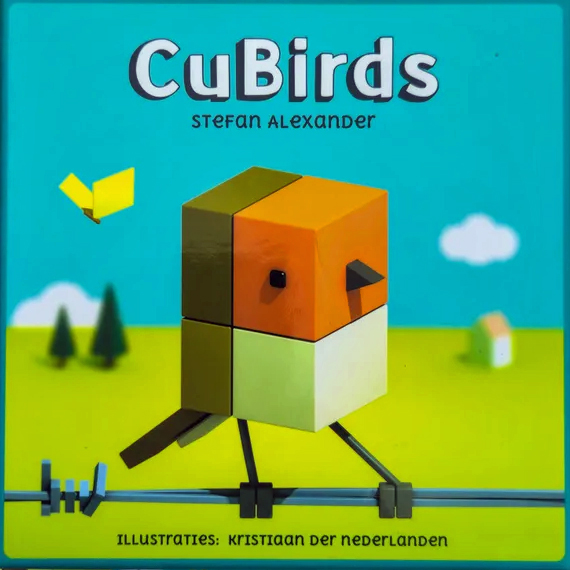

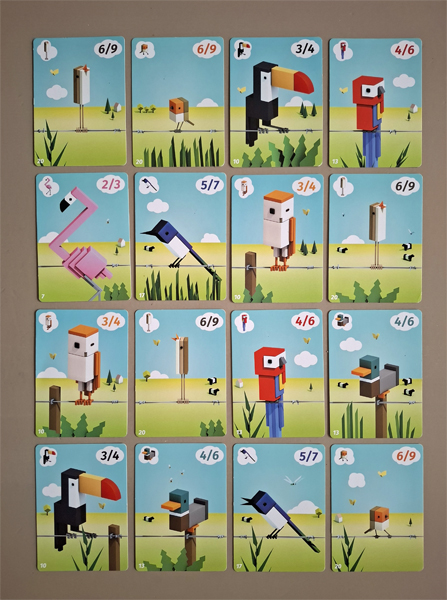
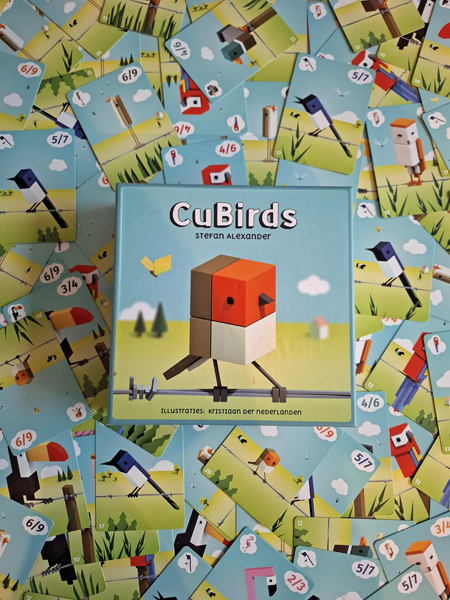
Bij CuBirds heb je 110 kaarten, verdeeld over 8 vogelsoorten, waarbij de ene soort al wat zeldzamer is dan de andere. De bedoeling van het spel is om ofwel minstens 1 kaart van 7 verschillende vogelsoorten te verzamelen, ofwel minstens 3 kaarten van 2 verschillende vogelsoorten. Kan je dit als eerste? Dan win je onmiddellijk CuBirds!
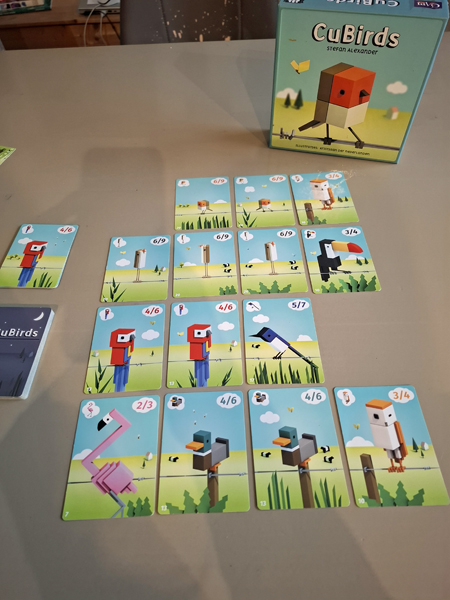
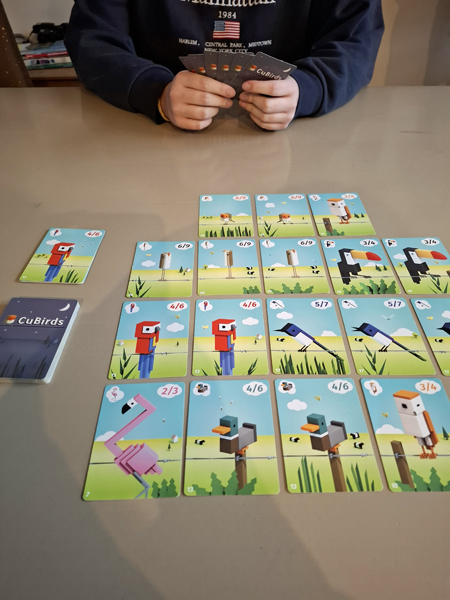
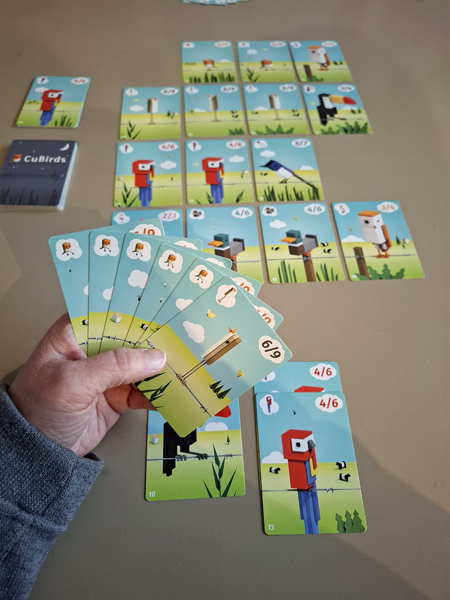
Om CuBirds te beginnen, leg je 4 rijtjes van 3 kaarten open op tafel. Zorg er voor dat er in elke rij 3 verschillende kaarten liggen. De rest van de kaarten vormen de trekstapel. Geef elke speler 8 kaarten van deze trekstapel. Geef daarna elke speler nog 1 kaart die open voor deze speler wordt neergelegd. Deze kaart vormt het begin van zijn collectie vogels.
De spelers zijn in wijzerzin aan de beurt. Wanneer je aan de beurt bent, voer je de volgende stappen uit:
- Vogels aanleggen (verplicht):
Kies 1 vogelsoort uit je hand en leg alle vogels die je van die soort in je hand hebt, aan aan één van de 4 rijen. Je kan dat links óf rechts van een rij doen. Als je deze vogels naast een rij legt waarin al vogels van die soort liggen, dan kan het zijn dat je daarmee andere vogelsoorten insluit. Neem al deze ingesloten vogels op hand. Schuif vervolgens de achtergebleven vogels tegen elkaar om het gat te dichten. Als er daardoor slechts 1 vogelsoort overblijft in die rij, dan moet je deze rij aanvullen met kaarten van de trekstapel tot er weer 2 verschillende vogelsoorten in die rij liggen. Als je je vogelkaart(en) zodanig aanlegt dat je geen andere vogels insluit, dan mag je 2 kaarten van de trekstapel nemen. Je mag er ook voor kiezen om dat niet te doen.
2. Een familie vormen (optioneel):
Een familie vogels bestaat uit meerdere vogels van dezelfde soort. Rechtsboven op de vogelkaarten staan 2 getallen, bvb 3/4. Dit wil zeggen dat je in dit geval 3 kaarten van deze vogelsoort nodig hebt om een kleine familie te vormen en 4 kaarten voor een grote familie. Om een familie te vormen, leg je alle vogels die je van die soort in je hand hebt, af op de aflegstapel. Zijn dat voldoende kaarten voor een kleine familie, dan mag je 1 van die kaarten toevoegen aan je collectie. Zijn dat voldoende kaarten voor een grote familie, dan mag je 2 van die kaarten toevoegen aan je collectie. Je collectie is steeds zichtbaar voor de andere spelers. Je hebt nu geen vogels van die soort meer in je hand. Je mag enkel kaarten voor een familie afleggen als je ook daadwerkelijk minstens een kleine familie kan vormen. Je mag slechts 1 familie per beurt vormen.
3. Een lege hand:
Als je aan het einde van je beurt geen kaarten meer op handen hebt, dan moeten alle andere spelers al hun handkaarten op de aflegstapel leggen. Alle spelers krijgen 8 nieuwe handkaarten van de trekstapel. Jijzelf bent nog eens aan de beurt. Als de trekstapel leeg is, dan schud je de aflegstapel om een nieuwe trekstapel te vormen.
CuBirds eindigt onmiddellijk wanneer een speler aan het einde van zijn beurt minstens 1 kaart van 7 verschillende vogelsoorten in zijn collectie heeft, ofwel minstens 3 kaarten van 2 verschillende vogelsoorten. Het spel eindigt ook direct wanneer er niet genoeg kaarten meer zijn (zowel trekstapel als aflegstapel samen) om aan iedere speler 8 kaarten te kunnen geven. De winnaar is in dat geval de speler met de grootste vogelcollectie.
Mijn mening over CuBirds?
CuBirds is een heel makkelijk te leren spelletje dat niet lang duurt. Perfect om even tussendoor te spelen als je iets luchtigs wil of als je maar eventjes tijd hebt. Het artwork van Kristiaan der Nederlanden (wat een mooie naam, toch?), ook bekend van Cubosaurus en Wild Cards, vind ik bijzonder aantrekkelijk in zijn eenvoud. Meer moet dat niet zijn. Ook de herspeelbaarheid van CuBirds is prima. Het is zelfs een tikkeltje verslavend, zeker omdat een potje niet lang duurt.
Minder makkelijk is het om CuBirds winnen. Want je bent heel afhankelijk van wat andere spelers doen. De verschillende rijen liggen open en ook de collectie vogels van alle spelers is voor iedereen zichtbaar. Deze informatie is cruciaal, maar wil nog niet altijd zeggen dat je dan kan doen wat je eigenlijk zou willen doen. Wanneer de vogelcollecties nog niet groot zijn, valt het nog wel mee, dan zijn alle opties nog open. Maar wanneer iemand in de buurt van de eindmeet komt, moet je goed zien wat je doet. Je moet dan niet alleen datgene doen waardoor je zelf vogels aan je collectie kan toevoegen, maar je moet dan vooral uitkijken dat je die tegenspeler niet per ongeluk de overwinning cadeau doet.
Wanneer je op het einde van je beurt geen kaarten meer in je handen hebt, dan moeten alle spelers al hun handkaarten afleggen en krijgen ze er nieuwe. Dit is, denk ik, de meest tactische zin uit de hele speluitleg. Maak er gebruik van! Maar kijk ook uit dat deze regel je zelf niet de das om doet als andere spelers hem toepassen. Als je ziet dat je tegenspelers aan het verzamelen zijn en dreigen een familie te kunnen vormen, dan kan het heel tactisch zijn om bvb geen kaarten bij te trekken en zo met een lege hand je beurt te eindigen. Dan moeten alle spelers alle handkaarten afleggen en is hun beginnende familie weg. Oef! Nog een kans voor jou om toch nog de eindzege naar je toe te trekken. Je hebt er in elk geval enkele beurten tijd mee gewonnen. Samengevat is CuBirds een eenvoudig spelletje dat heel snel opgezet is, vlot en snel speelt en heel vermakelijk is. Je hebt gelijk zin in “nóg een potje?”

CuBirds
Players: 2-5
Time: 20 minutes
Age: 8+
Author: Stefan Alexander
Publisher: Gam’in Biz
Year: 2018
In CuBirds, you have 110 cards, divided into 8 bird species, with some species being less common than others. The goal of the game is to collect at least 1 card from 7 different bird species, or at least 3 cards from 2 different bird species. Can you be the first to do that? Then you immediately win CuBirds!
To start CuBirds, place 4 rows of 3 cards face up on the table. Make sure there are 3 different cards in each row. The remaining cards form the draw pile. Deal 8 cards from this draw pile to each player. Then deal 1 more card to each player, which is played face up in front of them. This card forms the beginning of their bird collection.
Players take turns clockwise. When it’s your turn, perform the following steps:
- Placing birds (required):
Choose 1 bird species from your hand and place all the birds of that species on the left or right of 1 row. If you place these birds next to a row that already contains birds of that species, you might close in other species. Take all these closed in birds. Then slide the remaining birds together to close the gap. If only one bird species remains in that row, you must fill it with cards from the draw pile until there are two different bird species in that row again. If you do not close in any birds in the row, you may take two cards from the draw pile. You may also choose not to do so.
2. Forming a family (optional):
A family of birds consists of several birds of the same species. In the top right corner of the bird cards are two numbers, for example, 3/4. This means that in this case, you need 3 cards of that species to form a small family and 4 cards for a large family. To form a family, discard all the birds of that species in your hand to the discard pile. If you have enough cards for a small family, you may add 1 of those cards to your collection. If you have enough cards for a large family, you may add 2 of those cards to your collection. Your collection is always visible to the other players. You now have no more birds of that species in your hand. You may only discard cards for a family if you can actually form at least a small family. You may only form one family per turn.
3. An empty hand:
If you have no cards left in your hand at the end of your turn, all other players must discard all their cards to the discard pile. All players receive 8 new cards from the draw pile. It’s your turn again. When the draw pile is empty, shuffle the discard pile to form a new draw pile.
CuBirds ends immediately when a player has at least 1 card from 7 different bird species or at least 3 cards from 2 different bird species in their collection at the end of their turn. The game also ends immediately when there are not enough cards left (both the draw pile and the discard pile combined) to give each player 8 cards. The winner in this case is the player with the largest bird collection.
My opinion on CuBirds?
CuBirds is a very easy-to-learn game that doesn’t take long. Perfect for a quick play when you want something lighthearted or if you only have a little time. I find the artwork by Kristiaan der Nederlanden (what a beautiful name, isn’t it?), also known for Cubosaurus and Wild Cards, particularly appealing in its simplicity. It doesn’t need more. The replayability of CuBirds is also excellent. It’s even a bit addictive, especially since playing the game doesn’t take long.
Winning CuBirds isn’t as easy as playing it. You’re very dependent on what other players do. The various rows are open, and everyone’s bird collection is visible to everyone. This information is crucial, but it doesn’t always mean you can do what you actually want to do. When the bird collections aren’t large yet, it’s not too bad, all options are still open. But when someone gets close to the finish line, you have to pay close attention to what you’re doing. Not only should you do what allows you to add birds to your own collection, but you should also be careful not to accidentally give your opponent the victory as a present.
If you have no cards left in your hand at the end of your turn, all players must discard all their cards and receive new ones. This is, in my opinion, the most tactical sentence in the entire rulebook. Use it to your benefit! But also be careful that this rule doesn’t end up being your downfall if other players apply it. If you see that your opponents are gathering certain birds and must be close to forming a crucial family, it can be very tactical to, for example, not draw any cards and thus end your turn with an empty hand. Then all players must discard all their cards, and their family-to-be is gone. Phew! Another chance for you to claim victory after all. At least you’ve bought yourself a few turns. In short, CuBirds is a simple game that’s very quick to set up, plays smoothly and quickly, and is very entertaining. You immediately feel like having “another game?”