

Aantal spelers: 2-5
Speelduur: 20 minuten
Leeftijd: Vanaf 8 jaar
Auteur: Fabien Tanguy
Uitgever: Gam’inBiz
Jaar: 2022

Het doel van Cubosaurus is om je kudde dino’s zo in te richten dat ze je de meeste punten opleveren. Wie na 2 rondes (of 3 rondes als je met 2 speelt) de meeste punten heeft verzameld, is de beste dino-herder en wint Cubosaurus!
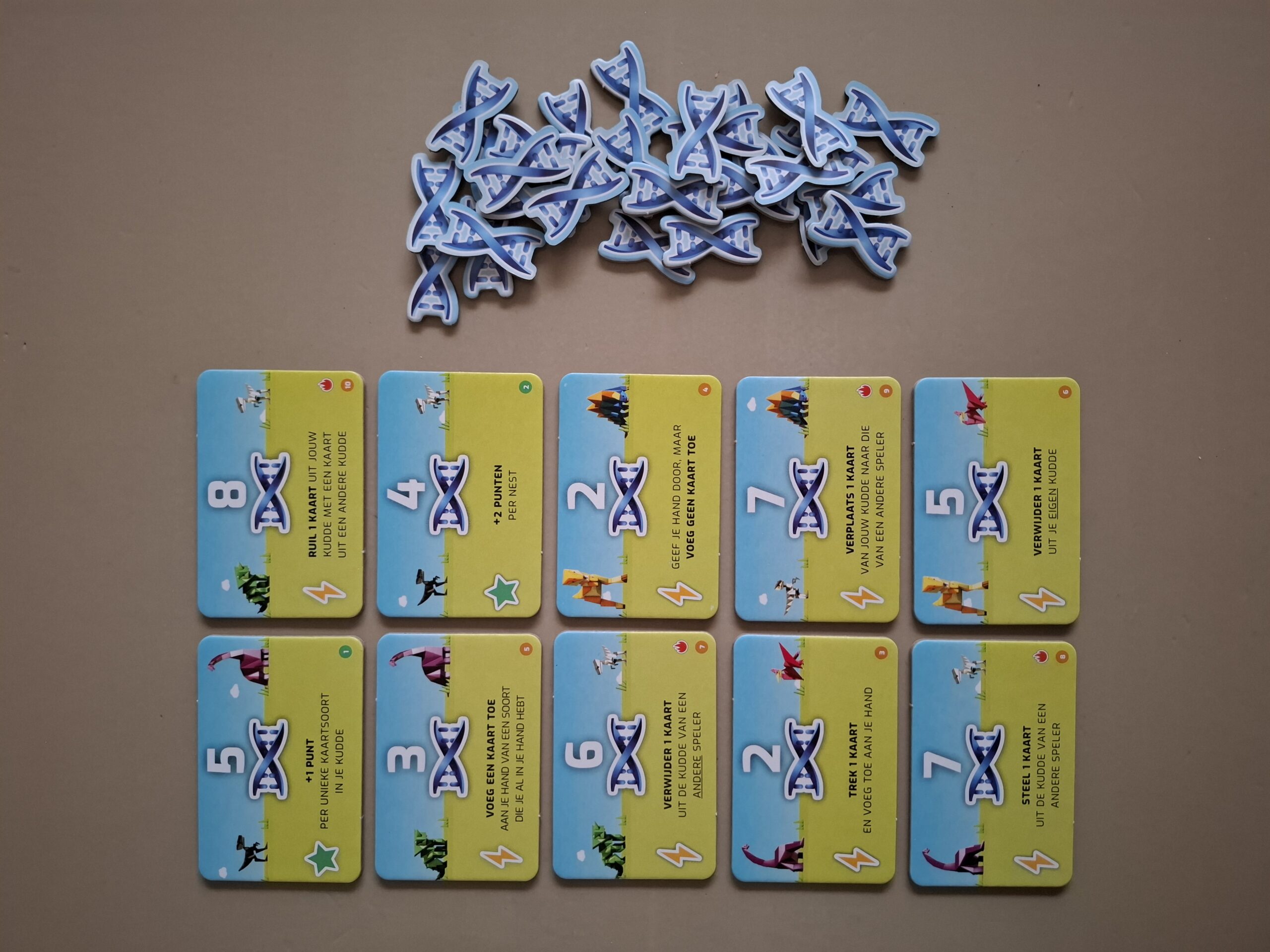
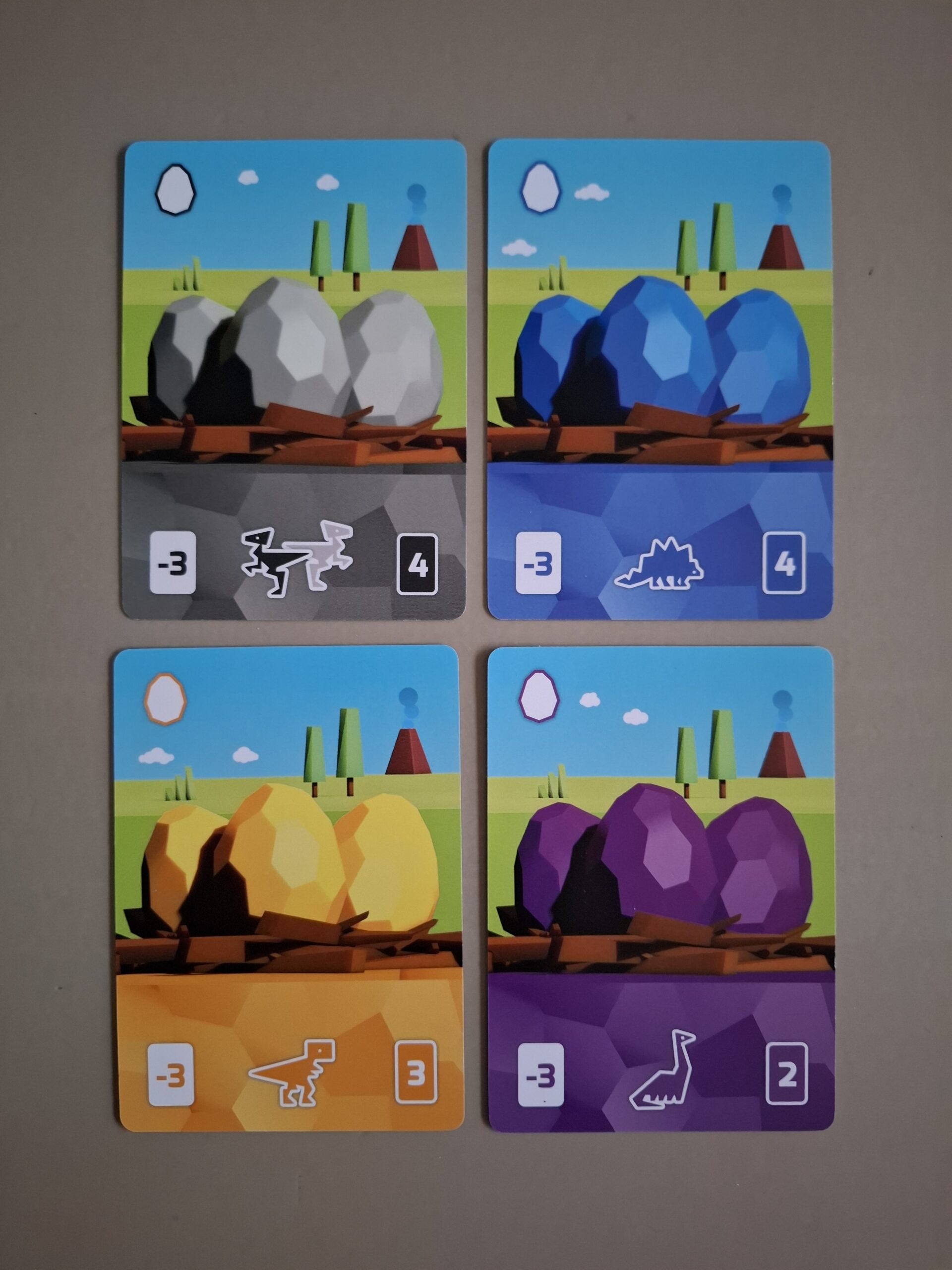
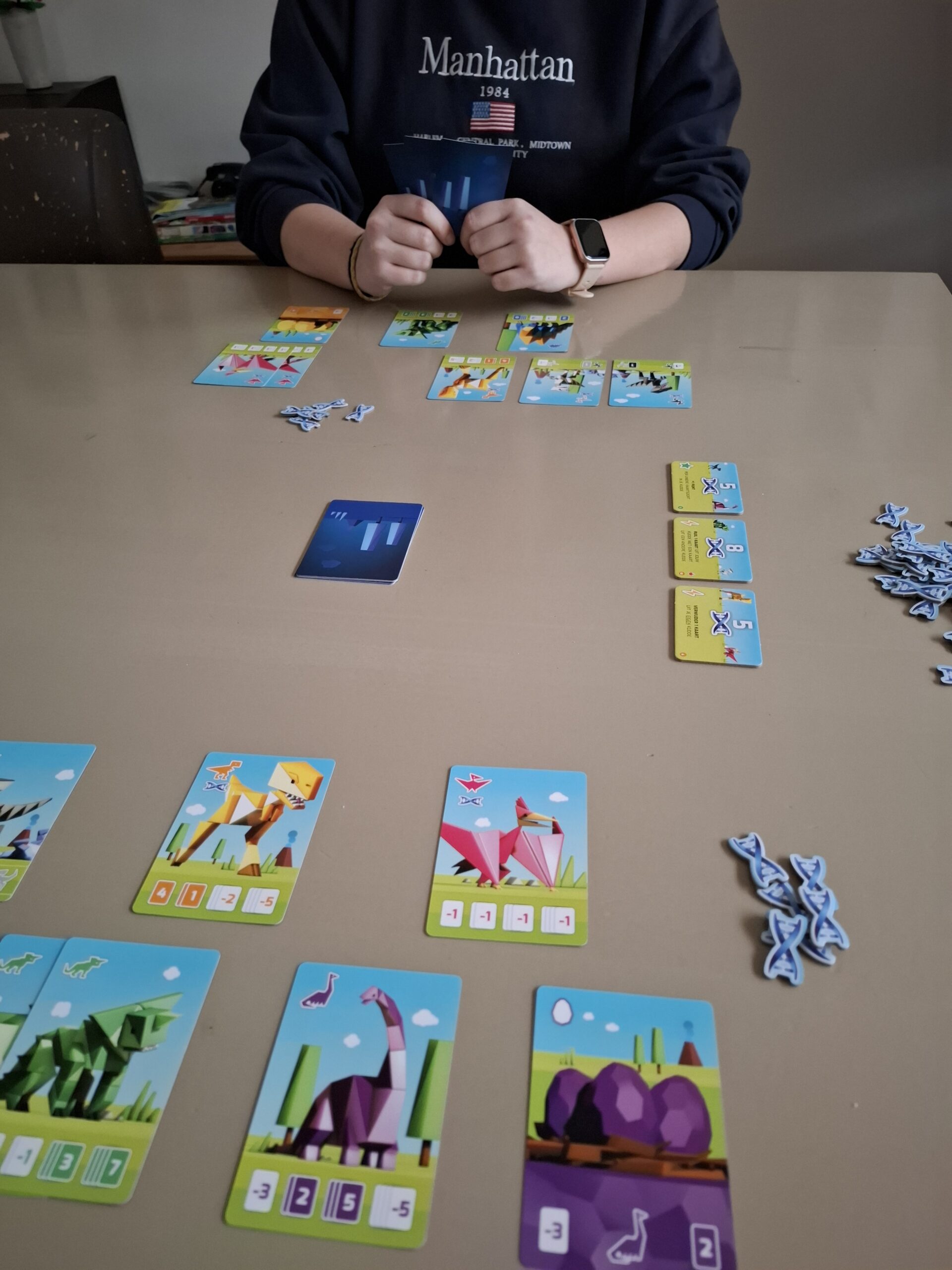
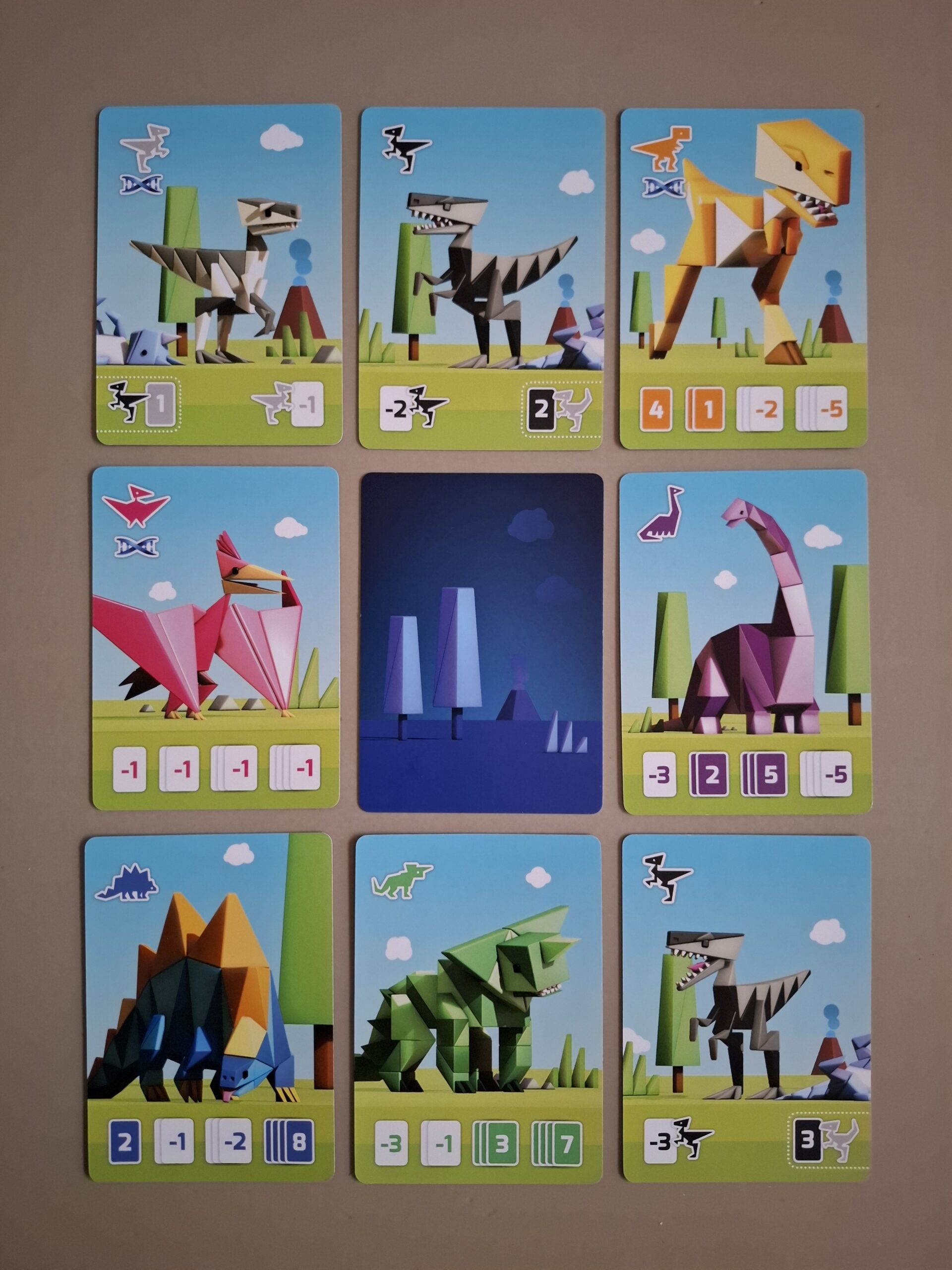
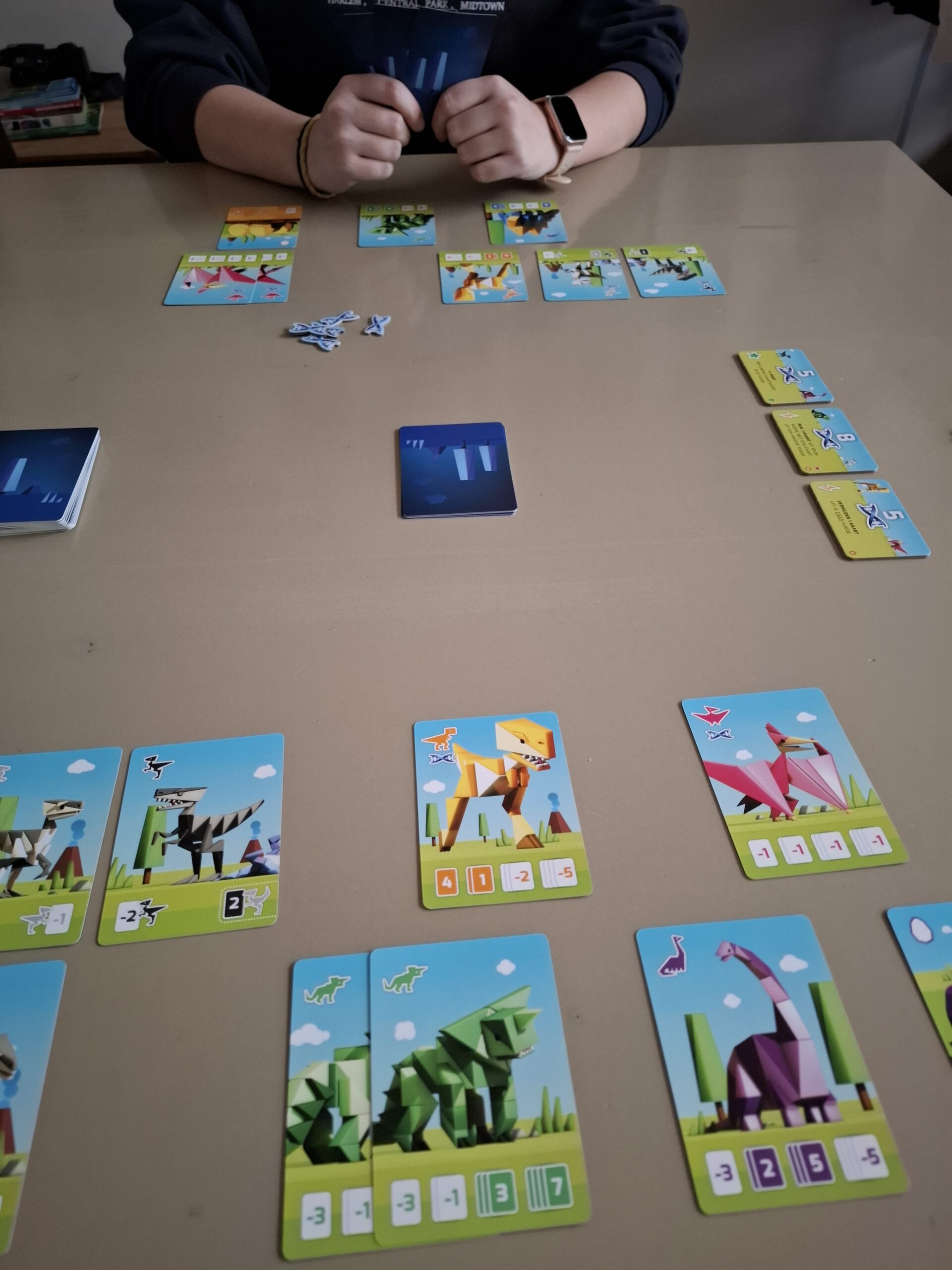
In Cubosaurus spelen 7 soorten dino’s mee, elk in hun eigen kleur en elk met hun eigen unieke manier om punten te scoren. Voor elk van de soorten is er ook een ei-kaart. Er zijn 55 kaarten beschikbaar, maar het aantal dat daadwerkelijk gebruikt wordt in een ronde, is gelijk aan het aantal spelers x10. De rest van de kaarten doet in die bepaalde ronde niet mee. Schud de kaarten goed en geef elke speler 4 kaarten. De spelers leggen deze 4 kaarten open voor zich neer. Deze kaarten vormen het begin van ieders kudde. De rest van de kaarten vormen een trekstapel in het midden. De DNA fiches leg je als een voorraad klaar. Leg ook een aantal evolutietegels klaar: evenveel als het aantal spelers +1. De evolutietegels geven je de mogelijkheid om een extra actie uit te voeren tijdens je beurt.
Elke speler is om de beurt aan zet met de wijzers van de klok mee (de 2e ronde wordt in tegenwijzerzin gespeeld). Wanneer je aan de beurt bent, gebeurt er het volgende:
- kaarten krijgen of pakken:
Ofwel krijg je kaarten van je buurman en dan hoef je er geen te trekken. Ofwel krijg je geen kaarten van je buurman. In dat geval trek je 1 kaart van de trekstapel. Je hebt nu 1 of meerdere kaarten vast. - een evolutietegel kopen:
Nadat je kaarten hebt gekregen of gepakt, maar voordat je beslist hebt wat je er mee zal doen, mag je 1 evolutietegel kopen. Hiervoor betaal je de benodigde hoeveelheid DNA fiches. Sommige acties moet je onmiddellijk uitvoeren, andere acties later in het spel. - kaarten houden of doorgeven:
Je hebt nu 2 mogelijkheden met de kaart(en) die je vast hebt. Ofwel houd je de kaarten en voeg je ze allemaal toe aan je kudde. Je legt de kaarten allemaal open bij de juiste dinosoort vóór je, zodat het voor iedereen een beetje overzichtelijk blijft wie welke dino’s heeft. Ofwel geef je al deze handkaarten door naar de volgende speler nadat je verplicht 1 kaart uit je kudde hebt toegevoegd aan deze handkaarten. Let daarbij op! Je mag geen kaart aan je hand toevoegen van een soort die je al op hand hebt (de 6 ei-kaarten tellen hierbij als 1 soort, de witte en zwarte velociraptors als 2 verschillende soorten). Als deze regel er voor zorgt dat je geen kaart uit je kudde kan toevoegen aan je hand, dan mag je de kaarten niet doorgeven en moet je ze verplicht allemaal toevoegen aan je kudde. - einde van een ronde:
Een ronde is afgelopen wanneer een speler een kaart zou moeten trekken en de trekstapel leeg is. Alle spelers tellen nu hoeveel punten hun kudde waard is en deze scores worden genoteerd. De dino’s worden per soort geteld. Ook de ei-kaarten worden gescoord.
Cubosaurus eindigt na 2 rondes (of 3 rondes als je met 2 speelt). Tel de scores van alle rondes per speler bij elkaar op. De speler met de hoogste score wint Cubosaurus!
Mijn mening over Cubosaurus?
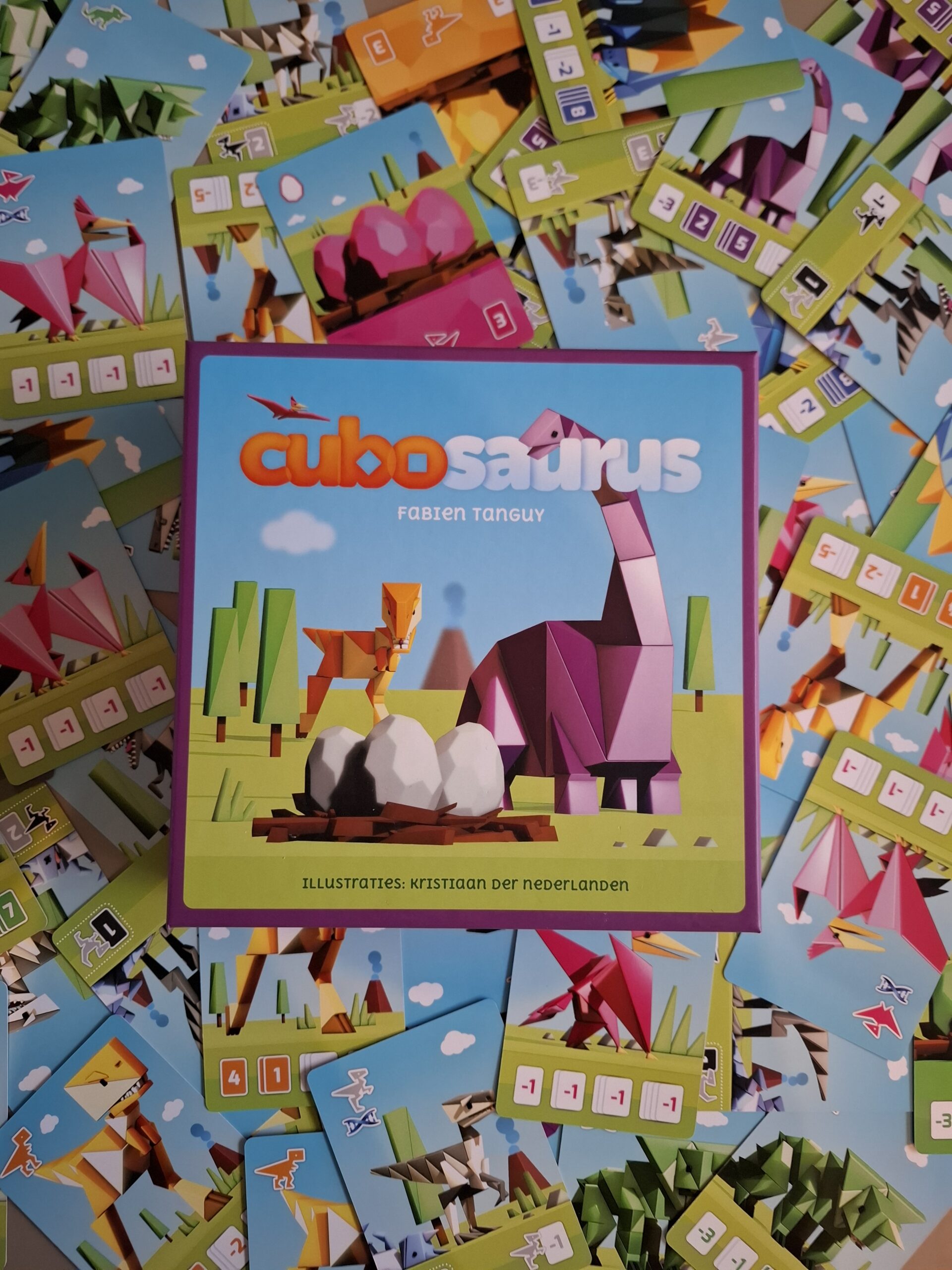
Cubosaurus is het 2e spel in de trilogie met tekeningen van Kristiaan der Nederlanden: met leuke, vrolijke animaties van dieren. De vogels bij CuBirds, de dino’s bij Cubosaurus en de wilde dieren bij Wild Cards: ze zijn allemaal even mooi om naar te kijken en geen 2 animatie-tekeningen zijn hetzelfde. Dat maakt deze reeks spellen sowieso visueel aantrekkelijk. Het zijn ook alledrie spellen die vlot en snel spelen, snel op te zetten zijn omdat ze niet veel materiaal bevatten en heel makkelijk aan te leren zijn.
Maar daarbij moet gezegd dat Cubosaurus en Wild Cards wel een heel stuk tactischer spelen dan CuBirds. Bij Cubosaurus ben je continu in het oog aan het houden welke dino’s de andere spelers aan het verzamelen zijn, hoeveel ze er van elke soort hebben en welke dino ze uit hun verzameling toevoegen aan hun hand om door te geven.
Persoonlijk vind ik Cubosaurus een beetje een frustrerend spelletje. Je kan vanalles willen krijgen en vanalles willen doen, maar het is niet gezegd dat je daar de kans toe krijgt. Eigenlijk wordt het volledige spel gespeeld met open kaarten. Iedere speler heeft zijn dinoverzameling open vóór zich neerliggen en, op de eerste getrokken kaart na, weet je ook perfect welke kaarten uit verzamelingen worden toegevoegd aan de hand die doorgegeven wordt. Dat maakt dat je dus eigenlijk alle info hebt om het spel tactisch te spelen, maar dat wil nog niet zeggen dat je dat dan ook effectief kan doen. Frustrerend. En daar wringt voor mij echt het schoentje.
Soms moet je ook gewoon de rondgaande hand accepteren omdat je geen kaart meer kan toevoegen om door te geven omdat al je soorten al in de rondgaande hand zitten. Maar soms wil dat zeggen dat je een hele hoop minpunten moet incasseren zonder dat je daar ook maar iets aan kan doen. Tactische spelletjes zijn leuk als die tactiek ook ergens toe leidt. Bij Cubosaurus heb ik soms de indruk dat ik het spel gewoon onderga in plaats van speel, hoewel ik een hele tactiek in mijn hoofd heb over hoe ik het spel zou kunnen winnen áls ik dat en dat en dat enz. De uitdrukking “als onze kat een koe was, kon je ze melken achter de stoof” comes to mind. Er zijn zoveel “als als als” dingen in dit spel dat er bij dit – op het eerste zicht – tactisch spel niet zo heel veel tactiek meer overblijft om effectief uit te voeren. Ik heb dan ook nog geen manier gevonden om de kans op winst in dit spel te vergroten.
Als je een vlot spelend, eenvoudig en tactisch spel wil, dan denk ik dat Wild Cards de betere keuze uit de trilogie is. Als je een vlot spelend, eenvoudig en vermakelijk spel wil, dan denk ik dat CuBirds de betere keuze uit de trilogie is. Je leest het al: voor mij persoonlijk is Cubosaurus het minst interessante en boeiende spel uit de trilogie, hoewel het nog steeds vlot speelt en eenvoudig is.

Cubosaurs
Players: 2-5
Time: 20 minutes
Age: 8+
Author: Fabien Tanguy
Publisher: Gam’inBiz
Year: 2022
The goal of Cubosaurus is to organize your dino herd so that they earn you the most points. Whoever has collected the most points after 2 rounds (or 3 rounds if you’re playing with two players) is the best dino herder and wins Cubosaurus!
Cubosaurus features 7 species of dinos, each with its own color and its own unique way of scoring points. Each species also has an egg card. There are 55 cards available, but the number actually used in a round is equal to the number of players x10. The remaining cards are not used in that particular round. Shuffle the cards well and deal 4 cards to each player. Players place these 4 cards face up in front of them. These cards form the start of each player’s herd. The remaining cards form a draw pile in the center. Place the DNA tokens as a stockpile. Also, prepare a number of evolution tiles: the same number as the number of players +1. Evolution tiles allow you to perform an additional action during your turn.
Each player takes turns in a clockwise direction (the second round is played counterclockwise). On your turn, the following happens:
- Receiving or drawing cards:
Either you receive cards from your neighbor and don’t need to draw any. Or you receive no cards from your neighbor. In that case, you draw one card from the draw pile. You now hold one or more cards. - Buying an evolution tile:
After receiving or drawing cards, but before deciding what to do with them, you may buy one evolution tile. You pay the required number of DNA tokens for this. Some actions must be performed immediately, others later in the game. - Keeping or passing on cards:
You now have two options with the card(s) you hold. You can either keep the cards and add them all to your herd. Place all the cards face up next to the correct dinosaur species in front of you, so everyone can keep track of which dinosaurs are in their possession. Alternatively, you can pass all these cards to the next player after adding one card from your herd to these cards. Be careful! You cannot add a card from a species you already have in your hand (the 6 egg cards count as one species, the white and black velociraptors as two different species). If this rule prevents you from adding a card from your herd to your hand, you cannot pass the cards and must add them all to your herd. - End of a round:
A round ends when a player is supposed to draw a card and the draw pile is empty. All players now count the points their herd is worth and note these scores. The dinosaurs are counted by species. The egg cards are also scored. Cubosaurus ends after 2 rounds (or 3 rounds if you are playing with 2 players). Add up the scores from all rounds for each player. The player with the highest score wins Cubosaurus!.
My opinion on Cubosaurus?
Cubosaurus is the second game in Kristiaan der Nederlanden’s trilogy of drawings: fun, cheerful animal animations. The birds in CuBirds, the dinosaurs in Cubosaurus, and the wild animals in Wild Cards: they’re all equally beautiful to look at, and no two animations are the same. That’s what makes this series of games visually appealing. All three games play smoothly and quickly, are quick to set up because they don’t have a lot of material, and are very easy to learn.
However, it must be said that Cubosaurus and Wild Cards are much more tactical than CuBirds. In Cubosaurus, you’re constantly keeping an eye on which dinosaurs the other players are collecting, how many of each species they have, and which dinosaur they’re adding from their collection to their hand to pass on.
Personally, I find Cubosaurus a bit of a frustrating game. You can want to get all sorts of things and do all sorts of things, but you won’t necessarily get the chance. The entire game is essentially played with open cards. Each player has their dinosaur collection face up in front of them, and except for the first card drawn, you know exactly which cards from those collections are added to the hand that’s being passed around. This means you have all the information you need to play the game tactically, but that doesn’t mean you can actually do just that. Frustrating. And that’s where the real problem lies for me.
Sometimes you just have to accept the hand being passed because you can’t add a card to pass on since all your species are already in the hand. But sometimes that means taking a ton of negative points without any control over it. Tactical games are fun when the tactics actually lead to something. With Cubosaurus, I sometimes feel like I’m just enduring the game instead of playing it, even though I have a whole tactical plan. I’m thinking about how I could win the game if I did this, that, and so on. The expression “If our cat were a cow, you could milk it” comes to mind. There are so many “if, if, if” things in this game that, at first glance, there’s not much tactical work left to execute effectively. Therefore, I haven’t yet found a way to increase my chances of winning Cubosaurus.
If you want a smooth, simple, and tactical game, I think Wild Cards is the better choice of the trilogy. If you want a smooth, simple, and entertaining game, I think CuBirds is the better choice of the trilogy. As you can see, for me personally, Cubosaurus is the least interesting and engaging game of the trilogy, although it’s still smooth and simple.