

Aantal spelers: 2-4
Speelduur: 45-60 minuten
Leeftijd: Vanaf 12 jaar
Auteur: John D. Clair
Uitgever: Brotherwise Games
Jaar: 2023
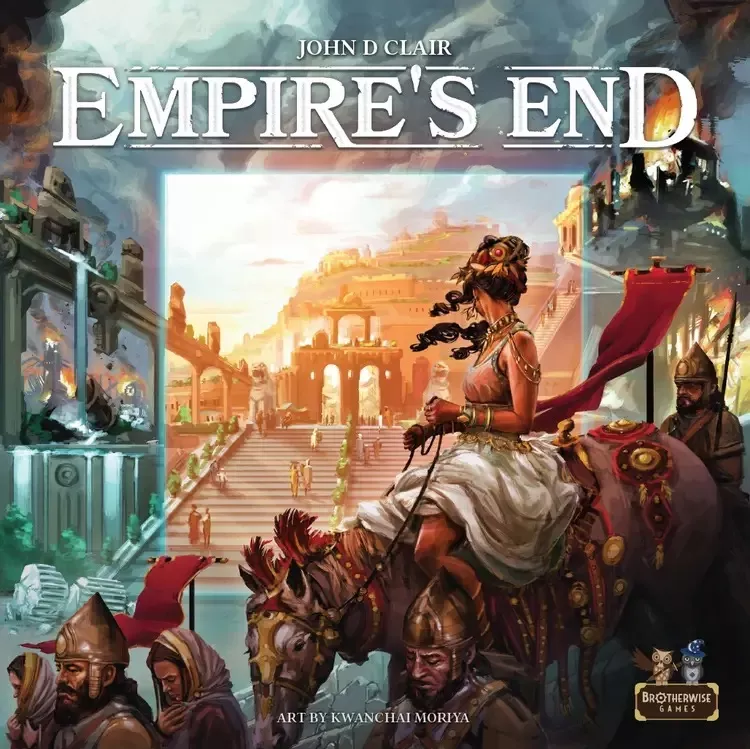

Dit is een herpublicatie van een review die ik eerder schreef voor bordspelwereld.nl
Ben je een fan van Gesjaakt (No Thanks!) en Space Base? Dan is dit je spel!
Elke speler begint het spel met een set van 11 tegels. Dit moet een Rijk (beschaving) voorstellen waar jij de leider van bent. Deze tegels kun je in groepen herverdelen. O.a. Industrie, Militair en Economie. Ze hebben plaatjes met onder andere Gevecht scenes, Wegen, Steden, Boerderijen en elke tegel heeft op de achterkant hetzelfde maar dan ‘in de band staande’ afbeelding.
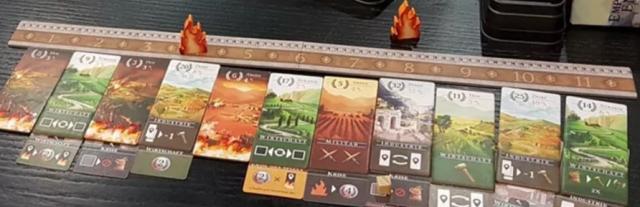
Iedereen heeft dezelfde set met 11 tegels. Elk van de tegels heeft een puntenwaarde variërend van 3-32 punten. De startspeler schud zijn tegels en legt ze met de ‘mooie’ kant naar boven in een willekeurige volgorde in een rij onder de 1-11 tracker in zijn/haar speelruimte.
Alle andere spelers leggen hun tegels nu in dezelfde volgorde als de startspeler.
Met de tegels kun je aan het einde van het spel de punten verdienen die erop staan, mits ze aan het einde van het spel niet in brand staan. Iedereen begint met 4 innovatie kaarten (verbeteringskaarten voor de industrie fase) en 2 van elke grondstof.
De grondstoffen in dit spel zijn; een zak Graan, Bijlen, Hamers en Gouden munten die ook als ‘joker’ kan worden gebruikt.
Wat je dus niet wil, is dat je rijk op gaat in rook, in de as wordt gelegd. Maar hoe kun je dit tegen gaan? Door elke fase te overleven en te controleren. Er is een scorebord met in het midden het verloop en aankondiging van de gebeurtenis. Deze bestaan uit o.a.
Conflict: De speler met de meeste gevechtskracht wint de meeste overwinningspunten en de andere spelers kunnen ook overwinningspunten halen en eventueel een bonus. Meestal staat er ook een slecht nieuws bericht op de conflict kaart voor de verliezer van het conflict.
Economie: Je groene kaarten in je rijk worden geactiveerd en levert productie op.
Een Rampen fase of een Dubbele rampen fase: Door de gevraagde grondstoffen te offeren hoef je niet 1 van je tegels (1-11) om te draaien naar de brandende afbeelding. Op elk kaartje staat een nummer. Dit geeft aan welke kaart in jouw rij (1-11) vernietigd kan worden als je niet kan bieden of deze juist wel wil vernietigen. Als dit nummer al in as ligt dan mag je de linker of rechter aangrenzende tegel omdraaien/verbranden. Als de kaart(en) getoond worden zet iedereen zijn ‘vlam’ meeple op de cijfers in zijn rij (1-11) die overeen komen met de getallen op de kaarten.
Je kan in je beurt beslissen om de kaart/kaarten toch te nemen. Je krijgt dan ook alle grondstoffen die op de kaart/kaarten liggen. Maar je moet dan wel de actie uitvoeren.
De kaart/kaarten mag je onder 1 van je tegels stoppen en tellen mee als de bijbehorende fase in werking gaat. Je kunt je verbrande tegel eventueel later repareren in een Industrie-fase.
Industrie: Innovatiekaarten uit de hand te bouwen, 1 tegel die in brand staat te repareren en/of tegellocaties verwisselen.
Je hebt allemaal een privacy scherm waar je je grondstoffen uit het zicht kan leggen zodat je mede tegen spelers niet kunnen zien wat je KAN bieden of wat je NIET kan bieden.
Als alle rondes voorbij is en de zandloper op het vakje ‘End of Game’ staat, is het spel afgelopen en worden de overwinningspunten geteld. De gene met de meeste punten…. Precies.
Oordeel:
Het is de uitleg in een notendop. Er zitten nog wat extra regels in en een hoop kaarten die wat meer uitleg nodig hebben. Het is op zich een simpel spel met wat leuke mogelijkheden.
Voor hetgeen wat het is duurt hij wat mij betreft wat te lang (met 4 spelers). Zit wel leuk in elkaar en als je met een groepje gevorderden spelers speelt moet het met z’n 4e in een 45/60 minuten te doen zijn. Leuk, vermakelijk en zeker goed om een keertje gespeeld te hebben. Zullen best fans zijn voor dit soort bied spellen maar het had bij mij geen WOW factor. Ik geef Empire’s End een 7. Overigens speelde wij met de Deluxe versie.

Empire's End
Players: 2-4
Time: 45-60 minutes
Age: 12+
Author: John D. Clair
Publisher: Brotherwise Games
Year: 2023
Are you a fan of Chased (No Thanks!) and Space Base? Then this is your game!
Each player starts the game with a set of 11 tiles. These should represent an Empire (civilization) that you are the leader of. You can redistribute these tiles into groups. Among them are Industry, Military and Economy. They have pictures that include Combat scenes, Roads, Cities, Farms and each tile has the same but “in band” picture on the back.
Everyone has the same set of 11 tiles. Each of the tiles has a point value ranging from 3-32 points. The starting player shuffles his tiles and places them ‘pretty’ side up in a random order in a row under the 1-11 tracker in his/her playing space.
All other players now place their tiles in the same order as the starting player.
The tiles allow you to earn the points on them at the end of the game, provided they are not on fire at the end of the game. Everyone starts with 4 innovation cards (improvement cards for the industry phase) and 2 of each resource.
The resources in this game are; a bag of Grain, Axes, Hammers and Gold coins which can also be used as ‘jokers’.
So what you don’t want is for your empire to go up in smoke, to be reduced to ashes. But how can you counter this? By surviving and controlling each phase. There is a scoreboard with the course and announcement of the event in the middle. These include.
Conflict: The player with the most combat power wins the most victory points and the other players can also gain victory points and possibly a bonus. Usually there is also a bad news message on the conflict card for the loser of the conflict.
Economy: Your green cards in your empire are activated and provide production.
A Disaster Phase or a Double Disaster Phase: By sacrificing the requested resources, you do not have to turn over 1 of your tiles (1-11) to the burning image. Each card has a number on it. This indicates which card in your row (1-11) can be destroyed if you cannot bid or want to destroy it. If this number is already in ashes then you may flip/burn the left or right adjacent tile. When the card(s) are shown everyone puts their ‘flame’ meeple on the numbers in their row (1-11) that correspond to the numbers on the cards.
You can decide on your turn to take the card(s) anyway. You then also get all the resources on the card(s). But you must then perform the action.
You may put the card(s) under 1 of your tiles and count when the corresponding phase takes effect. You may repair your burnt tile later in an Industry phase if necessary.
Industry: Build Innovation cards from hand, repair 1 tile on fire and/or swap tile locations.
You all have a privacy screen where you can place your resources out of sight so your fellow opposing players cannot see what you CAN bid or what you CANNOT bid.
When all the rounds are over and the hourglass is on the “End of Game” box, the game is over and the victory points are counted. The one with the most points…. Exactly.
Verdict:
It’s the explanation in a nutshell. There are some additional rules in there and a lot of cards that need a little more explanation. By itself, it’s a simple game with some nice features.
For what it is it takes a bit too long (with 4 players). It is nicely put together though and if you play with a group of advanced players it should be doable with 4<sup>e</sup> in about 45/60 minutes. Fun, entertaining and definitely good to have played once. Must be fans for this type of bidding game but it didn’t have a WOW factor with me. I give Empire’s End a 7. By the way, we played with the Deluxe version.