

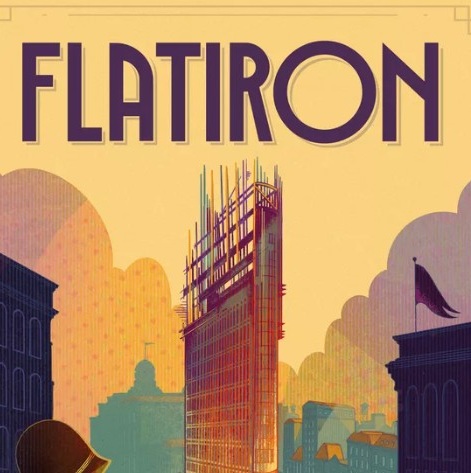

Kijkend naar dit bijzondere gebouw herken ik het direct. Dit is dat gebouw in de vorm van een heel smal taartpuntje in Manhattan New York. Eigenlijk is het geen taartpunt maar een strijkijzer.
In het tweespeler spel Flatiron ga je het gebouw opnieuw bouwen met pilaren en verdiepingen.
Opzet en onderdelen
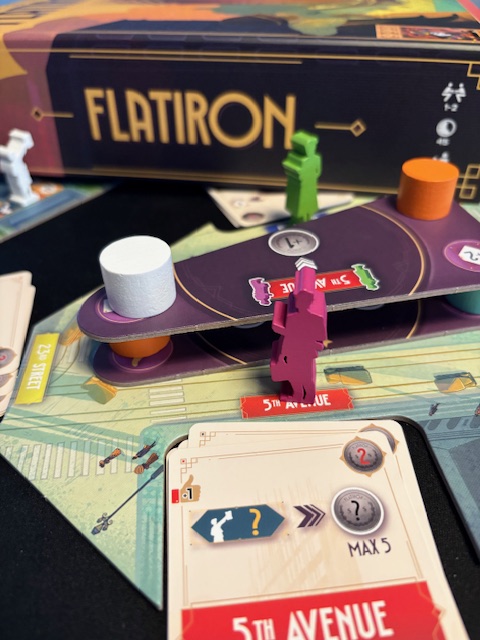
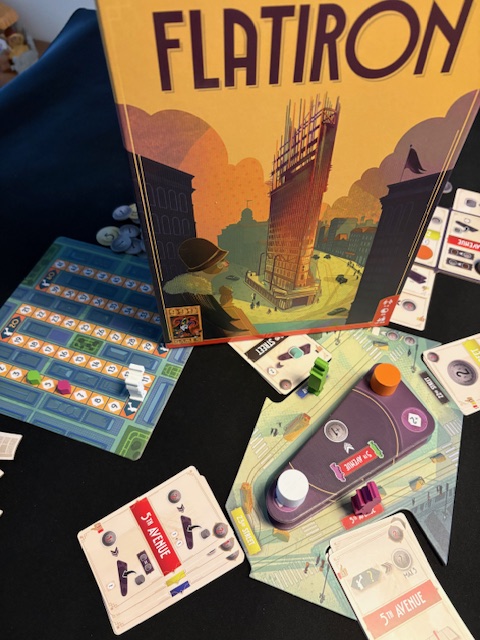
Flatiron bestaat uit spelersborden, hoofdborden, tokens, pilaren en figuren. De pilaren en figuren zijn van hout. De tokens en borden zijn van dik karton. Erg goede kwaliteit. En ook erg prettig: het past prima in de doos.
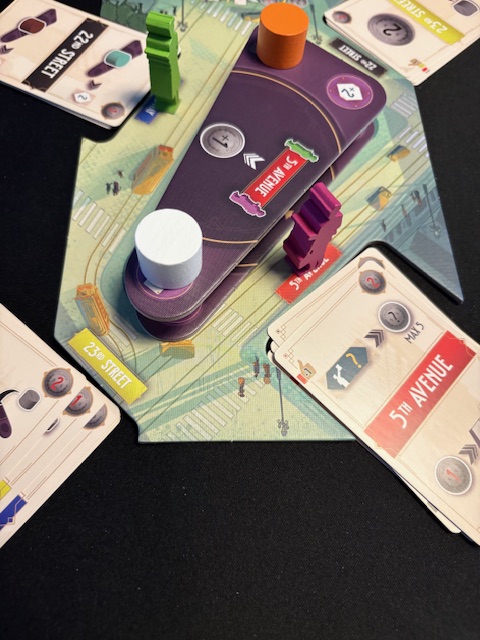
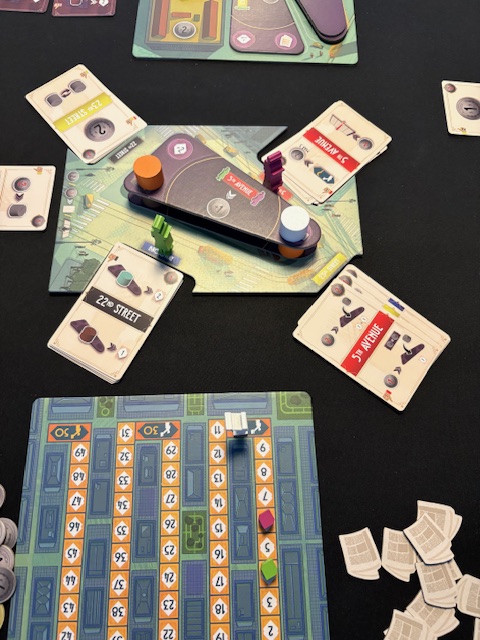
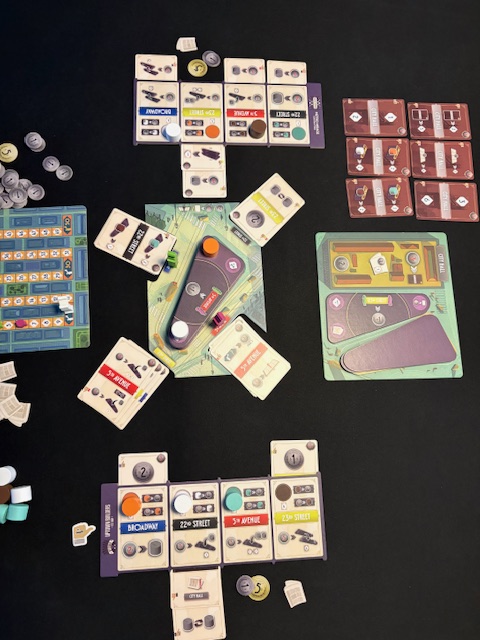
Beide spelers pakken een spelersbord, er zijn meerdere variaties in spelersborden. De hoofdborden (plattegrond waarop we gaan bouwen, city hall en scorespoor) leg je in het midden neer. In de hoeken van de plattegrond komen stapels met kaarten.
Hoe wordt het spel gespeeld
In de basis in het een workerplacement spel. Dit houdt in dat je je figuur neerzet op een plek en de actie doet van die plek. Je kan je figuur neerzetten bij een van de 4 kaarten stapels rondom de plattegrond of je zet je figuur neer in de City Hall.
Bij de plekken rondom de plattegrond kan je kiezen uit 3 acties per plek:
- Je koopt de kaart die daar bovenop ligt. Deze kaarten stop je onder of boven je spelersbord en verbeteren de acties van die straat
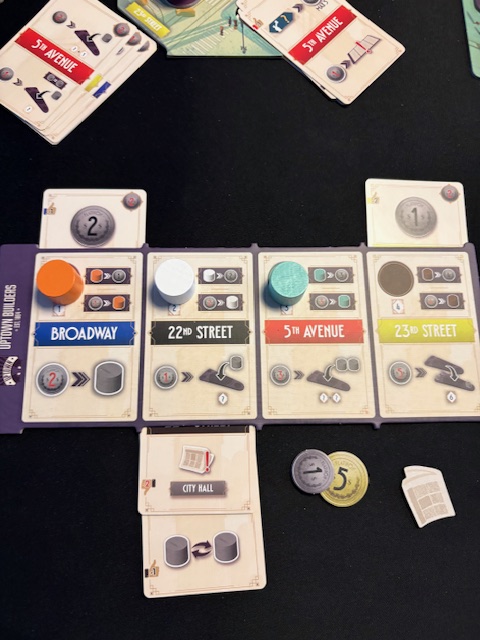
- Je voert de acties van de straat uit volgens je spelersbord van boven naar beneden
- Je pakt 2 munten
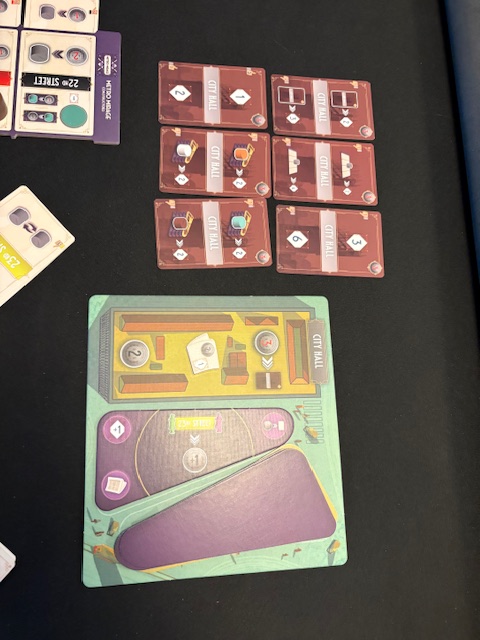
Bij de City Hall kan je ook uit 3 acties kiezen:
- Een einddoel kaart kopen voor eind bonussen. Deze stopt je onder of boven je spelersbord bij een willekeurige straat.
- De speciale acties van de krant uitvoeren (deze acties wisselt gedurende het spel)
- Je pakt 2 munten
Je spelersbord bestaat uit 4 straten die je kunt uitvoeren en verbeteren. Dit zijn dezelfde 4 straten als rond de plattegrond. Een belangrijke actie is pilaren bouwen voor de volgende verdieping. Als er op een verdieping 3 verschillende pilaren gebouwd zijn, kan een speler de volgende verdieping bouwen. Zo groeit het gebouw en als alle verdiepingen gebouwd zijn (5 verdiepingen), is het spel direct afgelopen. Tel de punten van de einddoelen bij je huidige punten en scoor de straten op je spelersbord. Een straat scoort 5 punten als de meer positieve reputatiepunten zijn dan negatieve op de straat kaarten. Omgekeerd (als er meer negatieve reputatiepunten zijn) scoort de straat 3 minpunten. Wie de meeste punten heeft, is de winnaar.
Wat vind ik van het spel
De makers van Flatiron hebben ook Het Witte Kasteel gemaakt. Kijk, dan trekt dit meteen mijn aandacht. Flatiron is een goed tweespeler spel met enige diepgang. Je probeert je tegenstander steeds te slim af te zijn door acties te doen voordat hij/zij dit doet.
De variatie in acties is goed en zorgt dat er altijd wat te doen is. Doordat er kaarten met extra acties toegevoegd worden aan je spelersbord, worden de acties steeds beter en langer. Het spel loopt dus ook naar het einde toe steeds sneller. Plotseling besef je dat er nog maar een verdieping over is.
Je kan verschillende strategieën toepassen: de korte strategie met direct pilaren gaan bouwen en punten scoren. Of de lange strategie met kaarten kopen en je acties verbeteren. De lange strategie kan je niet heel lang doorvoeren omdat pilaren bouwen best wel wat punten opleveren en het spel niet heel lang duurt. Dus er worden toch wel snel pilaren gebouwd met verdiepingen daarop.
Na een aantal potjes wordt het wel voorspelbaar: snel pilaren en verdiepingen kopen. Je kan behoorlijk goed inschatten wat je tegenspeler gaat doen: die wil ook pilaren en verdiepingen kopen. Het lijkt wat voorspelbaar en eentonig te worden. Dit wordt vaak opgelost door vooraf een persoonlijk doel mee te geven. Helaas zit dat niet in Flatiron en dat mis ik.
Dat maakt Flatiron zeker geen slecht spel, ik speel het graag. Er zitten veel mogelijkheden in en er is goed over de acties nagedacht. Helaas haalt het voor mij niet het niveau van Witte Kasteel.
Ik heb Flatiron ook solo gespeeld. Dat beviel me erg goed en is best spannend. Je speelt tegen een automa (Daniel Burnham, de architect). De automa wordt aangestuurd met eigen actiekaarten en scoort veel punten tijdens het spel. De automa krijgt willekeurige einddoelkaarten voor punten op het einde van het spel (dat zal voor de automa lang niet altijd goed uitpakken), dus daarmee moet je je eventuele achterstand goedmaken.
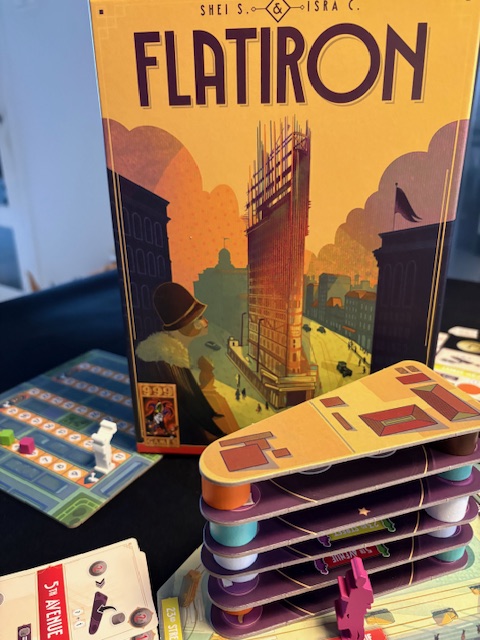

Flatiron
Looking at this unique building, I immediately recognize it. It’s that building shaped like a very narrow slice of pie in Manhattan, New York. Actually, it’s not a slice of pie, but an iron.
In the two-player game Flatiron, you rebuild the building with pillars and floors.
Layout and Components
Flatiron consists of player boards, main boards, tokens, pillars, and figures. The pillars and figures are made of wood. The tokens and boards are made of thick cardboard. Very good quality. And also very convenient: it fits perfectly in the box.
Both players take a player board; there are several variations of player boards. The main boards (the floor plan we’ll be building on, city hall, and scoring track) are placed in the center. Stacks of cards are placed in the corners of the floor plan.
How to Play
At its core, it’s a worker placement game. This means you place your figure on a spot and perform the action for that spot. You can place your figure at one of the four card stacks around the map, or you can place your figure in the City Hall.
At the locations around the map, you can choose from three actions per location:
– Buy the card on top of it. Place these cards under or above your player board and improve the actions of that street.
– Carry out the street’s actions, starting from top to bottom on your player board.
– Take two coins.
At the City Hall, you can also choose from three actions:
– Buy an end goal card for final bonuses. Place this card under or above your player board at any street.
– Carry out the special actions from the newspaper (these actions change throughout the game).
– Take two coins.
Your player board consists of four streets that you can carry out and improve. These are the same four streets as around the map. An important action is building pillars for the next floor. If three different pillars are built on a floor, a player can build the next floor. This is how the building grows, and when all five floors have been built, the game ends immediately. Add the points from the final goals to your current points and score the streets on your player board. A street scores 5 points if it has more positive reputation points than negative ones. Conversely (if there are more negative reputation points), the street scores 3 negative points. Whoever has the most points wins.
What do I think of the game?
The creators of Flatiron also created The White Castle. Well, this immediately caught my attention. Flatiron is a good two-player game with some depth. You constantly try to outsmart your opponent by taking actions before they do.
The variety of actions is good and ensures there’s always something to do. Because cards with extra actions are added to your player board, the actions become increasingly better and longer. The game therefore progresses more quickly towards the end. Suddenly, you realize there’s only one floor left.
You can use different strategies: the short strategy of immediately building pillars and scoring points. Or the long strategy of buying cards and improving your actions. You can’t implement the long strategy for very long because building pillars yields quite a few points, and the game doesn’t last very long. So, pillars with floors on top are built quite quickly.
After a few games, it does become predictable: quickly buying pillars and floors. You can pretty accurately predict what your opponent will do: they also want to buy pillars and floors. It does seem to become a bit predictable and monotonous. This is often solved by setting a personal goal beforehand. Unfortunately, that’s not in Flatiron, and I miss that.
That certainly doesn’t make Flatiron a bad game; I enjoy playing it. There are many possibilities, and the actions are well-thought-out. Unfortunately, for me, it doesn’t reach the level of White Castle.
I’ve also played Flatiron solo. I really enjoyed it and it’s quite exciting. You play against an automato (Daniel Burnham, the architect). The automato is controlled with its own action cards and scores a lot of points during the game. The automa receives random goal cards for points at the end of the game (which will not always work out well for the automa), so you have to make up any deficit with those.