

Aantal spelers: 1-2
Speelduur: 20 minuten
Leeftijd: Vanaf 10 jaar
Auteur: Amelie Le-Roche
Uitgever: Benki Games
Jaar: 2023
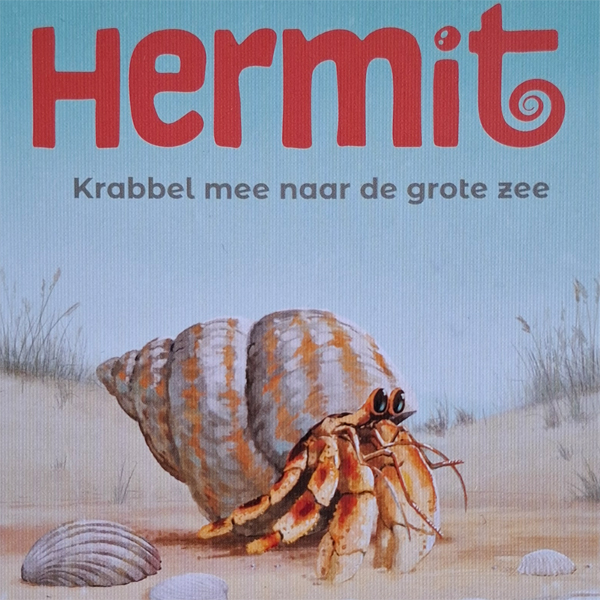

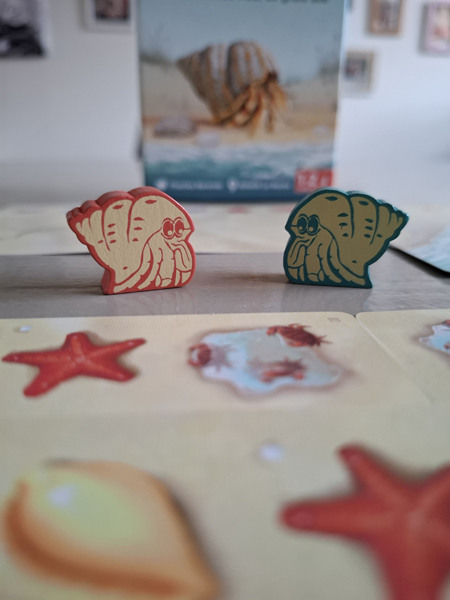
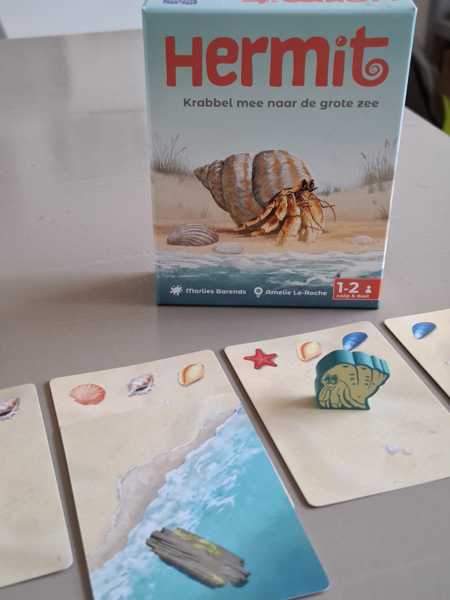
Hermit is een klein, kort kaartspelletje waarbij je probeert om Hermit, de heremietkreeft, terug naar zee te krijgen. Lukt jou dat (als eerste) vooraleer de zee zich helemaal terugtrekt? Dan win je Hermit!
Een heremietkreeft is een soort kreeftje dat geen eigen harde schaal ontwikkelt om zijn zachte achterlijf te beschermen. In plaats daarvan zoekt dit kreeftje een lege schelp van andere dieren (of iets vergelijkbaars) om rond zijn achterlijf te doen om het te beschermen. Wanneer de heremietkreeft groeit, wordt dit huisje te klein en moet hij op zoek naar een groter huisje. Zoveel heremietkreeftjes, zoveel verschillende huisjes!
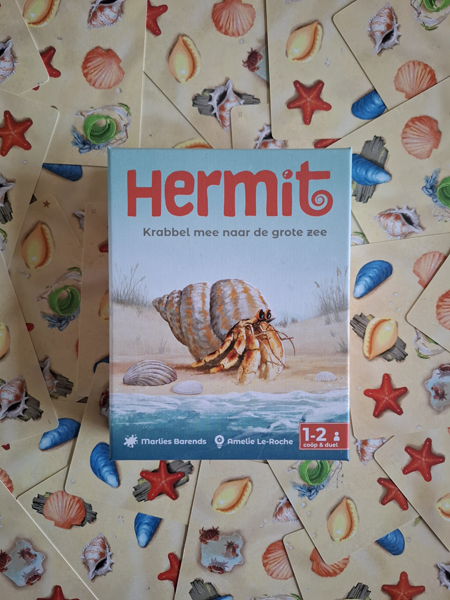
Voor ik uitleg hoe Hermit gespeeld wordt, vertel ik alvast dat het een heel veelzijdig spelletje is met telkens dezelfde basis. Er zijn 23 strandkaarten, 1 golfkaart en 2 heremietkreeftjes. En met slechts die componenten kan je:
solo spelen: de basis of een hogere moeilijkheidsgraad, en mét of zonder extra uitdagingen
coöperatief met 2 spelen: coöperatief samen spelen om Hermit naar zee te krijgen, de basis of een hogere moeilijkheidsgraad, en mét of zonder extra uitdagingen
competitief met 2 spelen: tegen elkaar spelen, met de eb/vloed variant of de stromingsvariant, om als eerste je kreeftje naar zee te krijgen, mét of zonder extra uitdagingen
coöperatief met meer dan 2 spelen: coöperatief met meerdere spelers spelen om Hermit samen naar zee te loodsen (je hebt dan wel 1 Hermit spel per speler nodig), de basis of een hogere moeilijkheidsgraad, en mét of zonder extra uitdagingen
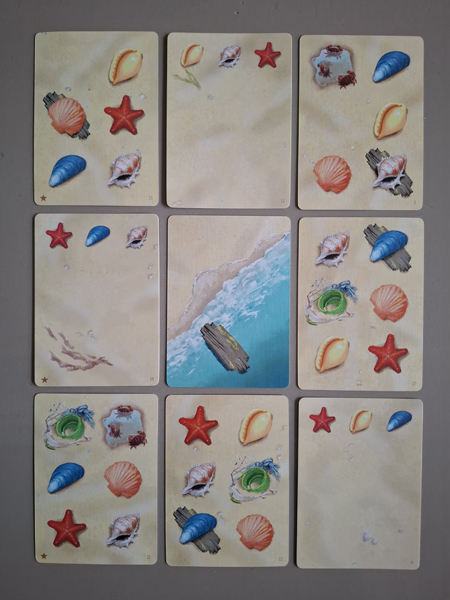
Al naargelang de keuze die je maakt om te spelen, is de startopstelling lichtjes anders. Ik leg het spel hier uit aan de hand van de solo-variant. De strandkaarten hebben 2 kanten: één kant (die de strandkant heet) heeft een stuk strand en bovenaan 3 schelpjes/zeesterren, de andere kant (die de schelpenkant heet) heeft 6 vakjes met daarin een schelp of een zeester (met of zonder drijfhout) of een poeltje, een dopje of een stukje strand.
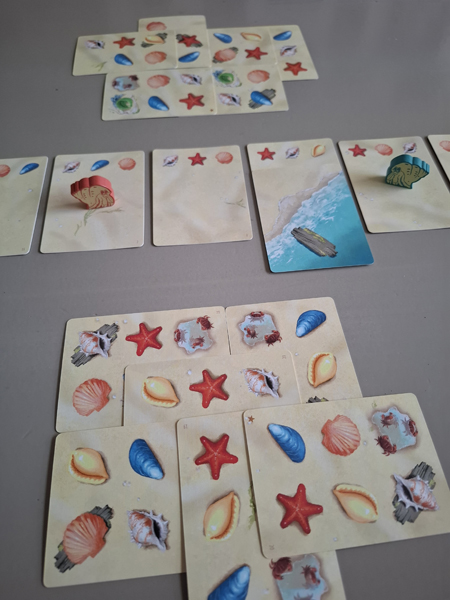
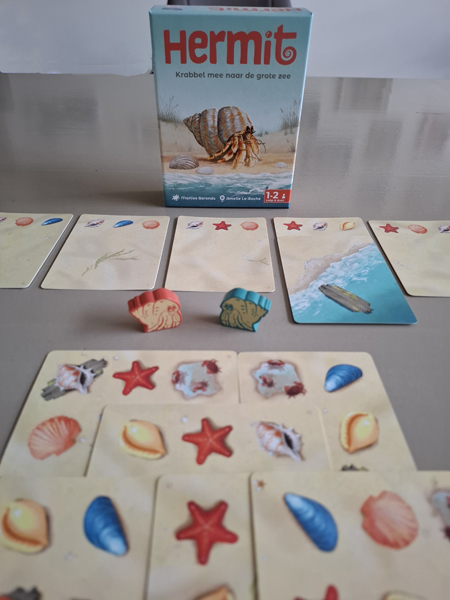
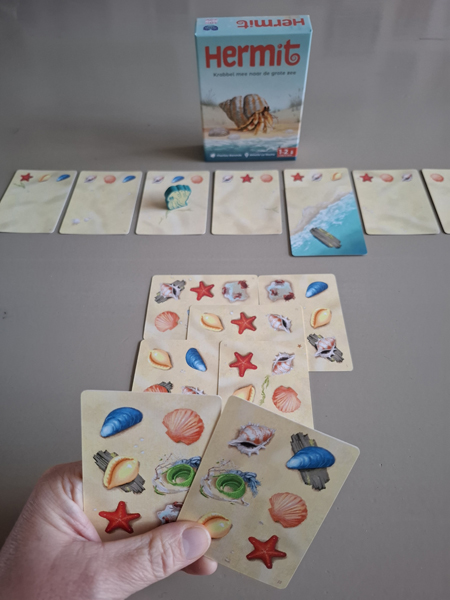
Leg 10 kaarten op een rij met de strandkant naar boven zodat alle schelpjes op een rij bovenaan liggen. Leg de golfkaart, met de kant met 1 stuk drijfhout naar boven, op de 6e kaart van links (zorg dat de schelpjes nog zichtbaar zijn) en zet je Hermit links naast het begin van deze rij. De overige 6 kaarten schud je en leg je als trekstapel met de strandkant naar boven. Draai de bovenste kaart om, met de schelpenkant naar boven, en leg deze in je speelveld. Nu kan het spel beginnen. Elke ronde verloopt over 4 stappen:
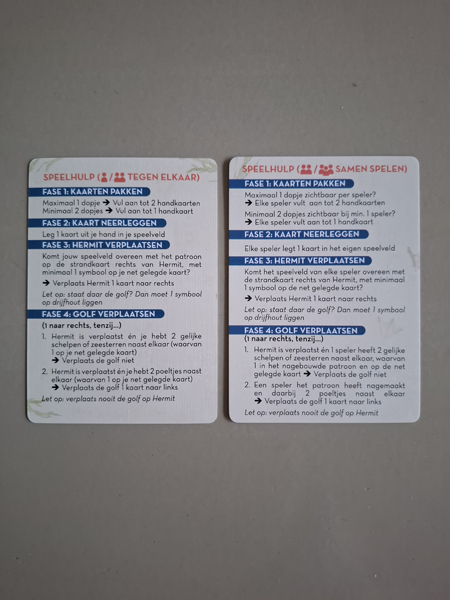
kaarten pakken: Als er in je speelveld maximaal 1 dopje zichtbaar is, dan mag je kaarten van je stapel trekken tot je er 2 vast hebt. Als er in je speelveld 2 of meer dopjes zichtbaar zijn, dan is je handlimiet beperkt tot 1 kaart en kan het zijn dat je geen kaarten mag trekken. Als je trekstapel op is, mag je kaarten trekken die achter Hermit liggen, van links naar rechts.
kaart neerleggen: Je mag 1 kaart uit je hand in je speelveld leggen. Dit mag naast andere kaarten of er geheel of gedeeltelijk bovenop. Zorg er wel voor dat er geen kaarten schuin liggen en dat alle afbeeldingen een mooi raster vormen. Het doel hierbij is om het patroon van 3 schelpen/zeesterren dat op de strandkaart rechts in de rij naast je Hermit staat afgebeeld, na te maken. Dit kan in een rij zijn of in een kolom. Spiegelen van het patroon mag ook.
Hermit verplaatsen: Als je er in geslaagd bent om het patroon op de volgende strandkaart in de rij na te bootsen en minstens 1 van de schelpen/zeesterren in het patroon ligt op de net geplaatste kaart, dan mag je Hermit 1 plaats naar rechts verzetten. Ligt de golfkaart op de strandkaart waarnaar je Hermit wil verplaatsen, dan moet minstens 1 symbool van het patroon op een stuk drijfhout afgebeeld staan. Is dit het geval en kan je Hermit verplaatsen naar de strandkaart met de golf, dan is het spel afgelopen en heb je onmiddellijk gewonnen.
de golfkaart verplaatsen: Verplaats de golfkaart één plaatsje naar rechts. Hierop zijn echter 2 uitzonderingen. Als je er in geslaagd bent om in deze ronde Hermit te verplaatsen én je hebt 2 zeesterren naast elkaar gekregen (waarvan 1 zeester op de net geplaatste kaart), dan blijft de golfkaart liggen. Als je er in geslaagd bent om in deze ronde Hermit te verplaatsen én je hebt 2 poeltjes naast elkaar gekregen (waarvan 1 poeltje op de net geplaatste kaart), dan verplaats je de golfkaart 1 plaatsje naar links, dus dichter bij Hermit. Als de golfkaart bij het verplaatsen óp Hermit zou belanden, dan blijft de golfkaart gewoon liggen.
Je wint Hermit meteen als je er in slaagt om Hermit naar de golfkaart te verplaatsen. Let wel: er moet dan dus minstens 1 van de symbolen van het te vormen patroon op een stuk drijfhout afgebeeld staan. Je verliest het spel van zodra de golfkaart helemaal rechts naast de laatste kaart terecht komt of als er in de eerste stap geen kaarten meer zijn om te trekken (ook niet achter Hermit).
Mijn mening over Hermit?
Eigenlijk ben ik helemaal geen fan van “solo” gezelschapsspellen. Dat gaat voor mij dan een beetje voorbij aan het gedeelte “gezelschap” in gezelschapsspellen. Ik heb dan eerder de neiging om met een goed boek of een spannende film in de zetel te kruipen. Of als je dan toch alleen thuis bent en een spel wil spelen, dan vind je mij eerder terug op Board Game Arena, waar je toch óók gezelschap hebt. Maar Hermit is dus ook speelbaar met 2. Ik heb beiden getest: het basisspel van de solo-variant en de eb/vloed variant van het 2-spelersspel tégen elkaar.
Toen ik de spelregels had doorgenomen, dacht ik: zo moeilijk kan dat toch niet zijn, dat basisspel. Nou, dat sloeg wel een beetje tegen! Waarom? Omdat je helemaal niet zo heel veel beurten hebt vooraleer die golfkaart (bij het solospel) naar rechts van het toneel verdwijnt. Je moet dus echt wel zorgen dat je niet alleen de patronen probeert na te bootsen, maar dat je tegelijkertijd ook voldoende keren 2 zeesterren of 2 poeltjes naast elkaar krijgt zodat de golfkaart niet te snel naar rechts opschuift! Niet zo eenvoudig als je op het eerste zicht zou denken. Het is passen en meten met de kaart die je gaat leggen wat nu de beste positie is. Niet alleen voor het huidige te vormen patroon, maar ook eventueel al voor de toekomstige patronen die je zal moeten nabootsen.
Je kan het spel moeilijker maken door de golfkaart om te draaien. Daarop staan 2 stukken drijfhout afgebeeld. Het is dan de bedoeling dat, in de laatste stap van Hermit, 2 schelpen/zeesterren op drijfhout staan afgebeeld in het patroon in plaats van 1. Niet makkelijk. Een andere manier om het moeilijker te maken, is om bij de startopstelling de golfkaart op strandkaart 7 of 8 leggen in plaats van op strandkaart 6. Persoonlijk vind ik de uitdagingen leuker om het moeilijker te maken dan de bovengenoemde opties. Uitdagingen kunnen bijvoorbeeld zijn dat je geen zichtbare dopjes meer mag hebben op het moment dat je de winnende stap van je Hermit zet, of dat je geen kaarten naast elkaar mag leggen (dus altijd minstens een hoek van een onderliggende kaart bedekken).
Hoewel ik grote fan ben van coöperatieve spellen, denk ik dat dat hier niet zo goed zal werken (ik heb het niet uitgetest, maar toch). Tenzij je met 2 mensen samen speelt die ongeveer hetzelfde niveau van ruimtelijk inzicht hebben. Anders denk ik dat de ene vooral speelt en de andere er een beetje bij zal zitten voor spek en bonen. Maar solo en competitief met 2 is Hermit dus een prima puzzelspelletje dat net iets moeilijker te realiseren en te winnen is dan je op het eerste zicht zou verwachten. Leuk!

Hermit
Players: 1-2
Time: 20 minutes
Age: 10+
Author: Amelie Le-Roche
Publisher: Benki Games
Year: 2023
Hermit is a small, short card game in which you try to get Hermit, the hermit crab, back to the sea. Can you do it (first) before the sea recedes completely? Then you win Hermit!
A hermit crab is a type of crab that does not develop its own hard shell to protect its soft abdomen. Instead, this crab looks for an empty shell from other animals (or something similar) to put around its abdomen to protect it. As the hermit crab grows, this house becomes too small and it has to look for a bigger one. So many hermit crabs, so many different houses!
Before I explain how Hermit is played, I will say that it is a very versatile game with the same basic rules each time. There are 23 beach cards, 1 wave card and 2 hermit crabs. And with just those components, you can:
play solo: the basic or a higher difficulty level, with or without extra challenges
play cooperatively with 2 players: play cooperatively to get Hermit to the sea, the basic or a higher difficulty level, with or without extra challenges
play competitively with 2 players: play against each other, with the ebb/tide variant or the current variant, to be the first to get your crab to the sea, with or without additional challenges
play cooperatively with more than 2 players: play cooperatively with multiple players to guide Hermit to the sea together (you will need 1 Hermit game per player), the basic or a higher difficulty level, and with or without additional challenges
Depending on the choice you make to play, the starting setup is slightly different. I will explain the game here using the solo variant. The beach cards have two sides: one side (called the beach side) has a piece of beach and three shells/starfish at the top, the other side (called the shell side) has six boxes containing a shell or starfish (with or without driftwood) or a puddle, a cap or a piece of beach.
Lay 10 cards in a row with the beach side facing up so that all the shells are in a row at the top. Place the wave card, with the side with 1 piece of driftwood facing up, on the 6th card from the left (make sure the shells are still visible) and place your Hermit to the left of the start of this row. Shuffle the remaining 6 cards and place them, beach side up, as a draw pile. Turn over the top card, with the shell side facing up, and place it in your playing area. Now the game can start. Each round consists of 4 steps:
drawing cards: If there is a maximum of 1 cap visible in your playing area, you may draw cards from your deck until you have 2. If there are 2 or more caps visible in your playing area, your hand limit is restricted to 1 card and you may not be allowed to draw any cards. If your draw pile is empty, you may draw cards from behind Hermit, from left to right.
Placing a card: You may place 1 card from your hand in your playing area. This may be next to other cards or completely or partially on top of them. Make sure that no cards are tilted and that all images form a nice grid. The aim is to replicate the pattern of 3 shells/starfish shown on the beach card to the right of your Hermit. This can be in a row or in a column. You may also mirror the pattern.
Moving Hermit: If you have managed to replicate the pattern on the next beach card in the row and at least 1 of the shells/starfish in the pattern is on the card you just placed, you may move Hermit 1 space to the right. If the wave card is on the beach card to which you want to move Hermit, at least one symbol from the pattern must be depicted on a piece of driftwood. If this is the case and you can move Hermit to the beach card with the wave, the game is over and you win immediately.
Moving the wave card: Move the wave card one space to the right. However, there are two exceptions to this. If you have managed to move Hermit in this round and you have two starfish next to each other (one of which is on the card you just placed), the wave card remains in place. If you have managed to move Hermit in this round and you have two pools next to each other (one of which is on the card you just placed), then move the wave card one space to the left, closer to Hermit. If the wave card would end up ón Hermit when you move it, then the wave card remains where it is.
You win Hermit immediately if you manage to move Hermit to the wave card. Please note: at least one of the symbols of the pattern to be formed must be depicted on a piece of driftwood. You lose the game as soon as the wave card ends up on the far right next to the last card or if there are no more cards to draw in the first step (not even behind Hermit).
My opinion on Hermit?
Actually, I’m not a fan of ‘solo’ games at all. In that case I’m more inclined to curl up on the sofa with a good book or an exciting film. Or if you are home alone and want to play a game, you’re more likely to find me on Board Game Arena, where you still have company. But Hermit can also be played with two players. I tested both: the basic solo variant and the ebb/tide variant of the competitive two-player game.
When I had read through the rules, I thought: the basic game can’t be that difficult. Boy, was I wrong! Why? Because you don’t have that many turns before the wave card (in the solo game) disappears to the right of the stage. So you really have to make sure that you not only try to imitate the patterns, but that you also get 2 starfish or 2 pools next to each other once in a while so that the wave card doesn’t move to the right too quickly! Not as easy as you might think at first glance. You have to try and figure out the best position for the card you are going to play. Not only for the current pattern you are forming, but also for any future patterns you will have to imitate.
You can make the game more difficult by turning the wave card over. Then it shows 2 pieces of driftwood. The aim is then, in the last step of Hermit, to have 2 shells/starfish on driftwood in the pattern instead of 1. Not easy. Another way to make it more difficult is to place the wave card on beach card 7 or 8 instead of beach card 6 at the start of the game. Personally, I prefer the additional challenges to make the game more difficult than the options mentioned above. Challenges could include not having any visible caps when you take the winning step with your Hermit, or not being allowed to place cards next to each other (so always cover at least one corner of a card underneath).
Although I am a big fan of cooperative games, I don’t think that will work very well for this game (I haven’t tested it, but still). Unless you play with two people who have roughly the same level of spatial awareness. Otherwise, I think one person will do most of the playing and the other will just be there for the ride. But solo and competitively with two players, Hermit is a great puzzle game that is slightly more difficult to realise and win than you might expect at first glance. Nice!