

Aantal spelers: 1-4
Speelduur: 30-60 minuten
Leeftijd: Vanaf 14 jaar
Auteur: Vital Lacerda, João Quintela Martins
Uitgever: Eagle-Gryphon Games
Jaar: 2025
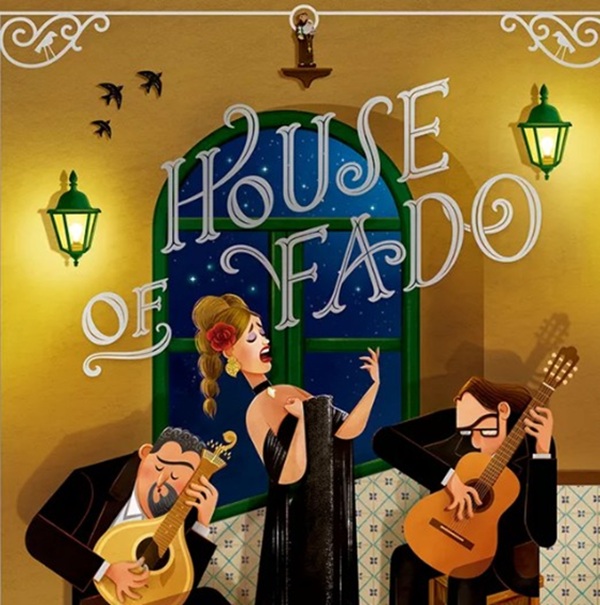

Fado-muziek is melancholische, traditionele Portugese volksmuziek. Het ontstond in de arbeidswijken van Lissabon en bestaat uit emotionele liederen over liefde, verlies, zeemansleven en het lot. De muziek wordt begeleid door een Portugese gitaar (een fado-gitaar), een klassieke gitaar en een zanger.
In House of Fado staat deze muziek centraal in je restaurant. Je runt een restaurant en deze keer gaat het niet om het maken van het beste eten, maar om het maken van de beste muziek. Je hebt drie artiesten in je restaurant. In het begin hebben ze een niveau van nul; ze kunnen nog niets. Daarna kun je ze opwaarderen tot niveau zes. Het opwaarderen van deze muzikanten is de belangrijkste manier om zoveel mogelijk punten te scoren in dit spel.
House of Fado is gemaakt door Vital Lacerda. Hoewel het eigenlijk een zwaar expertspel zou moeten zijn, is dat het niet. Dit is een van de lichtere werken van Vital Lacerda en daarom makkelijker toegankelijk en snel te leren.
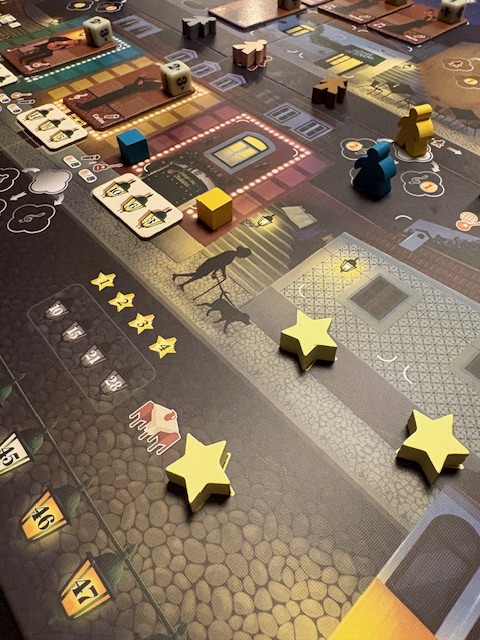
Het is een workerplacement spel. Je kunt je werkers op diverse plekken op het hoofdboard zetten. Op die plekken is er een klein cirkeltje met één centrale plek waar je je werkers op zet en drie kick-out plekken. Als jij je werker in het kleine cirkeltje zet, wordt een andere speler naar een bonusveldje gebumpd. Dat is een van de drie bumpveldjes daaronder en die speler mag dan een klein bonusvoordeeltje pakken.
Dit maakt het wel wat lastig om je acties te plannen. Je mag in een gebied met een worker placement-spel maar één keer staan. En je wilt niet teveel of te vaak andere spelers van de plek af bumpen zodat zij buiten hun beurt bonussen krijgen.
Opzet van het Spelcomponenten
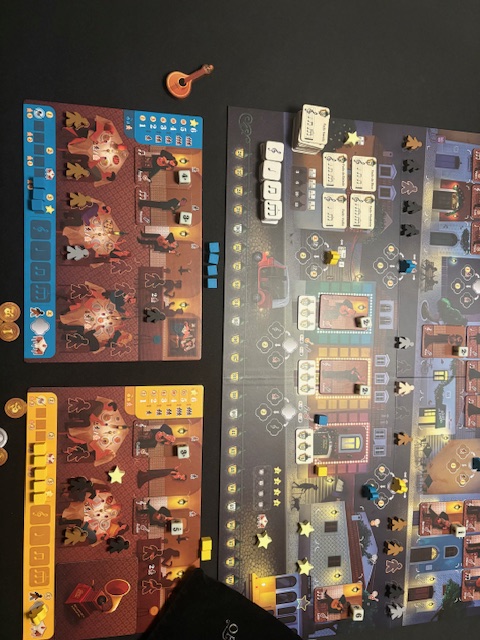
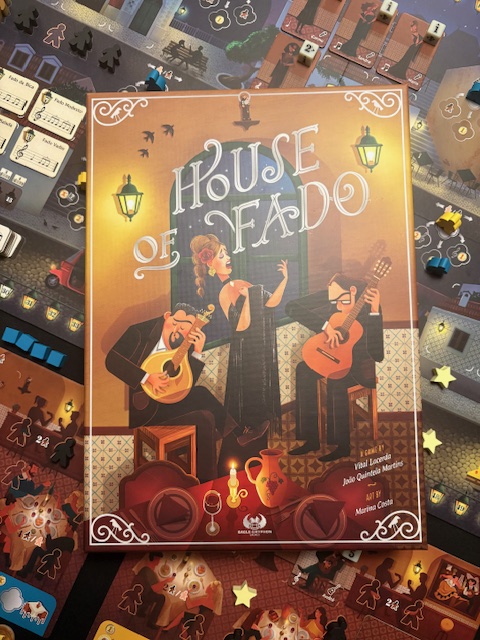
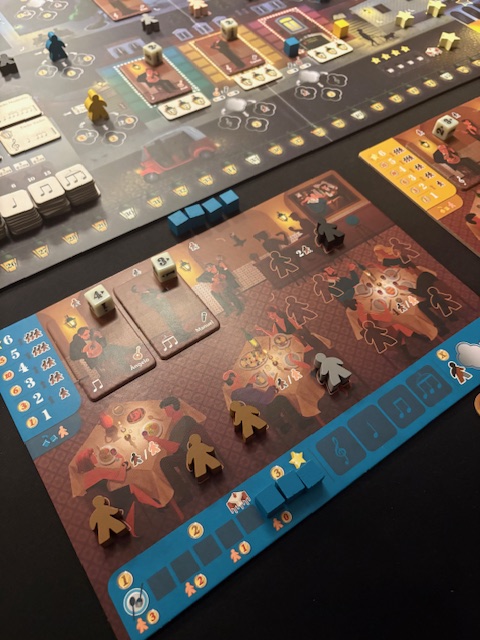
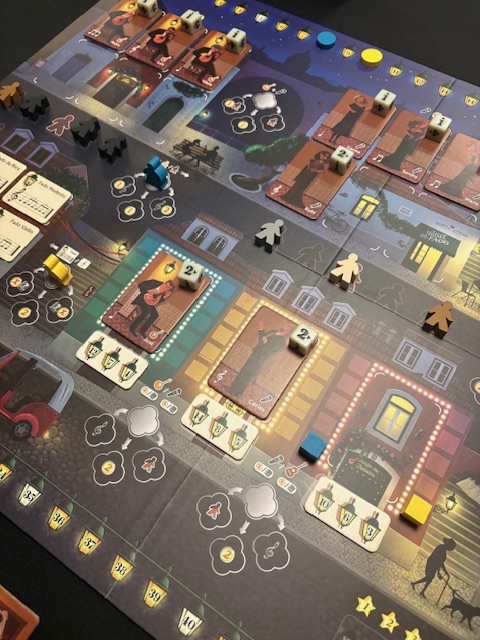
Het spel bestaat uit een groot hoofdbord waarop van alles gebeurt en spelersborden. Het spelersbord is je restaurant. De componenten zijn, zoals vaak bij Vital Lacerda spellen, fantastisch. Het karton is dik en er zijn gekleurde houten meeples. Er zitten veel dobbelstenen in het spel en alles past prima in de stevige doos met een speciaal gemaakte insert. Schrik niet: de dobbelstenen zijn niet om mee te dobbelen maar om level van muzikanten aan te geven.
Het opzetten is een gemiddelde klus. Er worden veel dingen op het hoofdbord neergelegd, zoals muzikanten, publiek, liedjes en scoretokens. Op je spelersbord leg je ook het een en ander neer, zoals een prestige track om bij te houden hoe beroemd je restaurant is. Allemaal top!
Hoe speel je het spel
In je beurt doe je één actie, waarbij je een worker placement moet doen. Je zet je werker ergens neer en dat kan op een aantal locaties.
De eerste locatie is de muziekmarkt. Daar kan je muzikanten inhuren, zoals gitaristen en zangers. Het kost uiteraard wel wat munten, maar die muzikanten kan je dan in je restaurant plaatsen.
De tweede locatie is de straat. Daarmee breng je het publiek naar binnen. Het publiek is heel belangrijk, want zij klappen voor je muzikanten en zorgen voor de stijging van de beroemdheid van je muzikanten.
De derde locatie is de muzikale ruimte. Daar worden liedjes gemaakt, nieuwe Fado liedjes. Je kan daar muzieknoten ophalen en met de juiste muzieknoten kan je een Fado-lied maken. Fado liederen zorgen voor aardig wat punten.
De vierde locatie is de billboard. Daar zet je muzikanten in de spotlight. Je haalt een muzikant uit je restaurant en zet die daar neer. Degene die het meest muzikanten in de billboard heeft gezet, wint veel punten.
De vijfde locatie is je eigen restaurantbord en daarmee kan je de dag in je restaurant sluiten. Bij het sluiten van de dag in je restaurant gebeuren er 5 stappen:
- De klanten die er zijn, betalen voor hun eten en dat zorgt voor inkomsten. Dat doen alle soorten klanten, behalve één soort: de recensent. Die betaalt niet voor zijn eten. Je hebt hem zelfs omgekocht om in je restaurant te komen kijken en een goede recensie te schrijven.
- De tweede stap is dat bezoekers gaan applaudisseren voor jouw muzikanten. Verschillende soorten bezoekers applaudisseren voor gitaristen, zangers of allebei. Als er genoeg geklapt wordt, stijgt de beroemdheid van die muzikanten en ook hun waarde.
- Het derde wat kan gebeuren is dat een muzikant door het applaudisseren in waarde stijgt naar level zes. Als hij level zes bereikt, gaat hij naar het hoofdbord en verdien je een ster.
- De vierde stap is dat je je muzikanten kunt ontslaan en naar de markt kunt sturen. De recensent doet zijn werk door twee prestige blokjes weg te halen en zo de prestige van je restaurant te vergroten.
- Als laatste verlaten alle klanten het restaurant en komen ze in de aflegstapel terecht.
Einde van het spel en punten
Het einde van het spel begint wanneer iemand 3 sterren heeft behaald. Je kunt sterren verdienen door een muzikant naar level 6 te brengen. Er zijn drie soorten muzikanten, dus je kunt 3 sterren verdienen. Je kunt ook een ster halen als je als eerste alle prestigeblokjes van je restaurant hebt verwijderd. Daarnaast krijg je een ster als je als eerste drie liedjes hebt gemaakt.
Als drie van deze vijf sterren zijn behaald, wordt de laatste ronde afgemaakt en tellen we de punten. De muzikanten in je restaurant scoren punten op basis van hun beroemdheid. De muzikanten op de billboards scoren punten op basis van de meerderheid van jouw spelersblokjes. Verder worden er punten gescoord op basis van het aantal gemaakte liedjes en het aantal behaalde sterren. Ten slotte krijg je nog één punt per elke vijf geld.
Wat vind ik van het spel?
House of Fado is een toegankelijk spel van Vital Lacerda. Het is prachtig weergegeven met een unieke stijl. En het straalt echt iets Portugees uit.
Het heeft kenmerken in het spel die doen denken aan The Gallerist. Daar wordt het ook mee vergeleken. Maar The Gallerist is wat zwaarder. House of Fado is een uitgeklede versie daarvan en daardoor is het makkelijker op tafel te krijgen.
Een leuke mechanisme in dit spel is dat je met worker placement een werker neerzet op een veld en daarmee iemand anders naar een bonusveldje verplaatst. Dit mechanisme zit ook in The Gallerist en maakt het spel heel interactief. Soms wil je ergens niet staan, maar heb je het toch nodig, dus doe je het maar. Hoe meer spelers er zijn, hoe vaker dit gebeurt. Hierdoor wordt het spel erg interactief en krijgen andere spelers ook bonusacties in jouw beurt.
Verder is het spel best spannend. Tijdens het spel lijkt het soms duidelijk wie er goed voorstaat, maar aan het einde zijn er veel punten te verdienen met sterren, liedjes, billboards en artiesten, waardoor het toch spannend blijft.
House of Fado duurt ook niet zo lang. Het begint wat langzaam en in het begin is het geld heel erg schaars. Maar als het eenmaal op gang is, dan gaat het redelijk hard en stroomt het geld ook binnen. En dan vliegen de sterren ook van het bord af. Zodat de laatste ronde onverwachts bereikt wordt. Je wilt altijd wel wat meer doen. En het gaat dus heel snel.
Dit is een spel dat ik lekker snel op tafel kan leggen met toch wel behoorlijk wat diepgang. Je kunt verschillende strategieën kiezen. Net als andere Vital Lacerda spellen die ik heb, is dit gewoon weer een topper. En deze is wat makkelijker op tafel te krijgen en wat makkelijker mee te nemen. En ook redelijk goed om uit te leggen aan andere spelers.
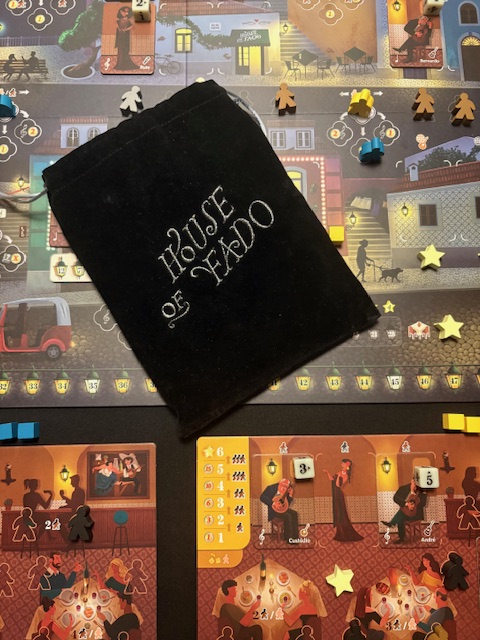

House of Fado
Players: 1-4
Time: 30-60 minutes
Age: 14+
Author: Vital Lacerda, João Quintela Martins
Publisher: Eagle-Gryphon Games
Year: 2025
Fado music is melancholic, traditional Portuguese folk music. It originated in the working-class neighborhoods of Lisbon and consists of emotional songs about love, loss, sailor’s life, and fate. The music is accompanied by a Portuguese guitar (a fado guitar), a classical guitar, and a singer.
In House of Fado, this music takes center stage in your restaurant. You run a restaurant, and this time it’s not about making the best food, but about making the best music. You have three performers in your restaurant. They start at a level of zero; they can’t do anything yet. Then you can level them up to level six. Leveling up these musicians is the most important way to score as many points as possible in this game.
House of Fado was created by Vital Lacerda. Although it should be a challenging expert game, it isn’t. This is one of Vital Lacerda’s lighter works and therefore more accessible and quick to learn.
It’s a worker placement game. You can place your workers in various positions on the main board. In these spaces, there’s a small circle with one central spot where you place your workers and three kick-out spots. If you place your worker in the small circle, another player is bumped to a bonus space. This is one of the three bump spaces below, and that player can then gain a small bonus advantage.
This does make planning your actions a bit tricky. You can only be in an area with a worker placement game once. And you don’t want to bump other players out of the spot too often or too often, so they get bonuses outside of their turn.
Game Components Design
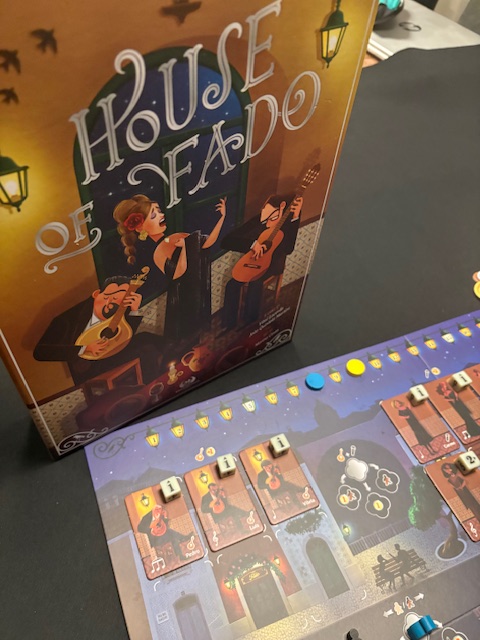
The game consists of a large main board where all sorts of things happen, and player boards. The player board is your restaurant. The components are, as is often the case with Vital Lacerda games, fantastic. The cardboard is thick, and there are colored wooden meeples. There are plenty of dice in the game, and everything fits nicely in the sturdy box with a custom-made insert. Don’t be alarmed: the dice aren’t for rolling, but for indicating the musicians’ levels.
Setting up is a moderate task. Many things are placed on the main board, such as musicians, audience, songs, and score tokens. You also place a few things on your player board, such as a prestige track to track your restaurant’s fame. All top-notch!
How to play the game
On your turn, you take one action, which involves a worker placement. You place your worker somewhere, and you can do so in several locations.
The first location is the music market. There, you can hire musicians, such as guitarists and singers. It costs some coins, of course, but you can then place those musicians in your restaurant.
The second location is the street. This is where you bring in the audience. The audience is very important because they applaud your musicians and increase their fame.
The third location is the music room. This is where songs are created—new Fado songs. You can collect music notes there, and with the right notes, you can create a Fado song. Fado songs earn you a fair amount of points.
The fourth location is the billboard. This is where you put musicians in the spotlight. You take a musician from your restaurant and place them there. The person who features the most musicians on the billboard wins a lot of points.
The fifth location is your own restaurant sign, which you use to close out the day at your restaurant. Five steps occur when closing out the day at your restaurant:
1- The customers pay for their food, which generates revenue. All types of customers do this, except one: the reviewer. They don’t pay for their food. You’ve even bribed them to come and see your restaurant and write a good review.
2- The second step is for visitors to applaud your musicians. Different types of visitors applaud guitarists, singers, or both. If there’s enough clapping, the fame of those musicians increases, as does their value.
3- The third thing that can happen is that a musician’s value increases to level six by applauding. When he reaches level six, he goes to the main board, and you earn a star.
4- The fourth step is firing your musicians and sending them to the market. The reviewer does his work by removing two prestige cubes, thus increasing the prestige of your restaurant.
5- Finally, all customers leave the restaurant and go into the discard pile.
End of the Game and Scoring
The end of the game begins when someone reaches 3 stars. You can earn stars by raising a musician to level 6. There are three types of musicians, so you can earn 3 stars. You also earn a star if you are the first to remove all prestige cubes from your restaurant. You also earn a star if you are the first to create three songs.
If three of these five stars have been earned, the final round is completed and the points are tallied. The musicians in your restaurant score points based on their celebrity. The musicians on the billboards score points based on the majority of your player cubes. Furthermore, points are scored based on the number of songs performed and the number of stars earned. Finally, you receive one point for every five coins.
What do I think of the game?
House of Fado is an accessible game by Vital Lacerda. It is beautifully rendered with a unique style. And it has a distinctly Portuguese feel.
It has gameplay features reminiscent of The Gallerist, which is also how it’s compared. However, The Gallerist is a bit more demanding. House of Fado is a stripped-down version, making it easier to play.
A fun mechanism in this game is worker placement, where you place a worker on a space and then move someone else to a bonus space. This mechanism is also present in The Gallerist and makes the game very interactive. Sometimes you don’t want to be somewhere, but you need to be, so you just do it. The more players there are, the more often this happens. This makes the game very interactive, and other players also get bonus actions on your turn.
Furthermore, the game is quite exciting. During the game, it sometimes seems clear who’s in the lead, but at the end, there are many points to be earned with stars, songs, billboards, and artists, which keeps it exciting.
House of Fado doesn’t take very long either. It starts a bit slow, and initially, money is very scarce. But once it gets going, it goes quite fast, and the money pours in. And then the stars fly off the board, so the final round arrives unexpectedly. You always want to do a little more. And so it moves very quickly.
This is a game I can put on the table quickly, but it has a fair amount of depth. You can choose different strategies. Like other Vital Lacerda games I have, this is simply another top-notch game. And this one is a bit easier to get on the table and a bit easier to carry. And also quite good to explain to other players.
Wat leuk dat je deze onbekendere workerplacement ( met bump mechanisme ) heb gereviewed. Voor mij is het een van de verrassingen van 2025 ! Erg leuk en goed spel
Zeker een onbekend pareltje