
Aantal spelers: 1-4
Speelduur: 120 minuten
Leeftijd: Vanaf 14 jaar
Auteur: Jamie Bloom
Uitgever: Bad Comet
Jaar: 2023

Dit is een herpublicatie van de review die ik schreef voor Bordspelwereld.nl.
Zou je het fijn vinden om zelf een stukje jungle te beheren? Run je eigen conservatie-project om het Amazone-woud te laten floreren: herstel het regenwoud, plant bomen en bloemen en zorg dat de dieren hier in vrede kunnen samenleven!
Amazonia is een synoniem voor de “Amazon Jungle”, het tropische regenwoud in het Amazone-gebied. Amazonia heeft ongeveer 5.500.000 km² regenwoud met daarin een ongeziene biodiversiteit aan planten en dieren. Enkele indrukwekkende cijfers: een geschatte 1 miljard individuele grote bomen, minstens 40.000 plantensoorten, ongeveer 2,5 miljoen insectensoorten, meer dan 2.000 vogel- en zoogdiersoorten, rond de 800 amfibie- en reptielsoorten en ongeveer 2.200 vissoorten in de Amazone zelf. 1 op de 5 wetenschappelijk gekende soorten leeft in Amazonia. Hiermee is het gebied de grootste verzameling levende planten en dieren ter wereld met een onvoorstelbare biomassa. Het is nu aan jou om een stukje van deze jungle te beheren en in zijn volle glorie te herstellen.
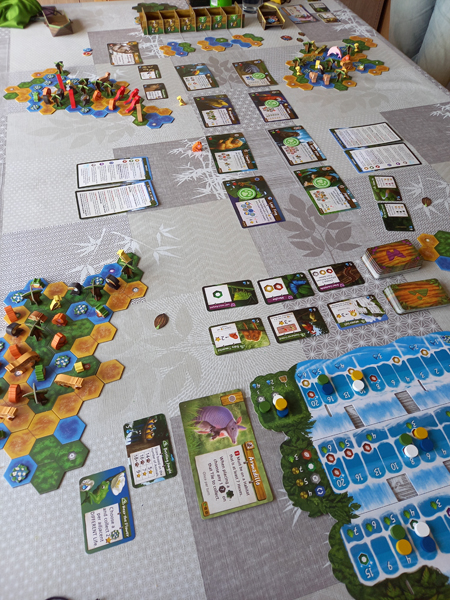
Elke speler krijgt aan het begin van het spel een begintegel, een zakje voor hulpmiddelen-fiches en een individueel dier met bijhorende dierkaart. Iedereen begint met dezelfde basishulpmiddelen in zijn zakje, maar tijdens het spel krijg je de kans om meer en waardevollere hulpmiddelen te kopen waardoor je meer en grootsere dingen kan doen tijdens je beurt. Het unieke dier dat je krijgt, geeft je een individueel voordeel dat enkel jij kan gebruiken eens je het dier in je jungle hebt losgelaten.
Daarnaast zijn er nog een aantal algemene, gemeenschappelijke spelonderdelen:
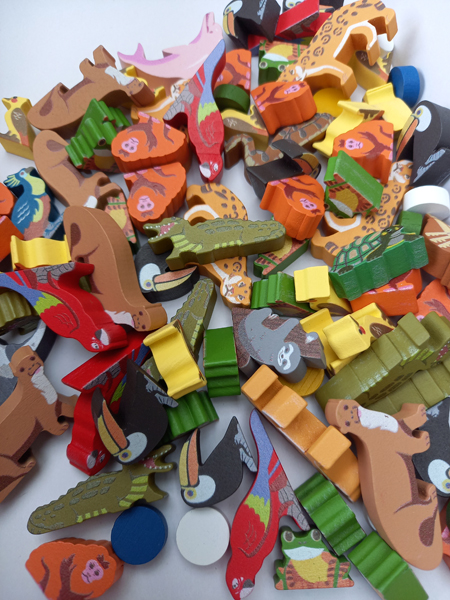
dieren: dieren zijn één van de 3 levensvormen. Er zijn 8 basisdiersoorten (het aantal dieren per soort wordt bepaald door het aantal spelers). De dieren kan je in je jungle plaatsen, rekening houdend met de voorwaarden. Bij elke diersoort horen 4 scorekaarten waarvan je er per spel 1 per diersoort kiest. Daarop staat de manier waarop je met die specifieke diersoort punten kan scoren aan het einde van het spel.
biotooptegels: elke biotooptegel bestaat uit 7 hexagons. De hexagons kunnen bos, water of moeras zijn. Op sommige hexagons staat nog een bonus afgebeeld die je krijgt wanneer je een levensvorm (boom, bloem of dier) op deze hexagon zet. Telkens je een biotooptegel koopt, ga je vooruit op het tegel-spoor. Dit levert je bonussen en punten op. Er zijn ook losse hexagons van bos, water en moeras: die krijg je soms als bonus en dient om gaten op te vullen of óver een andere tegel te leggen.
bomen: bomen zijn één van de drie levensvormen en worden altijd op een bos-hexagon geplaatst. Telkens je een boom plant, ga je vooruit op het bomen-spoor. Dit levert je bonussen en punten op. Bomen zijn soms een voorwaarde om te kunnen scoren met de dierkaarten.
waterbloemen: waterbloemen zijn één van de drie levensvormen en worden altijd op een water-hexagon geplaatst. Telkens je een waterbloem plant, ga je vooruit op het waterbloemen-spoor. Dit levert je bonussen en punten op. Waterbloemen zijn soms een voorwaarde om te kunnen scoren met de dierkaarten.
zaden: zaden kan je krijgen als bonus. Zaden zijn een soort joker om te gebruiken als gelijk welk hulpmiddel met waarde 1.
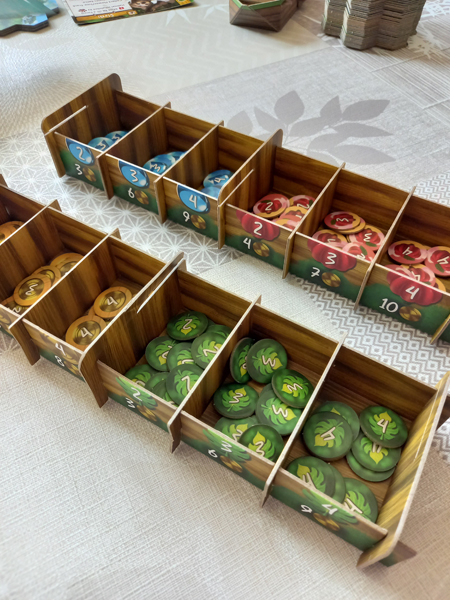
hulpmiddelen: er zijn 4 soorten hulpmiddelen: bladeren, water, fruit en geld. De waarden van de hulpmiddelenfiches gaan steeds van 1 tot 4. Geld heb je nodig om de andere hulpmiddelen te kunnen kopen. Bladeren, water en fruit heb je nodig om bomen, waterbloemen en dieren te kunnen kopen. Water heb je ook nodig om natuurkaarten te kunnen kopen.
natuurkaarten: er zijn 2 soorten natuurkaarten die je kan kopen met water: insectenkaarten en landschapskaarten. Ze geven je extra bonussen of punten.
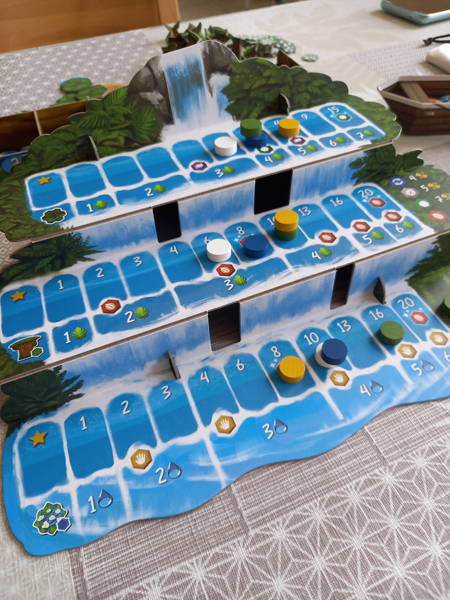
waterval: op de waterval staat het tegel-, bomen- en waterbloemen-spoor. Er staat ook nog een rugzak-spoor op. Dit spoor bepaalt hoeveel hulpmiddelen je mag meenemen naar de volgende beurt.
Wanneer een speler aan de beurt is, trekt hij blind 5 hulpmiddelenfiches uit zijn zakje. Met de hulpmiddelen die hij nu ter beschikking heeft (de 5 nieuwe en eventuele fiches die over waren uit de vorige beurt), mag hij zoveel acties uitvoeren als hij wil en in gelijk welke volgorde, zolang hij ze maar kan betalen. “Wisselgeld” krijg je niet. De in deze beurt gebruikte en gekochte fiches leg je in je bootje. Van zodra je zakje leeg is en je zou nog fiches moeten trekken, leg je de inhoud van je bootje terug in je zak en kan je weer verder. De actieve speler heeft keuze tussen volgende acties:
Een hulpmiddelenfiche kopen: met geld kan je extra hulpmiddelenfiches kopen. Leg ze in je bootje, ze komen in het spel wanneer je je zak weer terug vult.
Een biotooptegel plaatsen: zet je marker 1 vakje vooruit op het tegel-spoor. Daar zie je hoeveel bladeren je dient te betalen voor deze tegel. Tegels worden duurder naarmate je er meer gekocht hebt. Kies een tegel uit de 3 openliggende tegels en leg aan in je jungle. Ontvang eventueel bonussen die je kan verdienen op het tegel-spoor.
Een boom plaatsen: zet je marker 1 vakje vooruit op het bomen-spoor. Daar zie je hoeveel bladeren je dient te betalen voor een boom. Bomen worden duurder naarmate je er meer gekocht hebt. Plaats de boom op een bostegel in je jungle. Ontvang eventueel bonussen die je kan verdienen op het bomen-spoor en op de hexes.
Een waterbloem plaatsen: zet je marker 1 vakje vooruit op het waterbloemen-spoor. Daar zie je hoeveel water je dient te betalen voor een waterbloem. Waterbloemen worden duurder naarmate je er meer gekocht hebt. Plaats de waterbloem op een watertegel in je jungle. Ontvang eventueel bonussen die je kan verdienen op het waterbloemen-spoor en op de hexes.
Een dier plaatsen: kies een basisdier, betaal de kosten die op de dierkaart staan en plaats het dier in je jungle volgens de aangegeven plaatsingsvoorwaarden. Je eigen unieke dier mag je kosteloos plaatsen. Er zijn kleine dieren: die plaats je op 1 hexagon. En er zijn grote dieren: die plaats je over 2 hexagons. Ontvang eventueel bonussen die je kan verdienen op de hexes.
Een natuurkaart kopen: kies een natuurkaart en betaal de kostprijs met waterfiches. Koop je een insectenkaart, dan moet je die onmiddellijk gebruiken: het geeft je een extra bonus of actie. Koop je een landschapskaart, dan leg je die naast je jungle: het is een extra manier om punten te scoren aan het einde van het spel. Je mag maximum 4 landschapskaarten hebben.
Je rugzak uitbreiden: betaal water om je rugzak uit te breiden. Aan het begin van het spel mag je 1 ongebruikt hulpmiddelenfiche meenemen naar je volgende beurt. Deze capaciteit kan je uitbreiden tot maximum 3 fiches. Geef dit aan op het rugzak-spoor.
Een bonus kopen: op de waterval staan 4 bonussen afgebeeld die je altijd kan kopen: een zaad krijgen, een enkele hexagon kopen, een hulpmiddelenfiche composteren of een levensvorm uit je jungle op een andere (lege) plaats in je jungle zetten.
Wanneer je alle hulpmiddelenfiches in je beurt gebruikt hebt of je wenst de overgebleven fiche(s) mee te nemen naar je volgende beurt, dan is je beurt voorbij. De volgende speler met de klok mee is nu aan de beurt. Je mag al 5 nieuwe fiches uit je zak trekken zodat je al kan beginnen nadenken over je volgende beurt. Het spel gaat zo verder tot er 5 van de 8 basisdieren op zijn. De speler die het laatste van deze 5 dierensoorten koopt, krijgt het bonusfiche met 5 extra punten. De andere spelers zijn nu nog 1x aan de beurt. Daarna worden de punten geteld en wint de speler met de hoogste ecologische score. Je kan punten scoren als volgt:
dieren in je jungle: scoor de dieren in je jungle volgens de dierkaart die voor elke soort in het spel is.
landschapskaarten: scoor punten voor elke landschapskaart die je naast je jungle hebt verzameld.
tegel-spoor: lees de punten af waar je marker op het tegel-spoor staat.
bomen-spoor: lees de punten af waar je marker op het bomen-spoor staat.
waterbloemen-spoor: lees de punten af waar je marker op het waterbloemen-spoor staat.
zaden: elk zaad dat je niet gebruikt hebt, is 1 punt waard.
einde-spel fiche: 5 punten voor de speler die het einde van het spel inluidde.
Mijn mening over Life of the Amazonia?
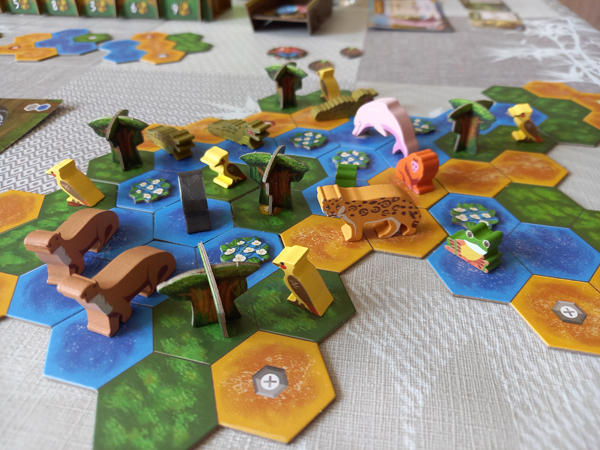
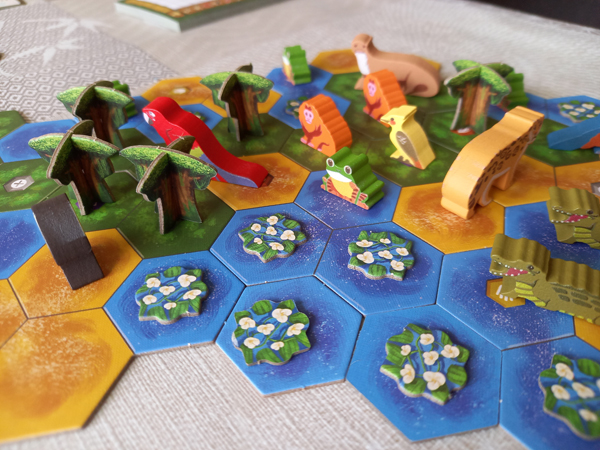
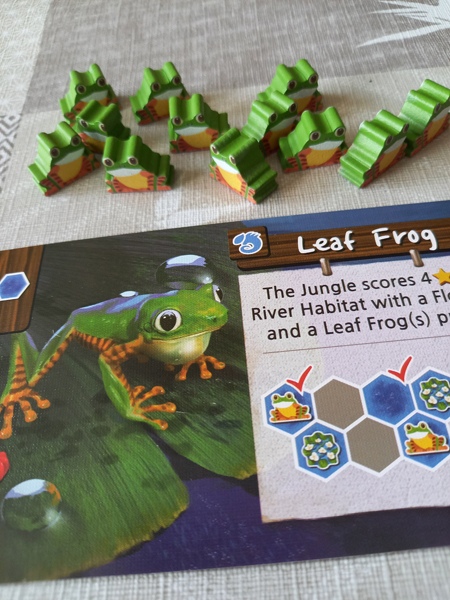
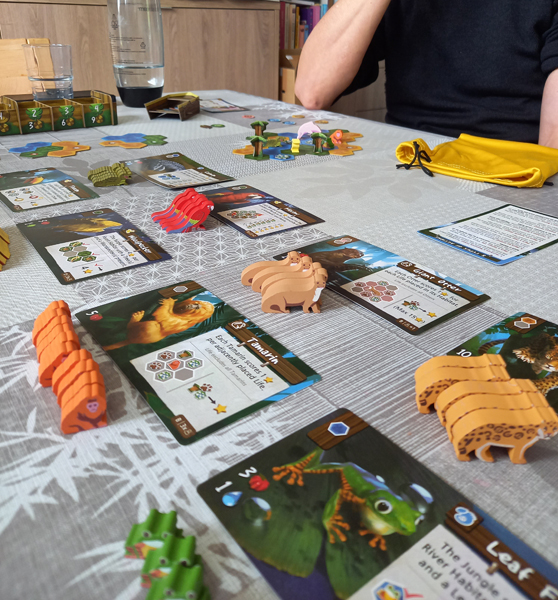
Ikzelf? Ik was al verkocht toen ik wist dat de doos vol houten diertjes zou zitten! En de titel en de doos deden me ook al watertanden! Ik heb iets met houten diertjes en ecologische natuurthema’s. Zou dat misschien kunnen zijn omdat ik van opleiding biologe ben…? Maar niet alleen de diertjes zijn leuk gemaakt, ook het artwork op de kaarten is heel mooi uitgewerkt. Daarom vind ik het wel zo jammer dat de bomen en de waterbloemen slechts uit karton gemaakt zijn. Dat doet echt afbreuk aan de houten diertjes! Je kan wel een upgrade kit kopen met daarin houten bomen, waterbloemen en hulpmiddelenfiches, maar dat had gewoon al in de basisdoos moeten zitten.
En toegegeven: het karton dat gebruikt werd voor de waterval, de biotooptegels en de kistjes voor hulpmiddelen is gewoon een maatje te dun. Zeker omdat je de waterval telkens uiteen moet halen, want deze past anders niet in de doos. Ik leg hem gewoon plat op tafel, dat werkt even goed en dan is het minder gedoe. Maar… dit kan ik gerust negeren als ik het spel in zijn geheel bekijk. Hoe fijn is het om op het einde van het spel je eigen stukje jungle te hebben met daarin boompjes, waterbloemen en diertjes! Ziet er echt mooi uit!
Het spelmechanisme vind ik ook heel fijn. Ik ben grote fan van engine-builders en modulaire spelborden en Amazonia heeft dat allebei. Net als bij “de Kwakzalvers van Kakelenburg” moet je ook hier je hulpmiddelen-zakje steeds verder uitbreiden om zo meer en grootsere dingen te kunnen doen. Dat is een leuk principe. Je moet in je beurt wel een beetje geluk hebben met de fiches die je trekt, maar als dat in de ene beurt niet goed is, dan kan het de volgende beurt alleen maar beter worden. Maak zeker ook gebruik van de composteer-bonussen: zo kan je fiches met waarde 1, die op den duur in de weg gaan zitten, elimineren en heb je er geen last meer van. Het is een spel met heel veel keuzemogelijkheden. Dat wil ook zeggen dat je elke beurt wel wat kan doen, ook al is het misschien niet meteen het eerste wat je in gedachten had. Houd zeker ook in de gaten wat de andere spelers aan het doen zijn. Soms is het nuttig om een dier waar je eerst niet in wou investeren, toch te kopen omdat anders een andere speler er misschien te veel punten mee kan scoren.
De herspeelbaarheid van dit spel is ook enorm groot. Omdat er 4 dierkaarten per diersoort zijn en de manier van punten scoren voor elk dier dan ook elke keer anders is – een beetje zoals bij Cascadia – is er heel veel variatie in de score mogelijkheden bij dit spel. Ook de natuurkaarten die open gelegd worden, zijn in elk spel wel een beetje anders. Het is echt een tactische puzzel in een heel mooie uitvoering en met een schitterend thema! En ondanks dat alles eigenlijk helemaal niet zo moeilijk om aan te leren. Een topper én een blijver!

Life of the Amazonia
Players: 1-4
Time: 120 minutes
Age: 14+
Author: Jamie Bloom
Publisher: Bad Comet
Year: 2023
This is a republication of a review I wrote for Bordspelwereld.nl.
Would you like to manage your own piece of jungle? Run your own conservation project to help the Amazon rainforest flourish: restore the rainforest, plant trees and flowers, and ensure that the animals can live here in peace!
Amazonia is synonymous with the “Amazon Jungle”, the tropical rainforest in the Amazon region. Amazonia has approximately 5.500.000 km² of rainforest, containing an unprecedented biodiversity of plants and animals. Some impressive figures: an estimated 1 billion individual large trees, at least 40.000 plant species, approximately 2,5 million insect species, more than 2.000 bird and mammal species, around 800 amphibian and reptile species and approximately 2.200 fish species in the Amazon itself. One in five scientifically known species lives in Amazonia. This makes the area the largest collection of living plants and animals in the world with an unimaginable biomass. It is now up to you to manage a piece of this jungle and restore it to its full glory.
At the start of the game, each player receives a starting tile, a bag for resource tokens and an individual animal with an accompanying animal card. Everyone starts with the same basic resources in their bag, but during the game you will have the opportunity to buy more and more valuable resources, allowing you to do more and greater things during your turn. The unique animal you receive gives you an individual advantage that only you can use once you have released the animal into your jungle.
In addition, there are a number of general, common game components:
Animals: animals are one of the three life forms. There are 8 basic animal species (the number of animals per species is determined by the number of players). You can place the animals in your jungle, taking into account the conditions and restrictions. Each animal species has 4 score cards, from which you choose 1 per animal species per game. These cards show how you can score points with that specific animal species at the end of the game.
Habitat tiles: each habitat tile consists of seven hexagons. The hexagons can be forest, water or swamp. Some hexagons also show a bonus that you receive when you place a life form (tree, flower or animal) on that hexagon. Each time you purchase a habitat tile, you advance on the tile track. This earns you bonuses and points. There are also separate hexagons of forest, water and swamp: you sometimes receive these as a bonus and they can be used to fill gaps or cover another tile.
Trees: Trees are one of the three life forms and are always placed on a forest hexagon. Each time you plant a tree, you advance on the tree track. This earns you bonuses and points. Trees are sometimes a prerequisite for scoring with animal cards.
Water flowers: Water flowers are one of the three life forms and are always placed on a water hexagon. Each time you plant a water flower, you advance on the water flower track. This earns you bonuses and points. Water flowers are sometimes a prerequisite for scoring with animal cards.
Seeds: Seeds can be obtained as a bonus. Seeds are a kind of wild card that can be used as any resource with a value of 1.
Resources: There are 4 types of resources: leaves, water, fruit and money. The values of the resource tokens range from 1 to 4. You need money to buy the other resources. You need leaves, water and fruit to buy trees, water flowers and animals. You also need water to buy nature cards.
Nature cards: there are two types of nature cards that you can buy with water: insect cards and landscape cards. They give you extra bonuses or points.
Waterfall: the waterfall has a tile, tree and water flower track. It also has a backpack track. This track determines how many resources you can take with you to the next turn.
When it is a player’s turn, they draw 5 resource tokens blindly from their bag. With the resources they now have available (the 5 new ones and any tokens left over from the previous turn), they may perform as many actions as they wish and in any order, as long as they can pay for them. You do not receive any “change”. Place the tokens used and purchased during this turn in your boat. Once your bag is empty and you still need to draw tokens, place the contents of your boat back in your bag and continue. The active player can choose between the following actions:
Buy a resource token: you can use money to buy extra resource tokens. Place them in your boat; they will come into play when you refill your bag.
Place a biotope tile: move your marker 1 space forward on the tile track. There you will see how many leaves you need to pay for this tile. Tiles become more expensive the more you buy. Choose a tile from the 3 open tiles and place it in your jungle. Receive any bonuses you can earn on the tile track.
Place a tree: move your marker 1 space forward on the tree track. There you will see how many leaves you need to pay for the tree. Trees become more expensive as you buy more of them. Place the tree on a forest tile in your jungle. Receive any bonuses you can earn on the tree track and on the forest hex.
Place a water flower: move your marker 1 space forward on the water flower track. There you will see how much water you need to pay for the water flower. Water flowers become more expensive as you buy more of them. Place the water flower on a water tile in your jungle. Receive any bonuses you can earn on the water flower track and on the water hex.
Place an animal: choose a basic animal, pay the cost shown on the animal card and place the animal in your jungle according to the placement rules and conditions. You may place your own unique animal free of charge. There are small animals: these are placed on 1 hexagon. And there are large animals: these are placed over 2 hexagons.
Buy a nature card: choose a nature card and pay the cost with water tokens. If you buy an insect card, you must use it immediately: it gives you an extra bonus or action. If you buy a landscape card, place it next to your jungle: it is an extra way to score points at the end of the game. You may have a maximum of 4 landscape cards.
Expanding your backpack: pay water to expand your backpack. At the start of the game, you may take 1 unused resource token to your next turn. You can expand this capacity to a maximum of 3 tokens. Indicate this on the backpack track.
Buy a bonus: there are 4 bonuses depicted on the waterfall that you can always buy: get a seed, buy a single hexagon, compost a resource token or move a life form from your jungle to another (empty) place in your jungle.
When you have used all the resource tokens in your turn or you wish to take the remaining token(s) with you to your next turn, your turn is over. The next player clockwise now takes their turn. You may already draw 5 new tokens from your bag so that you can start thinking about your next turn. The game continues in this manner until 5 of the 8 basic animals are gone. The player who purchases the last of these 5 animal species receives the bonus token with 5 extra points. The other players now have one more turn. After that, the points are counted and the player with the highest ecological score wins. You can score points as follows:
animals in your jungle: score the animals in your jungle according to the animal card that is in play for each species.
landscape cards: score points for each landscape card you have collected next to your jungle.
tile track: read the points where your marker is on the tile track.
tree track: read the points where your marker is on the tree track.
water flower track: read the points where your marker is on the water flower track.
seeds: each seed you have not used is worth 1 point.
end-of-game token: 5 points for the player who heralded the end of the game.
My opinion on Life of the Amazonia?
Me? I was already sold when I found out the box would be full of wooden animals! And the title and the box also made my mouth water! I have a thing for wooden animals and ecological nature themes. Could that be because I studied biology…? But it’s not just the animals that are nicely made, the artwork on the cards is also very beautifully detailed. That’s why I think it’s such a shame that the trees and water flowers are only made of cardboard. It really detracts from the wooden animals! You can buy an upgrade kit with wooden trees, water flowers and resource tokens, but that should have been included in the basic box.
And admittedly, the cardboard used for the waterfall, the biotope tiles and the resource boxes is just a bit too thin. Especially since you have to take the waterfall apart every time, because otherwise it doesn’t fit in the box. I just lay it flat on the table, which works just as well and is less hassle. But… I can easily ignore this when I look at the game as a whole. How nice is it to have your own piece of jungle at the end of the game, with trees, water flowers and animals! It looks really beautiful!
I also really like the game mechanics. I’m a big fan of engine builders and modular game boards, and Amazonia has both. Just like in “The Quacks of Quedlinburg”, you have to keep expanding your resource bag in order to do more and bigger things. That’s a fun principle. You do need a bit of luck with the tokens you draw during your turn, but if you don’t get a good draw in one turn, the next turn can only be better. Be sure to make use of the composting bonuses: this allows you to eliminate tokens with a value of 1, which eventually get in the way, so you don’t have to worry about them anymore. It is a game with many choices. That also means that you can do something every turn, even if it may not be the first thing you had in mind. Be sure to keep an eye on what the other players are doing. Sometimes it is useful to buy an animal you didn’t want to invest in at first, because otherwise another player might score too many points with it.
The replayability of this game is also enormous. Because there are four animal cards per animal species and the way of scoring points for each animal is different every time – a bit like in Cascadia – there is a lot of variation in the scoring possibilities in this game. The nature cards that are laid out are also slightly different in each game. It is truly a tactical puzzle in a beautiful design and with a wonderful theme! And despite all that, it is not that difficult to learn. A winner and a keeper!