

Aantal spelers: 1-5
Speelduur: 30 minuten
Leeftijd: Vanaf 8 jaar
Auteur: Stan van Rooijen
Uitgever: Tucker’s Fun Factory
Jaar: 2024
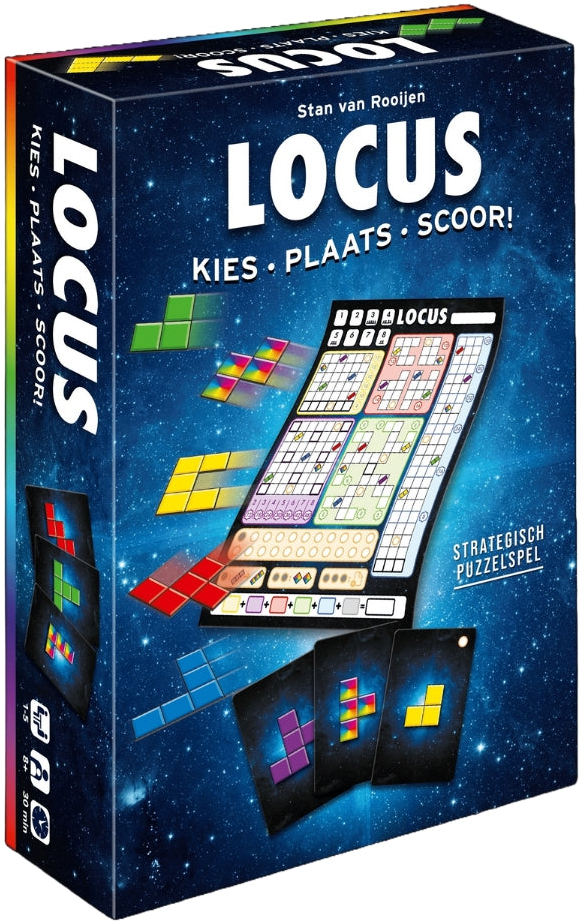

Locus is een flip & write-spel waarbij de spelers gekleurde tetris-blokken op hun scoreformulier tekenen om punten te scoren. Maak slimme keuzes, zorg voor kettingreacties, verzamel munten en ga voor de overwinning!
Ik was Locus al een paar keer tegengekomen, zowel op het web als op de spellenclub, waar ik hem overigens niet speelde, maar hij wel mijn interesse wekte. Wat ik hoorde over Locus was eigenlijk alleen maar positief. Het enthousiasme maakte me wel nieuwsgierig, maar ik ben geen trendvolger. Sterker nog, ik koop vaak juist geen trend-spellen, Aangezien de halve spellenclub ze dan al in hun bezit heeft, kan ik ze daar prima spelen. Als ik na maanden nog steeds enthousiast ben over een spel, dan schaf ik het aan.
Maar goed, Tucker’s Fun Factory schonk mij een review-exemplaar en dan zeg ik natuurlijk geen nee 😉
Locus – een eerste indruk
Locus zit in het bekende formaat waar veel van dit soort spellen in zitten. Ik vind dat fijn, ik houd van uniformiteit in mijn kast 😉
Wat ik opvallend vind is dat op de boxcover precies staat afgebeeld wat er in het doosje zit; het scoreformulier en de kaartjes. Er is niet gekozen voor een tekening of kunstwerk, maar gewoon simpelweg de inhoud. Heel effectief eigenlijk; Je weet meteen wat je kunt verwachten.
De sterrenstelsel-achtergrond, die ook terugkomt op het scoreblok en de kaartjes vind ik fijn gekozen, hoewel ik niet zo goed weet waarom. De spelregels zijn snel gelezen en niet heel moeilijk te begrijpen. Het spel doet me, in eerste instantie, aan Clever denken. Wat ik overigens ook een leuk spel vind, dus dat belooft wat.
Hoe wordt het gespeeld?
Elke speler krijgt een scoreblad.
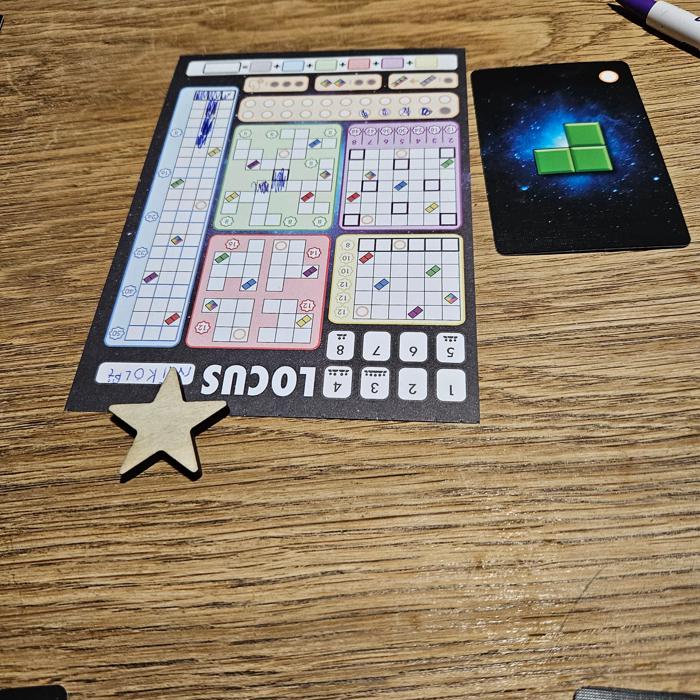
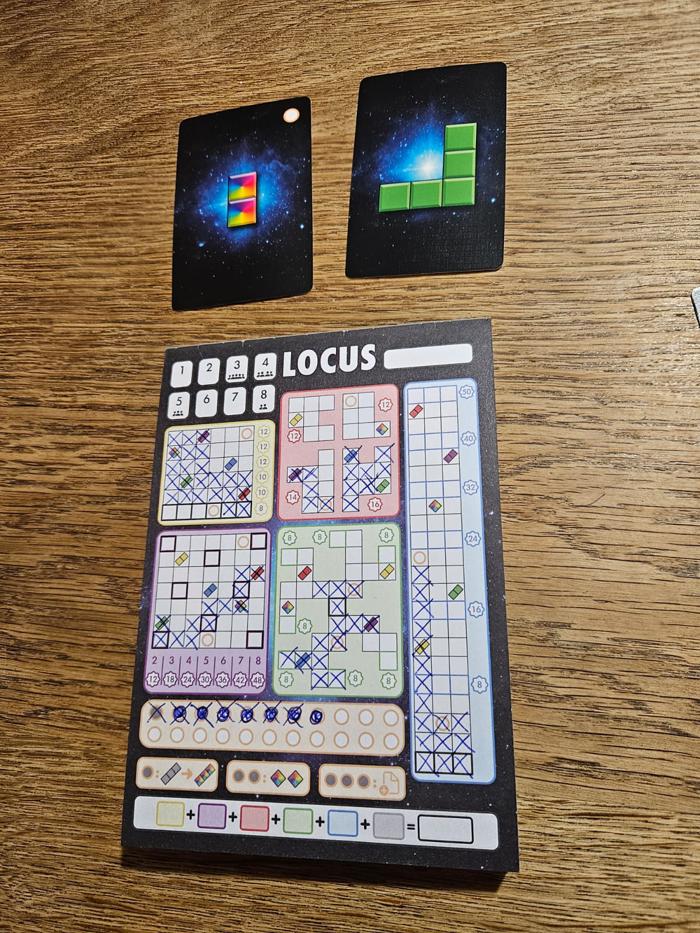
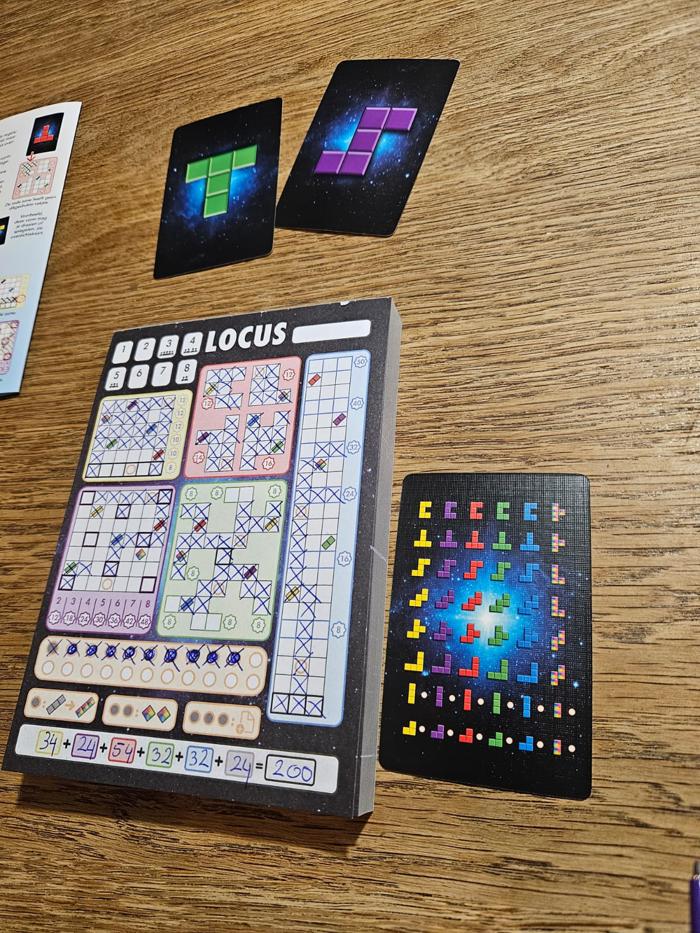
Op dat scoreblad staan 5 verschillende vakken met kleuren. Die vakken moeten straks gevuld worden met de tetris-blokken op de kaartjes. Elk vak heeft zijn eigen manier van scoren, zo moet je bij blauw bijvoorbeeld simpelweg proberen zo hoog mogelijk te komen en moet je bij geel proberen om zo veel mogelijk rijen helemaal te vullen.
De scorebladen bevatten ook allerlei bonussen. Wanneer je zo’n bonus afstreept mag je deze bonus inzetten.
Er zijn 3 soorten bonussen; een muntje, 2 vakjes in een bepaalde kleur, 1 vakje in een willekeurige kleur.
Tot zo ver het scoreblad. Maar hoe gaat het spel in zijn werk?
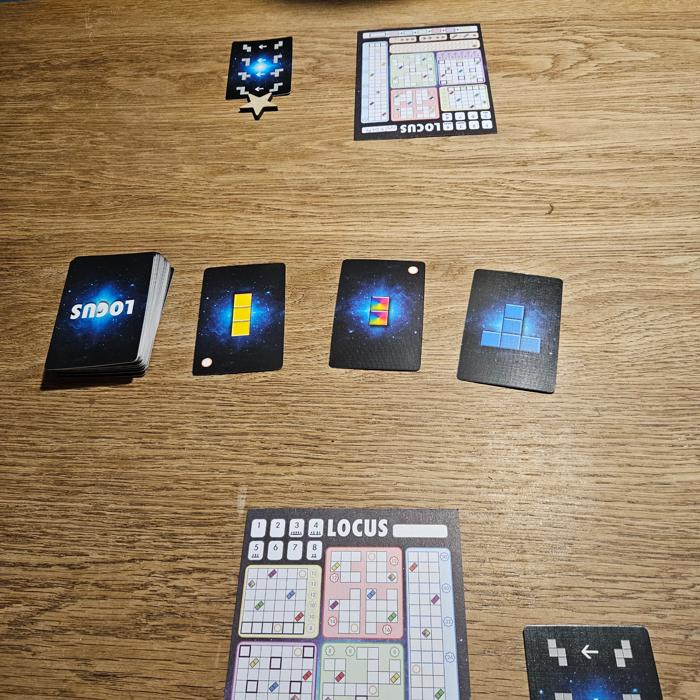
De kaartjes worden geschud en er wordt een trekstapel neergelegd.
Er worden zoveel kaarten omgedraaid als dat er spelers zijn, +1.
Nu mag de startspeler als eerste een kaart pakken, dan de tweede speler, etc.
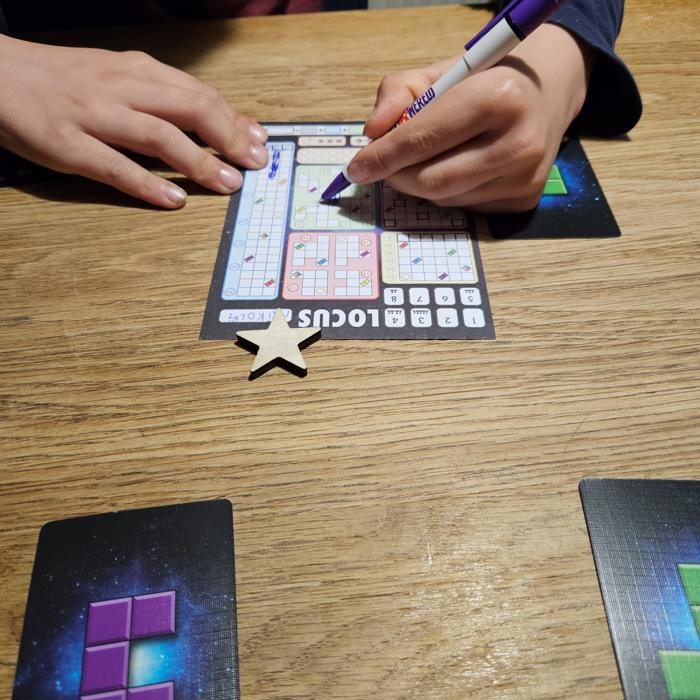
De vorm die op de gekozen kaart staat, mogen zij nu invullen op hun formulier. Als zij een bonus verdienen, mogen ze deze vervolgens ook invullen.
Het is mogelijk om 1 muntje te betalen om de gekozen vorm van kleur te veranderen.
Als iedereen een kaart gekozen heeft, blijft er 1 kaart over. Spelers mogen 3 munten betalen om deze laatste kaart ook te gebruiken.
Een speler mag in zijn beurt eventueel ook 2 munten betalen om op 2 willekeurige plekken 2 vakjes af te strepen.
De kaarten worden afgelegd en er worden weer nieuwe kaarten omgedraaid. Zo gaan de spelers door totdat er een bepaald aantal ronden gespeeld is (afhankelijk van het aantal spelers). Dan kan er overgegaan worden tot de puntentelling.
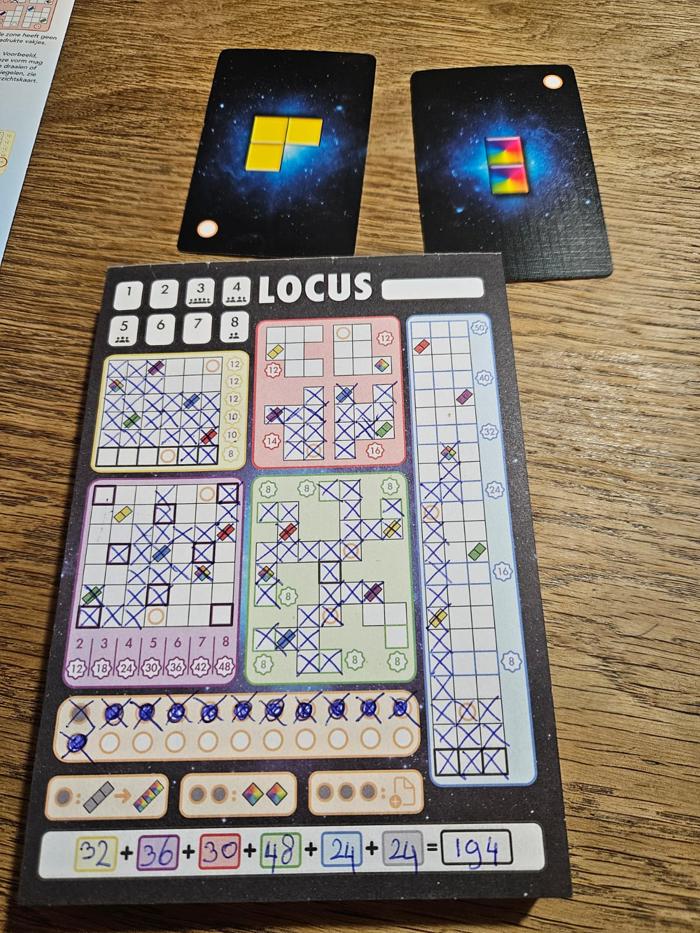
Zoals eerder gezegd, scoort elke kleur op zijn eigen manier. Maar daarnaast heb je nog een ‘grijze’ score. Dit is (nogmaals) de score van je laagst scorende kleur.
Uiteraard wint de speler met de meeste punten.
Solo-variant
De solo-variant speelt zo goed als hetzelfde als Locus voor meer spelers.
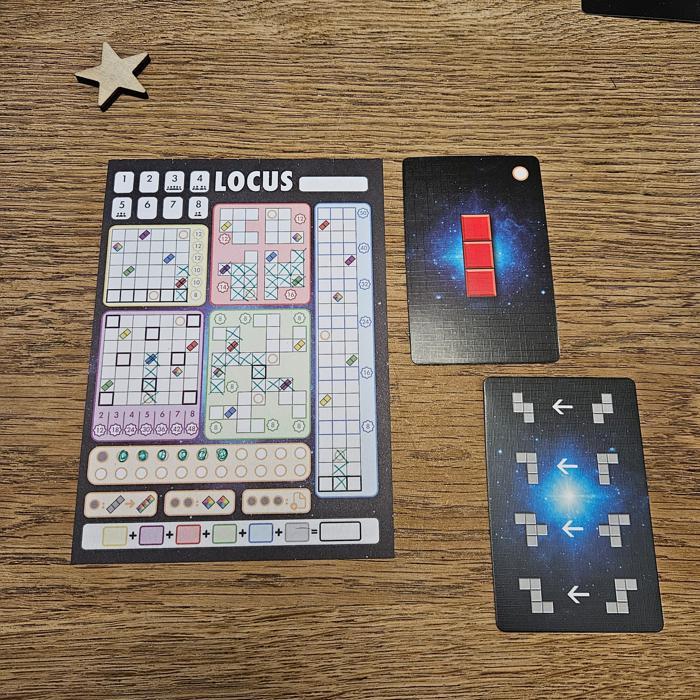
Je hoeft geen rondes bij te houden, maar je gaat het hele deck door. Elke ronde pak je de bovenste 3 kaarten van de stapel, één van die kaarten leg je blind weg. De andere 2 kaarten draai je om en daar kun je er dan één (of 2 tegen betaling van 3 munten) van kiezen.
Wat vinden wij van Locus?
Ik had best hoge verwachtingen van Locus. Ik probeer altijd zo onbevangen mogelijk een spel in te gaan, om een zo eerlijk mogelijk review te kunnen schrijven. Maar soms is dat lastig, zeker als je een spel vlak daarvoor heel vaak gepromoot ziet worden bijvoorbeeld. Desondanks deed ik mijn best om zo neutraal mogelijk te gaan spelen.
De verwachtingen waren hoog, maar Locus heeft niet teleurgesteld. In de eerste 3 dagen dat ik het spel in mijn bezit had, heb ik het zo’n 7 keer gespeeld. Voornamelijk solo, maar ook met anderen. Dat ik het zo vaak gespeeld heb in die 3 dagen, zegt denk ik wel wat, want een spel dat je niet leuk vindt leg je niet zo vaak op tafel. Dus dat ik het een leuk spel vind, dat moge duidelijk zijn. Ik vind het denk ik (zelfs) leuker dan Clever, wat ik ook een leuk spel vind.
Maar wat is er dan zo leuk aan? Ja, dat is eigenlijk een goede vraag. Laten we beginnen met wat algemene positieve dingen; Het scoreblad is kleurrijk, thematisch, maar toch ontzettend duidelijk. Locus heeft makkelijke regels en is daardoor met (bijna) iedereen te spelen én alles ziet er gewoon goed uit.
Dan meer spel inhoudelijk; Locus is wat mij betreft geniaal in zijn simpelheid. Het scoreblad behoeft weinig uitleg, waardoor je het ook aan kinderen, ouderen en niet-spellen-spelers uit kunt leggen en je ook nog weet hoe het werkt als je het een tijdje niet gespeeld hebt.
Daarentegen is het halen van hoge scores niet per se simpel. Het is een leuk puzzeltje. Zonder stress, maar met belangrijke keuzes; Mooie kettingreacties en tactische beslissingen rondom muntjes.
De solo-variant verdient wat mij betreft een aparte noot; Die is ontzettend goed uitgewerkt en werkt (bij mij in ieder geval) ontzettend verslavend. Omdat het vrij snel speelt, speel je makkelijk 2 potjes achter elkaar om te kijken of je je score kunt verbeteren… En dan misschien toch nog een derde?
Eindconclusie: Wat mij betreft is Locus één van de leukste Flip & Writes die ik tot nu toe speelde. Toegankelijk, maar zeker niet saai of simpel.
Ik geef Locus een 8.

Locus
Players: 1-5
Time: 30 minutes
Age: 8+
Author: Stan van Rooijen
Publisher: Tucker’s Fun Factory
Year: 2024
Locus is a flip & write game in which players draw colored Tetris blocks on their score sheets to score points. Make smart choices, create chain reactions, collect coins, and go for the win!
I had come across Locus a few times, both on the web and at the game club, where I didn’t play it, but it did pique my interest. What I heard about Locus was actually only positive. The enthusiasm made me curious, but I’m not a trend follower. In fact, I often don’t buy trendy games, since half the game club already has them, so I can play them there. If I’m still enthusiastic about a game after a few months, then I buy it.
Anyway, Tucker’s Fun Factory gave me a review copy, and of course I couldn’t say no 😉
Locus – a first impression
Locus comes in the familiar format that many games of this type use. I like that; I like uniformity in my closet 😉
What strikes me is that the box cover shows exactly what’s inside the box: the score sheet and the cards. They didn’t opt for a drawing or artwork, but simply the contents. Very effective, actually; you know immediately what to expect.
I like the galaxy background, which also appears on the score pad and the cards, although I’m not quite sure why. The rules are quick to read and not very difficult to understand. At first glance, the game reminds me of Clever. Which I also think is a fun game, so that’s promising.
How is it played?
Each player receives a score sheet.
That score sheet has 5 different colored boxes. Those boxes must be filled with the Tetris blocks on the cards. Each box has its own way of scoring. For example, with blue, you simply try to get as high as possible, and with yellow, you try to fill as many rows as possible.
The score sheets also contain all kinds of bonuses. When you check off a bonus, you can use it.
There are three types of bonuses: a coin, two boxes in a certain color, or one box in a random color.
So much for the score sheet. But how does the game work?
The cards are shuffled and a draw pile is placed on the table.
As many cards are turned over as there are players, +1.
Now the starting player may take a card first, then the second player, etc.
They may now fill in the shape on the chosen card on their form. If they earn a bonus, they may also fill this in.
It is possible to pay 1 coin to change the chosen shape’s color.
When everyone has chosen a card, 1 card remains. Players may pay 3 coins to use this last card as well.
A player may also pay 2 coins on their turn to cross off 2 boxes in 2 random places.
The cards are discarded and new cards are turned over. The players continue in this way until a certain number of rounds have been played (depending on the number of players). Then the points can be counted.
As mentioned earlier, each color scores in its own way. But you also have a “gray” score. This is (again) the score of your lowest-scoring color.
Of course, the player with the most points wins.
Solo variant
The solo variant plays almost the same as Locus for multiple players.
You don’t have to keep track of rounds, but you go through the entire deck. Each round, you take the top 3 cards from the deck and place one of those cards face down. You turn over the other 2 cards and can choose one (or 2 for a cost of 3 coins).
What do we think of Locus?
I had quite high expectations of Locus. I always try to approach a game as openly as possible, so that I can write the most honest review possible. But sometimes that’s difficult, especially when you’ve seen a game being promoted a lot just before, for example. Nevertheless, I did my best to play as neutrally as possible.
Expectations were high, but Locus did not disappoint. In the first 3 days that I had the game, I played it about 7 times. Mainly solo, but also with others. The fact that I played it so often in those 3 days says something, I think, because you don’t play a game you don’t like that often. So it’s clear that I like it. I think I like it (even) more than Clever, which I also enjoy.
But what’s so great about it? Yes, that’s actually a good question. Let’s start with some general positives: the score sheet is colorful, thematic, yet incredibly clear. Locus has simple rules, making it playable with (almost) anyone, and everything just looks good.
Then there’s the game itself; in my opinion, Locus is genius in its simplicity. The score sheet requires little explanation, so you can explain it to children, older people, and non-gamers, and you still know how it works even if you haven’t played it in a while.
On the other hand, achieving high scores is not necessarily simple. It’s a fun puzzle. No stress, but with important choices; nice chain reactions and tactical decisions involving coins.
In my opinion, the solo variant deserves a special mention; it is extremely well designed and (at least for me) incredibly addictive. Because it plays fairly quickly, you can easily play two games in a row to see if you can improve your score… And then maybe a third?
Final conclusion: As far as I’m concerned, Locus is one of the most enjoyable Flip & Writes I’ve played so far. Accessible, but certainly not boring or simple.
I give Locus an 8.