

Aantal spelers: 2-4
Speelduur: 40-60 minuten
Leeftijd: Vanaf 10 jaar
Auteur: Rita Modl
Uitgever: Pegasus Spiele
Jaar: 2024

Dit is een herpublicatie van een review die ik eerder schreef voor Bordspelwereld.nl.
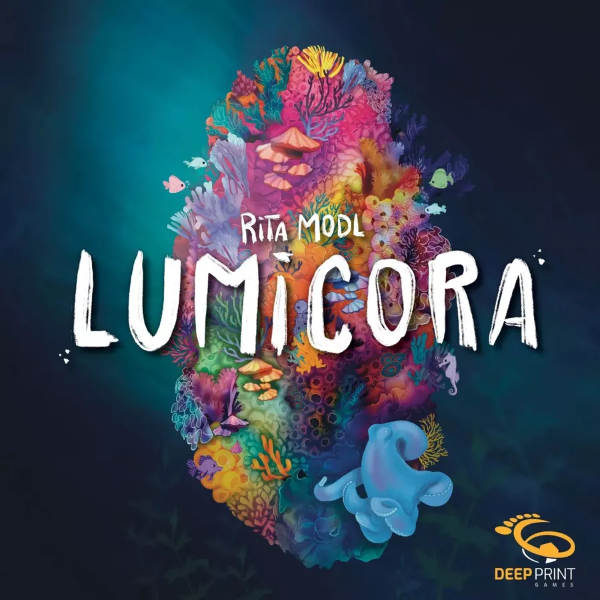
Een koraalrif is een ecosysteem van rifbouwende bloemdieren. Zo noemt Wikipedia dat. Wat een prachtige woorden zijn dat eigenlijk, “rifbouwende bloemdieren”. Je waant je meteen in een sprookje. En ook de doos van Lumicora belooft een vormgevingsfestijn omdat precies deze riffen als ware een prachtig veldboeket op je af komt. Omdat het koraalrif op zich geen nieuw thema is in spellenwereld stelde ik mij echter toch wel in op een abstract tegelleg-spel, omdat het modulaire/ blokjes karakter van deze bloemdiertjes zich nou eenmaal goed leent voor het bouwen van een eigen rif, zo bewijzen collega-spellen met soortgelijk thema. Gelukkig ben ik niet vies van abstracte puzzels, waarbij je door middel van draften van tegels je eigen wereld mag bouwen. De vraag is dan alleen: Is deze markt niet al verzadigd? Is dit niet gewoon wat we al hebben? En blijft het spel overeind zonder de thematische en vormgeving technische verwachtingen van de prachtige naam en doos waar te maken? Ik probeerde het uit.
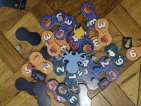
Want inderdaad, dat is wel wat dit spel is. Een tegelleg spel waarbij je je eigen rif gaat bouwen, met gekleurde tegels. Er is een mooie poging gedaan om de tegels eens niet rond, rechthoekig of zeshoekig te maken. Het zijn twee aan elkaar gemaakte rondjes/ rifstukjes, waarbij de verbinding de holling heeft, exact zoals bolling ook heeft, zodat ze prachtig als een soort MC Echer patroon in elkaar passen als je ze dwars op elkaar legt of verspringend naast elkaar. Ik vermoed dan ook dat dit allemaal prachtige wiskundige termen zal hebben, maar ik moest vooral denken aan de Haribo Tongue Fizz snoepjes. Dat dekt de lading ook. Google maar. Op de Fizz-stukjes kunnen zowel de getallen 1 t/m 6 staan en verschillende soorten schelpen of zeedieren.
Ik kan me voorstellen dat dit leest als een vrij cynische weergave van de feiten, maar eerlijk, ik hou van Fizz snoepjes en ga ook goed op de tegels van Lumicora. Welnu, wat gaan we hier dan allemaal mee doen?
De basis zal je wellicht niet verbazen. Hier scoort het spel natuurlijk geen vernieuwingspunten mee, want we gaan een zo waardevol mogelijk rif maken. De speler met de meeste punten wint. Maar ik beloof dat er wat leuk gimmicks zullen zitten in zowel het draften als het scoren van je rif, die het spel voor mij zeker de moeite waard maakte.
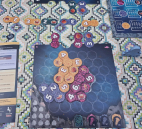
Iedere speler krijgt zijn eigen spelersbord. Hierop ga je je rif bouwen. Een rif bouw je altijd op limestones. Een deel is al voorgedrukt. Daar waar nog geen Limestones staan moet je deze inleveren om er te mogen bouwen. En deze Limestones heb je ook niet zomaar voor het grijpen. Die zullen eerst verdiend/ gedraft moeten worden tijdens een beurt.
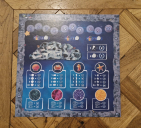
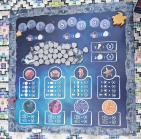
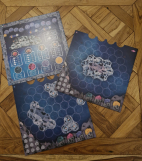
Bij de start krijg je een starttegel die je random draft uit een aantal starttegels. Jij startpositie is dus niet hetzelfde als die van je medespelers. Afhankelijk van het aantal speler stop je de riftegels (Lumino’s in de Engelse versie, we moeten nog even afwachten wat WGG hiervan gaat maken) in de zak. Je draft vervolgens vier van deze Lumino’s en legt ze aan je persoonlijke spelersbord. Ook draft je vier Lumino’s van een openbare markt, in dit spel Atoll genoemd. Elke speler krijgt een aantal scoringstegels, die bijhouden welke kleuren je reeds gescoord hebt. Ten slotte leg in je in het midden een gedeeld spelersbord waarop alle scoremogelijkheden goed staan uitgelegd, je de score dus ook op bijhoudt en het is de plek waar de voorraad Limestones op ligt en waarop een octopus de rondes goed bijhoudt.
Het spel bestaat uit tien rondes waarbij iedere speler één keer aan de beurt komt. Elke ronde bestaat uit twee fases.
-
De actiefase
-
De scoringsfase
-
De Actiefase
De acties fase bestaat uit 4 stappen.
Stap 1: Je kiest één Lumino uit je persoonlijke voorraad en verplaatst deze naar de Atoll
Stap 2: Kies één van de volgende acties
-
Neem een Limestone à Check het getal op de Lumino die je bij stap 1 in de Atoll hebt gelegd. Pak het aantal Limestones gelijk aan dat getal en leg deze in je voorraad.
-
Neem één Lumino uit je persoonlijk voorraad, of
-
Neem 1 tot 3 Lumino’s uit de Atoll à Deze Lumino’s moeten allemaal van dezelfde kleur zijn en mogen niet van dezelfde kleur zijn als de Lumino die je bij Stap 1 in de Atoll hebt gelegd.
Stap 3: Als er na het draften minder dan 4 Lumino’s in de markt liggen, vul je de Atoll aan met Lumino’s uit de zak
Stap 4: Je mag de Lumino’s verkregen bij stap 2 of 3 gaan plaatsen op je bord.
Aan het plaatsen van je tegels op je bord zitten een aantal haken en ogen, makkelijker gezegd: plaatsingsvoorwaarden. Je wilt de tegels op de voorgedrukte plaatsen leggen, door al dan niet eerst Limestones in te leveren wanneer de plek daar nog niet van is voorzien. Bij dit spel wil je echter alleen niet op je bord bouwen, je wil ook omhoog bouwen. Dus: Lumino op Lumino.
Waar moet je bij het plaatsen allemaal aan voldoen:
-
Wanneer je je Lumino aan legt moet minstens één deel van de zijkant (een Lumino kan uit twee kleuren bestaan), grenzen aan dezelfde kleur. Wanneer je stapelt en je legt hem óp dezelde kleur, dan telt dit ook als grenzend. Uitzondering is wanneer je niet kán matchen. In dat geval leg je je Lumino altijd op de onderste laag, ook wel level 1 genoemd.
-
Wanneer je een Lumino op een volgende level wilt plaatsen, mag hij niet volledig over een andere Lumino geplaats worden. Een Lumino op een volgend level overlapt dus altijd één deel van twee verschillende Lumino’s.
-
Een Lumino kan niet op twee verschillende levels liggen en dus schuin komen te liggen en moet altijd volledig op één level liggen. Er kunnen dus ook geen gaten ontstaan.
-
Wanneer je je Lumino’s wil plaatsen op plekken zonder Limestones, kan dit alleen wanneer je genoeg Limestones hebt om in te leveren. Één Lumino covert twee plekken en kost dus ook twee Limestones, tenzij een deel een voorbedrukt Limestone bedenkt. Dan kost het maar één Limestone.
-
Als je een Lumino niet kan plaatsen op basis van de voorwaarden, gaat de Lumino terug in de zak en verlies je een overwinningspunt.
-
De scoringsfase
Als alle spelers zijn geweest begint de scoringsfase in dezelfde volgorde als de beurtvolgorde. Ook deze fase bestaat weer uit verschillende stappen.
Stap 1: Alle spelers vullen hun persoonlijke voorraad aan door nieuwe Lumino’s te trekken uit de zak.
Stap 2: (Optioneel) Scoor een rif. In spelersvolgorde mogen spelers kiezen óf ze een koraalrif willen scoren. Dit mag, maar hoeft niet. Wanneer je een rif scoort zijn er een aantal dingen belangrijk:
-
Je scoort per level maar één getal, dit is altijd de laagste
-
Elke kleur rif mag je maar één keer in het spel scoren. Heb je dus een rif gescoord en je bouwt later bij, dan kun je deze niet opnieuw score. Het spel kent vier kleuren en tien rondes. Je hebt dus tien rondes om deze 4 kleuren te scoren. Dit betekent dat je dus ook zes rondes hebt waarin je niet scoort.
-
Je kan maar één kleur rif scoren in één beurt. Dit mag ook een rif zijn waar je 0 punten voor krijgt. Dit omdat je bij het scoren van je rif, het bij de start gekregen scorefiche van deze kleur omdraait. Hier staat een kwal op. Zo weet je dat je deze kleur al gescoord hebt. Deze kwallen leveren aan het einde van het spel punten op. Mits je ze nog hebt! Je kan ze namelijk in de actiefase ook gebruiken om de Atoll of je persoonlijke voorraad te verversen. Je fiche verdwijnt dan van het bord.
-
Afhankelijk van in welke beurt je scoort, levert een scoring ook nog Limestones op. Hoe vroeger in het spel je scoort, hoe meer dit er zijn. Maar logischerwijs is je rif dan ook nog kleiner.
Stap 3: De speler die als laatste een scoring uitvoert in deze ronde krijgt de startspelers marker (een houten Octopus) en is vanaf nu de startspeler. Wordt er in een ronde geen rif gescoord, dan blijft de startspeler hetzelfde.
Stap 4: Verplaats de rond marker op het gezamenlijke bord (een houten Schildpad).
Eindscore berekenen
Aan het einde van het spel vind er nog een final scoring plaats. Naast de tussentijdse tellingen van de riffen bouw je gedurende het hele spel ook aan je algehele flora en fauna en kun je nog scoren met:
-
Overgebleven en ongebruikte Limestones
-
Overgebleven scoringsfiches waarop de kwal zichtbaar is
-
Zichtbare Dieren De punten voor deze dieren lopen op naarmate je er meer van hebt. Zeldzamere dieren zijn meer waard.
-
Meerderheid in kleurgebieden. Dit wordt per kleur bekeken. De nr’s 1 en 2 vangen hiervoor punten.
Voor deze scores geldt dat er alleen gekeken wordt naar wat er op je bord ligt. Je persoonlijke voorraad of de Lumino’s in de Atoll doen niet mee met de final scoring.
Wat vind ik er van?
Zoals gezegd vind ik het thema niet vernieuwend. Maar helemaal kwalijk nemen kun je dat de makers niet. Natuur leent zich nou eenmaal erg goed als thema voor bordspelletjes. Of het helemaal naar mogelijkheden is uitgewerkt kunnen we het over hebben. Of het thema persee complementair is aan het spel en het spel dus niet zonder het thema kan ook. Heb je voor je spelplezier dus persee een thema-mechanisme-connectie nodig, dan is dit wellicht niet helemaal een spel voor jou. Akropolis had bij wijze van spreken hetzelfde thema kunnen hebben. Je hebt toch een thema nodig om je tegeltjes mee op te leuken. Dat is ook wel echt wat het is. Het thema is een mooi omhulsel van het mechanisme. Ik persoonlijk vind dat totaal niet erg, omdat dit thema zich er wel goed voor leent. Het had echter wel iets mooier uitgewerkt kunnen worden in de vormgeving. Hoewel ik het prachtig vind, is de vormgeving van met name de Luminio’s en de persoonlijke spelersborden vrij rustig gehouden, waar wat voor te zeggen is, maar hierdoor wordt ik niet dermate het thema ingezogen als sommige collega spellen dat wel lukt en wat de doos mij ook had doen hopen.
Maar als we even de verzadiging op de markt buiten beschouwing laten en proberen niet zuur te worden van alle mogelijk (en soms misschien zelfs onontkoombare) te maken vergelijkingen, heb ik zeker een erg leuk spel gespeeld. Zelfs als je wél vergelijkt trouwens, want ik vond er, zoals beloofd, zeker een paar leuke gimmicks inzitten die het alsnog een leuke aanvulling in je kast kan maken. Zeker als je van tegelleg spellen houdt en graag bezig bent om op een eigen spelersbordje je eigen wereld te creëren.
Even op een rijtje wat ik erg leuk vind:
-
Het deels moeten afstaan van je eigen voorraad aan de Atoll. Het maakt dat je je bezig moet houden met wat je klaar legt voor mede-spelers, dit maakt het minder solistisch dan soortgelijk spellen en dwingt je je bezig te houden met wat de ander doet.
-
Dat je niet uit de voorraad mag pakken wat je er zelf net hebt ingelegd. Dat is een mind fuck, omdat je soms juist in de Atoll wil leggen wat je zelf wilt gebruiken, omdat dat vaak is waar je medespelers juist niet mee bezig zijn, en je ze daarmee dus niet helpt. Maar als je m in je eigen voorraad houdt en vanuit daar wilt spelen, mag je maar één Lumino pakken en gaat de bouw van je rif weer erg traag. Maar leg m wél in de voorraad, dan ben je ‘m misschien toch kwijt. Hij moet maar net blijven liggen.
-
Dat de nieuwe startspeler getriggerd wordt juist door iemand die als laatste een actie doet, i.p.v. als eerste, waardoor het lastig is de positie af te dwingen, tenzij je dus de laatste bent. Dit zorgt voor een bepaalde mate van balans en het beïnvloed misschien je keuzen om op een bepaald moment juist wel of niet te scoren.
-
Dat je zelf kan bepalen wat en wanneer je scoort. Dit zijn strategische overwegingen. Je kán een kleur maar één keer scoren. Wanneer doe je dat? Wanneer is dat het slimste?
-
Het scoren van enkel het laagste getal op één level. Dit maakt het een leuke puzzel. Je zult zien dat je soms Lumino’s prima kan gebruiken. Niet om te scoren, maar wel als fundament voor een volgende laag. Ook kun je na het scoren van een kleur, delen er van weer gebruiken om met een andere kleur nog hogerop te komen omdat je zonder concequenties punten kan overbouwen.
-
De keuzes maken om Limestones te pakken. Het is een dure gok, want je legt geen Lumino’s in die beurt. Maar je hebt wel materiaal voor een groter fundament en dus grotere riffen in de toekomst. Keuzes keuzes keuzes. Het feit dat je je gebied eerst bouwklaar moet maken geeft t bijna ook iets worker-placement-achtigs, zonder dat er ook maar één werker in het spel zit.
Toch dekt hierboven niet helemaal de lading. Dingen die ik naast reeds genoemde zaken ook wat minder vind:
-
De scoringsfiches. Handig om bij te houden wat je al gescoort hebt. Maar ze zijn zo’n klein onderdeel van het spel dat je ze simpelweg vergéét om bijvoorbeeld te gebruiken om de Atoll of je eigen voorraad te vernieuwen. Ook leveren ze bij de eindtelling ook weer niet zó veel op. Het voelt een beetje als trucje om het trucje. En dan liggen ze ook nog onderaan je eigen score bord, waar je ze tijdens het spel aan de lopende band van afmaait en op de grond gooit (wanneer je dezelfde motoriek hebt).
-
Mijn hiervoor genoemde punt is wel een onderdeel van een ander basaal gevoel: namelijk dat dit spel álle ingrediënten heeft om een iets verder uitgediept spel te zijn dan veel van zijn soortgenoten. Alleen voelt het alsof dat nét niet is aangetikt. Het scorebord heeft nog een tweede kant die iets meer uitdaging biedt en waar het niet draait om de hoeveelheid dieren, maar per dier om hoe je ze geplaatst hebt, wat het iets uitdagender maakt. Maar het hele spel bekruipt mij het gevoel: hier had nét iets meer ingezeten. Hoewel ik het een superleuk spel vind bleven ik en mijn medespelers óók achter met een ietwat onverzadigd gevoel. Alsof niet alle mogelijkheden optimaal ingelost worden. Hiermee ontstijgt het zijn soortgenoten minder dan gehoopt. We kunnen onze vingers er niet helemaal opleggen, maar ergens blijft ook “een gemiste-kans” gevoel kleven. Alsof er écht nog meer inhad gezeten. Maar wellicht wordt dat dus ook aangestuurd door onze eigen wens voor wat meer variatie.
Hou je van puzzelen (in je eigen gebied), dierenthema’s, mooie kleuren, tegelleggers en spellen die niet al te zwaar zijn: Dit is jouw ding.
Zoek je meer figuurlijke diepgang in de vorm van nog meer hersengymnastiek, dan vind je dit spel hoogstwaarschijnlijk te licht.
Ik hou van beide, dus hij blijft in mijn kast! ?

Lumicora
Players: 2-4
Time: 40-60 minutes
Age: 10+
Author: Rita Modl
Publisher: Pegasus Spiele
Year: 2024
A coral reef is an ecosystem of reef-building flower creatures. That’s what Wikipedia calls it. What beautiful words those are, “reef-building flower creatures.” You immediately feel like you’re in a fairy tale. And the Lumicora box also promises a design feast, because these reefs appear like a beautiful bouquet of wildflowers. Because the coral reef isn’t a new theme in the gaming world, I was nevertheless expecting an abstract tile-laying game, because the modular/block nature of these flower creatures lends itself well to building your own reef, as other games with similar themes prove. Fortunately, I’m not averse to abstract puzzles, where you can build your own world by drafting tiles. The only question then is: Isn’t this market already saturated? Isn’t this just what we already have? And can the game survive without living up to the thematic and design expectations of the beautiful name and box? I gave it a try.
Because that’s exactly what this game is. A tile-laying game where you build your own reef with colored tiles. A nice attempt has been made to make the tiles not round, rectangular, or hexagonal. They’re two connected circles/reef pieces, where the connection has a concave shape, just like a convex shape, so they fit together beautifully like an MC Echer pattern when you place them crosswise or staggered next to each other. I suspect this will all have some beautiful mathematical terms, but I was mainly reminded of Haribo Tongue Fizz candies. That covers it. Just Google it. The Fizz pieces can have the numbers 1 through 6 on them, as well as different kinds of shells or sea creatures.
I can imagine this reads as a rather cynical representation of the facts, but honestly, I love Fizz candies and I also thrive on Lumicora tiles. So, what are we going to do with all this?
The basics probably won’t surprise you. Of course, the game doesn’t score any innovation points here, because we’re going to create the most valuable reef possible. The player with the most points wins. But I promise there will be some fun gimmicks in both drafting and scoring your reef, which definitely made the game worthwhile for me.
Each player gets their own player board. This is where you’ll build your reef. A reef is always built on limestones. Some of them are already pre-printed. Where there aren’t any limestones yet, you have to turn them in to be allowed to build. And these limestones aren’t readily available. They have to be earned/drafted during a turn.
At the start, you receive a starting tile that you randomly draft from a number of starting tiles. Your starting position is therefore not the same as that of your fellow players. Depending on the number of players, you put the reef tiles (called Luminoes in the English version; we’ll have to wait and see what WGG will make of them) into the bag. You then draft four of these Luminoes and place them on your personal player board. You also draft four Luminoes from a public market, called the Atoll in this game. Each player receives a number of scoring tiles, which keep track of the colors you’ve already scored. Finally, in the center, you place a shared player board on which all scoring options are clearly explained, so you also keep score. It also serves as the location for your Limestone supply and an octopus that keeps track of the rounds.
The game consists of ten rounds, with each player taking one turn. Each round consists of two phases.
The Action Phase
The Scoring Phase
The Action Phase
The Action Phase consists of four steps.
Step 1: Choose one Lumino from your personal supply and move it to the Atoll.
Step 2: Choose one of the following actions:
Take a Limestone à Check the number on the Lumino you placed in the Atoll in step 1. Take a Limestone equal to that number and place it in your supply.
Take one Lumino from your personal supply, or
Take 1 to 3 Luminos from the Atoll. These Luminos must all be the same color and cannot be the same color as the Lumino you placed in the Atoll in Step 1.
Step 3: If there are fewer than 4 Luminos in the market after drafting, replenish the Atoll with Luminos from the bag.
Step 4: You may place the Luminos obtained in Steps 2 or 3 on your board.
Placing your tiles on your board has a few caveats, more simply put: placement requirements. You want to place the tiles on the pre-printed spaces, by first trading in Limestones if the space isn’t already filled with them. However, in this game, you don’t just want to build on your board; you also want to build upwards. So: Lumino on Lumino.
What are the requirements for installation?
When installing your Lumino, at least one part of the side (one Lumino can consist of two colors, and must be adjacent to the same color). When stacked, placing it on the same color also counts as adjacent. The exception is when you can’t match. In that case, always place your Lumino on the bottom layer, also known as level 1.
If you want to place a Lumino on a higher level, it cannot be placed completely over another Lumino. A Lumino on a higher level always overlaps one piece of two different Luminos.
A Lumino cannot be on two different levels and therefore be placed diagonally, and must always be completely on one level. Therefore, no gaps can appear.
If you want to place your Luminos on spaces without Limestones, this is only possible if you have enough Limestones to trade. One Lumino covers two spaces and therefore costs two Limestones, unless one piece covers a pre-printed Limestone. In that case, it only costs one Limestone.
If you cannot place a Lumino based on the conditions, the Lumino goes back into the bag and you lose a victory point.
The Scoring Phase
Once all players have played, the scoring phase begins in the same order as the turn order. This phase also consists of several steps.
Step 1: All players replenish their personal supply by drawing new Luminoes from the bag.
Step 2: (Optional) Score a Reef. In turn order, players can choose whether or not to score a coral reef. This is allowed, but not required. When scoring a reef, there are a few important things to keep in mind:
You only score one number per level, which is always the lowest.
You can only score each color of reef once in the game. So, if you score a reef and later add more, you cannot score it again. The game has four colors and ten rounds. You therefore have ten rounds to score these four colors. This also means you have six rounds in which you do not score.
You can only score one reef color in a single turn. This can also be a reef that scores 0 points. This is because when you score your reef, you turn over the scoring token of that color you received at the start. It has a jellyfish on it. This way, you know you’ve already scored this color. These jellyfish score points at the end of the game, provided you still have them! You can also use them during the action phase to replenish the Atoll or your personal supply. Your token then disappears from the board.
Depending on which turn you score, scoring also earns Limestones. The earlier in the game you score, the more there are. But logically, your reef will also be smaller.
Step 3: The last player to score in this round receives the starting player marker (a wooden octopus) and is the starting player from then on. If no reef is scored in a round, the starting player remains the same.
Step 4: Move the round marker on the shared board (a wooden Turtle).
Calculating the final score
At the end of the game, there is a final scoring. In addition to the interim reef counts, you also build your overall flora and fauna throughout the game and can score with:
Remaining and unused Limestones
Remaining scoring tokens showing the jellyfish
Visible Animals: The points for these animals increase the more you have. Rarer animals are worth more.
Majority in color areas: This is calculated per color. Numbers 1 and 2 receive points for this.
For these scores, only what is on your board is considered. Your personal inventory or the Luminoes in the Atoll do not count towards the final scoring.
What do I think?
As mentioned, I don’t find the theme innovative. But you can’t entirely blame the developers for that. Nature simply lends itself very well as a theme for board games. Whether it’s fully developed to its full potential is debatable. Whether the theme necessarily complements the game, and therefore the game can’t exist without it, is also debatable. If, therefore, your enjoyment absolutely requires a theme-mechanism connection, then this might not be the game for you. Acropolis could have had the same theme, so to speak. You do need a theme to embellish your tiles, and that’s essentially what it is. The theme beautifully encapsulates the mechanism. Personally, I don’t mind that at all, because this theme lends itself well to it. However, it could have been more beautifully developed in the design. While I think it’s beautiful, the design of the Luminios and the personal player boards in particular is rather understated, which is a good thing, but it doesn’t draw me into the theme as much as some other games do, and which the box had led me to hope. But if we ignore the saturation in the market for a moment and try not to get soured by all the possible (and sometimes perhaps even unavoidable) comparisons that can be made, I certainly have played a really fun game. Even if you do compare, by the way, because, as promised, I definitely found a few nice gimmicks that could still make it a fun addition to your collection. Especially if you like tile-laying games and enjoy creating your own world on your own player board.
A few things I really like:
Having to partially relinquish your own supply to the Atoll. This forces you to focus on what you’re preparing for other players, making it less solo-oriented than similar games and forcing you to focus on what others are doing.
You can’t take from the supply what you’ve just put in. That’s a mind-boggling thing, because sometimes you want to put into the Atoll what you want to use yourself, because that’s often what your other players aren’t using, and you’re not helping them. But if you keep it in your own supply and want to play from there, you can only take one Lumino, and building your reef will be very slow again. But if you do put it in the stockpile, you might lose it anyway. It just has to stay there.
The new starting player is triggered by someone who takes an action last, instead of first, making it difficult to secure the position, unless you’re the last player. This creates a certain degree of balance and may influence your choices about whether or not to score at a given moment.
You can decide for yourself what and when to score. These are strategic considerations. You can only score a color once. When do you do that? When is it wisest?
Scoring only the lowest number on one level. This makes it a fun puzzle. You’ll see that Luminoes can sometimes be used effectively. Not to score, but as a foundation for the next level. Also, after scoring a color, you can reuse parts of it to reach a higher level with another color because you can build on top of it without consequences.
Making the choices to grab Limestones. It’s an expensive gamble, because you don’t place any Luminoes that turn. But you do have materials for a larger foundation and thus larger reefs in the future. Choices, choices, choices. The fact that you have to prepare your area for construction first almost makes it feel a bit like worker placement, without a single worker in play.
Yet, the above doesn’t quite cover it all. Things I find less useful, besides the ones already mentioned:
The scoring tokens. Handy for keeping track of your scores. But they’re such a small part of the game that you simply forget to use them, for example, to replenish the Atoll or your own stock. They also don’t yield that much in the final scoring. It feels a bit like a trick for the sake of a trick. And then there are the ones at the bottom of your own scoreboard, where you constantly mow them down and throw them on the ground during the game (if you have the same motor skills).
My aforementioned point is part of another fundamental feeling: namely, that this game has all the ingredients for a slightly more in-depth experience than many of its peers. Only, it feels like it’s just barely not quite there yet. The scoreboard has a second side that offers a bit more challenge, where it’s not about the number of animals, but about how you place each animal, which makes it a bit more challenging. But the whole game leaves me with the feeling: there could have been just a little more. While I think it’s a fantastic game, I and my fellow players were also left with a somewhat unsatisfied feeling. As if not all possibilities are being fully realized. This means it doesn’t surpass its peers as much as hoped. We can’t quite put our finger on it, but there’s also a lingering feeling of “a missed opportunity.” As if there really could have been more. But perhaps that’s also driven by our own desire for more variety. Do you enjoy puzzles (in your own area), animal themes, beautiful colors, tile layers, and games that aren’t too challenging? This is for you.
If you’re looking for more figurative depth in the form of even more brain training, you’ll probably find this game too light.
I love both, so it’s staying in my cupboard!