

Aantal spelers: 2-4
Speelduur: 20 minuten
Leeftijd: 8+
Auteur: Bernhard Lach, Uwe Rapp
Uitgever: Tuckers Fun Factory
Jaar: 2021
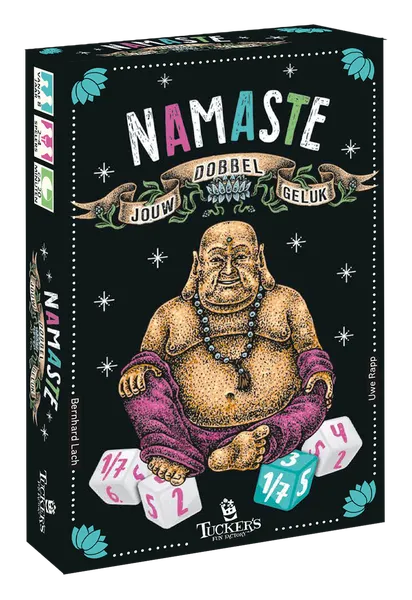

Namaste is een Roll & Write spel, waarbij je de geworpen punten slim moet invullen om punten te scoren. Maar pas op; wanneer je niet snel genoeg bent, kun je die punten op je buik schrijven. In Namaste moet je een balans vinden tussen snelheid en strategie.
Namaste – Een eerste indruk
Namaste zit in een heel fijn doosje, tenminste dat vind ik. Het is geen doosje met deksel, zoals we dat veelal gewend zijn, maar het doosje heeft een schuifsysteem, met een kleine opening, waardoor je het makkelijk met je vinger naar buiten schuift. Wat mij betreft echt een pluspunt.
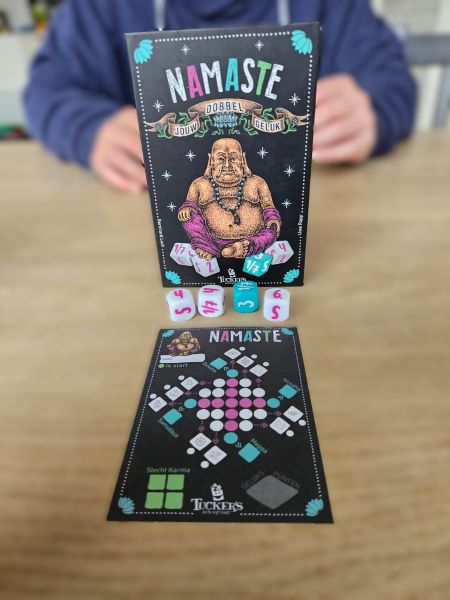
Bij het openen van het doosje treffen we maar weinig spelmateriaal aan; een scoreblok, 4 dobbelstenen en een handleiding.
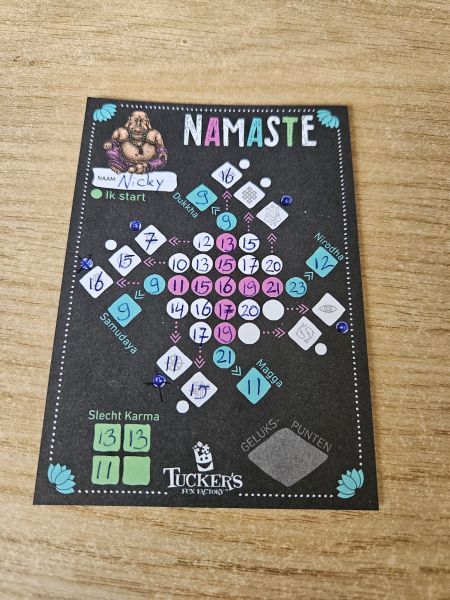
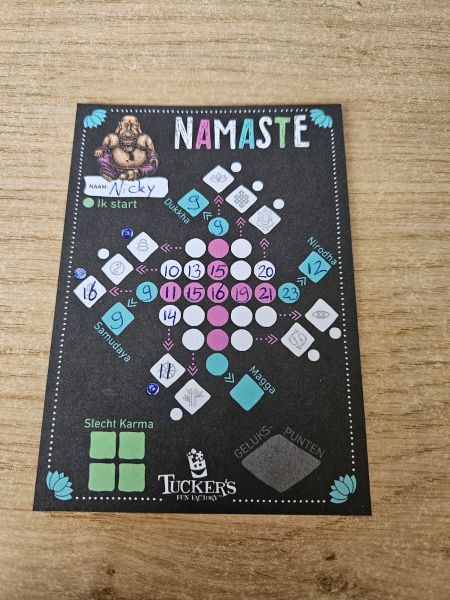
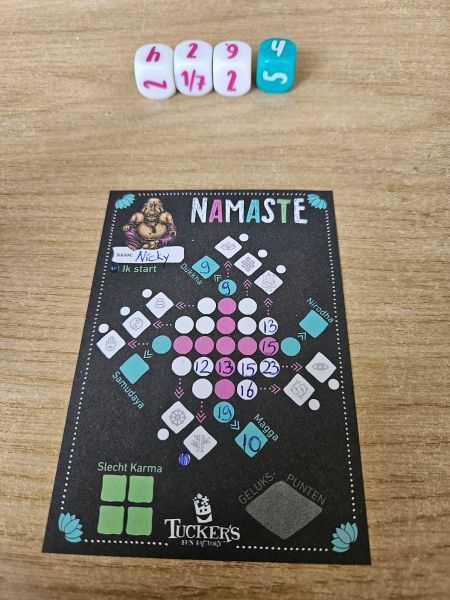
Het scoreformulier ziet er bijzonder uit; een zwarte achtergrond en allerlei boeddhistische termen en tekens.
Hoe wordt het gespeeld?
We gaan het scoreformulier even bekijken;
Op het formulier zie je een ruit met cirkels en daarom heen zie je vierkantjes en kleine cirkeltjes.
Onderaan staan nog 4 groene vakjes met slecht karma.
De geworpen resultaten worden in de cirkels in het midden ingevuld. De punten die meetellen voor je eindscore worden ingevuld in de vierkanten.
Hoe gaan we dat doen?
De eerste speler gooit alle 4 de dobbelstenen. Hij telt het resultaat en mag dit invullen in één van de cirkels op zijn scoreblad. Hierbij gelden de voorwaarden; In kolommen en rijen moeten cijfers oplopend zijn én mag hetzelfde cijfer niet dubbel voorkomen.
De niet actieve spelers tellen het resultaat van de witte dobbelstenen op en vullen die in op diens scorebladen.
Wanneer een speler een rij of kolom vol heeft mag hij in het bijbehorende vierkant (aangegeven d.m.v. pijltjes) het getal invullen dat in de middelste (paarse) cirkel van die rij of kolom staat.
Maar let op, alleen de speler die deze kolom/rij als eerste vol heeft mag de volle punten pakken. Andere spelers kleuren daarop het kleine cirkeltje naast het vierkant in, dit betekent dat als zij deze rij/kolom vol hebben, ze nog maar de helft van de punten uit de paarse cirkel mogen noteren.
Dan zijn er ook nog 4 blauwe cirkeltjes. Deze scoren direct. Bij de 2 linker cirkels mag je het getal gewoon overnemen. Bij de 2 rechter cirkels krijg je de helft van de punten.
Als je een worp niet in kunt vullen, krijg je de gegooide waarde als minpunten bij Slecht Karma.
Het spel eindigt als een speler óf alle cirkels heeft ingevuld of als iemand alle 4 de slecht karma vakjes geeft gevuld.
Nu worden de punten uit de vierkanten opgeteld en de minpunten afgetrokken. Wie de meeste punten heeft, wint.
Wat vinden wij van Namaste?
De vormgeving vind ik leuk, mijn enthousiasme over het doosje heb ik al geuit, maar ook de rest van de uitwerking vind ik leuk. Het thema is er, wat mij betreft, overduidelijk opgeplakt, want het spel had precies hetzelfde geweest zonder de boeddhistische details, maar hé, het geeft het spel wel een identiteit.
Het spel zelf is snel uitgelegd en speelt makkelijk weg. Wij maakten wel de eerste keer de fout om veel te ‘laag’ in te zetten. We hadden de waarden van de dobbelstenen niet helemaal goed ingeschat, waardoor we beiden al heel snel helemaal vast zaten. Het tweede potje hadden we inzicht in wat ‘hoog’ en ‘laag’ was, waardoor betere keuzes gemaakt werden.
Namaste is geen heel bijzonder spel, maar zeker een leuke aanvulling in de kast. Het is niet moeilijk, maar vergt wel licht nadenkwerk, een perfecte filler, opstarter of afsluiter.
Dit is wat mij betreft ook echt zo’n spel dat je meeneemt naar de camping, want je hebt het zo uitgelegd, ook aan niet-spellen-spelers.
Eindconclusie:
Namaste is een prima Roll & Write, niet heel bijzonder, maar zeker een leuke toevoeging aan de spellenkast. Ik geef Namaste 7 van de 10 sterren.

Namaste
Players: 2-4
Time: 20 minutes
Age: 8+
Author: Bernhard Lach, Uwe Rapp
Publisher: moses. Verlag GmbH
Year: 2021
Namaste is a Roll & Write game, in which you have to fill in the points you roll wisely in order to score points. But be careful; if you’re not quick enough, you can kiss those points goodbye. In Namaste, you have to find a balance between speed and strategy.
Namaste – First impressions
Namaste comes in a very nice box, at least in my opinion. It is not a box with a lid, as we are used to, but the box has a sliding system with a small opening, allowing you to easily slide it out with your finger. As far as I’m concerned, this is a real plus.
When opening the box, we find very little game material: a score pad, 4 dice, and a manual.
The score sheet looks unusual: a black background and all kinds of Buddhist terms and symbols.
How is it played?
Let’s take a look at the score sheet.
On the sheet, you see a diamond with circles and around it you see squares and small circles.
At the bottom are four green boxes with bad karma.
The results of the dice roll are entered in the circles in the middle. The points that count towards your final score are entered in the squares.
How do we do that?
The first player throws all four dice. He counts the result and may fill it in one of the circles on his score sheet. The following conditions apply: In columns and rows, numbers must be ascending and the same number may not appear twice.
The inactive players add up the results of the white dice and fill them in on their score sheets.
When a player has completed a row or column, they may fill in the number in the middle (purple) circle of that row or column in the corresponding square (indicated by arrows).
But beware, only the player who completes this column/row first may take the full points. Other players then color in the small circle next to the square, which means that if they complete this row/column, they may only score half the points from the purple circle.
There are also 4 blue circles. These score immediately. For the 2 circles on the left, you can simply copy the number. For the 2 circles on the right, you get half the points.
If you cannot fill in a throw, you get the thrown value as minus points in Bad Karma.
The game ends when a player has filled in all the circles or when someone has filled in all 4 Bad Karma boxes.
Now the points from the squares are added up and the minus points are subtracted. Whoever has the most points wins.
What do we think of Namaste?
I like the design; I’ve already expressed my enthusiasm about the box, but I also like the rest of the game. In my opinion, the theme is obviously tacked on, because the game would have been exactly the same without the Buddhist details, but hey, it does give the game an identity.
The game itself is quick to explain and easy to play. The first time we played, we made the mistake of betting too “low.” We hadn’t quite estimated the values of the dice correctly, which meant that we were both stuck very quickly. The second game, we understood what ‘high’ and “low” meant, which allowed us to make better choices.
Namaste is not a very special game, but it is definitely a nice addition to your collection. It is not difficult, but it does require some light thinking, making it a perfect filler, starter, or closer.
In my opinion, this is also one of those games that you take with you to the campsite, because it’s so easy to explain, even to non-gamers.
Final conclusion:
Namaste is a great Roll & Write game, not very special, but definitely a nice addition to your game collection. I give Namaste 7 out of 10 stars.