

Aantal spelers: 2-8
Speelduur: 30 minuten
Leeftijd: Vanaf 10 jaar
Auteur: Fréderic Moyersoen
Uitgever: 999 Games
Jaar: 2025
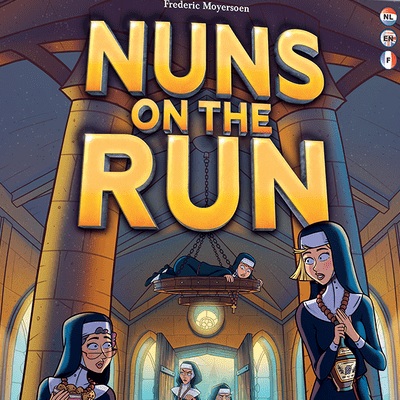

De jonge nonnen zijn stout! En ondeugend. Ze ontsnappen uit hun kamer in het klooster en zijn op zoek naar voorwerpen die verboden zijn: alcohol, make up, brieven van vriendjes, etc. Boefjes zijn het. Laat de oudere nonnen het maar niet merken.
In Nuns on the Run speel je of de jonge nonnen (novice) of de oudere nonnen. De jonge nonnen lopen onzichtbaar door het gebouw om voorwerpen te pakken terwijl de oudere nonnen (wel zichtbaar) dat proberen te voorkomen.
Componenten en opzet
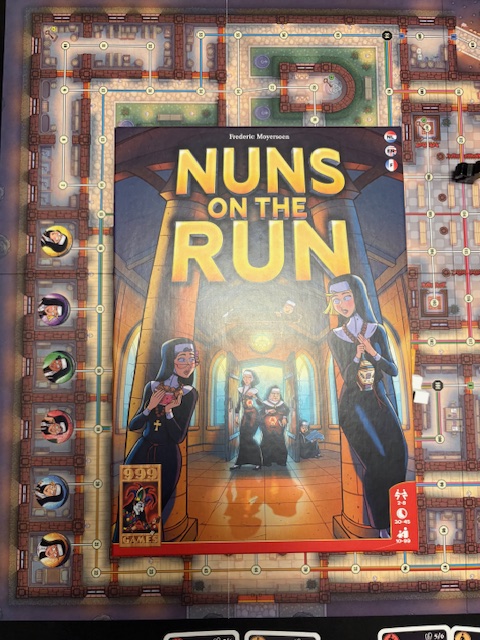
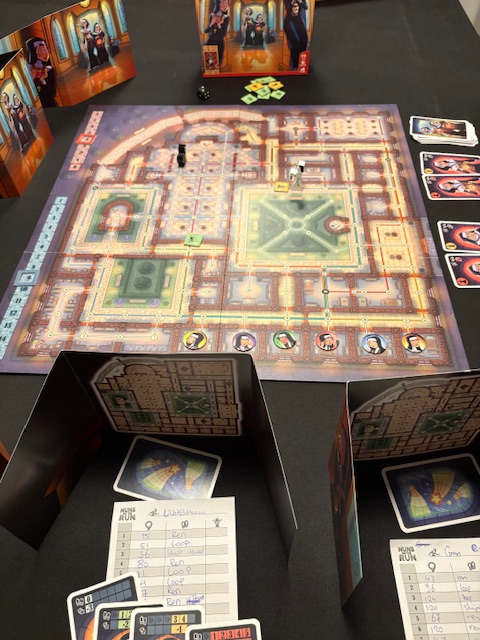
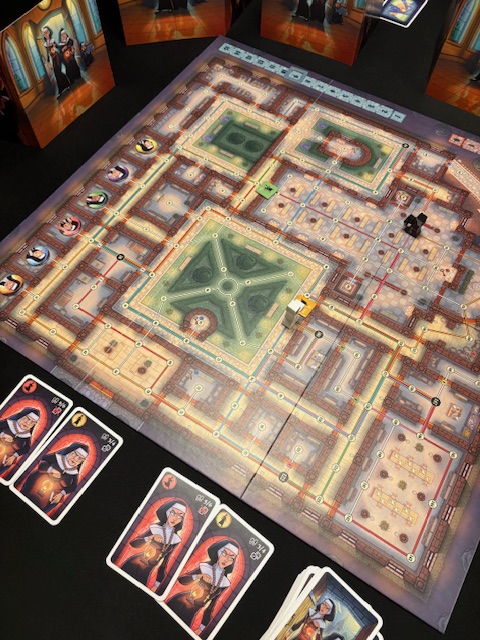
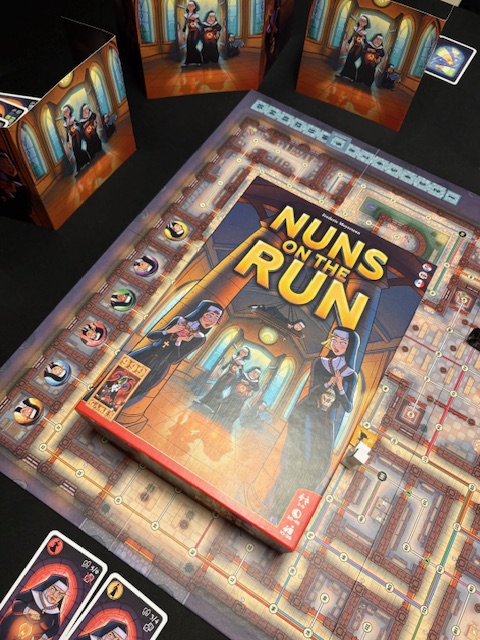
Nuns on the Run bestaat uit een speelbord, kaarten, schermen, 2 oudere nonnen en tokens. Prima kwaliteit en het artwork is heel grappig en past goed in het thema. Voordat je begint bepaal je eerst of je een jonge of een oudere non wilt spelen. Beide moeten in het spel aanwezig zijn. De 2 oudere nonnen kunnen door een speler gespeeld. De andere spelers spelen allemaal een jonge non (novices).
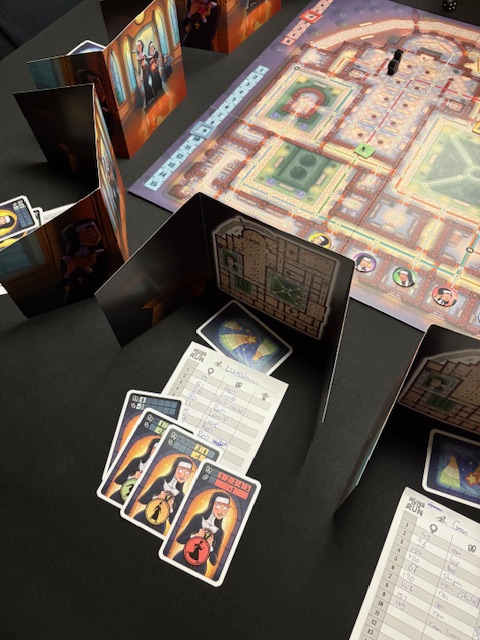
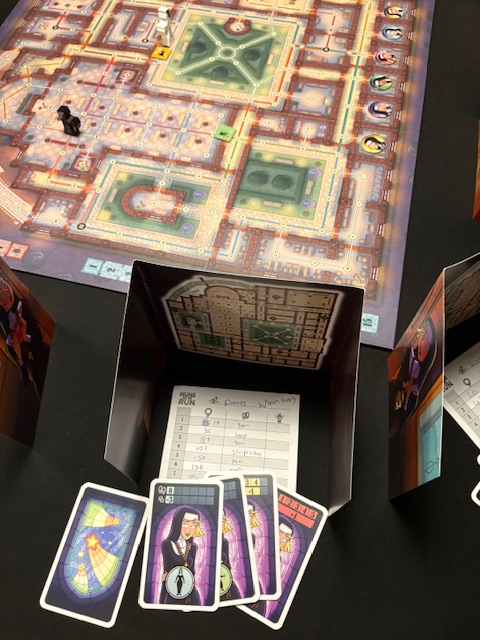
Leg het speelbord op tafel en geef iedereen zijn/haar bewegingskaarten. De novices krijgen een wenskaart, dit is de opdracht tot het pakken van verboden voorwerpen, een notitieblad, een scherm en tokens. De (oudere) nonnen krijgen bewegingskaarten en een route.
Hoe wordt het spel gespeeld
De novices moeten uit hun kamer lopen en eerst een sleutel pakken om vervolgens hun verboden voorwerp te pakken. Dit gebeurt niet zichtbaar op het hoofdbord maar op een notitieblok achter hun scherm. Ze lopen dus onzichtbaar door het klooster en proberen niet gepakt te worden door een non. De nonnen lopen wel zichtbaar op het hoofdbord en proberen de novices te pakken waarbij ze geholpen worden door het geluid wat de novices maken.
Als novices speel je het spel zo:
- Kies een van de vier kaarten uit je hand: blijven staan, sluipen, lopen of rennen
- Verplaats je een aantal stappen volgens de gekozen kaart. De verplaatsingen schrijf je op je notitieblok achter je scherm.
- Gooi de dobbelsteen en pas het getal aan met de gekozen kaart. Dit is het geluid. Als je gaat rennen heb je een grotere kans op meer geluid.
- Als het geluid een non kan bereiken, dan moet je een geluidstoken neerleggen bij de non met de richting vanwaar het geluid komt.
- Zo loop je door het klooster. Je moet eerst een sleutel ophalen om dichte deuren te openen en daarna het voorwerp ophalen. Als je als eerste terug bent in je slaapkamer met voorwerp, heb je gewonnen.
Als non speel je het spel zo:
- Je staat op het hoofdbord. Je speelt een bewegingskaart en loopt in de richting van het geluid (als dat er is) of andere volgens een vaste route.
- Als je een nieuwe ruimte inloopt met je lantaarn moeten novices in die ruimte aangeven dat ze daar ook zijn. De non kan ze dan zien. Uiteraard loopt de non dan naar ze toe. Om ze te pakken moet de non op hetzelfde veld staan als de novice
- Er zijn 2 nonnen die door het klooster lopen.
Wat vind ik van het spel
Nuns on the run kan gespeeld worden van 2-8 personen, maar is vooral geschikt voor 4-8 personen. Met te weinig spelers heb je kans dat het erg moeilijk wordt voor de nonnen om iemand te betrappen. Ik heb grote lol met het spel gehad. Ik speelde vaak de non en meerdere mensen keken mij zeer spannend aan om te ontdekken welke kant de non opging. De spanning is dan van de novices af te lezen. Na afloop ontstaan er dan ook allerlei verhalen: “ik was daar bijna gepakt”, “ik moest steeds omlopen”, het scheelde soms heel weinig”. Als het spel afgelopen is, barst de discussie en verhalen los. Dat komt natuurlijk omdat iedereen tijdens het spel alles zelf en verborgen doet. Helaas zijn de spelregels hier en daar wat onduidelijk en omslachtig geschreven, een duidelijke opsomming van de stappen zou prettiger zijn. Het hidden movement principe komt (helaas) niet veel voor en het is erg leuk dat er een spel met hidden movement uitkomt. Het is wat lastig om dit soort spellen goed in regels te gieten en beheersbaar te maken. Het spel Beast is dit uitmuntend gelukt, maar dat is meer een expert spel. Nun on the run is erin geslaagd om een lastig mechanisme naar het familiespel te brengen en erg toegankelijk te maken. Een top familiespel voor de iets grotere groep of gezin. Ik geef het graag een 8.

Nuns on the Run
Players: 2-8
Time: 30 minutes
Age: 10+
Author: Fréderic Moyersoen
Publisher: 999 Games
Year: 2025
The young nuns are naughty! And mischievous. They escape from their room in the convent and are looking for forbidden items: alcohol, makeup, letters from friends, etc. They’re rascals. Just don’t let the older nuns know.
In Nuns on the Run, you play either the young nuns (novices) or the older nuns. The young nuns invisibly move through the building to retrieve items, while the older nuns (visible) try to prevent them.
Components and Setup
Nuns on the Run consists of a game board, cards, screens, two older nuns, and tokens. The quality is excellent, and the artwork is very funny and fits the theme well. Before you start, decide whether you want to play a young or an older nun. Both must be present in the game. The two older nuns can be played by one player. The other players all play a young nun (novices).
Place the game board on the table and deal everyone their movement cards. The novices receive a wish card, which instructs them to retrieve forbidden objects, a notepad, a screen, and tokens. The (older) nuns receive movement cards and a route.
How to play the game
The novices must leave their room and first retrieve a key, then retrieve their forbidden object. This is not visible on the main board, but on a notepad behind their screen. They therefore walk through the monastery invisibly, trying to avoid being caught by a nun. The nuns, however, walk visibly on the main board and try to capture the novices, aided by the sounds the novices make.
As novices, you play the game as follows:
– Choose one of the four cards from your hand: stay put, sneak, walk, or run.
– Move a number of steps according to the chosen card. Record your movements on the notepad behind your screen.
– Roll the die and match the number with the chosen card. This is the sound. If you run, you have a greater chance of making more sound. – If the sound can reach a nun, you must place a sound token next to the nun, pointing in the direction the sound is coming from.
– This is how you move through the monastery. You must first retrieve a key to open closed doors and then retrieve the object. If you return to your bedroom with the object first, you win.
As a nun, you play the game as follows:
– You stand on the main board. You play a movement card and walk in the direction of the sound (if there is one) or in another direction, following a fixed route.
– When you enter a new room with your lantern, novices in that room must indicate that they are there. The nun can then see them. Naturally, the nun then walks towards them. To retrieve them, the nun must be on the same space as the novice.
– There are two nuns moving through the monastery.
What do I think of the game?
Nuns on the Run can be played by 2-8 players, but is best suited for 4-8 players. With too few players, it might be very difficult for the nuns to catch anyone. I had a lot of fun with this game. I often played the nun, and several people watched me anxiously, trying to figure out which way the nun was going. The tension in the novices was palpable. Afterwards, all sorts of stories arise: “I almost got caught there,” “I had to keep going around,” “sometimes it was a close call.” Once the game is over, discussions and stories erupt. This is, of course, because everyone does everything themselves and secretly during the game. Unfortunately, the rules are a bit unclear and cumbersome in places; a clear summary of the steps would be better. The hidden movement principle isn’t used very often (sadly), and it’s great that a game with hidden movement is being released. It’s somewhat difficult to properly formulate these kinds of games into rules and make them manageable. Beast succeeds admirably, but that’s more of an expert game. Nun on the Run has managed to bring a difficult mechanism to the family game and make it very accessible. A top family game for a slightly larger group or family. I give it an 8.