

Aantal spelers: 2-4
Speelduur: 40 minuten
Leeftijd: 8+
Auteur: Adrie Drent
Uitgever: Jolly Dutch Productions
Jaar: 2024
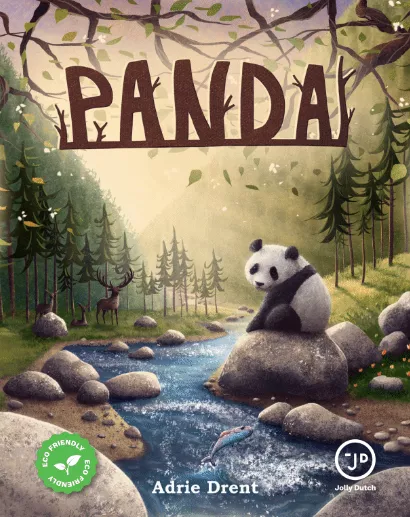

Dit is een herpublicatie van een review die ik eerder schreef voor bordspelwereld.nl
In Panda bevinden we ons tussen de wilde dieren in het Giant Panda National Park in China. Kan jij je prooi- en roofdieren zodanig uitzetten in het park dat ze je zo veel mogelijk punten opleveren? Dan win jij Panda!
Panda speelt zich af in het zeer recent (2021) opgerichte Giant Panda National Park in Centraal China. Het park strekt zich uit over 3 provincies en omvat 67 bestaande pandareservaten. Momenteel leven er zo’n 1900 reuzenpanda’s in dit nationale park en er zijn bewijzen dat de populatie aan het groeien is. Dat is goed nieuws voor dit iconische symbool van China! Door de 67 oorspronkelijke reservaten met elkaar te verbinden en er beschermde gebieden tussen te creëren, kunnen de reuzenpanda’s zich nu ongestoord tussen de verschillende regio’s verplaatsen en zo hun genetische diversiteit vergroten. Dit zal er voor zorgen dat de panda-populatie sterker en stabieler zal zijn in de toekomst.
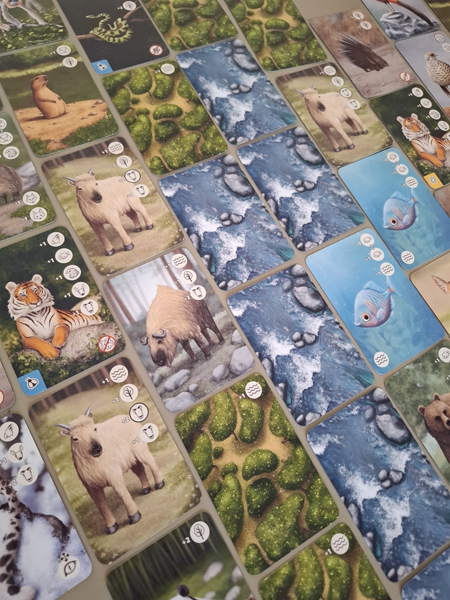
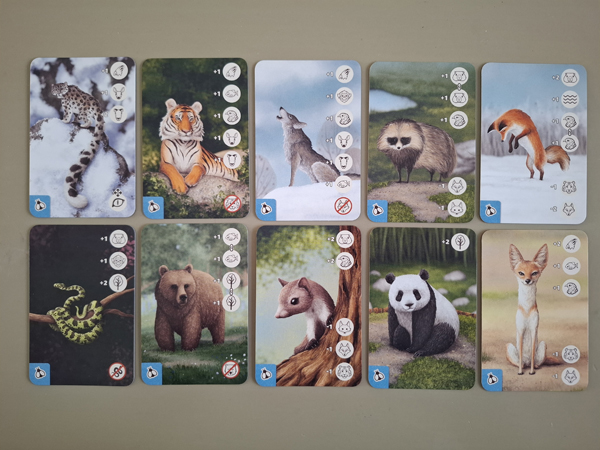
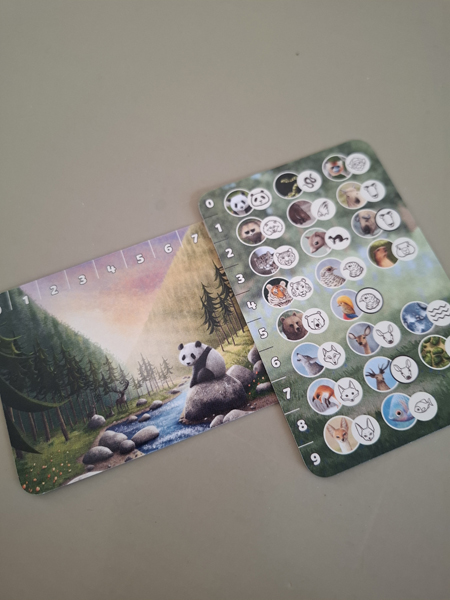
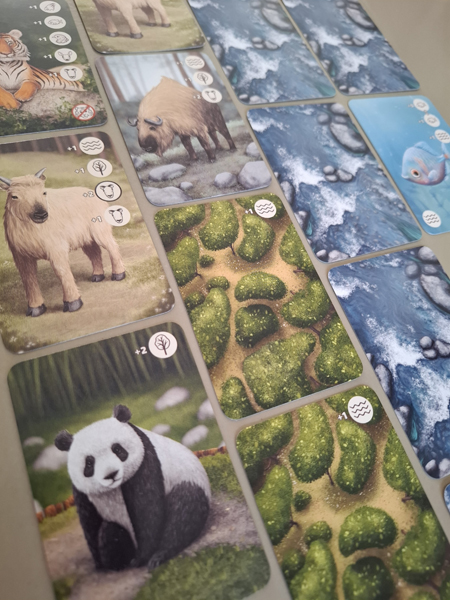
Panda is een kaartspel voor 2 tot 4 spelers dat ongeveer 40 minuten duurt. Je probeert zoveel mogelijk punten te scoren door prooi- en roofdieren strategisch in het Giant Panda National Park te plaatsen. Elke speler start met dezelfde 10 roofdierkaarten, die hij open voor zich neerlegt zodat de andere spelers kunnen zien wie welke roofdieren nog kan spelen. Elke speler krijgt aan het begin van elke ronde ook 6, 4 of 3 (naargelang het aantal spelers) prooidierkaarten. Om de beurt leggen de spelers 1 prooi- of roofdierkaart in het grid op tafel volgens de plaatsingsregels. In elke ronde mag iedere speler slechts 2 roofdierkaarten plaatsen en moet hij al zijn prooidierkaarten leggen. Een ronde eindigt dan ook wanneer alle spelers al hun prooidieren en 2 roofdieren in het park hebben geplaatst. Het spel loopt over 4 rondes waarbij alle kaarten tot op het einde van het spel op tafel blijven liggen. Daarna wordt de eindscore berekend.
Prooidieren worden gescoord op het moment dat ze gelegd worden, roofdieren leveren aan het einde van het spel punten op. Prooi- en roofdieren worden wel op exact dezelfde manier gescoord. Welk dier hoeveel punten oplevert, hangt volledig af van de kaarten waar ze naast liggen. Dit wordt heel duidelijk weergegeven via icoontjes op de verschillende kaarten. Omdat de prooidieren worden gescoord op het moment dat je ze legt, is het belangrijk om daarvóór al iets op te bouwen. Roofdieren krijgen pas aan het eind van het spel punten: de roofdieren kan je dus tijdens het verdere verloop van het spel nog verder omringen met de juiste dieren om er op het einde van het spel veel punten voor te krijgen.
Mijn mening over Panda?
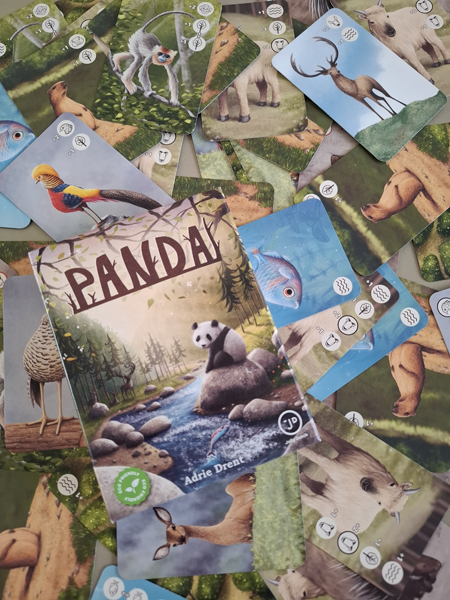
De prachtige tekening op de cover van Panda laat mij, als natuurliefhebber, niet onberoerd en trok dan ook meteen mijn aandacht toen ik het spel voor het eerst zag langskomen op mijn computerscherm. Ook het artwork op de kaarten is heel mooi met een duidelijke iconografie. Heel kort samengevat: Panda is een fijn puzzelspel in een klein, aantrekkelijk doosje. Let wel: het doosje is dan wel klein, maar om het spel te spelen heb je wel wat tafelruimte nodig. Ideaal voor op reis dus, maar niet voor onderweg!
Ik was wel een beetje teleurgesteld om te ontdekken dat het spel eigenlijk niet bepaald over reuzenpanda’s gaat. Op dat vlak is de titel dus wel wat misleidend. Het spel gaat over prooi- en roofdieren in het nationale park: er is per speler slechts 1 reuzenpanda in het spel. En die zit dan nog bij de roofdieren terwijl de reuzenpanda officieel een herbivoor is die voornamelijk bamboe eet! Biologisch gezien niet helemaal correct dus. Maar dat is uiteraard niet relevant voor het spel, dat is enkel mijn biologen-aard die even de kop op steekt. Als je het spel dus zou willen aanschaffen op basis van de titel omdat de reuzenpanda je lievelingsdier is, dan kom je bedrogen uit!
Maar verder is Panda een prima puzzelspel. Omdat iedereen in hetzelfde grid op tafel speelt, is de interactie tussen de spelers groot. Dit uit zich dan vooral in het elkaar dwarszitten en daar moet je wel tegen kunnen. Je kan iets heel moois proberen opbouwen met je prooidierkaarten en iemand anders kan dan zomaar een roofdier spelen op de plaats waar jij dat wou doen. Dat zou voor sommige spelers wel eens frustrerend kunnen zijn. Maar op een ander moment in het spel, lap je dat gewoon terug. Dat is ook het leuke aan het feit dat je slechts 2 roofdieren per ronde mag spelen (en in het hele spel dus slechts 8 van je 10 roofdieren): soms zou een speler je dwars kúnnen zitten, maar kan die dat op dat moment niet doen omdat hij in deze ronde geen roofdier meer mag spelen.
Het is dan ook fijn dat je steeds kan zien welke roofdieren je tegenstanders nog ter beschikking hebben. Het is bij de roofdieren dus vooral een kwestie van het juiste roofdier op het juiste moment te spelen. Dit is iets minder noodzakelijk bij het spelen van prooidieren. Zoals bij zoveel spellen is er een heel andere dynamiek wanneer je dit spel met 2 spelers speelt dan wel met 3 of 4 spelers. Bij 2 spelers is het altijd dezelfde persoon die je viseert, bij meer spelers is dat beter verdeeld en bijgevolg minder frustrerend. Denk dus 2x na vooraleer je dit spel met je partner speelt 😉.

Panda
Players: 2-4
Time: 40 minutes
Age: 8+
Author: Adrie Drent
Publisher: Jolly Dutch Productions
Year: 2024
In Panda, we find ourselves among the wild animals in the Giant Panda National Park in China. Can you release your preys and predators into the park in such a way that they earn you as many points as possible? Then you will win Panda!
Panda is set in the very recently (2021) established Giant Panda National Park in central China. The park spans 3 provinces and includes 67 existing panda reserves. Some 1900 giant pandas currently live in this national park and there is evidence that the population is growing. This is good news for this iconic symbol of China! By connecting all 67 original reserves and creating protected areas between them, the giant pandas can now move undisturbed between regions, increasing their genetic diversity. This will ensure that the panda population will be stronger and more stable in the future.
Panda is a card game for 2 to 4 players that lasts about 40 minutes. You try to score as many points as possible by strategically placing preys and predators in the Giant Panda National Park. Each player starts with the same 10 predator cards, which they place face-up in front of them so that the other players can see who can still play which predators. Each player also receives 6, 4 or 3 (depending on the number of players) predator cards at the beginning of each round. In turn, players place 1 prey or predator card in the grid on the table according to the placement rules. In each round, each player may only place 2 predator cards and must place all their prey cards. A round therefore ends when all players have placed all their prey cards and 2 predator cards. The game takes 4 rounds with all cards remaining on the table until the end of the game. After that, the final score is calculated.
Prey animals are scored the moment they are placed, predators score points at the end of the game. Prey animals and predators are scored in exactly the same way. Which animal scores how many points depends entirely on the cards they are placed next to. This is shown very clearly via icons on the different cards. Because the prey animals are scored the moment you place them, it is important to build up something beforehand. Predators only get points at the end of the game: you can therefore surround the predators with the right animals during the rest of the game to get lots of points for them at the end.
My opinion?
As a nature lover, the beautiful drawing on the cover of Panda does not leave me unmoved and therefore immediately caught my attention when I first saw the game passing by on my computer screen. The artwork on the cards is also very nice with clear iconography. Very briefly: Panda is a fine puzzle game in a small, attractive box. Note: the box may be small, but to play the game you will need some table space. So ideal for travelling, but not on the road!
I was a little disappointed to discover, though, that the game is not actually particularly about giant pandas. So on that front, the title is a bit misleading. The game is about prey and predators in the national park: there is only 1 giant panda per player in the game. And that one is among the predators while the giant panda is officially a herbivore that mainly eats bamboo! Biologically not quite correct then. But this is obviously irrelevant to the game, it’s just my biologist nature rearing its head. So if you would want to buy the game based on the title because the giant panda is your favourite animal, you will be disappointed!
But otherwise, Panda is a fine puzzle game. Because everyone plays in the same grid on the table, interaction between players is great. This manifests itself mainly in thwarting each other, and you have to be able to handle that. You can try to build something really nice with your prey cards and someone else can play a predator just where you wanted to. That could be frustrating for some players. But at another point in the game, you do exactly the same to them. That’s also the nice thing about the fact that you can only play two predators per round (and therefore only 8 of your 10 predators in the whole game): sometimes a player cóúld be bothering you, but can’t do so at that moment because he can’t play any more predators in this round.
So it’s nice that you can always see which predators your opponents still have available. With predators, it is mainly a matter of playing the right predator at the right time. This is slightly less necessary when playing prey animals. As with so many games, there is a very different dynamic when you play this game with 2 players rather than 3 or 4 players. With 2 players, it is always the same person you fish, with more players it is better distributed and consequently less frustrating. So think twice before playing this game with your partner .