Aantal spelers: 1-4
Speelduur: 15-30 minuten
Leeftijd: Vanaf 10 jaar
Auteur: Molly Johnson, Robert Melvin, Shawn Stankewich
Uitgever: White Goblin Games
Jaar: 2023

Dit is een herpublicatie van een review die ik eerder schreef voor bordspelwereld.nl
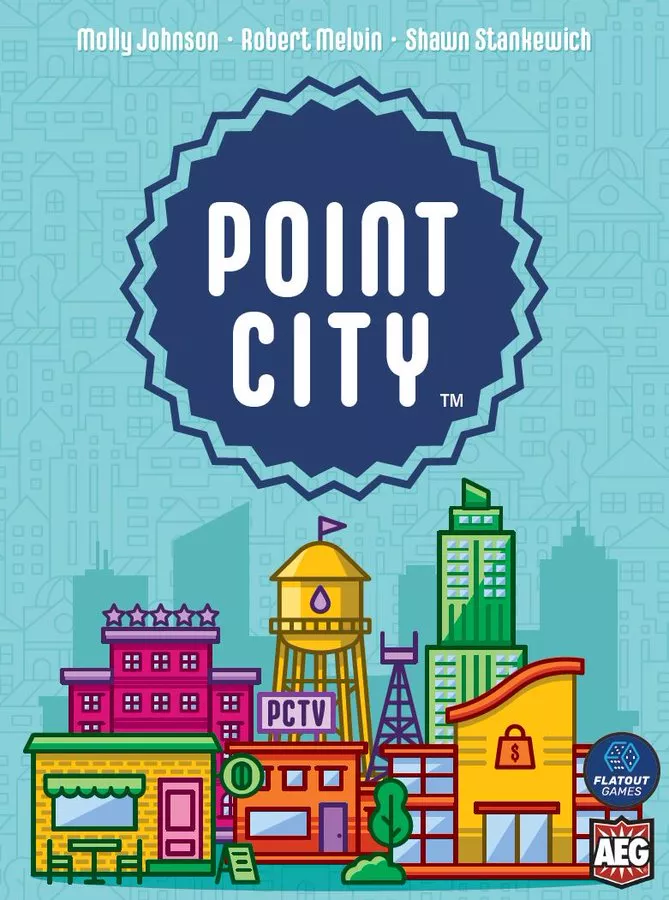
In Point City moeten de spelers middelen verzamelen om een stad te bouwen. Of je nou met 2 of met 4 spelers speelt, je hebt altijd 17 beurten om je stad te bouwen en daarmee zoveel mogelijk punten binnen te halen. Ook in dit spel, wie de meeste punten heeft, heeft gewonnen.
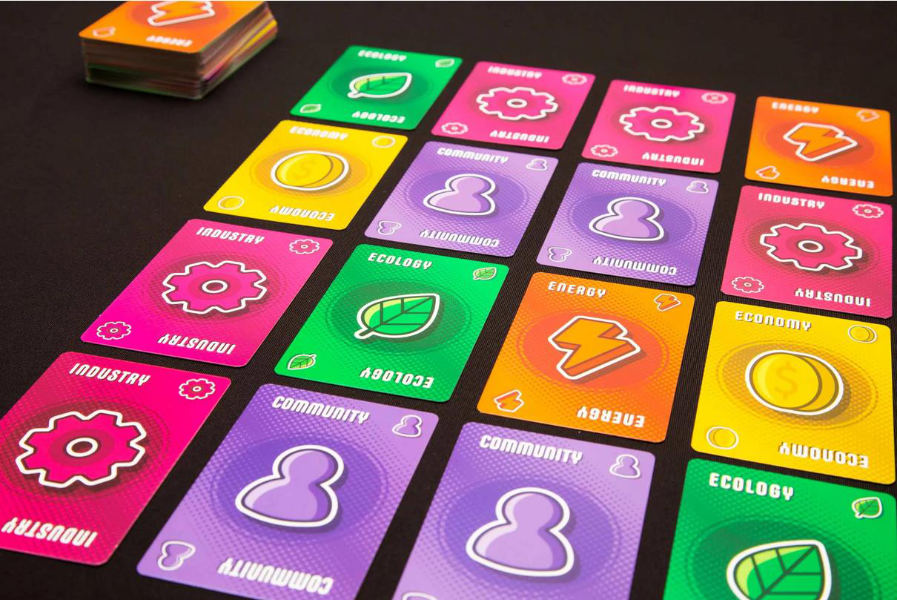
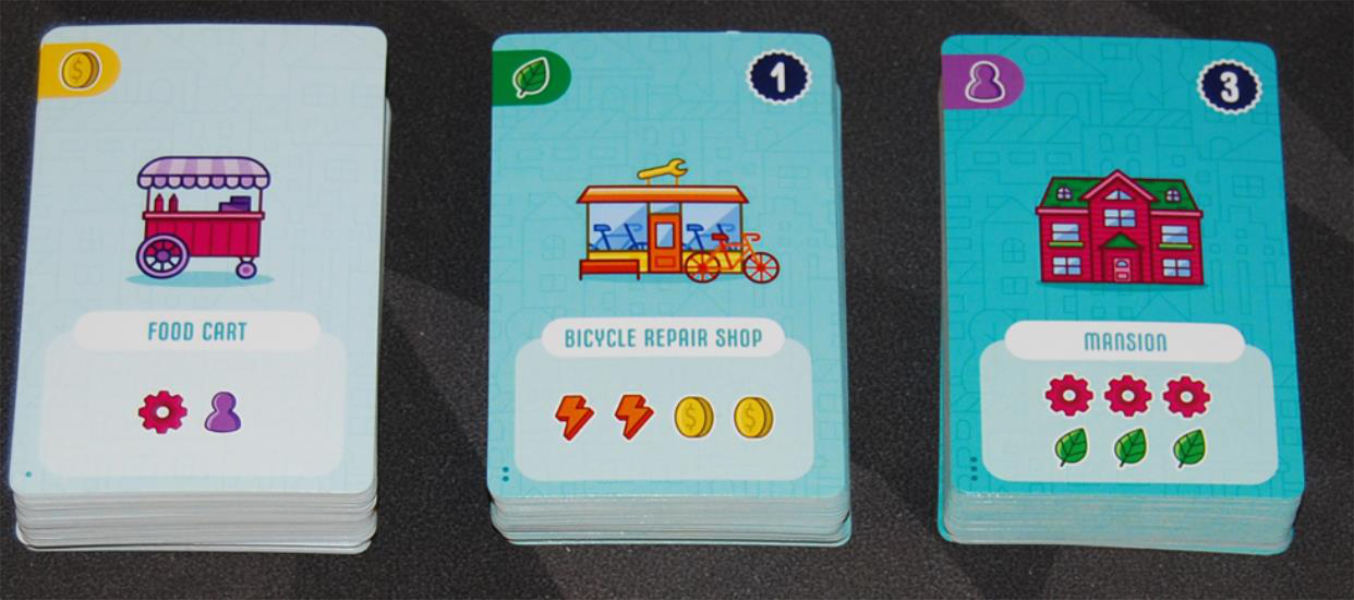
Je kunt je stad bouwen met kaarten. Deze kaarten hebben 2 kanten. De vel gekleurde kant is de voorkant en deze noemen we ëgrondstoffení: Industrie (tandwiel icoon, Rood), Energie (bliksem icoon, Oranje), Economie (geld icoon, Geel) , Ecologie (Blad icoon, Groen), en Gemeenschap (poppetje icoon, Paars), Joker (Ster icoon, Regenboog).
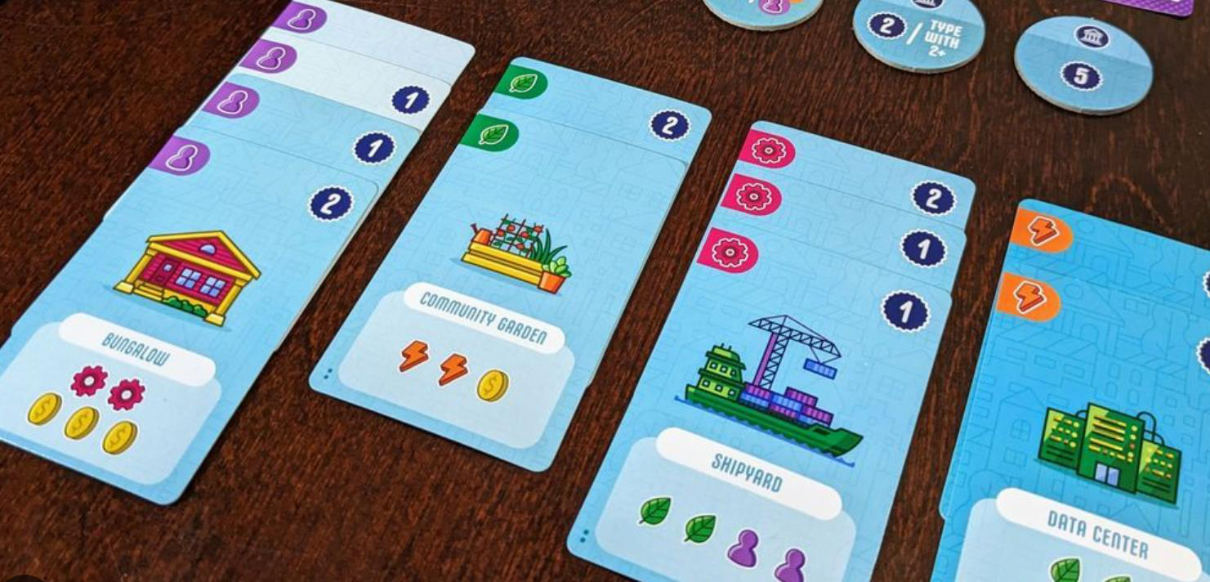
Op de achterkant van de kaart staat altijd een gebouw. Onderaan staat wat het kost om dat gebouw te bouwen, als er links boven aan een icoontje staat met een kleur, zal dit gebouw 1 van deze “grondstof” produceren en als er rechts boven aan op de kaart een getal staat, zijn dit overwinningspunten die bij elkaar opgeteld worden aan het einde van het spel.
Om het spel te beginnen is er wat voorbereiding nodig. Eerst is het belangrijk met hoeveel spelers je het spel gaat spelen. Je moet namelijk een gedeelte van de kaarten uit het spel halen.
Alle kaarten in het spel hebben op de ëfabriekskantí links onderaan 1, 2 of 3 stippen staan.
Je maakt in het begin van het spel 3 stapels met alle 1 stippen bij elkaar en een stapel met alle 2 stippen en een stapel met alle 3 stippen.
Kaarten met 1 stip zijn de kaarten met gebouwen die niet veel grondstoffen nodig hebben en die dus makkelijker zijn om in je bezit te komen. Kaarten met 2 stippen zijn weer iets moeilijker te bouwen en met 3 stippen zijn ëlastigeí om te bouwen.
Dus nu heb je 3 stapels.
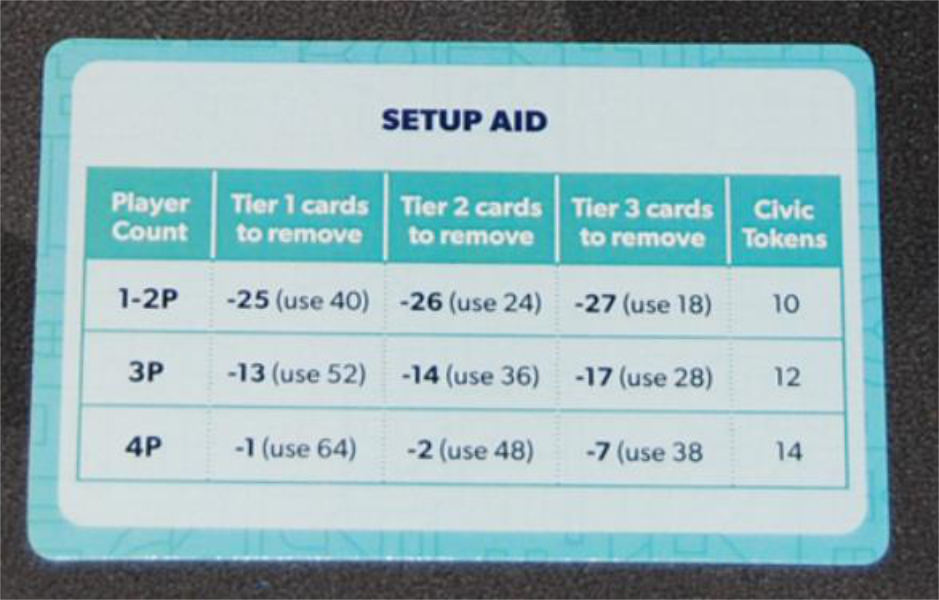
• Bij 1 of 2 spelers haal je van de 1 stippen 25 kaarten af, 26 van de 2 stippen en 27 van de 3 stippen.
• Bij 3 spelers haal je van de 1 stippen 13 kaarten af, 14 van de 2 stippen en 17 van de 3 stippen.
• Bij 4 spelers haal je van de 1 stippen 1 kaart af, 2 van de 2 stippen en 7 van de 3 stippen.
Er zit een hele handige kaart in de doos waar dit op staat.
• Pak nu de stapel met 3 stippen en leg deze stapel met de ëGrondstoffení kant naar boven (fel gekleurde kant).
• Pak nu de stapel met 2 stippen en leg die op de stapel met 3 stippen, ook met de ëGrondstoffení fel gekleurde kant naar boven.
En dit zelfde doe je met de stapel met 1 stip.
Er zitten nog ronde schijfjes in de doos. Zo’n schijfje is een “stadhuis”. Deze leg je allemaal met de rug naar boven op tafel.. husselt deze door elkaar en pakt er voor 1 of 2 spelers 10, voor 3 spelers 12 en voor 4 spelers 14. De rest gaat terug in de doos. Deze stadhuizen worden omgedraaid op tafel, zichtbaar voor iedereen.
Nu gaan we in het midden van de tafel een raster van 4 x 4 aan kaarten neerleggen.
Je pakt van de stapel en legt deze 1 voor 1 neer. Je begint links boven aan en eindigt rechts onderaan. Kaarten die aangevuld worden later in het spel worden altijd in deze beweging neergelegd. Dus niet random. Dit kan namelijk invloed hebben op het spel.
Er liggen nu 4 rijtjes van 4 met fel gekleurde kaartjes met daarop grondstoffen op tafel, de stadhuizen liggen op tafel en de stapel met kaarten liggen goed.
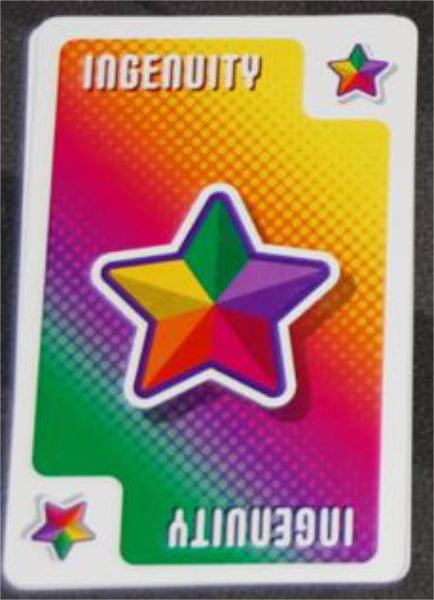
Nu krijgt elke speler nog een Joker. Een ster kaart met een witte rand.
We kiezen een startspeler.. en we kunnen beginnen!
Regels
Je pakt of koopt altijd 2 kaarten die aan elkaar grenzen horizontaal of verticaal (dus niet diagonaal). Een fel gekleurde grondstof kaart mag je gratis pakken maar is het een fabriek/gebouw, dan moet je de grondstoffen daarvoor in je bezit voor je hebben. Deze staan op de fabriekskaart afgebeeld met icoontjes.
Deze grondstoffen moet je dan eerst verzameld hebben om die fabriek/gebouw te kunnen kopen.
Dus 2 aangrenzende grondstof kaarten mag je gratis pakken maar als er 2 gebouwen/fabrieken aan elkaar grenzen en geen gratis grondstof kaart ernaast ligt, dan moet je die wel kunnen betalen met je grondstoffen die je voor je hebt liggen. Anders kan je het andere gebouw ook niet kopen. Je MOET altijd 2 kaarten die aan elkaar grenzen pakken/kopen.
Als je een fabriek/gebouw koopt dan leg je de fel gekleurde kaarten die je daarvoor nodig hebt op de aflegstapel. Sommige gebouwen/fabrieken produceren 1 grondstof. Deze mag permanent voor je liggen als je deze gebouwd hebt. Elke beurt produceert deze 1 grondstof en deze mag je dus maar 1 keer gebruiken in je beurt. Deze kun je dus gebruiken om fabrieken/gebouwen te kopen maar hoef je dus niet af te leggen op de aflegstapel.
Koop je een gebouw/fabriek met een “Stadhuis” symbool rechts boven aan op de kaart? Dan mag je een Stadhuis schijfje pakken. Deze kan extra punten opleveren aan het einde van het spel. In de handleiding staat vermeld wat elk schijfje doet en hoeveel hij oplevert.
Als je zo’n schijfje in je bezit hebt, kun je ook je spel aanpassen naar de mogelijkheid van het schijfje waardoor je misschien meer punten kunt halen.
Als er iets gepakt is van tafel (de 16 kaarten op tafel) dan worden deze als volgt aangevuld.
Op de plek waar een grondstof kaart lag, komt een fabriek/gebouw te liggen (van de trekstapel en dan omdraaien) En op de plek waar een fabriek/gebouw lag komt een grondstof kaart van de trekstapel. Deze regel blijft het hele spel van kracht en de kaarten worden dus van links boven naar rechts onder aangevuld. Er zitten 2 schijfjes in de doos om dit eventueel duidelijk te maken wat waar lag.
Kan je niets pakken of “kopen” met je beschikbare grondstoffen, dan mag je 2 “grondstof” kaarten van de trekstapel pakken.
Dat was dan je beurt.
Is deze stapel op, dan eindigt het spel want dan is iedereen 17 keer aan de beurt geweest. Punten worden geteld en wie de meeste punten heeft.. die is de winnaar van Point City.
Oordeel
Ik heb de Kickstarter versie gekocht in het Engels en daar zitten nog 4 extra stadhuisschijfjes bij.
Binnenkort, (oktober/november 2023) brengt White Goblin de Nederlandse versie uit. Deze is te pre-orderen op hun website.
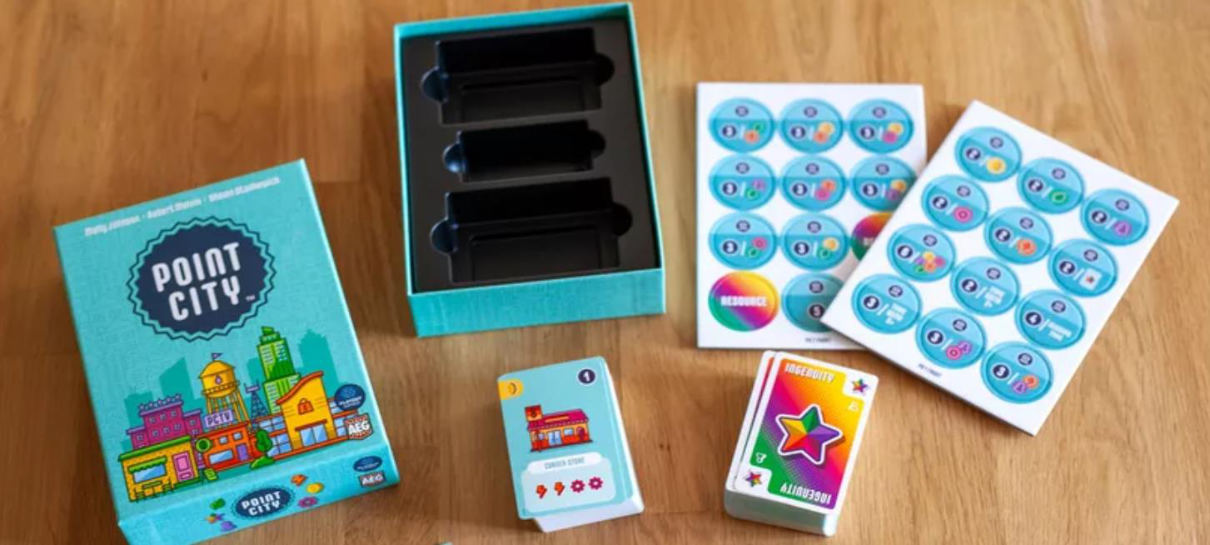
In de doos zitten
• 160 dubbelzijdige grondstof/gebouwen kaarten
• 4 speler startkaarten
• 22 stadhuis schijfjes
• 2 schijfjes met daarop grondstof of fabriek
• 1 overzichtskaart voor de verdeling kaarten en schijfjes aantal spelers (super handig)
• een boekje met spelregels.
Het is een super leuk spelletje wat je makkelijk op tafel krijgt. Het zit goed in elkaar en omdat je steeds kaarten en schijfjes er uit haalt aan het begin van het spel, en elk potje anders is, een hoge her-speelbaarheid factor. Het opzetten kost even tijd maar daarna kan je snel door..
Tip
Bij het opruimen even alle kaarten op stippen sorteren. Dat scheelt tijd bij het opzetten van het volgende spelletje.
Ik wil ook even vermelden dat de insert van de doos prima is. Het is geen lege doos met zakjes.
Prijzen varieren van 19 à 25 euro. Ik heb de Kickstarter gekocht voor 25 euro.
Gewoon een goed spelletje. Doos niet al te groot dus kan lekker mee op vakantie.

Point City
Players: 1-4
Time: 15-30 minutes
Age: 8+
Author: Molly Johnson, Robert Melvin, Shawn Stankewich
Publisher: Flatout Games
Year: 2023
In Point City, players must gather resources to build a city. Whether you play with 2 or 4 players, you always have 17 turns to build your city and collect as many points as possible. Also in this game, whoever has the most points wins.
You can build your city with cards. These cards have 2 sides. The sheet colored side is the front and we call these ‘resources’: Industry (gear icon, Red), Energy (lightning icon, Orange), Economy (money icon, Yellow), Ecology (Leaf icon, Green), and Community (puppet icon , Purple), Joker (Star icon, Rainbow).
There is always a building on the back of the card. At the bottom it says what it costs to build that building, if there is an icon with a color at the top left, this building will produce 1 of this “resource” and if there is a number at the top right of the card, these are victory points that are added together at the end of the game.
To start the game some preparation is needed. First it is important how many players you will play the game with. You have to remove some of the cards from the game.
All cards in the game have 1, 2 or 3 dots on the ‘factory side’ at the bottom left.
At the beginning of the game you make 3 piles with all 1 dots together and a pile with all 2 dots and a pile with all 3 dots.
Cards with 1 dot are cards with buildings that do not require many resources and are therefore easier to acquire. Cards with 2 dots are slightly more difficult to build and cards with 3 dots are ‘difficult’ to build.
So now you have 3 piles.
With 1 or 2 players you remove 25 cards from the 1 dots, 26 from the 2 dots and 27 from the 3 dots.
With 3 players you remove 13 cards from the 1 dots, 14 from the 2 dots and 17 from the 3 dots.
With 4 players you remove 1 card from the 1 dots, 2 from the 2 dots and 7 from the 3 dots.
There is a very handy card in the box that says this.
Now take the stack with 3 dots and place this stack with the ‘Resources’ side up (brightly colored side).
Now take the stack with 2 dots and place it on the stack with 3 dots, also with the ‘Raw Materials’ brightly colored side up.
And you do the same with the stack with 1 dot.
There are still round discs in the box. Such a disk is a “town hall”. Place all of these with their backs up on the table, mix them up and take 10 for 1 or 2 players, 12 for 3 players and 14 for 4 players. The rest goes back in the box. These town halls are turned over on the table, visible to everyone.
Now we are going to place a 4 x 4 grid of cards in the center of the table.
You take from the pile and put it down one by one. You start at the top left and end at the bottom right. Cards that are replenished later in the game are always placed in this movement. So not random. This can affect the game.
There are now 4 rows of 4 with brightly colored cards with raw materials on them on the table, the town halls are on the table and the stack of cards is in the right place.
Now each player gets another Joker. A star card with a white border.
We choose a starting player… and we can start!
Lines
You always take or buy 2 cards that are adjacent to each other horizontally or vertically (not diagonally). You can take a brightly colored resource card for free, but if it is a factory/building, you must have the resources in your possession. These are depicted on the factory map with icons.
You must first have collected these raw materials before you can buy that factory/building.
So you can take 2 adjacent resource cards for free, but if there are 2 buildings/factories adjacent to each other and there is no free resource card next to them, you must be able to pay for them with the resources you have in front of you. Otherwise you cannot buy the other building. You MUST always take/buy 2 cards that are adjacent to each other.
If you buy a factory/building, place the brightly colored cards you need for it on the discard pile. Some buildings/factories produce 1 resource. This may be permanently in front of you once you have built it. Each turn it produces 1 resource, so you can only use it once in your turn. You can use these to buy factories/buildings, but you do not have to discard them from the discard pile.
Do you buy a building/factory with a “City Hall” symbol at the top right of the map? Then you can take a Town Hall token. This can earn extra points at the end of the game. The manual states what each disc does and how much it yields.
If you have such a disc in your possession, you can also adjust your game to the disc’s capabilities, which may allow you to get more points.
If something is taken from the table (the 16 cards on the table), they are added as follows.
A factory/building is placed on the spot where a raw material card was located (from the draw pile and then turned over). And on the spot where a factory/building was located, a raw material card is placed from the draw pile. This rule remains in effect throughout the game and the cards are therefore replenished from top left to bottom right. There are 2 discs in the box to make it clear what was where.
If you cannot take or “buy” anything with your available resources, you may take 2 “resource” cards from the draw pile.
That was your turn.
If this pile is used up, the game ends because everyone has had a turn 17 times. Points are counted and whoever has the most points… is the winner of Point City.
Judgement
I bought the Kickstarter version in English and it comes with 4 extra town hall discs.
White Goblin will soon release the Dutch version (October/November 2023). This can be pre-ordered on their website.
Sit in the box
160 double-sided resource/building cards
4 player starting cards
22 town hall tokens
2 discs with raw material or factory on it
1 overview card for the distribution of cards and discs of number of players (super handy)
a booklet with rules of the game.
It is a super fun game that you can easily get on the table. It is well put together and because you always take out cards and discs at the start of the game, and every game is different, a high re-playability factor. Setting up takes some time, but after that you can continue quickly..
Tip
When cleaning up, sort all the cards by dots. This saves time when setting up the next game.
I would also like to mention that the box insert is fine. It’s not an empty box with bags.
Prices vary from 19 to 25 euros. I bought the Kickstarter for 25 euros.
Just a good game. The box is not too big so it can be taken along on holiday.