

Aantal spelers: 1-5
Speelduur: 15-30 minuten
Leeftijd: 10+ (8+)
Auteur: Molly Johnson, Robert Melvin, Shawn Stankewich
Uitgever: White Goblin Games
Jaar: 2025
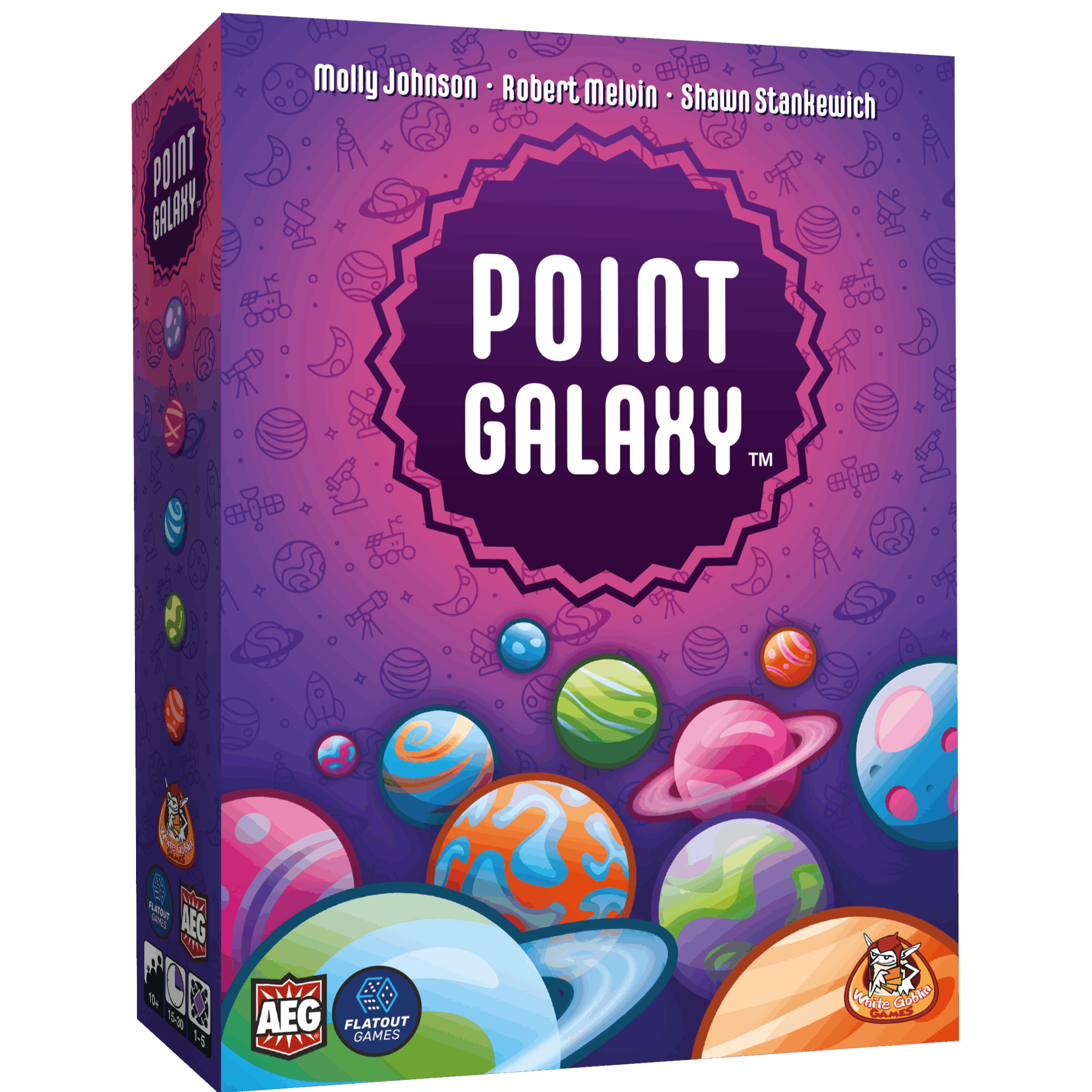

Binnenkort verschijnt Point Galaxy in het Nederlands bij White Goblin Games.
Ik ben een gematigd fan van de Point-serie en heb de Engelse versie van Point Galaxy al in mijn bezit. Dus: tijd voor een review.
Point Galaxy is een spel in de Point-reeks: een kaartspel voor 1–5 spelers waarin je op verschillende manieren punten kunt scoren.
Iedere speler bouwt een eigen heelal, dat voornamelijk bestaat uit planeten, maar ook zonnen, manen en asteroïden leveren punten op. En vergeet ondertussen niet om ook nog wat onderzoek te doen in de ruimte!
Point Galaxy – een eerste indruk
Qua uiterlijk doet Point Galaxy sterk denken aan Point City: hetzelfde doosje, dubbelzijdige kaarten en puntentokens.
Ik kan Point City enorm waarderen, dus ik was benieuwd of Point Galaxy net zo leuk – of misschien zelfs leuker – zou zijn.
Mikolaj is erg geïnteresseerd in het heelal, dus zodra het spel hier binnen was, wilde hij het meteen spelen. Het thema werd in elk geval direct goedgekeurd.
Het regelboekje is duidelijk, al moet je bij sommige ‘speciale kaarten’ wel even goed lezen. Gelukkig is er voor iedere speler een referentiekaart: aan de ene kant uitleg over de speciale kaarten en aan de andere kant een overzicht van alle scoringsmogelijkheden, inclusief bijbehorende punten.
Hoe wordt het gespeeld?
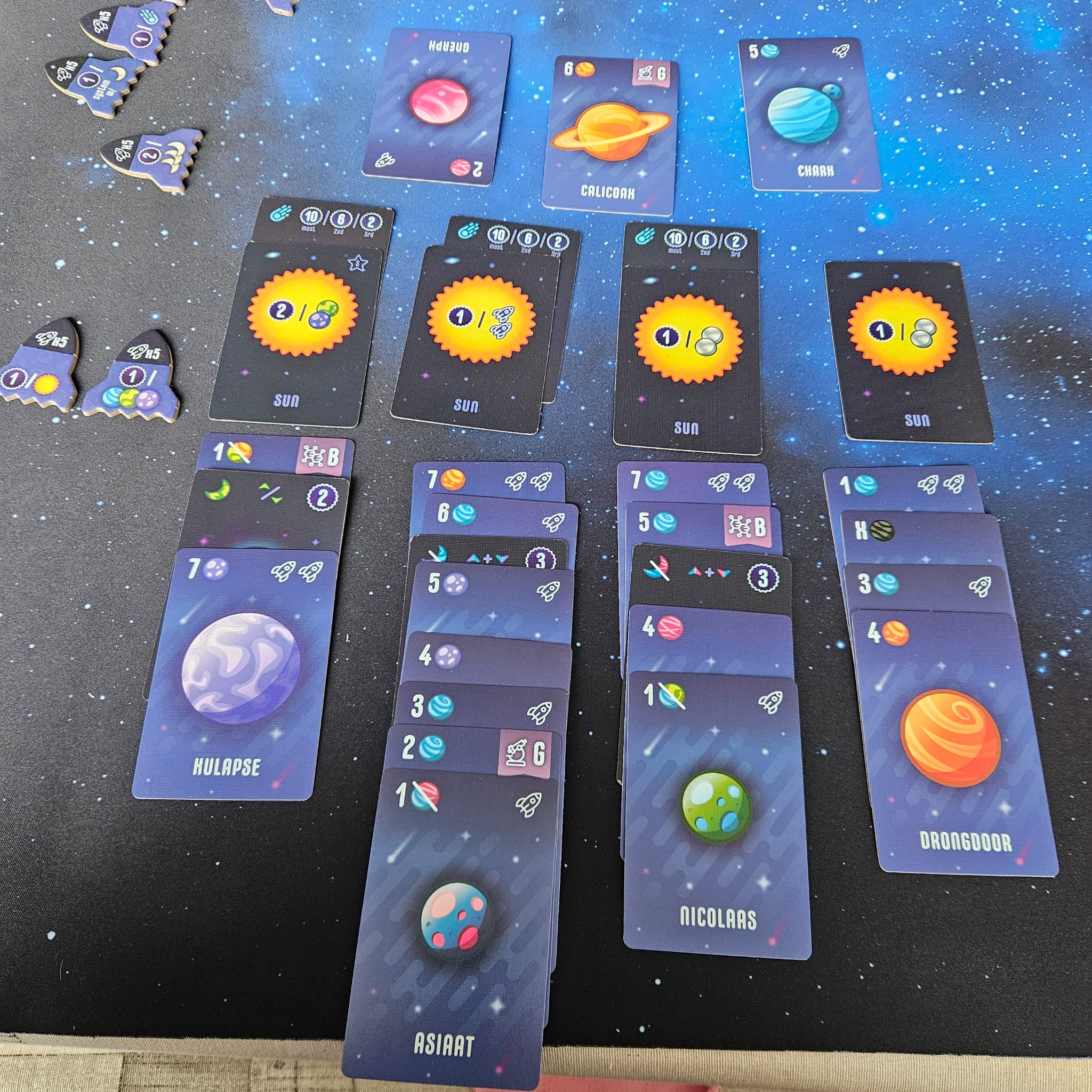
Iedere speler krijgt één startkaart met een zon: het begin van diens heelal.
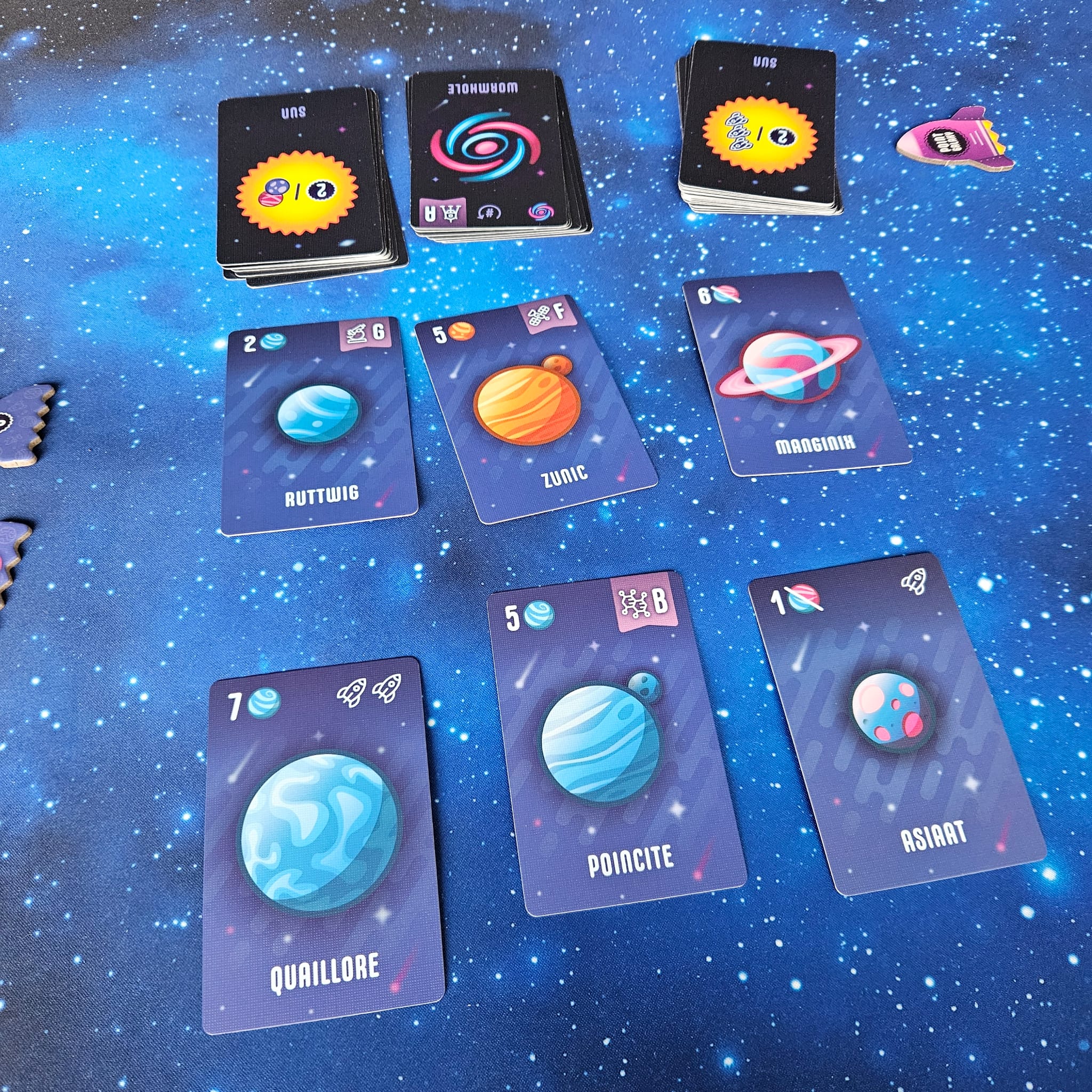
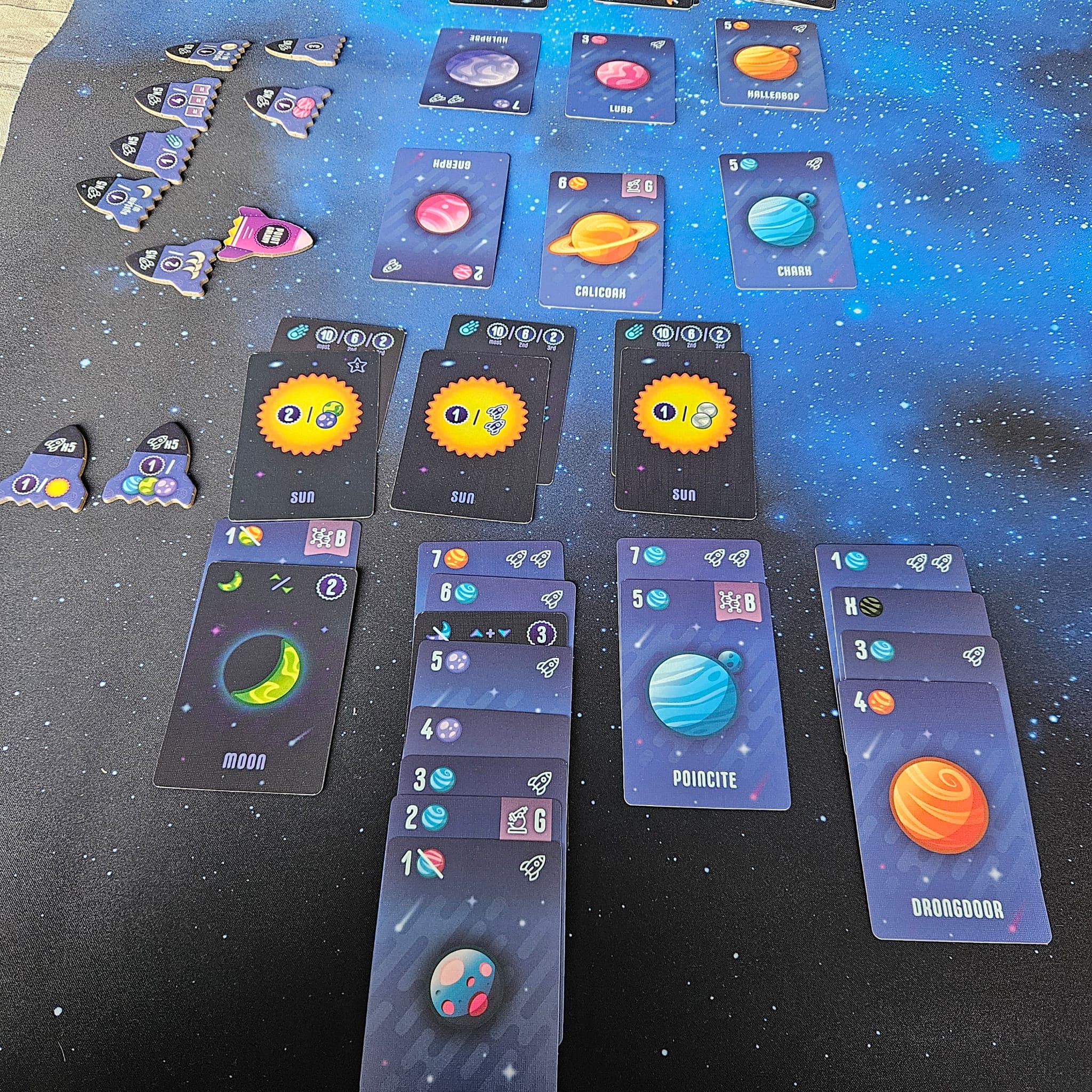
De overige kaarten worden geschud met de ‘speciale’ zijde naar boven en verdeeld in ongeveer drie gelijke stapels. Van elke stapel worden de bovenste twee kaarten omgedraaid. Zo ontstaat een aanbod van zes planeten en drie speciale kaarten.
Spelers pakken om de beurt twee kaarten uit het aanbod en plaatsen deze in hun eigen heelal.
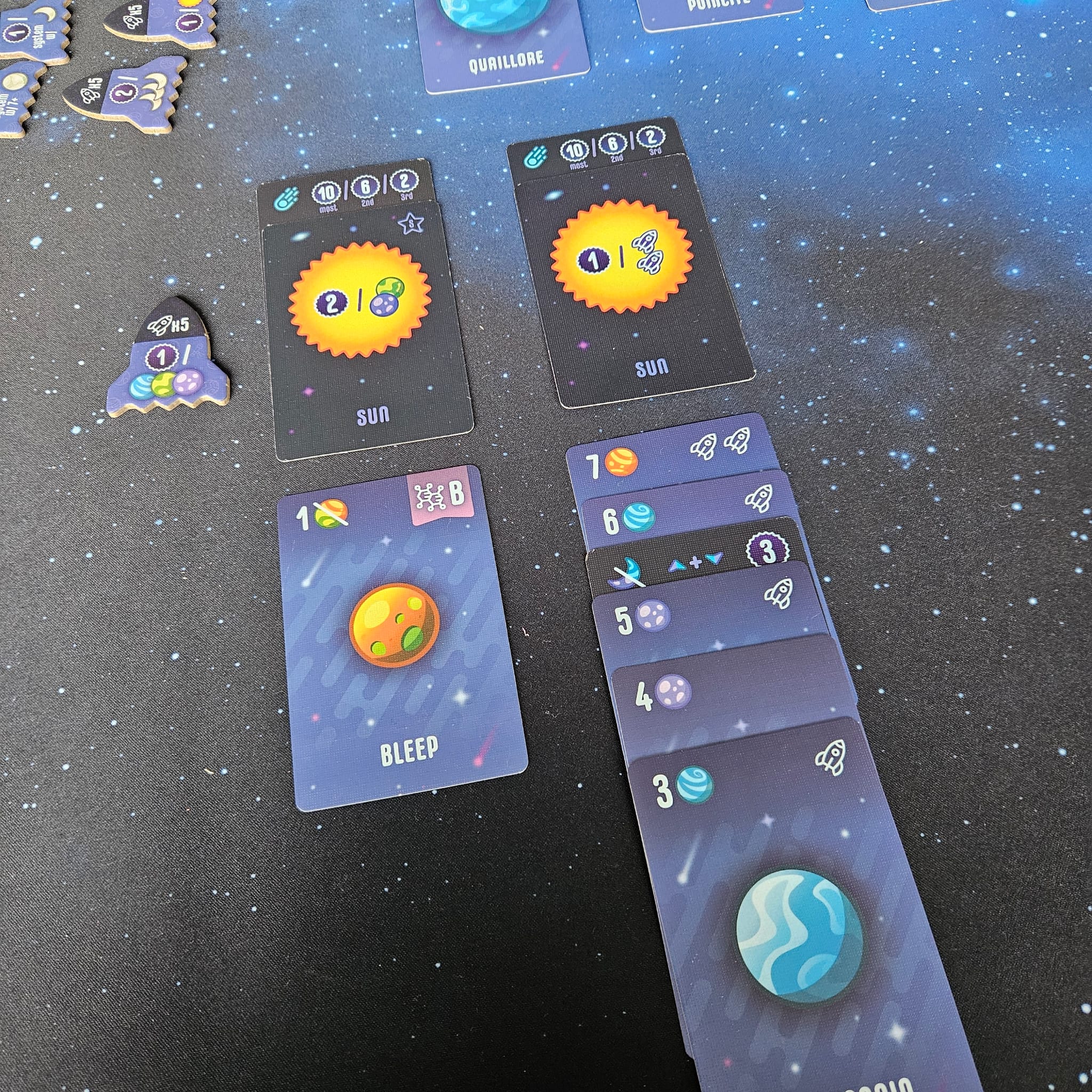
Je heelal bestaat uit kolommen kaarten, ook wel zonnestelsels. De basis van een zonnestelsel wordt gevormd door planeten. Speciale kaarten (zoals zonnen en manen) kunnen aan een zonnestelsel worden toegevoegd om extra punten te scoren.
Planeten
-
In elk zonnestelsel mag elk getal maar één keer voorkomen.
-
De kaarten worden in oplopende of aflopende volgorde geplaatst.
-
Een nieuwe kaart mag alleen boven of onder de bestaande kaarten worden gelegd, niet ertussen.
-
Het is niet verplicht om alle getallen te gebruiken: een reeks als 1–3–4–6 is dus toegestaan.
Je mag op elk moment met een planeet een nieuw zonnestelsel beginnen.
Speciale kaarten
Asteroïde
Asteroïden worden achter een zon geplaatst. Je mag er dus alleen één pakken als je een beschikbare zon hebt.
Wormgat
Een wormgat mag in een zonnestelsel worden gelegd en zorgt ervoor dat je opnieuw mag beginnen met een getallenreeks.
Maan
Een maan wordt in een zonnestelsel geplaatst. Op de kaart staat aangegeven tussen welke planeten de maan moet liggen om punten te scoren.
Zon
Een zon wordt boven een zonnestelsel gelegd. Dit mag bij een bestaand zonnestelsel (maximaal één zon per zonnestelsel) of bij een nieuw zonnestelsel.
Dit vormt de basis van het bouwen van je heelal.
Puntentelling
Zonnen
Elke zon heeft een eigen scoringsvoorwaarde en scoort punten op basis van de kaarten die eronder liggen en aan die voorwaarde voldoen.
Planeten
Per zonnestelsel wordt gekeken hoeveel verschillende getallen het bevat.
Asteroïden
De spelers met de meeste asteroïden ontvangen punten (1e, 2e en 3e plaats).
Manen
Manen scoren punten wanneer ze aan hun specifieke voorwaarden voldoen.
Onderzoeksvelden
Sommige kaarten bevatten onderzoeksvelden. Hoe meer verschillende onderzoeksvelden je verzamelt, hoe meer punten je krijgt.
Raketten
Voor elke vijf raketten in je hele heelal mag je een rakettoken kiezen. Ook hierop staan weer voorwaarden om punten te scoren.
Dit gebeurt direct na het plaatsen van de vijfde (of tiende, vijftiende, enz.) raket.
De speler met de meeste punten wint.
Oeps…
De eerste keer dat ik Point Galaxy speelde, was ik niet erg onder de indruk. Het spel werd uitgelegd, maar tijdens het spelen snapten we meerdere dingen niet of leken regels niet te kloppen. Het voelde chaotisch en we liepen vast.
Toen ik het spel later zelf in bezit kreeg, ben ik opnieuw in de spelregels gedoken. Ik zag meteen waar het de eerste keer mis was gegaan* en gaf het spel een nieuwe kans. En nog één. En nog één. Ik speelde met twee spelers, met drie spelers en solo.
* De regels zijn niet moeilijk, maar je moet ze wel goed lezen. Eén (essentiële) regel missen en je hele spel ligt in duigen.
Solo
Omdat ik het spel oorspronkelijk vooral voor solo had aangeschaft, begon ik daarmee.
In de solo-variant speel je tegen een bot die je op drie niveaus kunt instellen. Deze niveaus veranderen niet het spelverloop, alleen de puntentelling.
Je speelt zelf precies hetzelfde als in een spel met meerdere spelers. Voor de bot ligt vast welke kaarten hij pakt; dit houd je bij door een rakettoken rondom het aanbod te verplaatsen.
Hierdoor heb je enige voorkennis over wat er in de volgende ronde voor jou overblijft – iets wat je bij meerdere spelers maar moet afwachten.
Daarnaast bevat het spel een kleine solo-campagne in het regelboekje, wat een leuke extra is.
Wat vinden wij van Point Galaxy?
Na de eerste speelsessie had ik het gevoel dat het spel potentie had, maar dat die er niet uit was gekomen. Daarom gaf ik het, ondanks die eerste teleurstelling, toch een nieuwe kans. En terecht.
Point Galaxy is echt een prima spel. Solo voelt het als een ontspannen puzzel: de bot voert geen ingewikkelde acties uit, waardoor je lekker kunt doorspelen.
Ook met meerdere spelers speelt het prettig, zelfs met Mikolaj (7,5 jaar). Volgens het doosje is hij daar eigenlijk nog te jong voor (10+), maar hij deed het verrassend goed. Voor de overzichtelijkheid hebben we de wormgaten weggelaten en de rakettokens vooraf uitgekozen in plaats van willekeurig te trekken.
Dat 10+ advies zit hem vooral in het feit dat er veel verschillende manieren zijn om te scoren. Dat is tegelijkertijd de kracht én de zwakte van het spel. Er gebeurt veel, je moet veel in de gaten houden en er zijn constant keuzes te maken. Dat kan overweldigend aanvoelen voor zo’n relatief simpel kaartspel.
Aan de andere kant zorgt dit er juist voor dat spelers moeten schakelen: je wordt een bepaalde richting op gestuurd, maar moet soms bijsturen omdat de juiste kaarten niet voorbij komen.
Hoe meer spelers, hoe sterker dit effect wordt. Het aanbod verandert sneller en is minder voorspelbaar dan in solo, waar je precies weet wat de bot gaat pakken en daarop kunt anticiperen.
Ondanks de soms wat chaotische indruk vind ik Point Galaxy vooral een ontspannen puzzelspel. Een klein minpuntje vind ik de kleuren van de planeten: die zijn voor veel mensen lastig uit elkaar te houden (zelf heb ik daar gelukkig weinig last van).
Wat ik erg geslaagd vind, is dat het typische ‘Point-gevoel’ behouden is gebleven, terwijl Point Galaxy toch duidelijk anders speelt dan Point City. Persoonlijk vind ik Point City nét iets leuker, maar de spellen verschillen genoeg om ze allebei in de kast te laten staan.
Eindconclusie
Point Galaxy is een (tamelijk) relaxte puzzel die soms wat chaotisch kan aanvoelen – en dat is wat mij betreft juist zijn kracht.
Score: 7/10

Point Galaxy
Players: 1-5
Time: 15-30 minutes
Age: 10+ (8+)
Author: Molly Johnson, Robert Melvin, Shawn Stankewich
Publisher: Flatout Games / Alderac Entertainment Group
Year: 2025
Soon Point Galaxy will be released in Dutch by White Goblin Games.
I am a moderate fan of the Point series and already own the English version of Point Galaxy — so it’s time for a review.
Point Galaxy is a game in the Point series: a card game for 1–5 players in which points can be scored in many different ways.
Each player builds their own universe, consisting mainly of planets, but suns, moons, and asteroids also score points. And don’t forget to do some research in space along the way!
Point Galaxy – a first impression
Visually, Point Galaxy strongly resembles Point City: the same small box, double-sided cards, and score tokens.
I really enjoy Point City, so I was curious to see whether Point Galaxy would be just as fun — or perhaps even better.
Mikolaj is very interested in space, so as soon as the game arrived, he wanted to play it immediately. The theme was instantly approved.
The rulebook is clear, although some ‘special cards’ require careful reading. Fortunately, each player gets a reference card: one side explains the special cards, while the other side shows all scoring methods, including their point values.
How is it played?
Each player receives one starting card with a sun — the beginning of their universe.
The remaining cards are shuffled with the ‘special’ side face up and divided into roughly three equal stacks. The top two cards of each stack are flipped face up, creating a display of six planets and three special cards.
Players then take turns taking two cards from the display and placing them into their own universe.
Your universe consists of columns of cards, also known as solar systems. The foundation of a solar system is made up of planets. Special cards (such as suns and moons) can be added to a solar system to score additional points.
Planets
-
In each solar system, each number may only appear once.
-
Cards must be placed in ascending or descending order.
-
A new card may only be placed above or below the existing cards, never in between.
-
You do not need to place all numbers: a sequence like 1–3–4–6 is perfectly valid.
At any time, you may start a new solar system using a planet.
Special cards
Asteroid
Asteroids are placed behind a sun. You may only take one if you have an available sun.
Wormhole
A wormhole may be placed in a solar system and allows you to start a new number sequence.
Moon
A moon is placed within a solar system. The card indicates between which planets it must be placed in order to score points.
Sun
A sun is placed above a solar system. This may be an existing solar system (note: only one sun per system) or a newly started one.
This forms the basis of building your universe.
Scoring
Suns
Each sun has its own scoring condition and scores points based on the cards beneath it that meet that condition.
Planets
For each solar system, you count how many different numbers it contains.
Asteroids
Players with the most asteroids receive points (1st, 2nd, and 3rd place).
Moons
Moons score points when their conditions are met.
Research fields
Some cards contain research fields. The more different research fields you collect in your universe, the more points you score.
Rockets
For every five rockets in your entire universe, you may choose one rocket token. These tokens also have scoring conditions.
This selection happens immediately after placing the fifth (or tenth, fifteenth, etc.) rocket.
The player with the highest total score wins.
Oops…
The first time I played Point Galaxy, I wasn’t very impressed. The game was explained to me, but several times during play we didn’t understand certain things or felt that rules didn’t quite add up. It became chaotic, and we got stuck.
When I later got the game myself, I immediately dove into the rulebook. I quickly saw where things had gone wrong the first time* and decided to give the game another chance. And another. And another. I played with two players, three players, and solo.
* The rules are not difficult, but you do need to read them carefully. Miss one (essential) rule and your entire game falls apart.
Solo
Since I originally bought the game mainly for solo play, that’s where I started.
In the solo variant, you play against a bot that can be set to three different levels. These levels don’t change gameplay, only the scoring.
You play exactly the same as you would in a multiplayer game. The bot’s card choices are predetermined; you track these by moving a rocket token around the display.
This gives you some foreknowledge of what will remain available for you next round — something you simply have to wait and see in multiplayer games.
Additionally, the rulebook includes a small solo campaign, which is a nice extra.
What do we think of Point Galaxy?
After the first play, I felt the game had potential that didn’t quite come through. That’s why I decided to give it another chance despite that initial disappointment. And it paid off.
Point Galaxy is genuinely a solid game. Solo, it feels like a relaxing puzzle: the bot doesn’t perform complex actions, so you can simply enjoy playing.
I also played it with multiple players and with Mikolaj (7.5 years old). According to the box, he’s technically too young (10+), but he played surprisingly well. For clarity, we left out the wormholes and selected the rocket tokens in advance instead of placing them randomly.
The 10+ age recommendation likely comes from the many different ways to score points. This is both the game’s strength and its weakness. There’s a lot going on, a lot to keep track of, and many choices to make. For such a relatively simple card game, that can feel overwhelming.
On the other hand, this is exactly what makes the game interesting. Players are pushed in certain directions but sometimes need to pivot when the right cards don’t appear.
The more players there are, the more noticeable this becomes, as the display changes much more rapidly. This makes it quite different from solo play, where you know exactly what your opponent will take and can anticipate it.
Despite its occasionally chaotic feel, I find Point Galaxy to be a very relaxing puzzle game. One small downside is the color scheme of the planets: many people find them difficult to distinguish (personally, this doesn’t bother me much).
I also really enjoy how the familiar ‘Point feel’ is preserved while Point Galaxy still plays very differently from Point City. Personally, I like Point City just a bit more, but the games are different enough that they both deserve a spot on the shelf.
Final conclusion
Point Galaxy is a (fairly) relaxing puzzle game that can sometimes feel a bit chaotic — which, to me, is exactly its strength.
Score: 7/10