

Aantal spelers: 1-4
Speelduur: 30 minuten
Leeftijd: Vanaf 8 jaar
Auteur: Tomáš Holek
Uitgever: DSV Games
Jaar: 2025
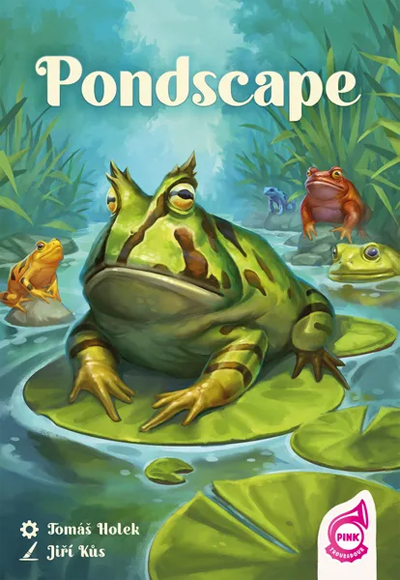

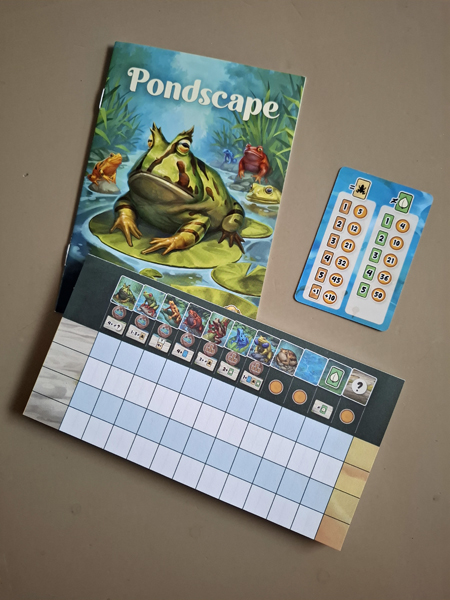
In Pondscape probeert elke speler om een zo harmonieus mogelijke kikkerpopulatie te creëren in zijn vijver. Kan jij de beste combinatie maken van kikkersoorten, voedsel en leefgebieden, dan win jij Pondscape!
Wereldwijd zijn er bijna 8.000 soorten kikkers en er worden er nog steeds nieuwe ontdekt. Kikkers zijn een zeer diverse groep amfibieën. Ze leven grotendeels semi-aquatisch en gedijen goed in vochtige omgevingen, vooral regenwouden, maar ook in Europa zijn veel soorten te vinden. Ze kunnen enorm variëren in grootte en kleur. In de lage landen zijn vooral de bruine en groene kikker, de boomkikker, de meerkikker en de heikikker gekend.
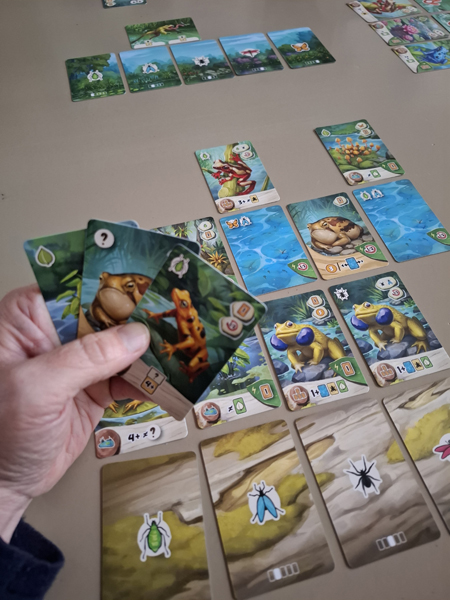
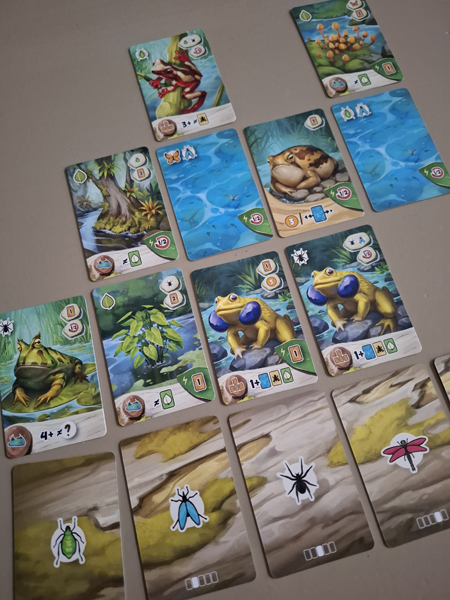
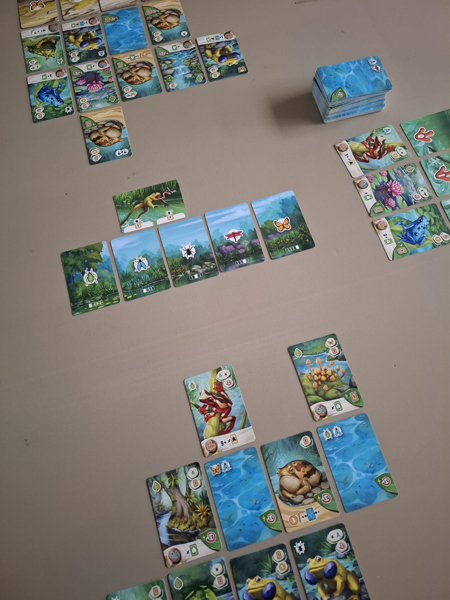
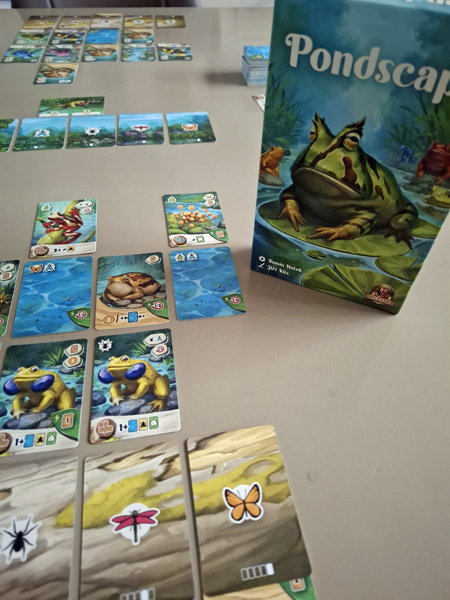
Doel van Pondscape is om een evenwichtig en bloeiend vijverecosysteem voor je kikkers te creëren. Dit doet elke speler door een vijver van 3 bij 5 kaarten in zijn eigen speelgebied te vormen. De algemene voedselrij van 5 kaarten wordt in het midden van de tafel gelegd, samen met de springkikkerkaart. Elke speler legt zijn persoonlijke voedselrij van 5 kaarten voor zich neer. Je vijvergrid wordt hierboven gevormd, 3 kaarten boven elke persoonlijke voedselkaart.
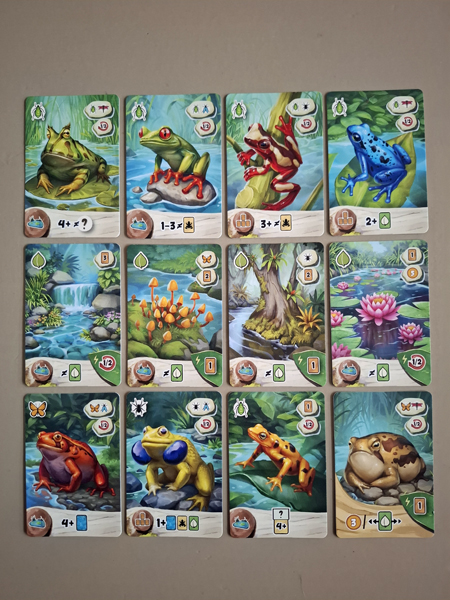
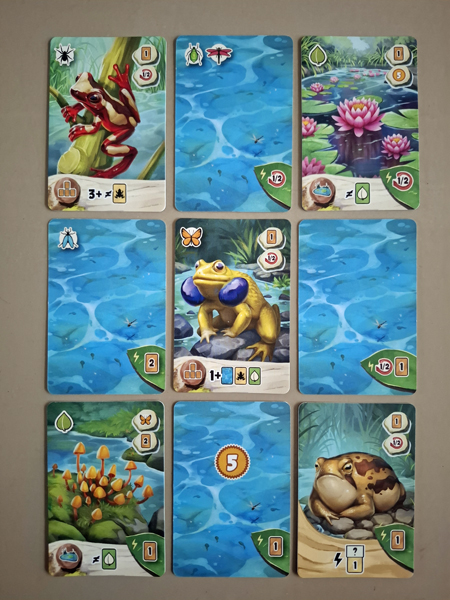
Verder wordt Pondscape gespeeld met een stapel vijverkaarten. De vijverstapel bevat kikkerkaarten en habitatkaarten. De achterkant van elke kaart kan als waterkaart gespeeld worden. De rechterbovenhoek van elke kaart laat zien wat je krijgt als je de kaart als waterkaart zou spelen. Alle kaarten kunnen voedselsymbolen, directe effecten of eindscorevoorwaarden tonen. Er zijn 5 verschillende habitattypen en 8 verschillende kikkersoorten die elk hun eigen voorwaarde hebben om punten te kunnen scoren. Van de vijverstapel worden 3 kaarten open gelegd bij de verplaatsingskaarten. Deze kaarten vormen het aanbod.
Wanneer je aan de beurt bent, doe je het volgende:
- Kies een kaart uit het aanbod en neem deze in je hand.
- Als de kaart bij een verplaatsingskaart met waarde 1 of 2 lag, verplaats dan de springkikkerkaart 1 of 2 velden vooruit rond de algemene voedselrij. De springkikkerkaart bepaalt onder welke 2 persoonlijke voedselkaarten je een kaart zou mogen schuiven.
- Vul het aanbod aan.
- Speel een kaart uit je hand in je vijver. Dat mag ook de kaart zijn die je net uit het aanbod nam. Je mag een kaart gelijk waar in je vijver spelen, ook als waterkaart. Een geplaatste kaart kan niet meer verlegd worden.
- Handel eventuele effecten af die op de gespeelde kaart staan.
De volgende effecten kunnen op de kikker-, habitat- of waterkaarten staan:
- springkikkeractie: Als je een kaart speelt met een springkikkersymbool, dan verplaats je de springkikker 1 of 2 plaatsen. Daarna mag je 0, 1 of 2 kaarten onder je persoonlijke voedselrij schuiven bij het voedsel waar de springkikker zich op dat moment bevindt.
- kaarten trekken: Als je een kaart speelt met een kaarttrekactie, dan mag je onmiddellijk 1, 2 of 3 kaarten van de vijverstapel trekken en op hand nemen.
- schuifeffect: Als je een kaart met een schuifeffect speelt, dan mag je 1 of 2 kaarten naar keuze onder een voedselkaart of voedselkaarten naar keuze schuiven.
Pondscape wordt gespeeld in 15 ronden. Na 15 ronden zou iedereen zijn vijver vol met kaarten moeten hebben liggen en ga je over naar de puntentelling. De speler met de meeste punten wint Pondscape!
Je kan punten scoren op volgende manieren:
- punten per kikkergroep volgens de scoringkaart: Pondscape bevat 8 verschillende kikkersoorten die elk hun eigen scoringsvoorwaarde hebben. Aan het einde van het spel scoor je punten voor elke kikkersoort die aan zijn scoringsvoorwaarde voldoet. Hoeveel punten je juist scoort per kikkersoort hangt af van hoeveel kikkers van die soort je in je vijver hebt en van de groepjes die ze vormen. Je scoort elke kikkergroep apart. In de spelregels staat goed uitgelegd wat de scoringsvoorwaarde van elke kikkersoort is. Woestijnregenkikkerkaarten scoren per individu, niet als groep.
- punten voor je leefgebieden volgens de scoringkaart: Pondscape bevat 5 verschillende leefgebieden. Hoe meer verschillende je er hebt, hoe meer punten je er voor krijgt.
- punten op waterkaarten: Op sommige waterkaarten staan punten afgebeeld.
- punten voor kaarten die onder je voedselkaarten liggen: Elke ondergeschoven kaart levert je 1 punt op voor elk bijpassend voedselsymbool in je vijver.
Mijn mening over Pondscape?
Ik was niet onmiddellijk verkocht door het thema. Ik hou wel van beestjes, maar kikkers zijn nu niet direct de meest aaibare wezens. Toegegeven dat er wel een paar echt mooie, opvallende soorten op de kaarten afgebeeld staan. In al mijn curiositeit ben ik dan even gaan surfen naar de kikkersoorten en de kikkers in dit spel bestaan dus écht. Ze zijn ook heel mooi getekend. Maar Pondscape blijkt uiteindelijk wel een heel leuk puzzelspelletje te zijn met toch meer diepgang dan je op het eerste zicht zou verwachten na het lezen van de relatief eenvoudige spelregels.
Uiteraard is het de bedoeling dat je díé kikkers in je vijver plaatst die je veel punten kunnen opleveren. Je scoort veel meer punten door meerdere kikkers van dezelfde soort te hebben dan allemaal enkelingen of duo’s. Hou er ook rekening mee dat je enkel punten kan scoren voor een bepaalde kikkersoort als die soort ook daadwerkelijk aan zijn scoringsvoorwaarde voldoet. Voor het scoren van sommige soorten is het ook belangrijk waar je ze juist in je vijver zet, of eerder naast welke andere kaarten je ze plaatst. Uiteindelijk zal je dus moeten kiezen voor welke kikkersoorten je gaat en welke soorten je niet in je vijver zal zetten.
Kaarten van kikkers die je niet in je vijver wil zetten, kan je dan gebruiken om onder je voedselkaarten te schuiven of om als waterkaarten te gebruiken. En daar komt het volgende laagje in de diepgang van Pondscape. Je moet heel tactisch spelen om op het juiste moment kaarten onder je voedselkaarten te kunnen schuiven, want dat kan namelijk enkel onder het voedsel waar de springkikkerkaart op dat ogenblik ligt. Het is echt niet zo eenvoudig om al die zaken – scoringsvoorwaarden, voedsel, springkikkerkaart en leefgebieden – tegelijk in het oog te houden.
Een leuke variatie zou kunnen zijn om de algemene voedselrij niet steeds in dezelfde volgorde te leggen. Ik begrijp ook niet goed waarom dat een regel is. Het is juist leuker als de voedselrij niet elke keer hetzelfde is. Zorg wel dat je je persoonlijke voedselrij in dezelfde volgorde legt dan de algemene voedselrij, want anders zorgt dat wel eens voor verwarring. Er is ook een solo-modus, maar solo speel ik nooit. Zelf vind ik Pondscape niet zo interessant om met 2 te spelen, maar met 3 of 4 spelers is het echt een leuk puzzeltje met eenvoudige regels en toch behoorlijk wat denkwerk. Vermits het ook niet zo heel lang duurt, is Pondscape een prima tussendoortje of waardige afsluiter!
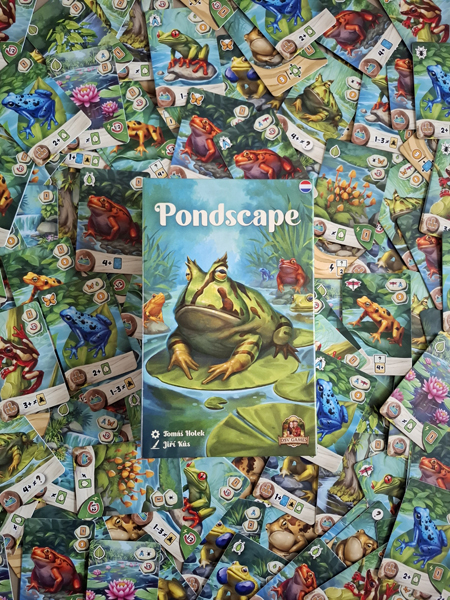

Pondscape
Players: 1-4
Time: 30 minutes
Age: 8+
Author: Tomáš Holek
Publisher: DSV Games
Year: 2025
In Pondscape, each player strives to create the most harmonious frog population possible in their pond. If you can find the best combination of frog species, food and habitats, you win Pondscape!
There are nearly 8.000 frog species worldwide, and new ones are still being discovered. Frogs are a very diverse group of amphibians. They are largely semi-aquatic and thrive in moist environments, especially rainforests, but a lot of species can also be found in Europe. They can vary enormously in size and color. In the Low Countries, the brown and green frogs, the tree frog, the marsh frog and the moor frog are well-known.
The goal of Pondscape is to create a balanced and thriving pond ecosystem for your frogs. Each player does this by creating a 3×5-card pond in their own playing area. The general food row of 5 cards is placed in the center of the table, along with the jumping frog card. Each player places their personal food row of 5 cards in front of them. Your pond grid is formed above this personal food row, 3 cards above each card.
Pondscape is also played with a deck of pond cards. The pond deck contains frog cards and habitat cards. The back of each card can be played as a water card. The top right corner of each card shows what you would get if you played it as a water card. All cards can show food symbols, immediate effects or final scoring conditions. There are 5 different habitat types and 8 different frog species, each with their own scoring condition. 3 cards from the pond deck are placed face-up next to the movement cards. These cards form the supply.
On your turn, you have to take the following steps:
- Choose a card from the supply and take it into your hand.
- If the card was on a movement card with a value of 1 or 2, move the jumping frog card 1 or 2 spaces forward around the general food row. The jumping frog card determines which 2 personal food cards you may slide a card under when you use this effect.
- Replenish the supply.
- Play a card from your hand into your pond. This can also be the card you just drew from the supply. You may play a card anywhere in your pond, also as a water card. A played card can never be moved.
- Resolve any effects on the played card.
The following effects can be found on the frog, habitat, or water cards:
- Jumping frog action: If you play a card with a jumping frog symbol, you move the jumping frog 1 or 2 spaces. You may then slide 0, 1 or 2 cards under your personal food row, under the type of food where the jumping frog is currently located.
- Draw cards: If you play a card with a draw action, you may immediately draw 1, 2 or 3 cards from the pond deck and take them into your hand.
- Slide effect: If you play a card with a slide effect, you may slide 1 or 2 cards of your choice under a food card or cards of your choice.
Pondscape is played in 15 rounds. After 15 rounds, everyone should have filled their pond with cards and the scoring begins. The player with the most points wins Pondscape!
You can score points in the following ways:
- Points per frog group according to the scoring card: Pondscape contains 8 different frog species, each with their own scoring requirement. At the end of the game, you score points for each frog species that meets its scoring requirement. The number of points you score per frog species depends on how many frogs of that species you have in your pond and the groups they form. You score each frog group separately. The rulebook clearly explains the scoring requirement for each frog species. Desert Rain Frog cards score individually, not as a group.
- Points for your habitats according to the scoring card: Pondscape contains 5 different habitats. The more different habitats you have, the more points you receive.
- Points on water cards: Some water cards depict points.
- Points for cards placed under your food cards: Each card placed under your food cards, scores you 1 point for each matching food symbol in your pond.
My opinion on Pondscape?
I wasn’t immediately sold on the theme. I do love animals, but frogs aren’t exactly the most cuddly creatures. Admittedly, there are some really beautiful, striking species depicted on the cards. In all my curiosity, I browsed the internet through the frog species, and the frogs in this game actually do exist. They’re beautifully drawn too. But Pondscape ultimately turns out to be a very enjoyable puzzle game with more depth than you might initially expect after reading the relatively simple rules.
Of course, the goal is to place the frogs in your pond that can earn you a lot of points. You score far more points by having multiple frogs of the same species than by having all singles or pairs. Also, keep in mind that you can only score points for a specific frog species if that species actually meets its scoring requirement. For scoring some species, it’s also important where you place them in your pond, or rather, next to which other cards you place them. Ultimately, you’ll have to choose which frog species you’ll keep in your pond and which you won’t.
You can use cards of frogs you don’t want in your pond to slide under your food cards or to use them as water cards. And that’s where Pondscape’s next layer of depth comes in. You have to be very tactical to slide cards under your food cards at the right time, because you can only do that under the food where the jumping frog card is currently located. It’s really not that easy to keep track of all these things – scoring requirements, food, jumping frog card and habitats – simultaneously.
A nice variation would be to not always place the general food row in the same order. I don’t really understand why that is a rule. It’s actually more fun if the food row isn’t the same every time. Make sure you place your personal food row in the same order as the general food row, otherwise it can sometimes cause confusion. There’s also a solo mode, but I never play solo. I personally don’t find Pondscape particularly interesting for two players, but with three or four players, it’s a really fun puzzle with simple rules that still requires a fair amount of thinking. Since it’s also not very long, Pondscape is a great filler or a worthy end-of-the-night game!