Aantal spelers: 2-4
Speelduur: 10 minuten
Leeftijd: Vanaf 4 jaar
Auteur: Thilo Hutzler
Uitgever: HABA
Jaar: 2011

Normaal begin ik een review eigenlijk altijd met een korte introductie van het spel. Maar in dit geval begin ik met een oproep; Ben jij ergotherapeut, fysiotherapeut, PMT’er, dramatherapeut of werk je op een andere manier (in therapievorm) met kinderen waarbij het lichaam centraal staat? Lees dan verder! We gaan natuurlijk een kinderspel reviewen, dus als je een kinderspel zoekt, lees dan ook gewoon verder.
Prinses Toverfee – een eerste indruk
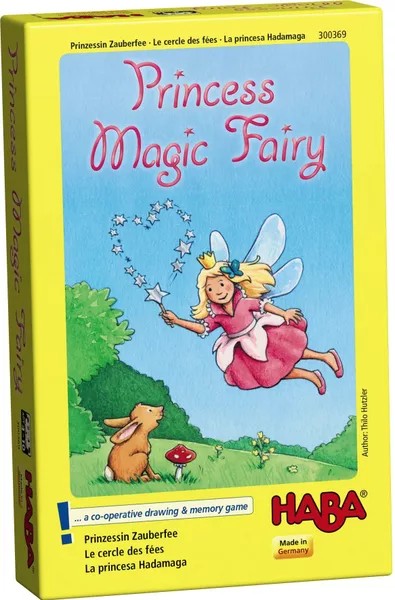
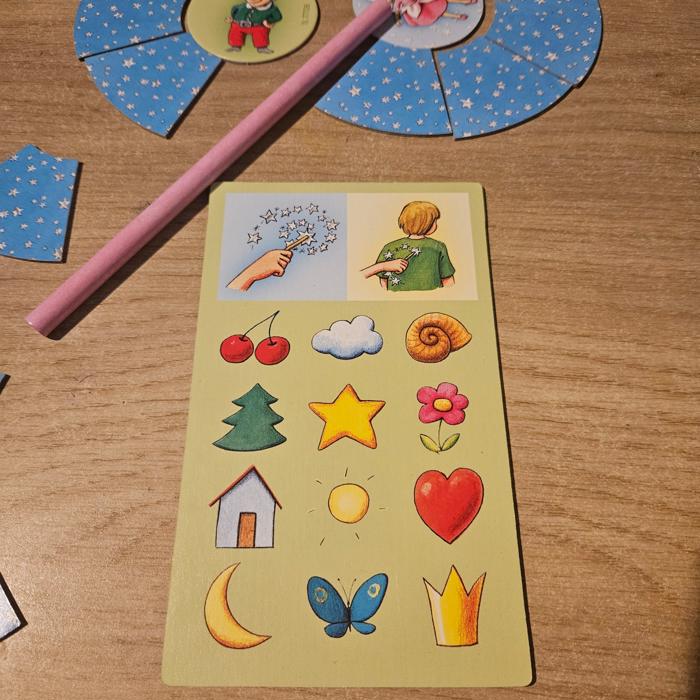
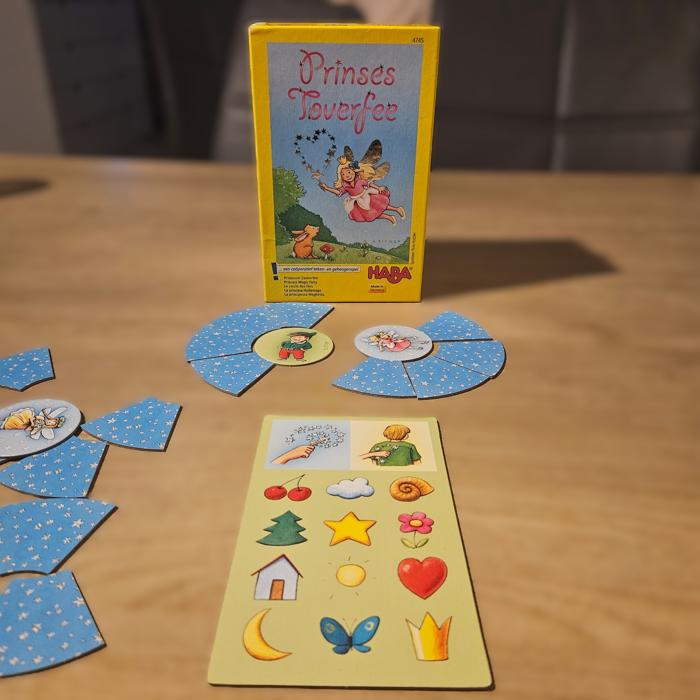
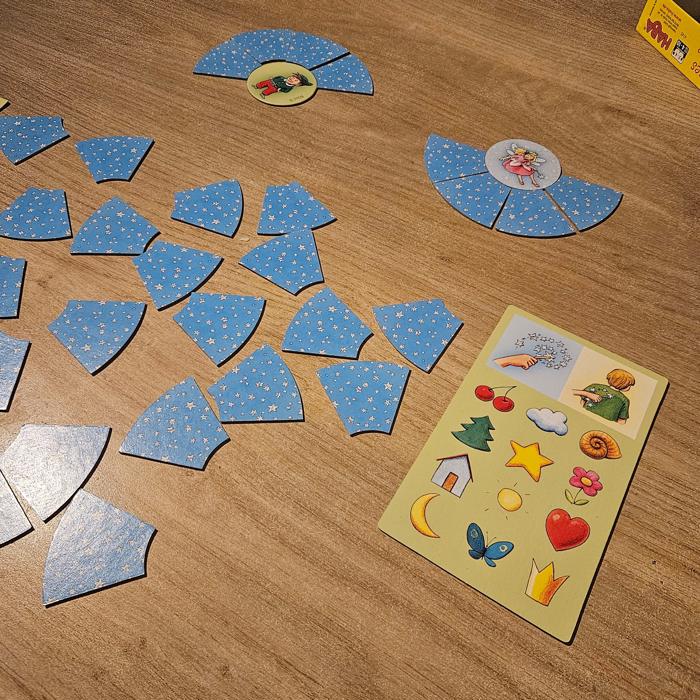
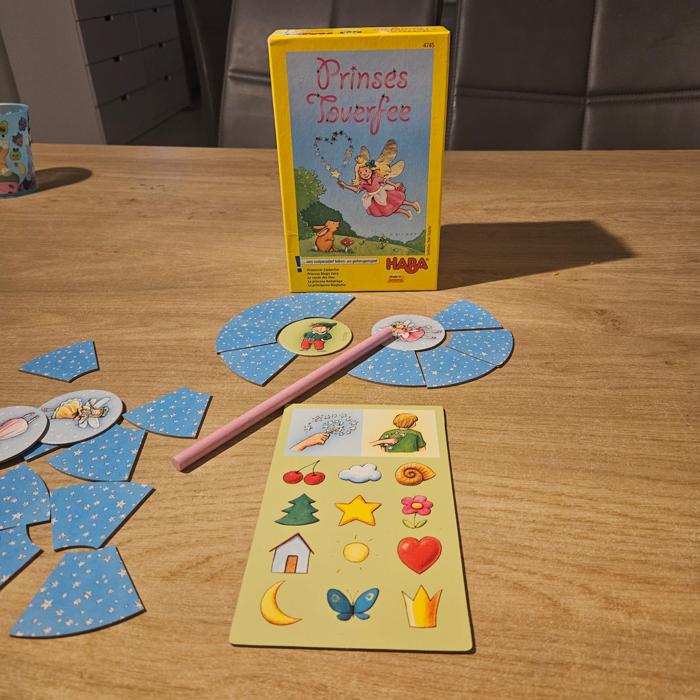
Prinses Toverfee zit weer in het bekende gele HABA-doosje. Een klein doosje met daarin niet heel veel verschillende onderdelen; een aantal cirkels en aantal puzzelstukken, een toverstaf en 4 ‘spiekbriefjes’. Alles is van zeer degelijk materiaal. Het geheel doet wel wat zoetsappig aan, het zal stoere kinderen daardoor misschien wat minder aanspreken.
Hoe wordt het gespeeld?
Prinses Toverfee is een coöperatief spel, dat wil zeggen dat er dus geen winnaar of verliezer is. Je werkt samen om het doel te bereiken. In prinses toverfee speel je (samen) als toverfee tegen de kabouter. Het is de bedoeling dat de cirkel van de toverfee eerder voltooid is dan die van de kabouter.
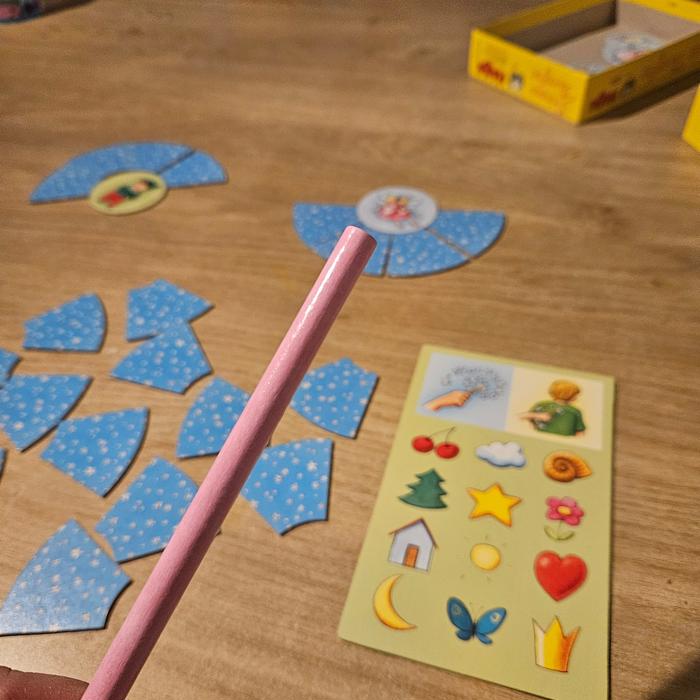
De cirkels met de toverfee en de kabouter worden midden op tafel gelegd en alle puzzelstukken worden gedekt verspreidt. Elke speler krijg een ‘spiekbriefje’. Nu spelen spelers ombeurten.
De speler pakt een puzzelstuk van tafel en bekijkt die (zonder het te laten zien aan de rest). Er zijn 3 soorten stukjes;
-
Een kabouter; Helaas, de kabouter heeft deze beurt gekaapt. Het puzzelstuk met de kabouter wordt bij de cirkel van de kabouter gelegd.
-
Een afbeelding met een blauwe achtergrond.
De speler neemt de toverstaf en tekent met de toverstaf in de lucht de afbeelding. De andere speler(s) moeten nu raden welke afbeelding getekend is, hiervoor kunnen zij het spiekbriefje gebruiken. Ze moeten goed nadenken en overleggen, want er mag maar één antwoord gegeven worden. Is het antwoord goed? Dan mag het puzzelstukje bij de fee geplaatst worden. Is het antwoord fout, dan moet het puzzelstukje bij de kabouter geplaatst worden.
-
Een afbeelding met gele achtergrond.
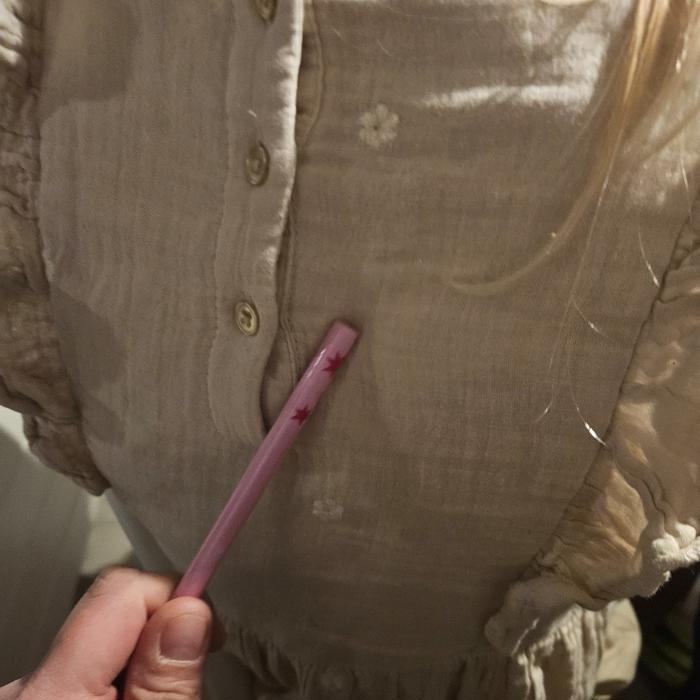
De speler neemt de toverstaf en tekent de afbeelding met de toverstaf op de rug van één van de spelers. Verder gelden dezelfde vervolgstappen als bij het blauwe puzzelstukje.
Zo gaan de spelers ombeurten door totdat óf de toverfee geheel omsloten is met puzzelstukken (winst) of de kabouter helemaal omsloten is (verlies).
Wat vinden wij van Prinses Toverfee?
Prinses Toverfee is wat mij betreft een heel goed voorbeeld van hoe je van een simpel ‘huis-tuin-en-keuken’-spel een gestructureerd (bord)spel kunt maken. Soms is dat echt niet nodig; denk aan boter-kaas-en-eieren of kamertje verhuren, dat kan echt prima op papier zonder toevoegingen. Maar is dit geval is het echt goed uitgewerkt. De spiekbriefjes werken fantastisch, want je hoeft niet in het wilde weg te gokken of bedenken wat iemand getekend heeft, maar je hebt een richting. Zeker voor wat jongere kinderen werkt dat heel goed. Leonore (5) is fan van dit spel, het tekenen op de rug is voor haar echt een fantastisch aspect in dit spel. Zonder heel diep op allerlei inhoudelijke materie in te gaan is het, naast dat het gewoon een leuk spel is, ook goed voor kinderen om op die manier met hun eigen lijf en dat van anderen in contact te komen. Afhankelijk van de leeftijd van de kinderen komen er nog veel meer vaardigheden om de hoek kijken; Zo merk ik dat Leonore (5) het bijvoorbeeld nog lastig vind om echt ‘rechte’ hoeken te tekenen, dat kan ze mooi oefenen dus. Voor oudere kinderen is het de sport om te bedenken hoe je iets tekent (waar start je, waar leg je de nadruk) zodat de anderen het zo snel mogelijk herkennen.
Het spel op zichzelf is dus eigenlijk ontzettend simpel, maar er zitten veel lagen in. Die je overigens helemaal niet allemaal hoeft te doorzien als je als (groot)ouder gewoon een leuk spel met je (klein)kinderen wilt spelen, want ook dan is dit spel ontzettend geschikt.
De bekende oerdegelijke HABA-uitvoering maakt dat dit gewoon een heel compleet spel is. Enige kleine minpuntje vind ik dat de toverstaf roze is en je kunt kiezen uit 4 toverfeeën, had een extra toverstaf in een andere kleur gedaan en had 2 toverfeeën omgeruild voor 2 tovenaars en je had een nóg groter publiek enthousiast gekregen voor dit spel.
De spelduur is precies lang genoeg voor jonge spelers en de tekeningen die gemaakt moeten worden zijn voor iedereen herkenbaar en duidelijk.
Eindconclusie: Perfect spel voor een gewoon leuk spel met je (klein)kinderen, maar ook fantastisch om in te zetten in (therapeutisch) werk met kinderen waarbij het lichaam centraal staat. Prinses Toverfee krijgt van mij een 7,5.
Let op; Helaas is Prinses Toverfee niet meer nieuw verkrijgbaar. Tweedehands kun je hem nog op verschillende plekken vinden. Mocht je hiernaar opzoek gaan, zoek dan ook naar de (originele) Duitse titel Prinzessin Zauberfee, deze lijkt volop (tweedehands) verkrijgbaar. Het spel zelf is taal-onafhankelijk. En bij de Duitse versie zit meestal ook een Engelse en/of Nederlandse handleiding

Princess Magic Fairy
Players: 2-4
Time: 10 minutes
Age: 4+
Author: Thilo Hutzler
Publisher: HABA
Year: 2011
Normally I always start a review with a short introduction of the game. But in this case, I start with an appeal; Are you an occupational therapist, physiotherapist, PMT, drama therapist or do you work with children in another way (in therapy form) in which the body is central? Then read on! Of course, we are going to review a children’s game, so if you are looking for a children’s game, just read on.
Princess Magic Fairy – a first impression
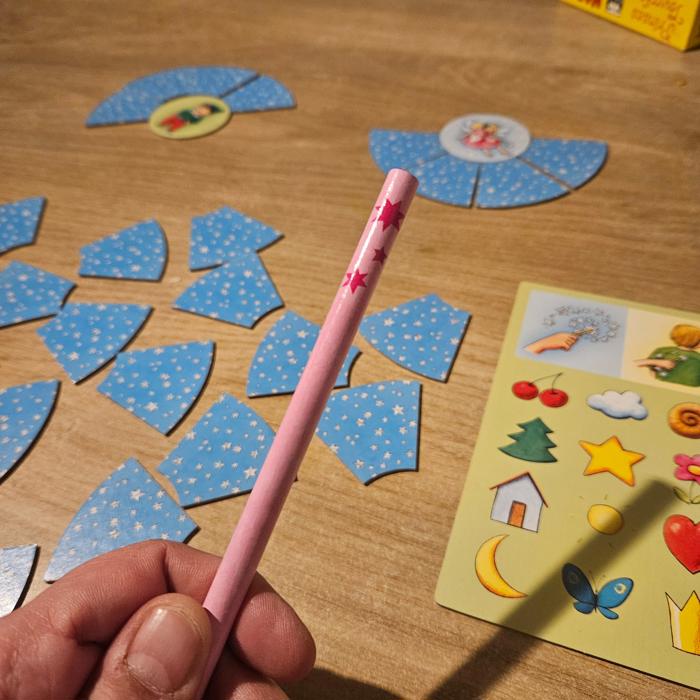
Princess Magic Fairy is back in the well-known yellow HABA box. A small box with not many different parts in it; a number of circles and a number of puzzle pieces, a magic wand and 4 ‘cheat sheets’. Everything is made of very solid material. The whole thing does look a bit sugary, it may therefore appeal less to ’tough’ kids.
How is it played?
Princess Magic Fairy is a cooperative game, which means that there is no winner or loser. You work together to achieve the goal. In Princess Magic Fairy you play (together) as a magic fairy against the gnome. The idea is that the circle of the magic fairy is completed before that of the gnome.
The circles with the magic fairy and the gnome are placed in the middle of the table and all the puzzle pieces are spread face down. Each player gets a ‘cheat sheet’. Now players take turns.
The player takes a puzzle piece from the table and looks at it (without showing it to the rest). There are 3 types of pieces;
-
A gnome; Unfortunately, the gnome hijacked this turn. The puzzle piece with the gnome is placed next to the circle of the gnome.
-
An image with a blue background.
The player takes the magic wand and draws the image with the magic wand in the air. The other player(s) now have to guess which image is drawn, they can use the cheat sheet for this. They have to think carefully and deliberate, because only one answer can be given. Is the answer correct? Then the puzzle piece can be placed next to the fairy. If the answer is wrong, the puzzle piece must be placed next to the gnome.
-
An image with a yellow background.
The player takes the magic wand and draws the image with the magic wand on the back of one of the players. Furthermore, the same follow-up steps apply as with the blue puzzle piece.
The players take turns until either the fairy is completely enclosed with puzzle pieces (win) or the gnome is completely enclosed (loss).
What do we think of Princess Magic Fairy?
As far as I’m concerned, Princess Magic Fairy is a very good example of how you can turn a simple ‘home-garden-and-kitchen’ game into a structured (board) game. Sometimes that is really not necessary; Think of tic-tac-toe or renting out a room, which is really fine on paper without additives. But in this case it is really well worked out. The cheat sheets work great, because you don’t have to guess at random or think about what someone has drawn, but you have a direction. This works very well, especially for younger children. Leonore (5) is a fan of this game, drawing on the back is really a fantastic aspect in this game for her. Without going very deep into all kinds of substantive matter, in addition to being just a fun game, it is also good for children to come into contact with their own body and that of others in this way. Depending on the age of the children, many more skills come into play; For example, I notice that Leonore (5) still finds it difficult to draw really ‘right’ angles, so she can practice that nicely. For older children, the sport is to think about how to draw something (where do you start, where do you put the emphasis) so that the others recognize it as quickly as possible.
So the game itself is actually very simple, but there are many layers to it. Which, by the way, you don’t have to see through at all if you, as a (grand)parent, just want to play a fun game with your (grand)children, because even then this game is very suitable.
The well-known rock-solid HABA version makes this a very complete game. The only small downside I think is that the magic wand is pink and you can choose from 4 magic fairies, had put an extra magic wand in a different color and had exchanged 2 magic fairies for 2 wizards and you would have gotten an even larger audience enthusiastic about this game.
The game duration is just long enough for young players and the drawings that have to be made are recognizable and clear to everyone.
Final conclusion: Perfect game for a just fun game with your (grand)children, but also fantastic to use in (therapeutic) work with children where the body is central. Princess Magic Fairy gets a 7.5 from me.
Believeon; Unfortunately, Princess Magic Fairy is no longer available new. You can still find it second-hand in various places. If you are looking for this, also look for the (original) German title Prinzessin Zauberfee, which seems to be widely available (second-hand). The game itself is language-independent. And the German version usually also comes with an English and/or Dutch manual