

Aantal spelers: 1 (-5)
Speelduur: 20 minuten
Leeftijd: Vanaf 8 jaar
Auteur: Adam Hill, Ben Pinchback, Matt Riddle
Uitgever: Allplay
Jaar: 2024


Welkom in River Valley! De prachtige stukjes glas die hier langs de rivier te vinden zijn, hebben de meest ondernemende bosdieren aangetrokken om een winkeltje te beginnen. In River Valley Glassworks speel je als een van deze pioniers en haal je glas uit het aanbod van riviertegels.
River Valley Glassworks – Een eerste indruk.
Laten we beginnen te zeggen dat ik de ‘deluxe’ versie van dit spel in mijn bezit heb.
Ik heb de gewone editie nog nooit in het echt gezien, maar kan wel wat vergelijken met plaatjes van het internet natuurlijk.
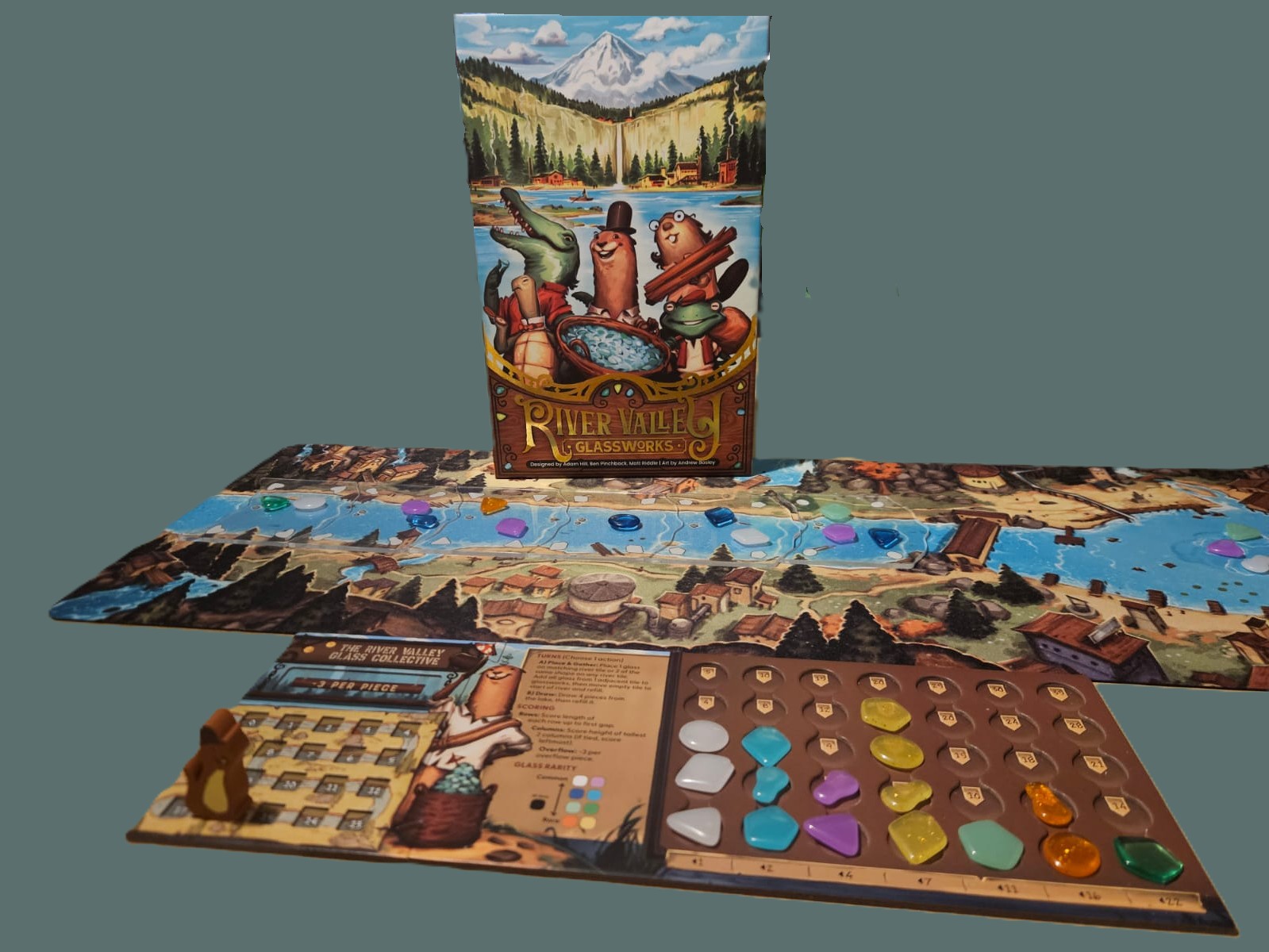
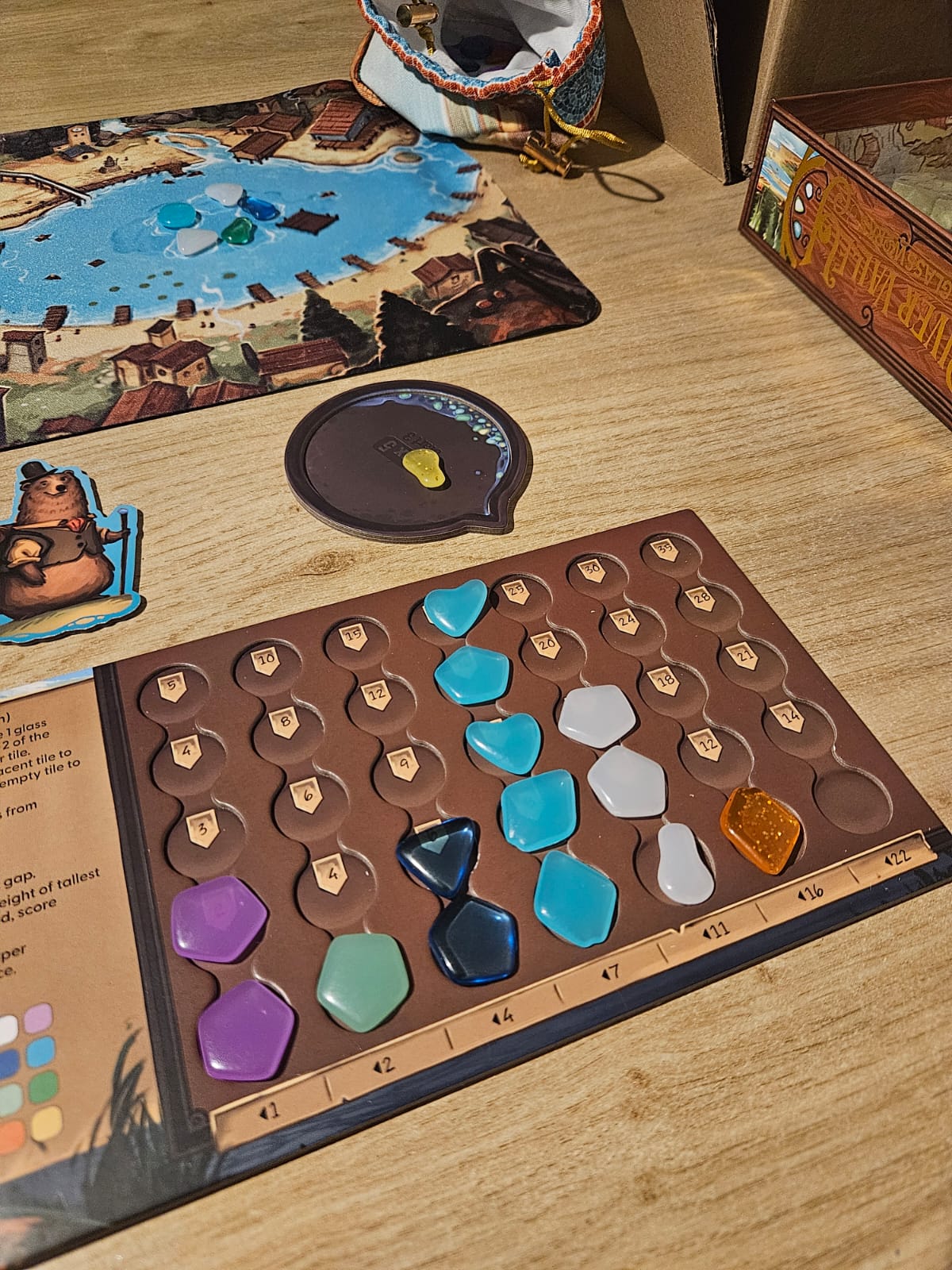
Mijn Deluxe versie is in één woord prachtig! Een zakje met daarin hele mooie ‘glasstukjes’, een neopreen-matje waarop de rivier en de bron staan geprint. Mooie Glastegels, en fantastisch gedetailleerd uitgewerkte persoonlijke bordjes. Aan mijn woordkeuze kun je al horen dat ik ontzettend fan ben. Niet voor niets koos ik voor de deluxe versie. Het ziet er echt prachtig uit!
De foto’s die ik van het standaard spel heb gezien zien er trouwens ook gewoon echt prima uit! Het artwork is precies hetzelfde en je hebt ook mooie glasstukjes. Alleen de rest is net wat minder luxe uitgevoerd.
Het regelboekje beslaat 4 bladzijden, maar als deze alleen uit tekst had bestaan had het waarschijnlijk op 1 bladzijde gepast. In het regelboekje staan namelijk foto’s om het geheel duidelijker te maken. Wat overigens niet écht nodig is, want het spel speelt eigenlijk vrij simpel.
Hoe wordt het gespeeld?
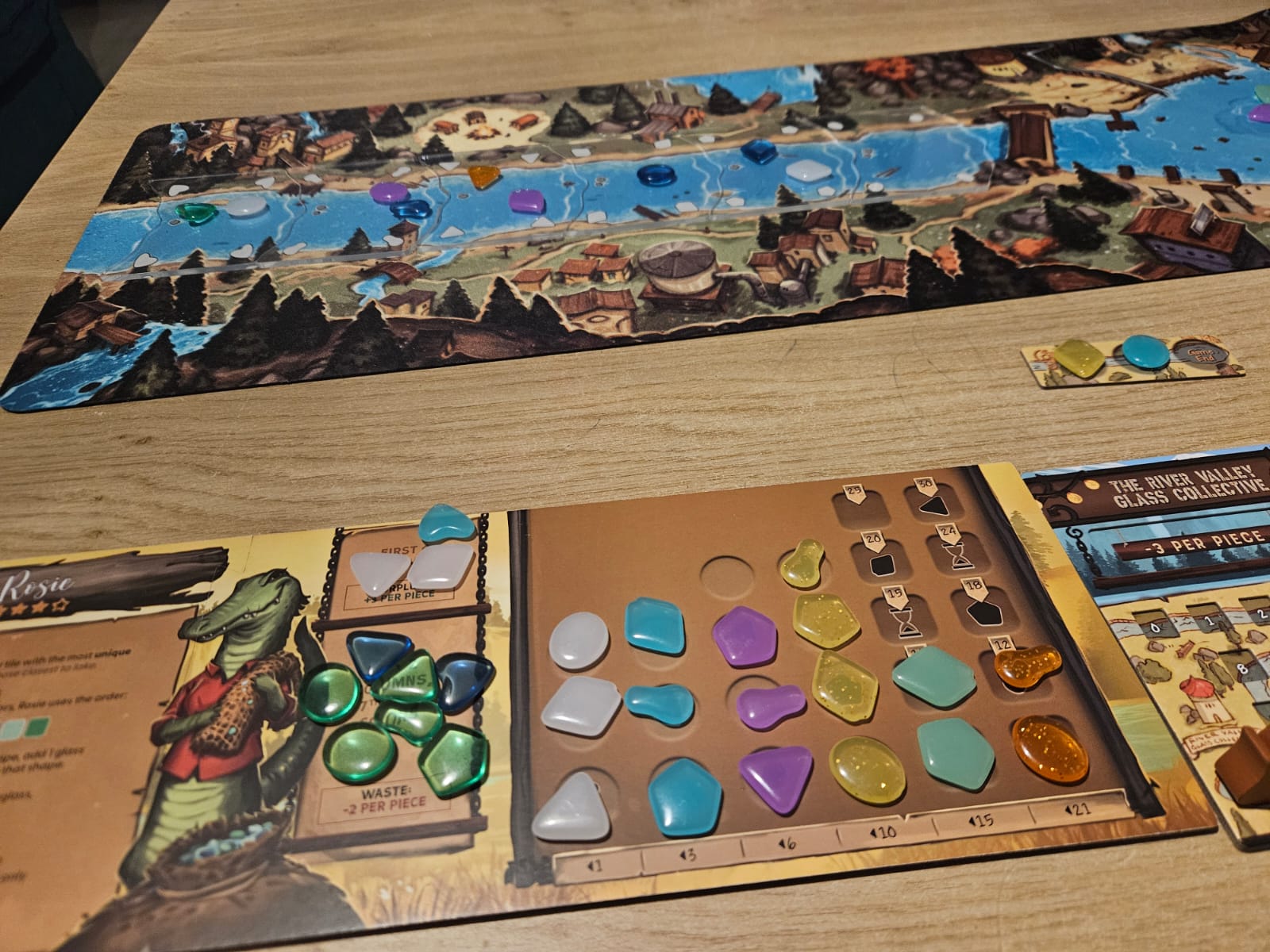
River Valley Glassworks heeft 5 speelborden. Aan de achterzijde van deze borden staan de tegenstanders voor het solospel, die verschillen in moeilijkheid. Je kiest dus één van deze tegenstanders en legt deze met de ‘achterzijde’ (eigenlijk solo-zijde) naar boven. Voor jezelf kies je één van de andere borden. Je speelt zelf wel met de ‘gewone’ zijde van het bord.
Vervolgens leg je de rest van het spel klaar. Je vult de rivier en de bron met glasstukjes en je legt 3 glasstukken op je eigen pan.
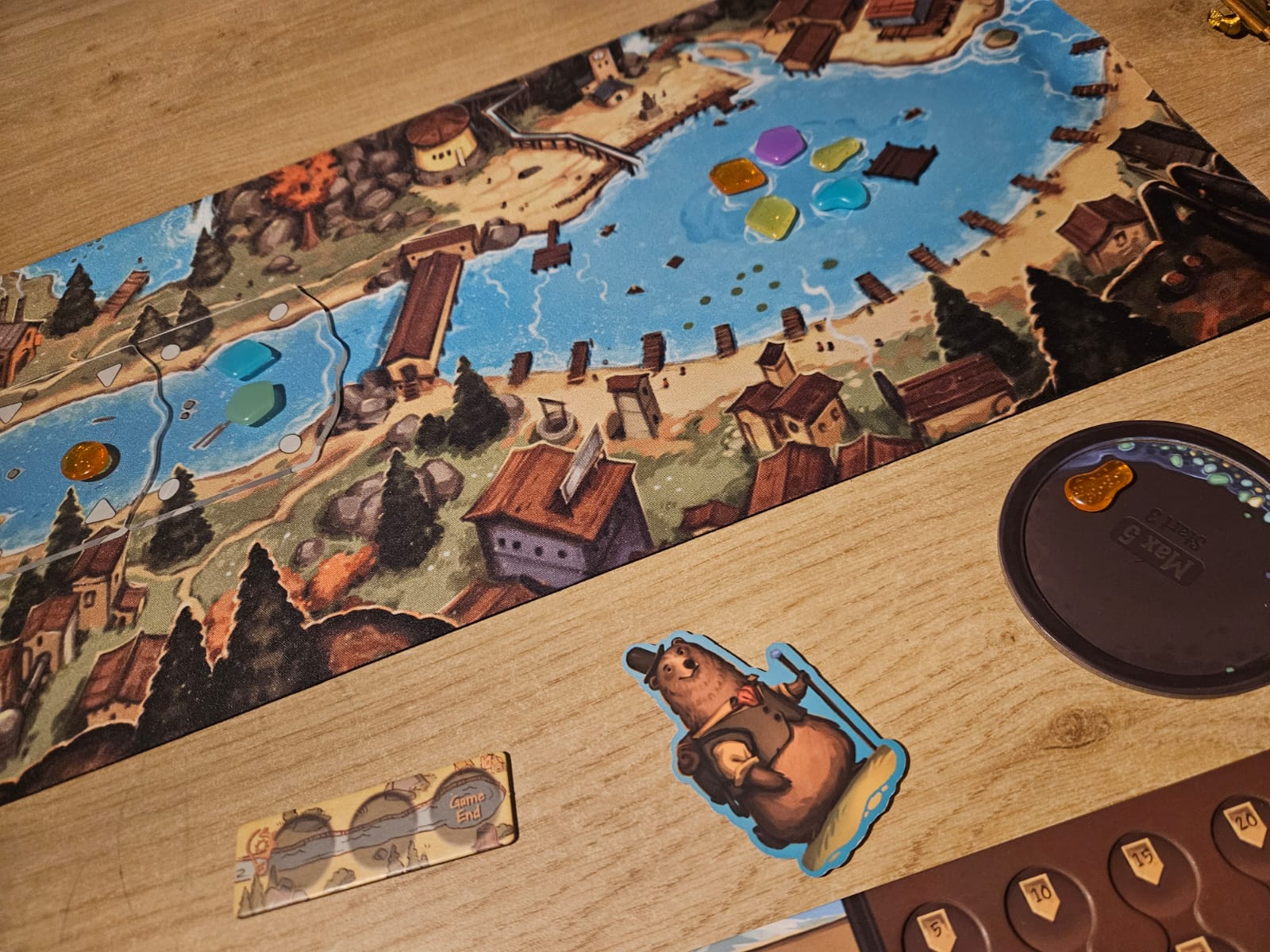
Voor het solospel heb je nog de ‘end-game-tegel’ nodig. Die leg je ook neer.
Nu gaan jij en je tegenstander ombeurten spelen.
In jouw beurt heb je keuze uit 2 opties;
1. Glas uit de rivier nemen.
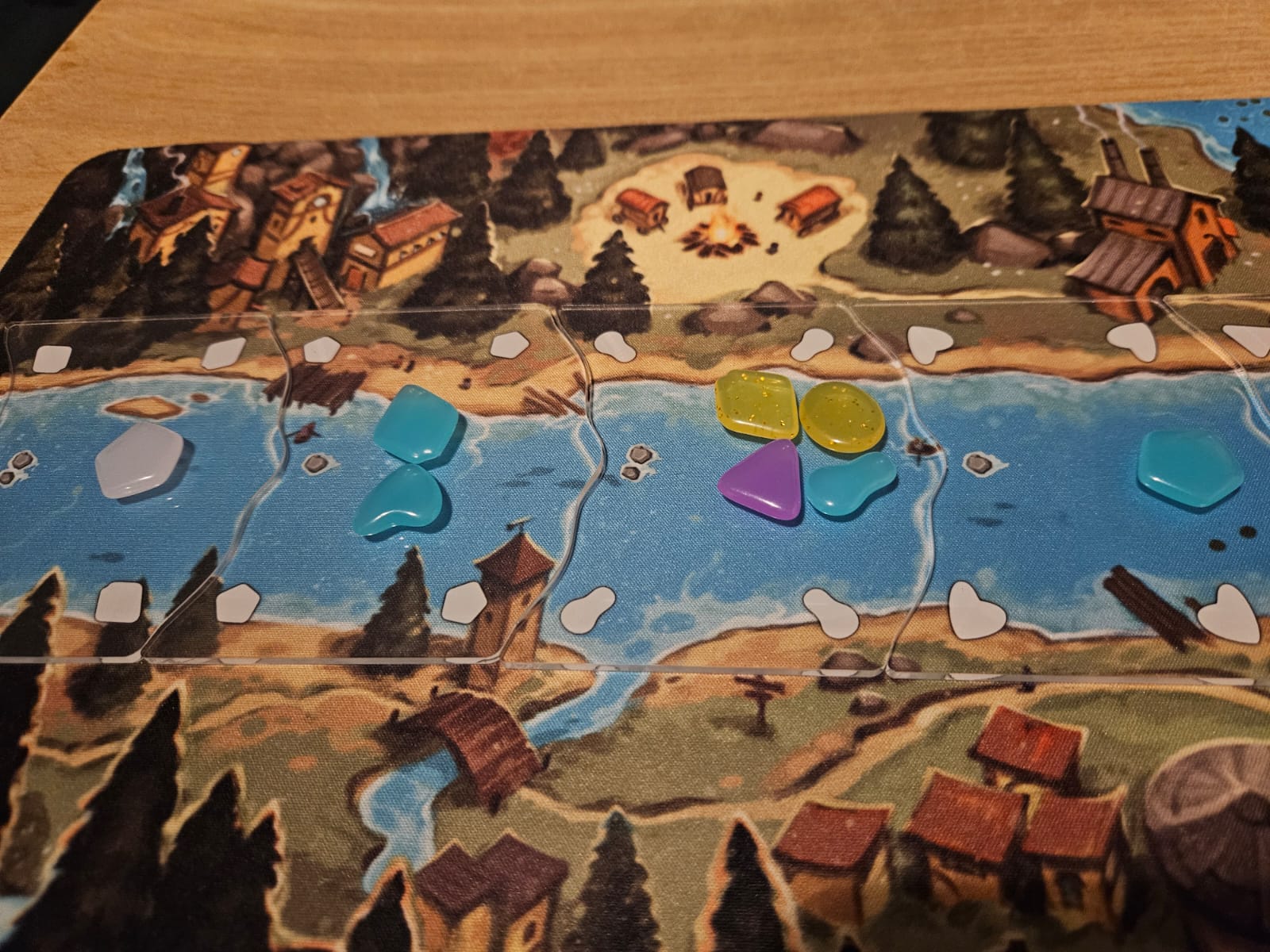
Neem een glasstukje uit je pan en leg deze op de tegel in de rivier die dezelfde vorm laat zien.
Pak nu alle glasstukjes van de tegel die rechts óf links van jouw geplaatste glasstukje ligt.
Deze glasstukjes plaats je nu in je winkel. Elke kolom geeft een kleur aan. Dus gelijke kleuren in dezelfde kolom.
Het nu leeggekomen rivierdeel wordt verplaatst naar het begin van de rivier en aangevuld met nieuw glas.
2. Je pan aanvullen.
Je mag 4 glasstukjes uit de bron op je pan leggen. Het 5de glasstuk gaat op de end-game tegel.
Let op, je mag maximaal 5 glasstukjes in je pan hebben liggen, als je dit maximum overschrijdt, gaan de glasstukjes in je overloop, wat je minpunten kost.
Nu is de beurt aan je tegenstander.
Elke tegenstander heeft zijn eigen manier van glas verzamelen, in zijn winkel plaatsen en punten scoren. Dit staat heel goed beschreven op zijn persoonlijke tegel die aan de winkel vast zit.
Bijvoorbeeld; Je tegenstander verzamelt altijd glas van de tegel waarop het meeste glas ligt.
Je voert de verzamelactie voor je tegenstander uit, en verschuift ook weer de lege tegel in de rivier.
Omdat jouw tegenstander geen glas op de rivier plaatst, zijn er iconen in zijn winkel die het plaatsen van een stukje glas (uit de voorraad) triggeren.
Het eindspel kan op 2 manieren worden ingeluid;
1. Wanneer jij 17 (of meer) glasstukjes in je winkel hebt.
2. Wanneer het derde glasstukje op de end-game tegel wordt geplaatst.
Je maakt je beurt gewoon af en ook je tegenstander is nog aan de beurt.
Vervolgens wordt de allerlaatste ronde gespeeld.
Puntentelling:
De puntentelling van je tegenstander staat beschreven op zijn bordje en varieert van tegenstander tot tegenstander.
Voor jou geldt dezelfde puntentelling als in het ‘reguliere’ spel.
Je krijgt punten per rij. Gezien vanaf de linkerkant, tot aan de eerste ‘onderbreking’.
Daarnaast krijg je punten voor de 2 hoogste kolommen, bij gelijke kolommen telt de meest linkse (die met de laagste punten).
Eventuele glasstukjes in je overloop zijn minpunten.
Wat vind ik van River Valley Glassworks – als solospel?
Dat ik over de vormgeving en de uitwerking daarvan super enthousiast ben, hebben jullie al kunnen lezen in de eerste alinea, dus daar zal ik verder mijn mond over houden ;).
River Valley Glassworks is een echt puzzelspel, dat moet je liggen, daar moet je van houden. Ik hou daarvan, ontzettend! Dus wat dat betreft zit ik met River Valley Glassworks echt goed.
De uitwerking van het solo-spel vind ik echt heel goed. Veel meer dan in het ‘reguliere’ (meer-spelers) spel, kun je in het solospel écht je tegenstander dwarszitten. De acties van je tegenstander zijn weliswaar vrij statisch, hij/zij doet eigenlijk elke keer ongeveer hetzelfde, maar doordat jij weet wat hij gaat goed, kun je jouw eigen acties hierop aanpassen. Vaak voelt dat voor mij een beetje als ‘valsspelen met voorkennis’. Maar dat is bij River Valley Glassworks niet het geval. Daarbij heb ik juist het gevoel dat dat moet, dat je dat nodig hebt om te kunnen winnen. Zeker bij de tegenstanders van de hogere niveaus.
Het scoren op je eigen rivier en het proberen zo ongunstig mogelijk resultaat voor je tegenstander te creëren, maakt River Valley Glassworks voor mij een fantastisch spel.. ehm, puzzel.. of toch een spel?
De speelduur is kort, een solospel duurt misschien 20 minuten. Afhankelijk van hoe snel je denkt en hoe moeilijk je keuzes zijn, kan het ook in een kwartier. Het spel is relatief snel afgelopen omdat je al heel snel aan die 17 glasstukjes in je winkel zit. De eerste paar potjes vond ik dat ontzettend jammer, maar dat is juist die extra kracht van het spel. Je moet keuzes maken, want je hebt maar relatief weinig zetten. Datzelfde geldt voor die allerlaatste ronde, lukt het je om het precies zo uit te spelen dat je die laatste ronde ten volle kan benutten?
Al met al is River Valley Glassworks wat mij betreft een perfect puzzelspel, wat makkelijk te spelen is, maar moeilijker te ‘masteren’ is. Het artwork maakt het helemaal af en als het je ding is, zou ik zeker voor de deluxe versie gaan 🙂
Ik geef River Valley Glassworks – solo dus een 8,5

River Valley Glassworks
Players: 1 (-5)
Time: 20 minutes
Age: 8+
Author: Adam Hill, Ben Pinchback, Matt Riddle
Publisher: AllPlay
Year: 2024
Welcome to River Valley! The beautiful pieces of glass found here along the river have attracted the most enterprising forest animals to start a shop. In River Valley Glassworks, you play as one of these pioneers and collect glass from the river tiles.
River Valley Glassworks – A first impression.
Let’s start by saying that I own the ‘deluxe’ version of this game.
I’ve never seen the regular edition in real life, but I can compare it to pictures on the internet, of course.
My Deluxe version is, in a word, beautiful! A bag containing beautiful ‘glass pieces’, a neoprene mat with the river and the source printed on it. Beautiful glass tiles and fantastically detailed personal boards. You can tell from my choice of words that I’m a huge fan. It’s no coincidence that I chose the deluxe version. It looks really beautiful!
The photos I’ve seen of the standard game also look really good! The artwork is exactly the same and you also get beautiful glass pieces. Only the rest is slightly less luxurious.
The rulebook is four pages long, but if it had consisted of text only, it would probably have fit on one page. The rulebook contains photos to make everything clearer. This isn’t really necessary, though, because the game is actually quite simple to play.
How is it played?
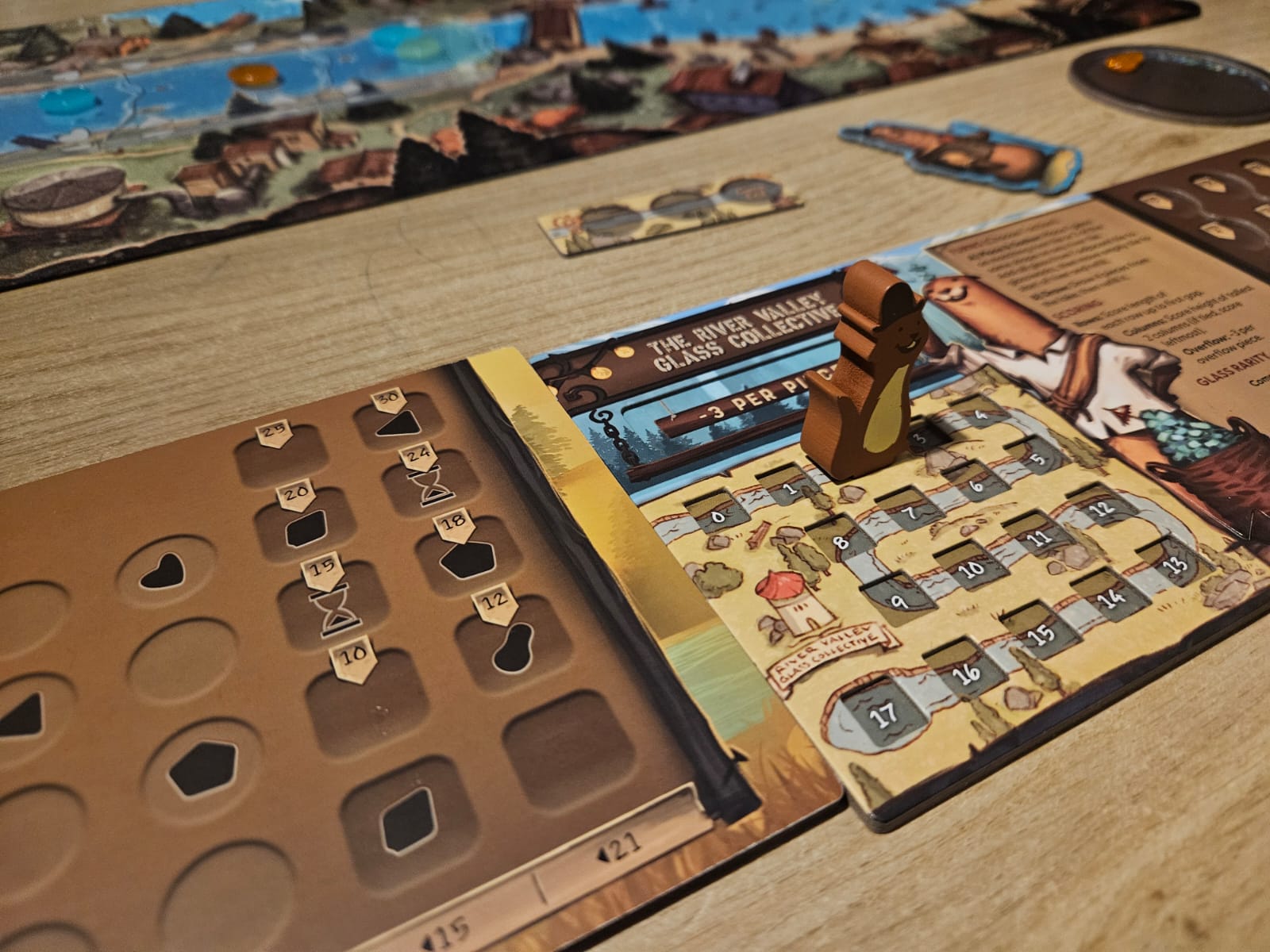
River Valley Glassworks has five game boards. On the back of these boards are the opponents for the solo game, which vary in difficulty. You choose one of these opponents and place it with the “back” (actually the solo side) facing up. For yourself, you choose one of the other boards. You play with the “regular” side of the board.
Next, you prepare the rest of the game. You fill the river and the source with glass pieces and place 3 glass pieces on your own pan.
For the solo game, you also need the ‘end-game tile’. Place this down as well.
Now you and your opponent take turns playing.
On your turn, you have two options:
1. Take glass from the river.
Take a piece of glass from your pan and place it on the tile in the river that shows the same shape.
Now take all the pieces of glass from the tile to the right or left of the piece you placed.
Place these pieces of glass in your shop. Each column indicates a color. So, same colors in the same column.
The now empty section of the river is moved to the beginning of the river and replenished with new glass.
2. Replenish your pan.
You may place 4 pieces of glass from the source on your pan. The 5th piece of glass goes on the end-game tile.
Please note that you may have a maximum of 5 pieces of glass in your pan. If you exceed this maximum, the pieces of glass will go into your overflow, which will cost you points.
Now it is your opponent’s turn.
Each opponent has their own way of collecting glass, placing it in their shop, and scoring points. This is clearly described on their personal tile attached to the shop.
For example, your opponent always collects glass from the tile with the most glass on it.
You carry out the collection action for your opponent and also move the empty tile back into the river.
Because your opponent does not place glass on the river, there are icons in their shop that trigger the placement of a piece of glass (from the stock).
The endgame can be triggered in two ways:
1. When you have 17 (or more) pieces of glass in your shop.
2. When the third piece of glass is placed on the endgame tile.
You simply finish your turn and your opponent also takes their turn.
Then the very last round is played.
Scoring:
Your opponent’s scoring is described on their board and varies from opponent to opponent.
For you, the same scoring applies as in the ‘regular’ game.
You receive points per row. Viewed from the left, up to the first ‘break’.
You also receive points for the two highest columns; in the event of equal columns, the leftmost column (the one with the lowest points) counts.
Any glass pieces in your overflow are minus points.
What do I think of River Valley Glassworks as a solo game?
You’ve already read in the first paragraph that I’m super enthusiastic about the design and its execution, so I’ll keep quiet about that ;).
River Valley Glassworks is a real puzzle game, which you have to like, you have to love it. I love it, very much! So in that respect, River Valley Glassworks is really good for me.
I think the solo game is really well designed. Much more than in the “regular” (multiplayer) game, you can really thwart your opponent in the solo game. Your opponent’s actions are fairly static, he/she does pretty much the same thing every time, but because you know what he/she is going to do, you can adjust your own actions accordingly. This often feels a bit like ‘cheating with inside information’ to me. But that’s not the case with River Valley Glassworks. In fact, I feel that you have to do this, that you need to do this in order to win. Especially against opponents at the higher levels.
Scoring on your own river and trying to create the most unfavorable outcome possible for your opponent makes River Valley Glassworks a fantastic game for me… um, puzzle… or is it a game?
The playing time is short; a solo game takes maybe 20 minutes. Depending on how fast you think and how difficult your choices are, it can also take 15 minutes. The game ends relatively quickly because you quickly reach those 17 glass pieces in your shop. I found that very unfortunate in the first few games, but that is precisely the extra power of the game. You have to make choices because you have relatively few moves. The same applies to that very last round. Can you play it out in such a way that you can make full use of that last round?
All in all, River Valley Glassworks is, in my opinion, a perfect puzzle game that is easy to play but difficult to master. The artwork completes it, and if it’s your thing, I would definitely go for the deluxe version 🙂
I give River Valley Glassworks – solo an 8.5.