Aantal spelers: 2-6
Speelduur: 10-15 minuten
Leeftijd: Vanaf 8 jaar
Auteur: Jesse Douma, Vincent Jassies
Uitgever: Growly Games
Jaar: 2024
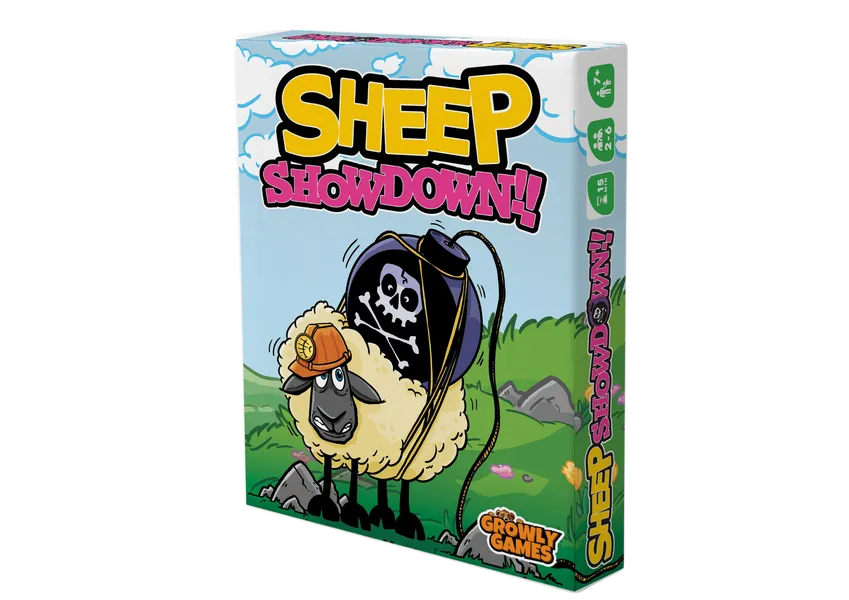

Het leven in de bergen sprak me altijd aan, zeker leven in de bergen tussen een hele kudde schapen. Dit is waarschijnlijk een heel geromantiseerde gedachte en zou nooit haalbaar zijn zonder een trouwe herdershond die het verschil tussen verschillende soorten schapen en een grote boze wolf kent. Voor alle duidelijkheid, ik leef geen kluizenaarsleven in de bergen met een kudde schapen, maar als ik dat zou willen doen kan Sheep Showdown een perfecte voorbereiding zijn.
Spelverloop
Zoals de spelduur je waarschijnlijk al vertelde is Sheep Showdown een kort maar krachtig spel waarbij je de herdershond gaat verplaatsen om zoveel mogelijk schapen in je kudde te krijgen, maar pas op voor de grote boze wolven.
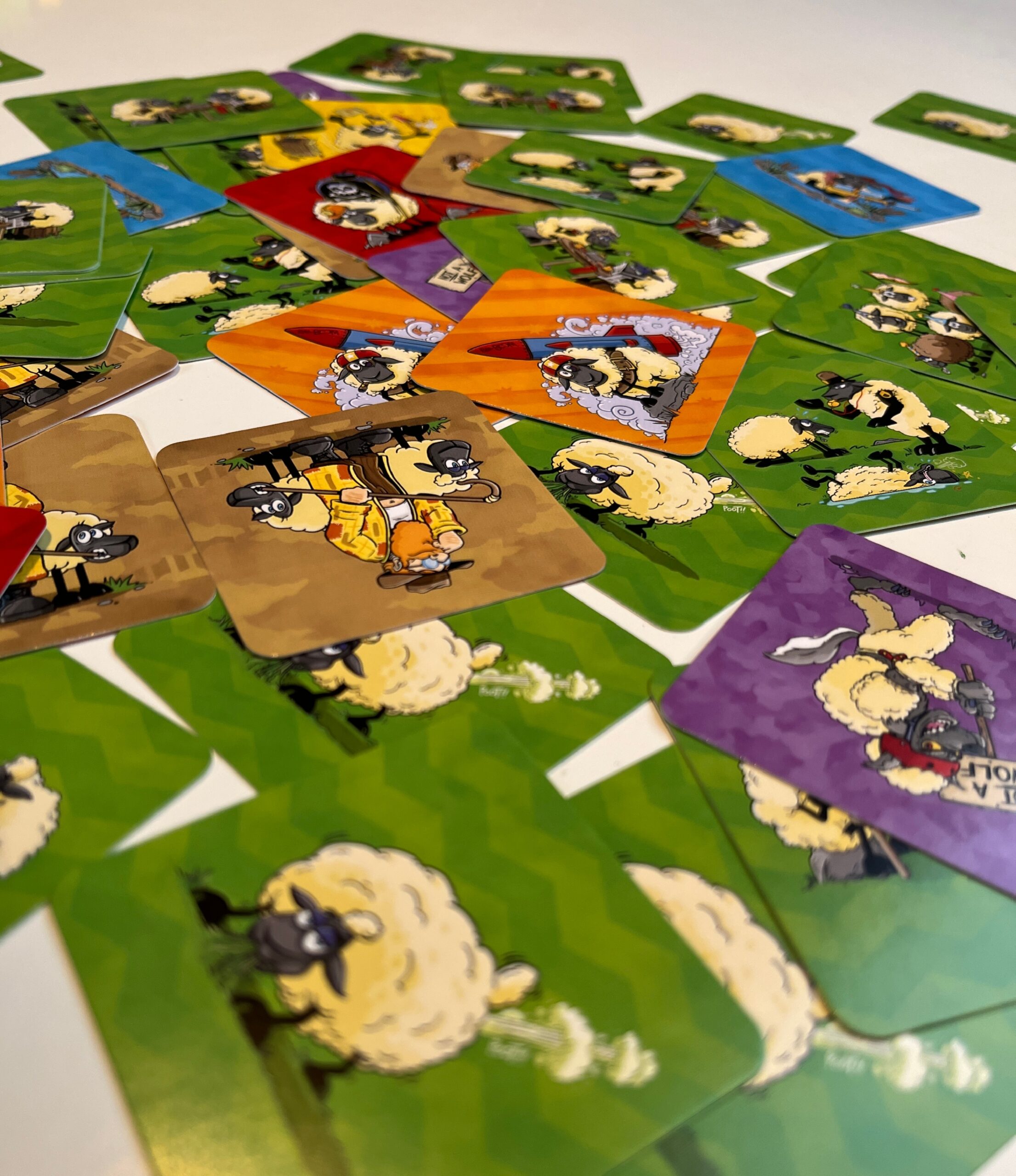
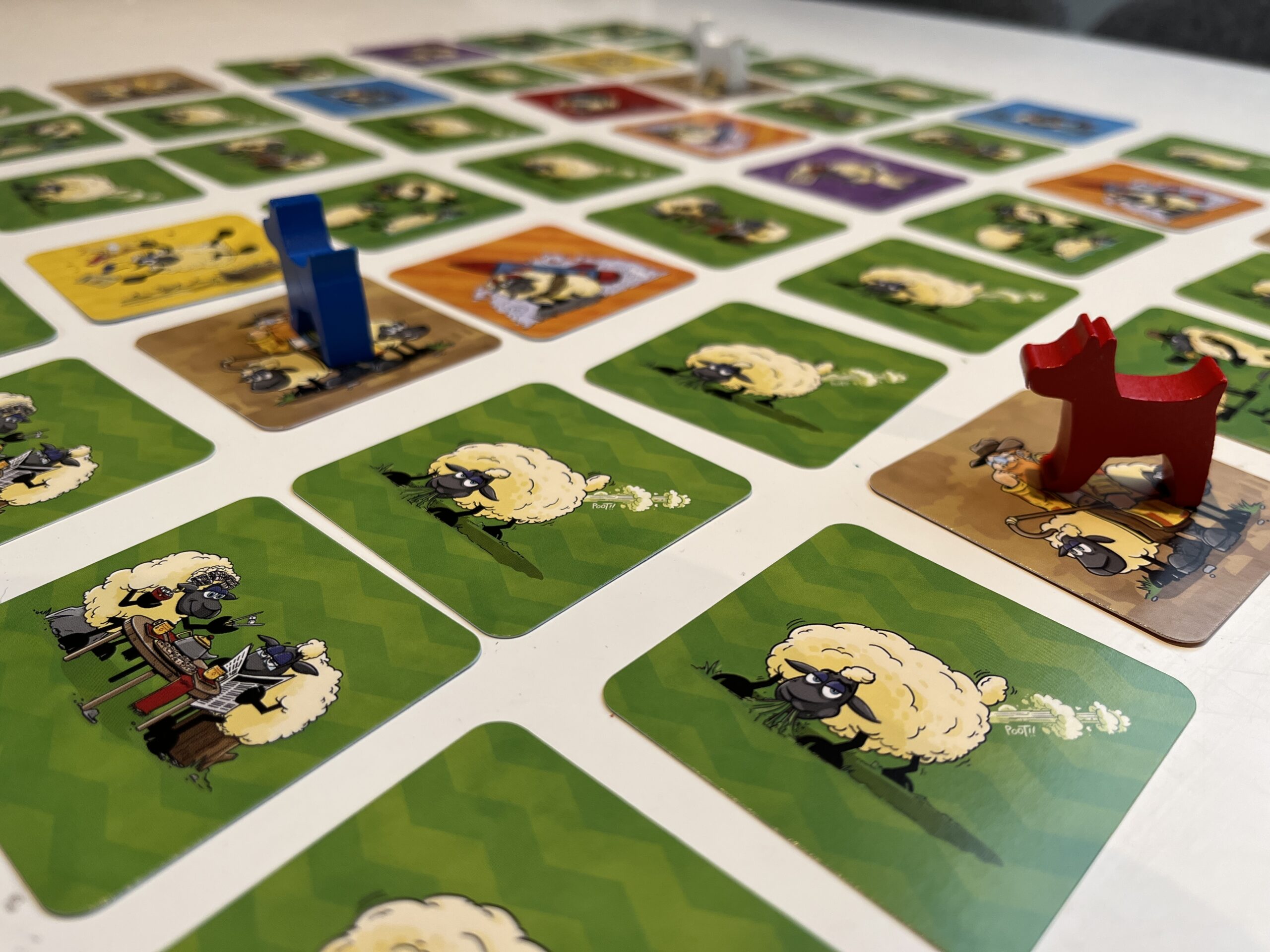
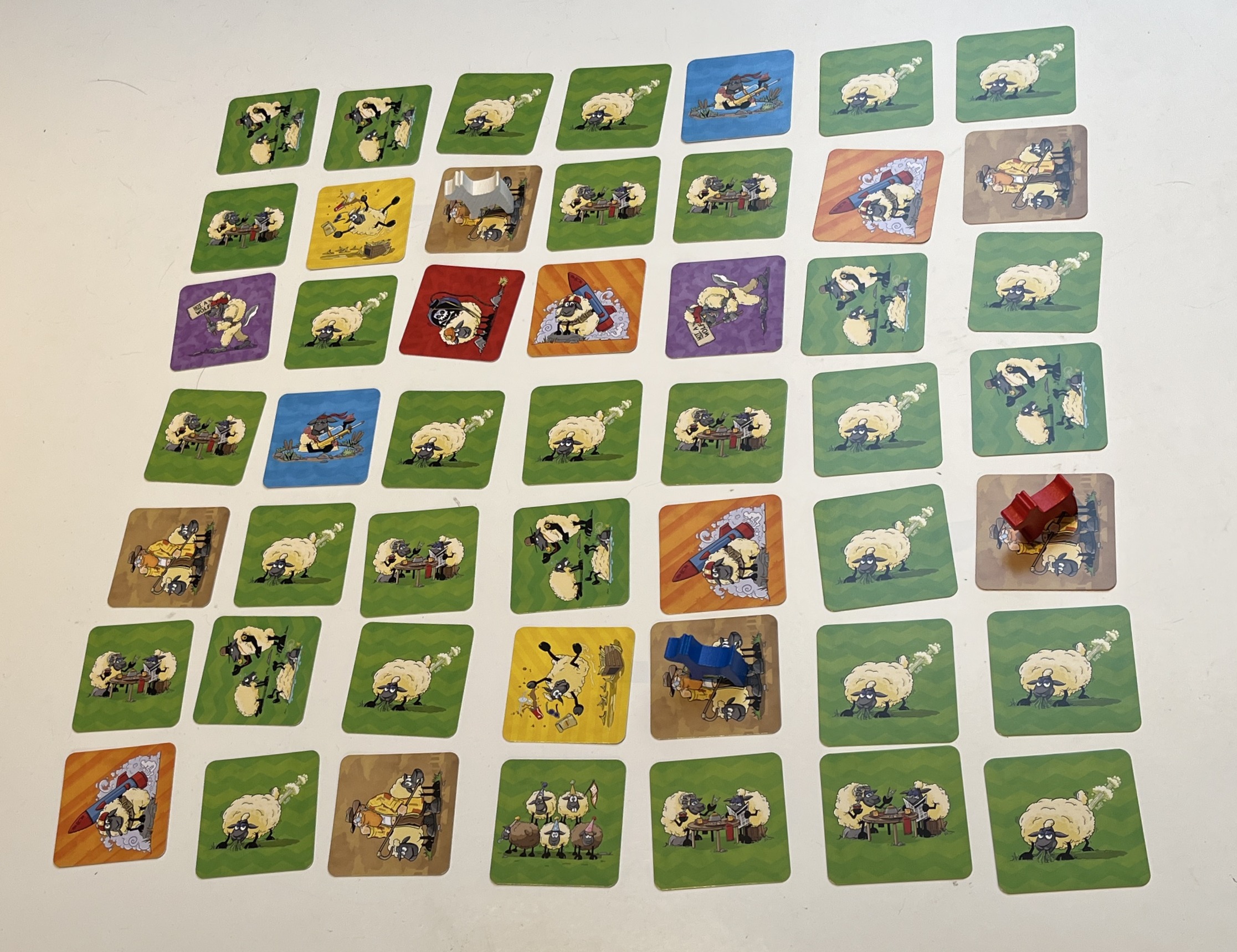
Het speelveld bestaat uit een raster van 7×7 (of 9×9 bij een groter spelersaantal) met allerlei verschillende soorten kaarten. Het merendeel van de kaarten zijn natuurlijk schapenkaarten. Op deze schapenkaarten staan telkens 1-5 schapen waarbij de kaarten met 1 schaap natuurlijk meer aanwezig zijn dan de andere aantallen. Natuurlijk zijn er ook nog speciale kaarten zoals het raketschaap, het schuifschaap, de herder, een bom en natuurlijk enkele wolf kaarten.
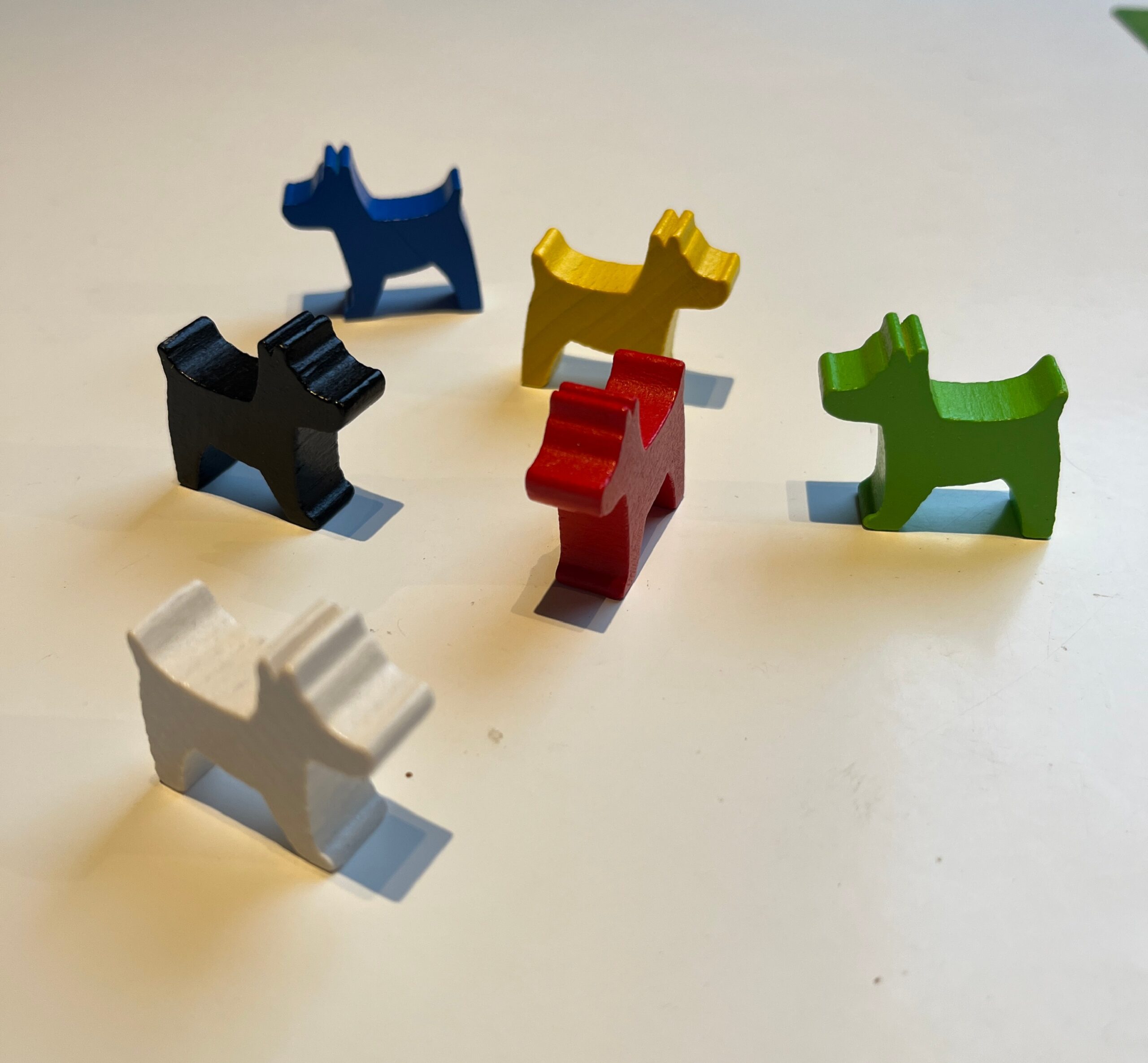
Elke beurt mag je herdershond 1 stap zetten op een orthogonaal aangrenzend kaart. De kaart waar je op landt is voor jou tenzij het een speciale kaart is. Dit betekent dat als je op een schaapkaart komt, je deze kaart in jouw kudde krijgt. Hoe meer schapen hier op de kaart staan, hoe meer punten die kaart zal oplossen. Het is dus evident dat je probeert naar die hogere schapenaantallen te navigeren.
Als je de kaart wegneemt, wordt deze niet aangevuld waardoor er gaten in het raster ontstaan. Leuk, zou je denken? Welja, als alle plekken rondom je herdershond leeg zijn, lig je uit het spel. Je moet dus tactisch je route kiezen om zo lang mogelijk stappen te kunnen blijven zetten.
Niet alleen de schaapkaarten worden uit het raster genomen als je erop komt, want ook de wolfkaarten komen in je bezit als je erop komt. Deze kaarten leveren je helaas minpunten op, maar ze hebben de speciale eigenschap waarmee je een andere hond een stap mag laten zetten. Als je dit tactisch inzet, kan je zo andere spelers buiten spel zetten.
De laatste kaart die uit het spel verdwijnt is de bom. Als je op deze kaart stapt of gezet wordt, ontploft de bom natuurlijk. Wat betekent dit dan juist? Wel, als de bom ontploft verdwijnen alle omliggende tegels (inclusief de herdershonden die daar staan) uit het spel. Zo kan je dus plots heel wat extra lege vakken genereren.
Er waren nog enkele andere kaarten met speciale eigenschappen die niet uit het spel verdwijnen, maar die het mogelijk maken om meerdere vakjes vooruit te gaan. Zo hebben we het raketschaap, waarbij je exact 2 stappen ver kan springen. Niet verder, maar ook niet dichter. Het schuifschaap zorgt ervoor dat je een vakje doorschuift in de richting van de stap die je zette om op dit schaap terecht te komen. Dit is tevens het enige schaap dat je diagonaal kan benaderen. Tenslotte hebben we nog de herderskaarten. Dit zijn de kaarten waarop je herdershond start bij het begin van het spel en als je na een stap op een herder landt, moet je teleporteren naar een andere herderskaart.
Als laatste twist mag de speler die een andere speler uitschakelt een kaart uit diens kudde trekken om zo eventueel extra punten te verkrijgen.
Gebruik de kaarten slim om als laatste en met de meeste schapen in je kudde als beste herdershond te worden bekroond.
Spelmechanisme
Zoals je waarschijnlijk al vermoedde, is map reduction een van de mechanismes. Het raster wordt steeds kleiner naarmate spelers stappen zetten met hun herdershond. Verder kan het spel best hard zijn. Om het met licht overdreven termen te zeggen, worden vriendschappen in dit spel serieus op de proef gesteld. Dit mechanisme staat bekend als “take that” omdat het spel spelers tegenover mekaar zet met enkele heel simpele acties.
Mijn bescheiden mening
Het spel ziet er wat “silly” uit en dat geeft het wat mij betreft ook meteen een zekere charme. De leuke tekenstijl wordt gecombineerd met fijne regels waardoor dit een fijne fillergame wordt. Het spel duurt ongeveer 15 minuten en heeft genoeg te bieden om meteen een 2e rondje te starten.
Wat maakt Sheep Showdown zo sterk?
- De korte spelduur: zo kan je zonder problemen meerdere rondjes aan elkaar rijgen zonder er genoeg van te krijgen.
- De leuke tekenstijl: dit past perfect bij de fijne interactie tussen de spelers.
- Variatie: het raster kan er steeds verschillend uitzien. In de regels staat een aangeraden selectie van kaartjes, maar die liggen steeds op een andere (random) plaats in het raster, waardoor elk spel anders voelt. Moest dit toch niet genoeg variatie zijn, kan je steeds zelf een selectie maken van kaarten waarbij er bijvoorbeeld meer wolven aanwezig zijn.
Is het alleen maar positief?
Het spel is een leuke tactische puzzel, waarbij je andere spelers een serieuze hak kan zetten. Helaas betekent dit ook dat je vroeger uit het spel kan liggen dan andere spelers waardoor je even “technisch werkloos” bent op je spelavond. Gelukkig duurt het spel echt niet lang en kan je zo weer meedoen met een volgend rondje.
Wat mij betreft mogen er nog wat meer kaarten zijn van de verschillende soorten om zelf wat meer te kunnen wisselen, maar dat is slechts een kleine kanttekening. Zo zouden meer bommen en meer wolven het spel nog meer een “take that”-attitude geven.
Conclusie
Het spel geeft de speler een leuke en snelle interactie, maar toch ook de mogelijkheid dieper na te denken over de te zetten stappen. Denk goed na over waar je naartoe gaat, want voor je het weet is het game over voor jou en je herdershond. In ons eerste rondje op Spiel, werden zelfs afspraken gemaakt tussen spelers om andere spelers op een bom te laten lopen. Meer “take that” wordt het niet.
Een heel leuke spelervaring voor een korte pauze op het werk of op een spelavond? Ik raad deze zeker aan in die categorie. Ik geef dit spel dan ook met recht en rede een 7.5/10. Een mooi startspel voor Growly Games, mogen er nog vele hoofdstukken volgen!

Sheep Showdown
Players: 2-6
Time: 10-15 minutes
Age: 8+
Author: Jesse Douma, Vincent Jassies
Publisher: Growly Games
Year: 2024
Mountain life always appealed to me, especially living among a whole flock of sheep. This is probably a rather romanticized notion and would never be feasible without a faithful sheepdog who knows the difference between different types of sheep and a big, bad wolf. To be clear, I don’t live a hermit’s life in the mountains with a flock of sheep, but if I wanted to, Sheep Showdown could be the perfect preparation.
Gameplay
As the game duration probably already told you, Sheep Showdown is a short but intense game where you move your sheepdog to get as many sheep as possible into your flock, but watch out for the big bad wolves.
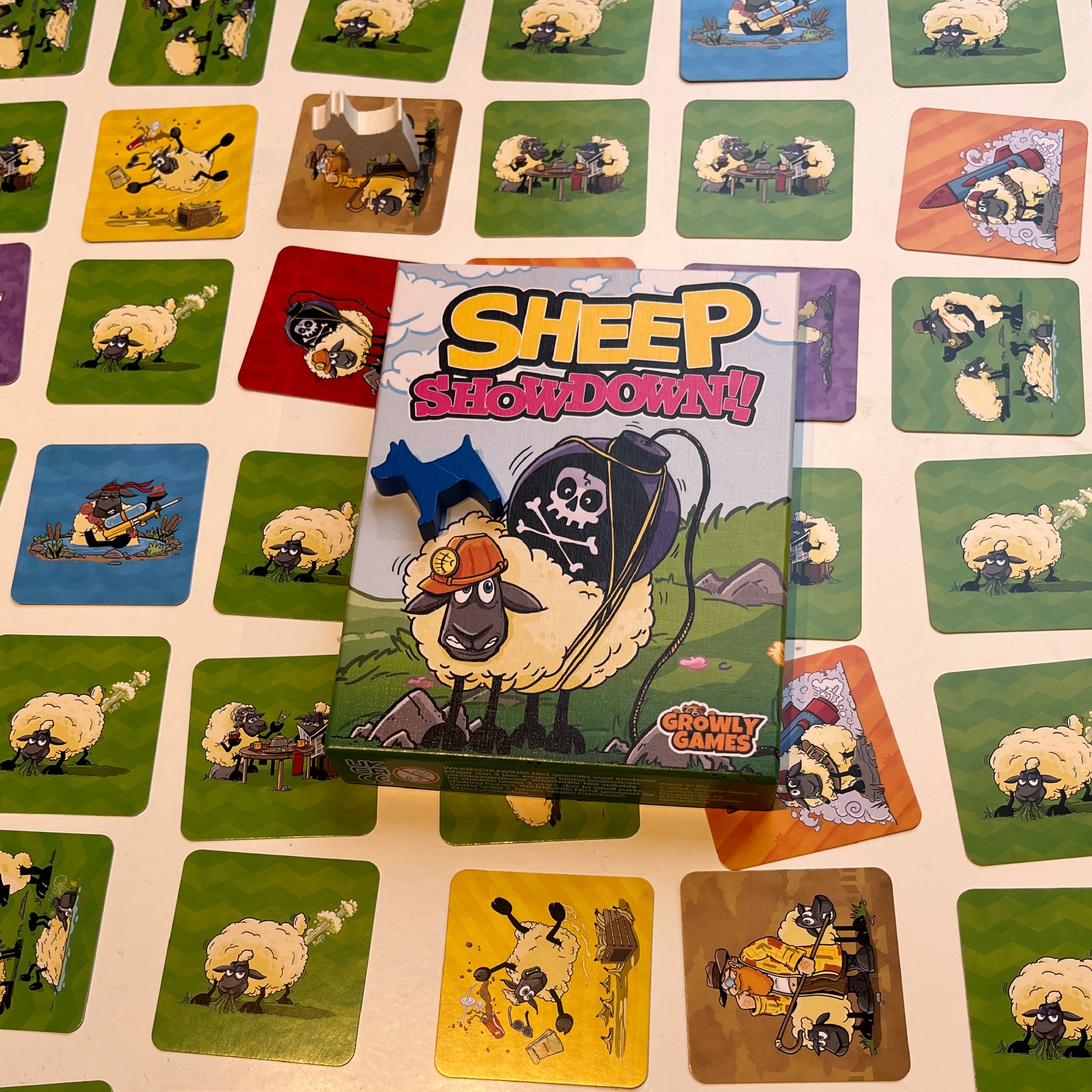
The playing field consists of a 7×7 grid (or 9×9 for a larger player count) with all sorts of different cards. Most of the cards are, of course, sheep cards. These sheep cards each depict 1-5 sheep, with cards with 1 sheep naturally being more numerous than the other cards. There are also special cards, such as the rocket sheep, the sliding sheep, the shepherd, a bomb, and, of course, a few wolf cards.
Each turn, your sheepdog can move 1 step onto an orthogonally adjacent card. The card you land on is yours unless it’s a special card. This means that if you land on a sheep card, you get that card into your flock. The more sheep there are on the card, the more points that card will resolve. So, it’s obvious that you’re trying to navigate to those higher sheep numbers. If you remove the card, it won’t be replenished, creating gaps in the grid. Sounds good, right? Well, if all the spaces around your sheepdog are empty, you’re out of the game. So you have to choose your route tactically to keep moving as long as possible.
Not only are the sheep cards removed from the grid when you land on them, but the wolf cards also come into your possession. These cards, unfortunately, give you negative points, but they also have the special ability to allow another dog to move. If you use this tactically, you can eliminate other players.
The last card to be removed from the game is the bomb. If you step on or are placed on this card, the bomb explodes, of course. What does this actually mean? Well, when the bomb explodes, all surrounding tiles (including the sheepdogs standing there) disappear from the game. This can suddenly create a lot of extra empty spaces.
There were a few other cards with special abilities that remain in play, but allow you to advance multiple spaces. For example, we have the rocket sheep, which allows you to jump exactly two spaces. Neither further nor closer. The sliding sheep allows you to slide one space in the direction of the step you took to land on it. This is also the only sheep you can approach diagonally. Finally, we have the shepherd cards. These are the cards on which your sheepdog starts at the beginning of the game, and if you land on a shepherd after one step, you must teleport to another shepherd card.
As a final twist, the player who eliminates another player may draw a card from their flock to potentially earn extra points.
Use these cards wisely to be crowned the best sheepdog at the end, with the most sheep in your flock.
Game Mechanics
As you probably already guessed, map reduction is one of the mechanics. The grid shrinks as players take steps with their German Shepherd. Furthermore, the game can be quite tough. To put it mildly, friendships are seriously tested in this game. This mechanic is known as “take that” because the game pits players against each other with a few very simple actions.
My Humble Opinion
The game looks a bit silly, which, in my opinion, gives it a certain charm. The attractive art style combines with the easy-to-follow rules to make this a great filler game. The game lasts about 15 minutes and offers enough to immediately start a second round.
What makes the game so strong?
- The short game time: this allows you to easily string together multiple rounds without getting tired of them.
- The attractive art style: this perfectly complements the pleasant interaction between players.
- Variety: the grid can look different each time. The rules include a recommended selection of cards, but these are always placed in a different (random) position on the grid, making each game feel different. If this still isn’t enough variety, you can always create your own selection of cards with, for example, more wolves.
Is it all just positive?
The game is a fun tactical puzzle where you can seriously mess with other players. Unfortunately, this also means you might be out of the game earlier than other players, leaving you temporarily “technically unemployed” on your game night. Fortunately, the game doesn’t last long, and you can easily rejoin the next round.
I’d like to see a few more cards of the different suits to allow for more variety, but that’s just a minor quibble. More bombs and wolves would give the game a more “take that” vibe.
Conclusion
The game offers the player a fun and fast-paced interaction, yet also allows for deeper reflection on the next steps. Think carefully about where you’re going, because before you know it, it’s game over for you and your German Shepherd. In our first round at Spiel, players even made agreements to have other players walk on a bomb. It doesn’t get more “take that” than that.
A really fun gaming experience for a short break at work or a game night? I definitely recommend this one in that category. I rightly give this game a 7.5/10. A great starter game for Growly Games; may many more chapters follow!