

Aantal spelers: 2-4
Speelduur: 15 minuten
Leeftijd: Vanaf 8 jaar
Auteur: Jérémy Partinico, Christelle Partinico
Uitgever: Subverti
Jaar: 2025
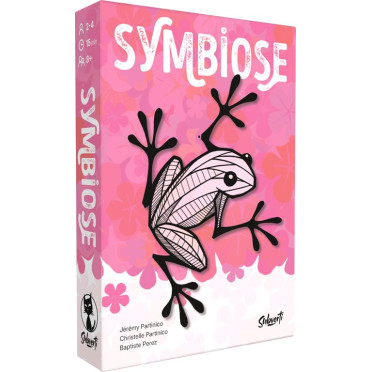

Symbiose is een snel kaartspel voor 2–4 spelers. Op het doosje staat: “Een snel en strategisch kaartspel” en dat is precies wat het is.
Zelf heb ik Symbiose, behalve in mijn eigen kast en in die van mijn MeepleTales-collega Anouk, nog nooit ergens langs zien komen.
Daarom vond ik het tijd om dit spel(letje) wat extra aandacht te geven.
Symbiose – een eerste indruk
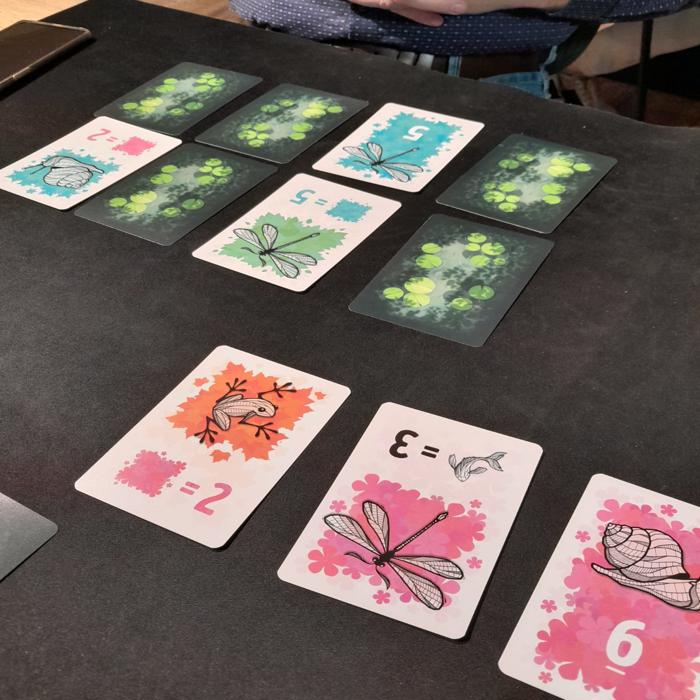
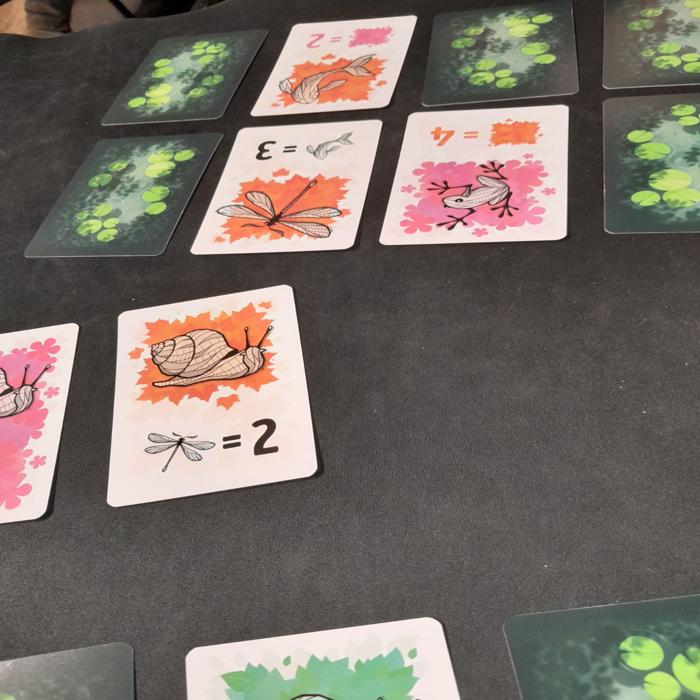
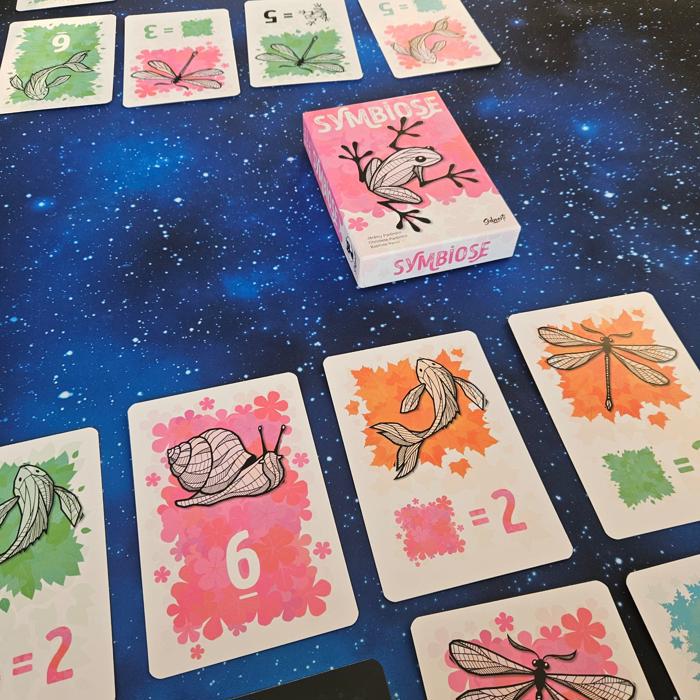
Zoals gezegd is Symbiose een snel kaartspel. Dat is dan ook alles wat er in het doosje zit: een stapeltje kaarten en een klein boekje met regels. De kaarten zijn groter dan de gemiddelde speelkaart en tonen verschillende (water)dieren in uiteenlopende kleuren.
Het geheel ziet er niet heel spannend uit, maar wel effectief: geen poespas.
Mijn versie is Frans. Helaas kon ik (nog) geen Engelse versie vinden. De regels zijn gelukkig simpel. Een korte zoektocht op Google leerde mij dat er inmiddels wel een Duitse versie is van Pegasus Spiele, mocht je Duits beter zijn dan je Frans.
Hoe wordt het gespeeld?
Het doel van Symbiose is om een zo symbiotisch mogelijke poel te creëren, bestaande uit 8 kaarten (2×4). Een symbiotische poel levert je punten op.
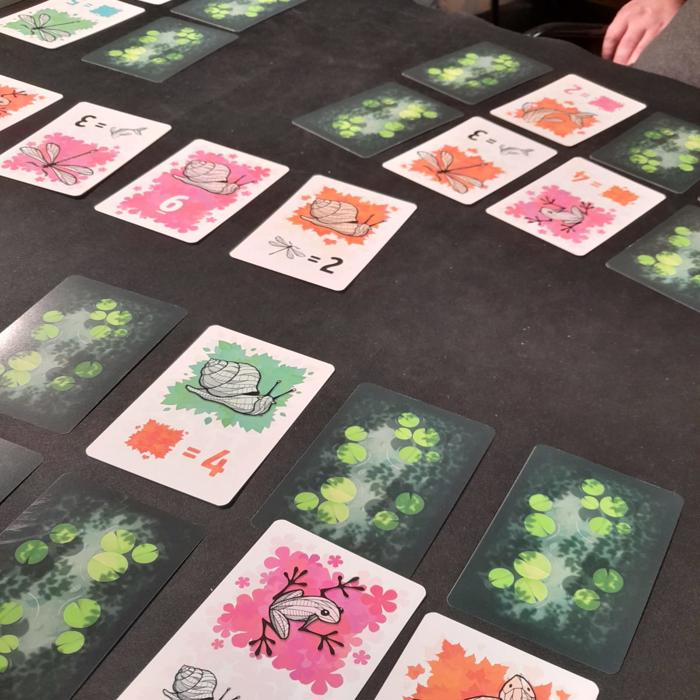
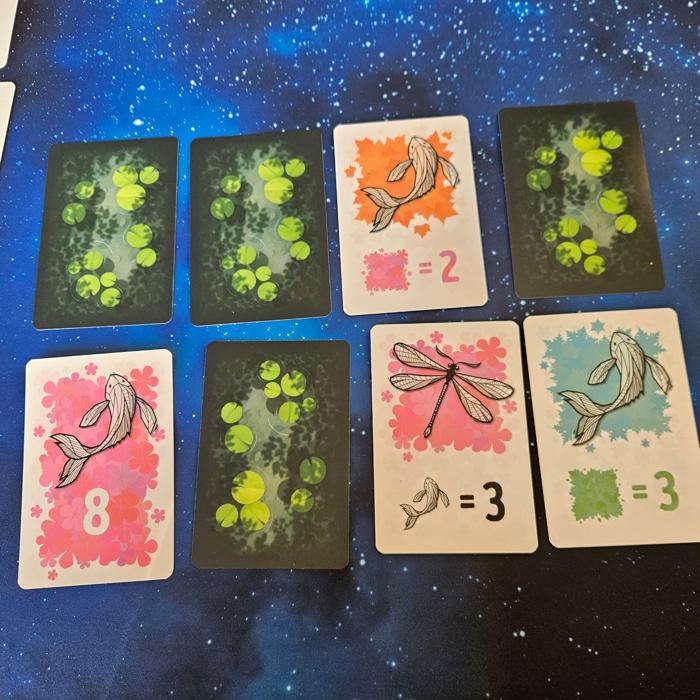
Elke speler begint met een raster (jouw poel) van 4×2 gesloten kaarten.
Op tafel liggen 4 open kaarten in de rivier (dit is het aanbod).
Aan het begin van het spel draaien alle spelers één kaart in hun poel open. Dit is hun startpunt.
Het is hierbij handig om één van de middelste vier kaarten om te draaien; waarom, daar kom ik zo op terug.
Hoe bouw je zo’n symbiotische poel?
Je scoort punten door symbiose te maken. Alle kaarten hebben drie elementen: een waterdier, een (achtergrond)kleur en een scoringsvoorwaarde.
Zo’n scoringsvoorwaarde is bijvoorbeeld: 5 punten per kikker. Er zijn ook een aantal kaarten met een vaste score.
Je poel bestaat uit twee rijen van vier kaarten. Je wilt symbiose maken met je eigen poel, maar ook met die van je medespelers.
De twee rechterkaarten scoren op de poel van je rechterbuur en de twee linkerkaarten scoren op de poel van je linkerbuur.
Je scoort hierbij op diens hele poel. Dus als jouw linkerkaart zegt 5 punten per kikker en je linkerbuur heeft twee kikkers in zijn poel liggen, krijg je 10 punten voor die kaart.
De middelste vier kaarten scoren op je eigen poel. Ook hier telt je hele poel mee.
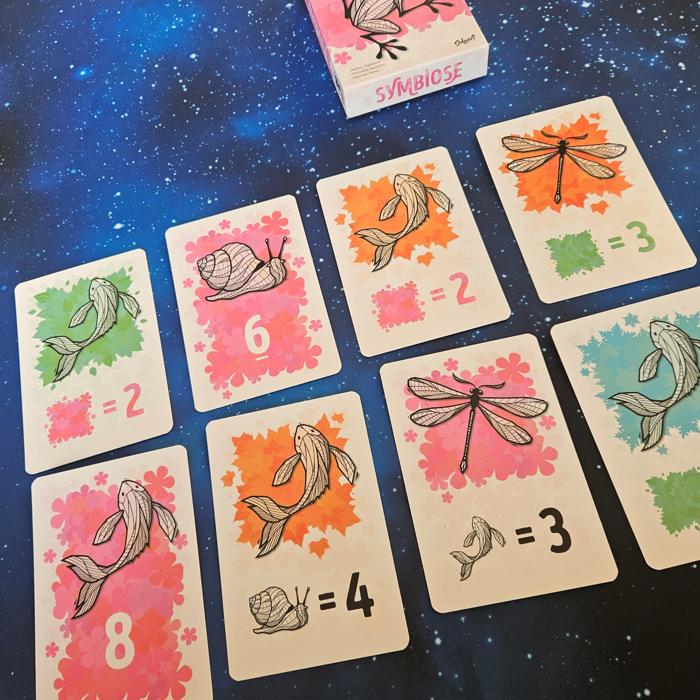
In bovenstaande afbeelding wordt als volgt gescoord:
kaart 1: 2 punten per roze kaart van de linkerbuur
kaart 2: 6 punten
kaart 3: 6 punten (want 3 roze kaarten in de eigen poel)
kaart 4: 3 punten per groene kaart bij de rechterbuur
kaart 5: 8 punten
kaart 6: 4 punten (want 1 slak in de eigen poel)
kaart 7: 15 punten (want 5 vissen in de eigen poel)
kaart 8: 3 punten per groene kaart bij de rechterbuur
Nu weet je hoe je een symbiotische poel scoort, maar hoe bouw je die op?
Je bent begonnen met het open draaien van één kaart in je poel. Bij voorkeur is dit een kaart in het midden, zodat je een begindoel hebt. Daarna mogen spelers om beurten een kaart uit het aanbod pakken.
Je pakt één kaart uit het aanbod en plaatst deze in je poel. De (gesloten) kaart die daar lag, leg je open in het aanbod. Je weet dus nooit van tevoren wat je teruglegt.
Zo gaat het spel verder totdat iedere speler acht open kaarten in zijn poel heeft liggen.
De speler met de meest symbiotische poel (en dus de meeste punten) wint het spel.
Wat vinden wij van Symbiose?
Ik vind Symbiose een ondergewaardeerd spel(letje). Hoewel bovenstaande uitleg misschien niet meteen heel duidelijk is, heb je het snel genoeg door zodra het spel daadwerkelijk op tafel ligt.
De spelduur is kort (ongeveer 15 minuten), maar het is zeker geen saai spel. Het is snel uitgelegd en zowel beginnende als gevorderde spelers kunnen makkelijk aansluiten.
Ik neem het spel graag mee naar de spellenclub, omdat het wat mij betreft een perfecte filler is: korte speelduur, maar veel meer inhoud dan bijvoorbeeld LLAMA, dat ik vaak voorbij zie komen als filler.
Wat ik vooral leuk vind aan Symbiose is dat je, zoals de titel al zegt, echt bezig bent met wat je buren doen. Je bent niet alleen met je eigen poel bezig, maar moet ook goed letten op die van je medespelers. Afhankelijk van het spelverloop kun je je buren zelfs flink punten door de neus boren.
De uitwerking is simpel, maar ontzettend duidelijk.
Eindconclusie
Symbiose is wat mij betreft een ondergewaardeerd spelletje. Ik zou iedereen aanraden dit aan te schaffen als snelle filler voor tussendoor.
Symbiose krijgt van mij een 7,5/10.
N.B.
Eerst een spelletje uitproberen? Symbiose staat op BGA.
N.B. 2
Helaas is Symbiose (nog) niet in Nederland verkrijgbaar. Ik bestelde de Franse versie bij Philibert.

Symbiose
Players: 2-4
Time: 15 minutes
Age: 8+
Author: Jérémy Partinico, Christelle Partinico
Publisher: Subverti
Year: 2025
Symbiose is a fast card game for 2–4 players. The box states: “A fast and strategic card game”, and that is exactly what it is.
Apart from my own collection and that of my MeepleTales colleague Anouk, I have never really seen Symbiose appear anywhere else.
That’s why I felt it was time to give this little game some extra attention.
Symbiose – First Impressions
As mentioned, Symbiose is a fast card game. That is also all you will find in the box: a small deck of cards and a compact rulebook. The cards are larger than standard playing cards and feature various (aquatic) animals in different colors.
Visually, it may not look very exciting, but it is effective: no unnecessary frills.
My copy is in French. Unfortunately, I have not (yet) been able to find an English version. Luckily, the rules are very straightforward. A quick Google search taught me that a German version by Pegasus Spiele does exist, in case your German is better than your French.
How Is It Played?
The goal of Symbiose is to create the most symbiotic pond possible, consisting of 8 cards (2×4). A symbiotic pond earns you points.
Each player starts with a grid (your pond) of 4×2 face-down cards.
In the center of the table, there are 4 face-up cards in the river (this is the card market).
At the start of the game, all players flip one card in their pond face up. This is their starting point.
It is helpful to flip one of the four middle cards—more on why later.
How Do You Build a Symbiotic Pond?
You score points by creating symbiosis. Every card has three elements: an aquatic animal, a (background) color, and a scoring condition.
An example of such a scoring condition is: 5 points per frog. There are also several cards with a fixed score.
Your pond consists of two rows of four cards. You want to create symbiosis not only with your own pond, but also with those of your neighbors.
The two rightmost cards score based on your right-hand neighbor’s pond, and the two leftmost cards score based on your left-hand neighbor’s pond.
You always score based on that player’s entire pond. So if your left card says 5 points per frog and your left neighbor has two frogs in their pond, you score 10 points for that card.
The four middle cards score based on your own pond—again, your entire pond is taken into account.
In the example above, scoring works as follows:
card 1: 2 points per pink card in the left neighbor’s pond
card 2: 6 points
card 3: 6 points (because there are 3 pink cards in your own pond)
card 4: 3 points per green card in the right neighbor’s pond
card 5: 8 points
card 6: 4 points (because there is 1 snail in your own pond)
card 7: 15 points (because there are 5 fish in your own pond)
card 8: 3 points per green card in the right neighbor’s pond
Now that you know how a symbiotic pond scores, how do you actually build one?
You begin by flipping one card in your pond face up. Ideally, this is one of the middle cards, as it gives you an initial direction. Players then take turns choosing a card from the river.
You take one card from the market and place it into your pond. The face-down card that was previously in that position is then flipped face up and placed into the river. You never know in advance which card you will add back to the market.
The game continues until every player has eight face-up cards in their pond.
The player with the most symbiotic pond (and therefore the most points) wins the game.
What Do We Think of Symbiose?
I consider Symbiose to be an underrated little game. While the explanation above may not be perfectly clear at first glance, the game quickly makes sense once it is on the table.
The playtime is short (around 15 minutes), but it is far from boring. The rules are easy to explain, and both beginner and experienced players can jump in without any trouble.
I enjoy bringing this game to board game meetups, as it is, in my opinion, a perfect filler: short playtime, but much more depth than, for example, LLAMA, which I often see used as a filler game.
What I especially like about Symbiose is that—just like the title suggests—you are truly engaged with what your neighbors are doing. You are not simply focused on your own pond; you constantly have to pay attention to the ponds of other players as well. Depending on how the game unfolds, you can even actively deny your neighbors valuable points.
The design is simple, but very clear and effective.
Final Verdict
Symbiose is, in my opinion, an underrated game. I would recommend it to anyone looking for a quick filler game to play in between longer sessions.
I give Symbiose a 7.5/10.
Note:
Want to try the game first? Symbiose is available on BGA.
Note 2:
Unfortunately, Symbiose is not (yet) available in the Netherlands. I ordered the French version from Philibert.