

Aantal spelers: 1-4
Speelduur: 45-180 minuten
Leeftijd: Vanaf 14 jaar
Auteur: Cédric Millet
Uitgever: 999 Games
Jaar: 2025
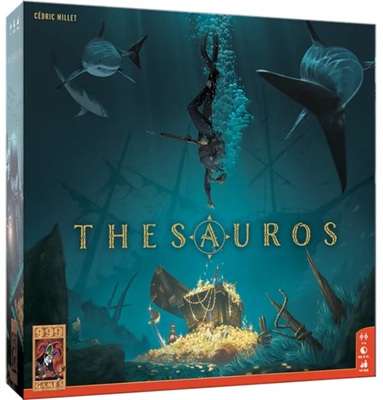

Mel Fisher. Heb je daar wel eens van gehoord? Mel, inmiddels overleden, was een kippenboer in Indiana (VS). Hij verhuisde naar Californië en opende een duikwinkel. Samen met zijn vrouw Dolores werd Mel erg succesvol. Dolores was een van de eerste vrouwen die kon duiken en heeft een wereldrecord van 50 uur onder water. Dat doe ik haar niet na, trouwens. Wat is er zo bijzonder aan dit stel? Mel Fisher werd schatjager, een diepzee schatjager. Na vele jaren zoeken vond hij het Spaanse schip Atocha die in 1622 verloren was gegaan tijdens een orkaan. Mel vond het wrak in 1972 met vrijwel alle schatten aan boord…totale waarde…hou je vast…$ 450 miljoen…Ik heb wel eens een tientje gevonden op het strand, er is nog een lange weg te gaan.
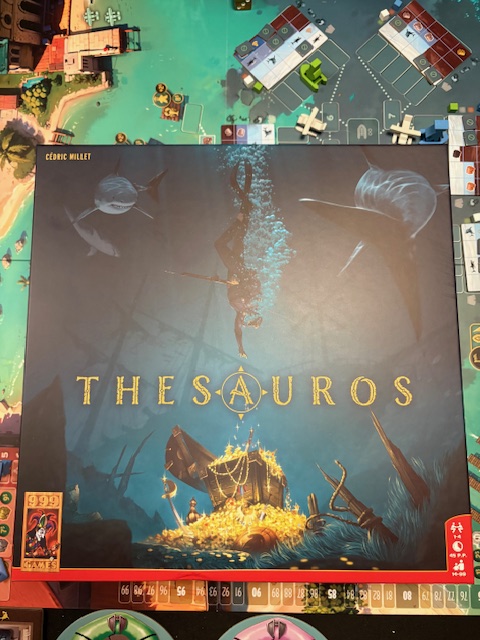
In Thesaurus ga je schatjagen op zee. In een prachtig vormgegeven expert bordspel bezoek je veel locaties om duikspullen, duikkaarten, boten te kopen en breng je jouw gevonden schatten terug naar het museum. Maar, pas op voor de haaien.
Opzet en componenten.
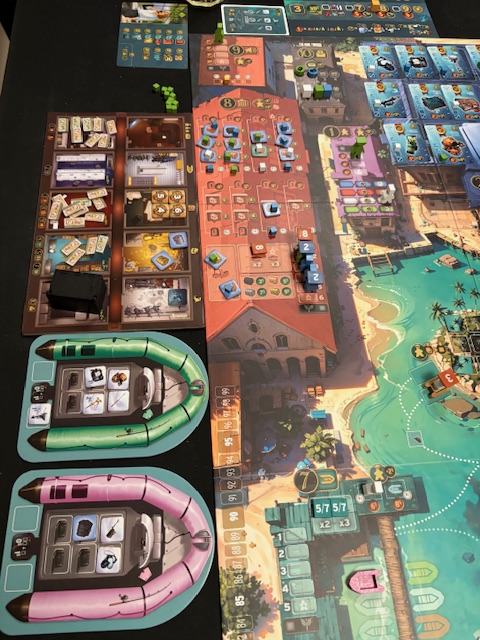
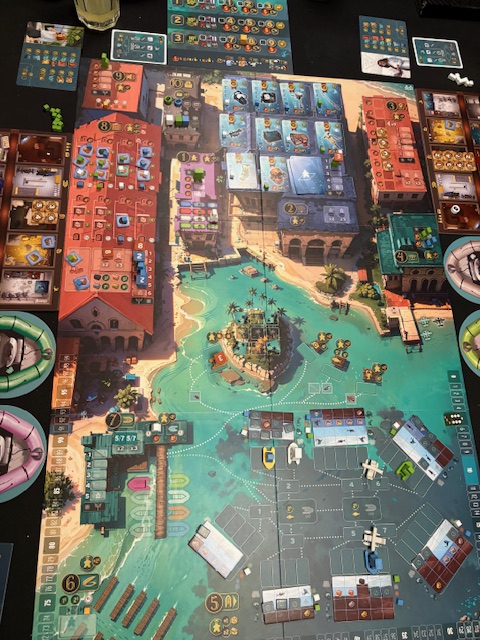
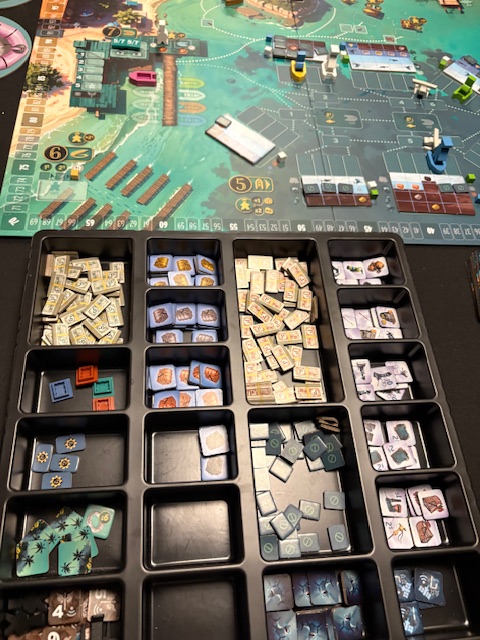
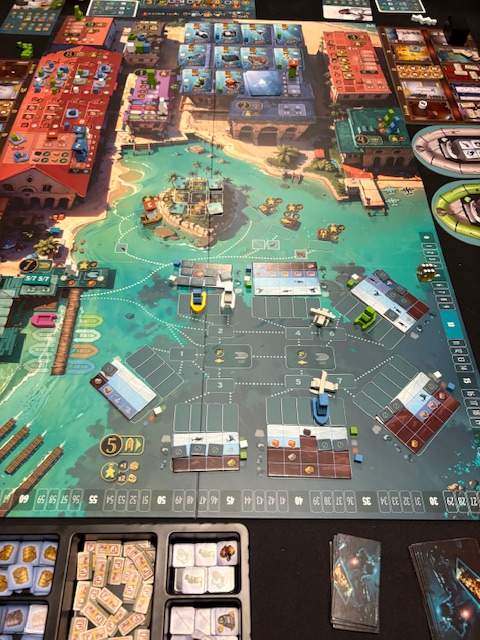
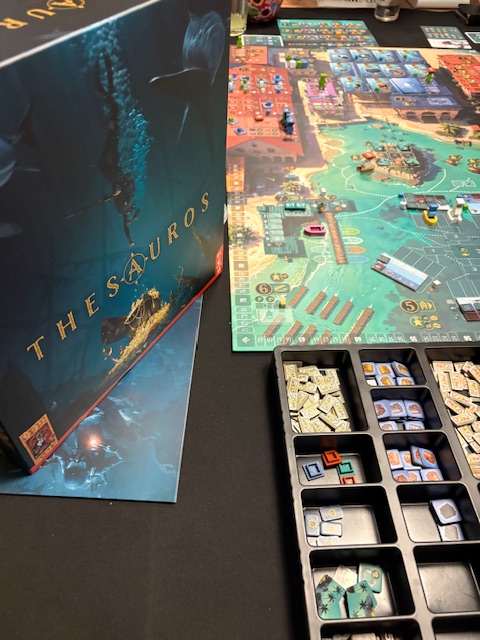
Had ik al gezegd dat Theasaurus prachtig is vormgegeven? Het grote hoofdbord is prachtig geïllustreerd met een tropisch gebied vol gebouwen, strand en zeelocaties. Dit expert spel kent vele tokens, blokjes, fiches, bootjes, en een paar vliegtuigen. Verreweg de meeste kleine onderdelen zitten in een grote opbrengdoos met veel vakjes en een deksel. Enorm handig.
1 op de 12 mannen heeft moeite met het onderscheiden van kleuren die dicht bij elkaar liggen. De gouden en bronzen schatten in Thesauros zijn voor mij dan ook niet te onderscheiden. Even de gouden schatten een andere vorm geven zou een makkelijke oplossing zijn.
De opzet valt door deze grote doos mee, de doos met onderdelen zet je zo neer op tafel. Verder nog wat spelersbordjes vullen, kaarten schudden en schatkaarten neerleggen. Dit gaat best snel.
Hoe wordt het spel gespeeld
In Thesauros wint de speler met de meeste punten. Er worden 3 jaren gespeeld en in elk jaar worden er 3 rondes (ook wel seizoenen genoemd) gespeeld waarin je je baas en werknemers aan het werk zet.
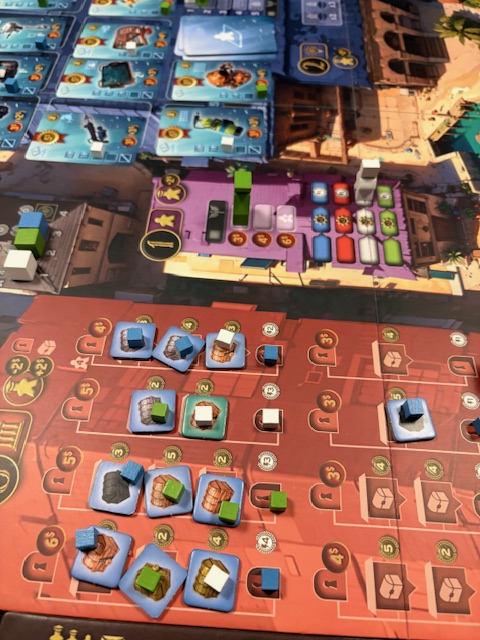
Aan het begin van elk jaar moet je eerst je geld indelen voor de acties die je gaat doen in de komende 3 rondes. Per ronde doe je 3 tot 6 acties (afhankelijk of je extra werknemers in dienst genomen hebt). Dus aan het begin van een jaar moet je je geld verdelen over de bankrekeningen van de specifieke acties voor minimaal de komende 9 acties (3 rondes maal 3 acties). Dat is best ver vooruit denken. Je kan in de rondes geld overmaken van de ene bankrekening naar de andere, maar dat kost wel extra geld…beetje zonde. Kortom het geldbeheer is meteen al expert niveau en is vooral voor de eerste potjes best lastig.
Er zijn 5 bankrekeningen waarop je je geld kan storten en onderaan de bankrekening staat welke acties je kan doen met het geld op die rekening. Je kan dan ook alleen maar betalen vanaf die rekening en niet met andere rekeningen. Tenzij je extra kosten maakt.
Nadat je je geld hebt ingedeeld begint de eerste ronde. Elke speler zet een baas/werknemer op het bord bij een actie en nadat alles op het bord staat, gaan we de acties af. De baas krijgt vaak korting (of een ander voordeel) bij de actie waar hij staat.
Er zijn 10 soorten acties op het bord, maar die zullen niet alle 10 per ronde gedaan worden. Alleen de acties waar een baas/werknemer staat, wordt gedaan.
De 10 acties zijn in het kort:
- Huur nieuw personeel in. Je kan hier een nieuwe werknemer inhuren die je meteen bij een actie kan inzetten
- Koop patenten en voorwerpen voor in je boot. Hier koop je voorwerpen die je nodig hebt voor het schatduiken zoals een duikmasker, luchtfles, harpoen, sonarapparatuur, etc. Je kan ook een patent kopen op deze spullen zodat andere spelers jou een commissie moeten betalen wanneer ze het voorwerp kopen.
- Hier koop je schatkaarten. Zonder kaart kan je niet in de gebieden op zee komen waar de schatten liggen.
- Een zeevliegtuig reserveren. Je reserveert alvast een zeevliegtuig voor actie 5 zodat je je opgedoken schatten direct naar land kan vliegen zonder dat je helemaal terug moet varen.
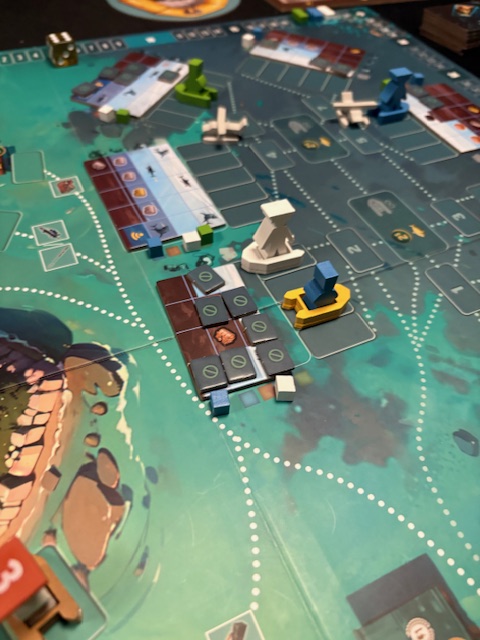
- Dit is het echte werk. Het schatduiken. Vaar naar een gebied waarvan je een kaart hebt en ga duiken. Je hebt alle apparatuur nodig die op deze locatie aangegeven staat. Als er haaien zijn, moet je deze eerst verjagen met een harpoen (je kan de haaien zelfs doden). Na het duiken laad je de schat in je boot.
- Een kleine actie: ontvang een paar dollar aan geld
- Je kan hier een extra boot kopen zodat je meer schatten kan opduiken of je vaart naar de lagune waar je geen schatten zult vinden, maar wel veel geld door het maken van foto’s, vissen of kreeften vangen. Het eiland in de lagune geeft allerlei (afgedekte) bonussen.
- Het museum. Hier verkoop je je schatten voor geld en elke plek in een tentoonstellingszaal levert aan het einde van het spel overwinningspunten op. Als eerste moet iemand wel een tentoonstellingszaal financieren voordat er schatten tentoongesteld kunnen worden.
- Weer een kleine actie: koop overwinningspunten voor geld
- Spelersvolgorde: leg een enveloppe neer om te gaan bieden voor de eerst startpositie. Het geld wat je gebruikt komt van een van de bankrekeningen (net zoals bij de andere acties), alleen deze bankrekening is een klein kistje waardoor andere spelers niet kunnen zien wat je gaat bieden. Hoogste bieder wordt startspeler volgende ronde.
Nadat dit allemaal gedaan is, moet je je werknemers salaris betalen van USD 2 per werknemer. Dit komt van je eerste bankrekening.
Dit doe je 3 rondes en het jaar is afgelopen. De posities van spelersvolgorde krijgen nog overwinningspunten en het volgende jaar begint met nieuw inkomen om te verdelen over de bankrekeningen.
Na het derde jaar (of bij vol museum) is het spel afgelopen.
Wat vind ik van het spel
Thesaurus heeft me aangenaam verrast. Ik hou wel van een goed spel waarin het thema goed toegepast wordt. En dat is hier zeker het geval. De acties kloppen met het duiken naar schatten. Je moet spullen, schatkaarten en boot hebben. Je verkoopt je schatten aan het museum. Allemaal erg logisch. De acties afzonderlijk zijn dan ook niet ingewikkeld, het is vooral het hoeveelheid keuzes dat maakt dat Thesauros een expertspel is. Het geldbeheer en daarmee het storten op de bankrekeningen is echt flink vooruit plannen. Dat wordt vanzelf makkelijker als het Thesauros vaker speelt. Het ziet er prachtig uit en speelt goed. Oh wat is het toch lekker als je een mooie schat opduikt en meteen in je vliegtuig stop om vervolgens in dezelfde ronde nog in het museum neer te leggen. Je voelt je een echt ontdekker!
Een eerste potje kan erg lang duren. De uitleg, met 10 soorten acties, is behoorlijk en ook de jaren kunnen lang duren. Een eerste potje met 3 spelers is toch echt iets meer dan 3 uur. Met 4 spelers zou ik het alleen spelen als zij allemaal het spel al vaker gespeeld hebben.
Er zijn wat onduidelijkheden in het regelboek en er ontbreekt zelfs een regel. Onduidelijk is of je boot beperkte plaatsen heeft voor voorwerpen (er ontbreekt een oneindig-teken in de boot) en het terughalen van enveloppe wordt niet vermeld.
Thesaurus is een goed spel wat volledig klopt met het thema en dat is best lastig voor een expertspel. Prachtig vormgegeven en ik zal er zeker vaker induiken!

Thesauros
Players: 1-4
Time: 45-180 minutes
Age: 14+
Author: Cédric Millet
Publisher: Super Meeple
Year: 2025
Mel Fisher. Have you ever heard of him? Mel, now deceased, was a chicken farmer in Indiana, USA. He moved to California and opened a dive shop. Together with his wife, Dolores, Mel became very successful. Dolores was one of the first women to dive and holds the world record for 50 hours underwater. I won’t be able to emulate her, by the way. What’s so special about this couple? Mel Fisher became a treasure hunter, a deep-sea treasure hunter. After many years of searching, he found the Spanish ship Atocha, which was lost in a hurricane in 1622. Mel found the wreck in 1972 with almost all the treasure on board…total value…brace yourself…$450 million…I once found a $10 on the beach; there’s still a long way to go.
In Thesaurus, you go treasure hunting at sea. In a beautifully designed expert board game, you visit many locations to buy diving equipment, dive maps, and boats, and then return your found treasures to the museum. But watch out for the sharks.
Design and components.
Did I mention that Theasaurus is beautifully designed? The large main board is beautifully illustrated with a tropical area full of buildings, beaches, and seaside locations. This expert game features many tokens, blocks, counters, boats, and a few airplanes. The vast majority of small parts come in a large, compartmentalized box with a lid. Very handy.
One in twelve men has difficulty distinguishing colors that are close together. Therefore, I can’t distinguish between the gold and bronze treasures in Thesauros. A simple solution would be to reshape the gold treasures.
The design is easy thanks to this large box; the box with parts is easy to place on the table. Then you fill the player boards, shuffle the cards, and lay out the treasure cards. This goes pretty quickly.
How to play:
In Thesauros, the player with the most points wins. The game lasts for three years, and each year features three rounds (also called seasons) where you put your boss and employees to work.
At the beginning of each year, you must first allocate your money for the actions you’ll take in the upcoming three rounds. You perform three to six actions per round (depending on whether you’ve hired additional employees). So, at the beginning of a year, you have to distribute your money among the bank accounts for the specific actions for at least the next nine actions (three rounds times three actions). That’s quite a bit of planning ahead. You can transfer money from one bank account to another during the rounds, but that costs extra money…a bit of a waste. In short, managing your money is expert-level right from the start and quite challenging, especially for the first few rounds.
There are five bank accounts you can deposit your money into, and at the bottom of each bank account, you’ll see which actions you can perform with the money in that account. You can only pay from that account and not from other accounts, unless you incur additional costs.
After you’ve allocated your money, the first round begins. Each player places a boss/employee on the board for an action, and after everything is on the board, we go through the actions. The boss often receives a discount (or another benefit) for the action they’re on.
There are 10 types of actions on the board, but not all 10 will be performed each round. Only the actions where a boss/employee is listed are performed.
The 10 actions are, in short:
1- Hire new staff. Here you can hire a new employee who you can immediately deploy for an action.
2- Buy patents and items for your boat. Here you buy items you need for treasure diving, such as a diving mask, air tank, harpoon, sonar equipment, etc. You can also buy a patent on these items so that other players have to pay you a commission when they buy the item.
3- Here you buy treasure maps. Without a map, you can’t access the areas of the sea where the treasures are located.
4- Reserve a sea plane. You reserve a seaplane for action 5 so you can fly your recovered treasures directly to land without having to sail all the way back.
5- This is the real deal: treasure diving. Sail to an area you have a map of and go diving. You’ll need all the equipment indicated for this location. If there are sharks, you’ll first have to chase them away with a harpoon (you can even kill them). After diving, load the treasure into your boat.
6- A small action: get a few dollars in cash.
7- You can buy an extra boat here so you can dig up more treasures, or you can sail to the lagoon, where you won’t find any treasures, but you will earn a lot of money by taking photos, fishing, or catching lobsters. The island in the lagoon offers all kinds of (covered) bonuses.
8- The museum. Here you sell your treasures for money, and each space in an exhibition hall yields victory points at the end of the game. First, someone has to finance an exhibition space before treasures can be displayed.
9- Another small action: buy points for money
10- Player order: Place an envelope to bid for the first starting position. The money you use comes from one of the bank accounts (just like with the other actions), but this bank account is a small box so other players can’t see what you’re bidding. The highest bidder becomes the starting player for the next round.
After all this is done, you have to pay your employees a salary of USD 2 per employee. This comes from your first bank account.
You do this for three rounds, and then the year ends. The positions in the player order receive victory points, and the next year begins with new income to distribute among the bank accounts.
After the third year (or when the museum is full), the game ends.
What do I think of the game?
Thesaurus pleasantly surprised me. I love a good game that applies the theme well. And that’s certainly the case here. The actions correspond with treasure diving. You need supplies, treasure maps, and a boat. You sell your treasures to the museum. It all makes perfect sense. The individual actions aren’t complicated; it’s mainly the sheer number of choices that makes Thesauros a game for experts. Managing your money, and thus depositing it into bank accounts, requires a lot of planning ahead. This will naturally become easier the more you play Thesauros. It looks beautiful and plays well. Oh, how wonderful it is to uncover a beautiful treasure and immediately put it in your plane, only to then deposit it in the museum in the same round. You feel like a true explorer!
A first game can take a very long time. The explanation, with 10 types of actions, is quite thorough, and the games can also drag on for years. A first game with 3 players is definitely a little over 3 hours. With 4 players, I would only play it if they’ve all played the game several times.
There are some ambiguities in the rulebook, and there’s even a missing rule. It’s unclear whether your boat has limited slots for items (there’s no infinity sign on the boat), and retrieving envelopes isn’t mentioned. Thesaurus is a good game that perfectly matches the theme, which is quite challenging for an expert game. It’s beautifully designed, and I’ll definitely be diving into it again!