Aantal spelers: 1-6
Speelduur: 30 minuten
Leeftijd: Vanaf 10 jaar
Auteur: Alexis Allard, Benoit Turpin
Uitgever: Jumping Turtle Games
Jaar: 2021


Dit is een herpublicatie van een review die ik eerder schreef voor bordspelwereld.nl
Nadat we woonwijken en casino’s hebben gebouwd is het moment gekomen om de ruimte in te trekken. Welcome to the moon is een flip & write spel waarin je de maan probeert te koloniseren. Ben jij de beste ruimtevaartingenieur? Dan win jij Welcome to the moon!
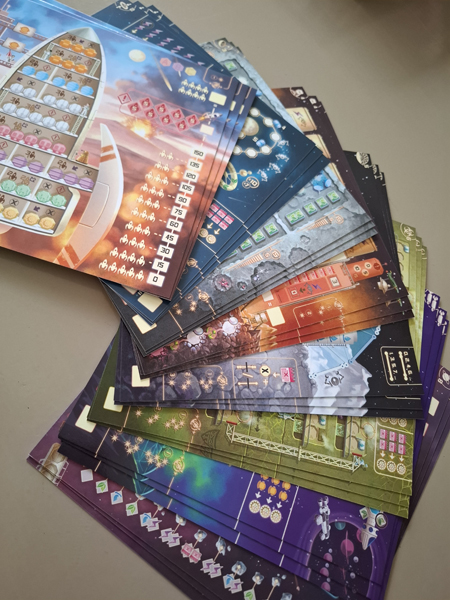
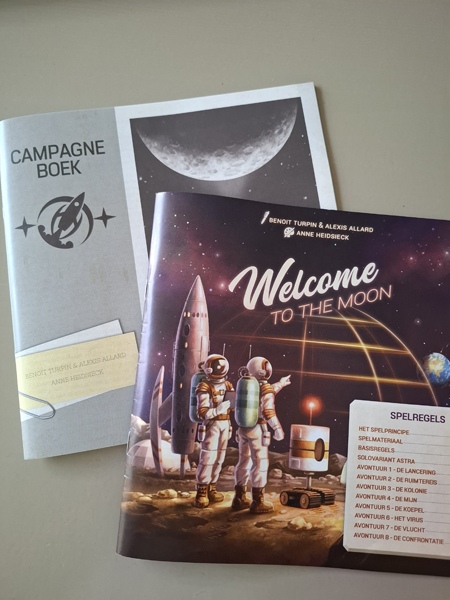
Welcome to the moon is het derde spel in de “Welcome to…” trilogie. In Welcome to your perfect home werden woonwijken gebouwd en in Welcome to Las Vegas werden casino’s gebouwd. In Welcome to the moon gaan we de maan koloniseren. Dat is nodig, want de Aarde hebben we ondertussen eigenhandig om zeep geholpen! Welcome to the moon verschilt van zijn 2 voorgangers door het feit dat je kan kiezen of je de avontuurmodus speelt of de campagnemodus. In de doos zitten 8 verschillende avonturen. Je kan die allemaal apart spelen, dus als 8 verschillende spellen, of, in de juiste volgorde, als campagne. Hierbij hebben beslissingen op het einde van het ene avontuur invloed op wat er in het volgende avontuur staat te gebeuren. Het spel heeft ook een soloversie, Astra genaamd (niet door mij getest).
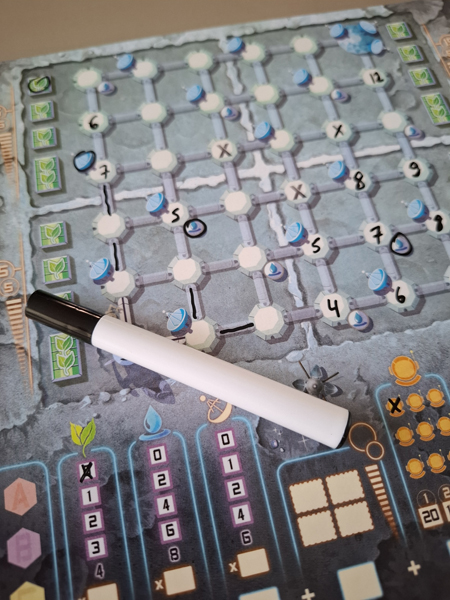
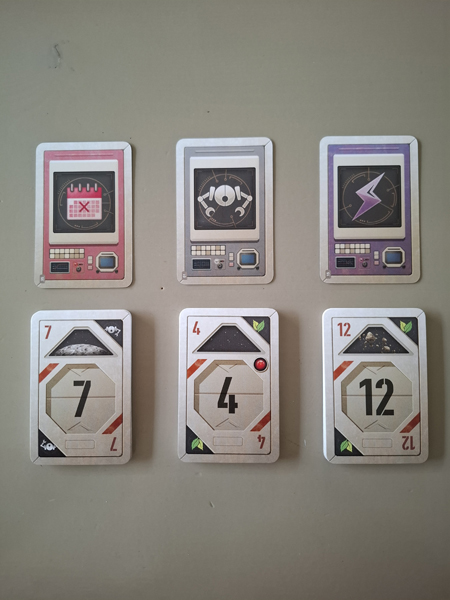
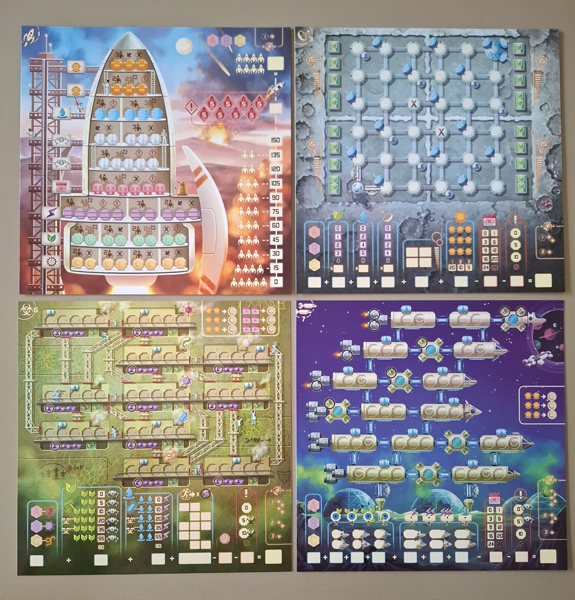
Aan het begin van het spel krijgt elke speler 1 avontuurblad en 1 uitwisbare stift. Voor elk avontuur zijn er een aantal missiekaarten beschikbaar waaruit er 3 worden gekozen. Deze missiekaarten leveren extra punten op wanneer je de missies volbrengt. Verder zijn er 63 raketkaarten die aan de ene kant een getal (1 t.e.m. 15) en aan de andere kant een symbool hebben. De raketkaarten zijn voor elk avontuur dezelfde en kunnen ingedeeld worden in categorieën volgens hun symbool. In elk avontuur is de actie die bij het symbool hoort, lichtjes anders. Elk avontuur heeft zijn uitzonderingen op de basisregels of bijkomende spelregels. Maar het zou mij te ver leiden om die hier allemaal voor elk avontuur apart uit te leggen.
De raketkaarten worden allemaal met het nummer naar boven gelegd, de stapel wordt grondig geschud en er worden 3 stapels, van 21 kaarten elk, naast elkaar gelegd. Van elke stapel wordt de bovenste kaart omgedraaid. Zo creëer je 3 combinaties van getal-en-symbool. Iedereen kiest nu tegelijk welke getal-symbool-combinatie hij wil gebruiken. Je moet het getal verplicht invullen volgens de invulregels. Getallen invullen is altijd in oplopende volgorde per invulzone. Je mag wel gaten in je getallenrij laten die je later opvult. Hetzelfde getal mag echter nooit 2x in dezelfde invulzone voorkomen. Als je geen van de 3 getallen kan invullen, dan moet je een systeemfout aanduiden. Na het invullen van het getal, ben je vrij om de bijhorende symbool-actie uit te voeren of niet. De verschillende symbolen staan voor volgende acties:
- robotkaarten: Met de robotactie kan je verbindingen of scheidingen tussen elementen maken, iets opbouwen of nieuwe elementen ontdekken.
- energiekaarten: Met de energie-actie kan je andere acties of hun puntenwaarde versterken.
- plantenkaarten: Plantenkaarten helpen je om hulpbronnen te verzamelen en punten of bonussen te verdienen.
- waterkaarten: Waterkaarten helpen je om hulpbronnen te verzamelen en punten of bonussen te verdienen.
- planningskaarten: Met de planningsactie mag je in dezelfde beurt altijd een extra veld invullen. Je mag hierbij in een veld naar keuze een X invullen. Soms levert het gebruik van deze actie je ook strafpunten of extra bonussen op.
- astronautkaarten: Met de astronautenactie mag je het getal dat je moet invullen met 0, 1 of 2 verhogen of verlagen. Je mag hierbij niet onder nul gaan, maar je mag wel verhogen naar 16 of 17.
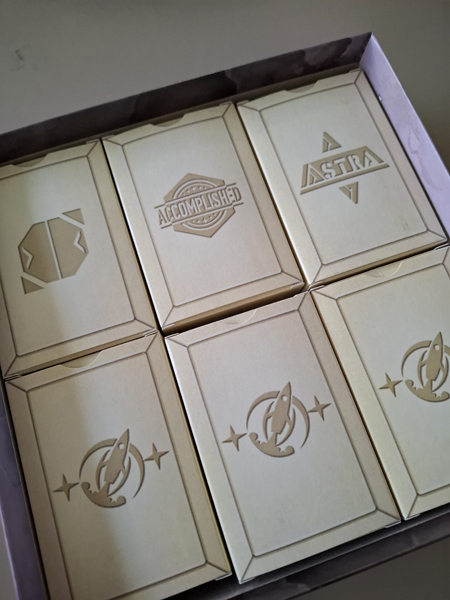
- campagnekaarten: Deze kaarten behoren niet tot de raketkaarten en zitten ook niet bij de basis-avontuurmodus. Ze zijn bedoeld bij de verschillende avonturen als je deze als campagne speelt. Je mag ze dan ook pas bekijken als het campagneboek je daartoe aanspoort. Om geen spoilers prijs te geven, zal ik hier dan ook niet over uitweiden.
Het avontuur eindigt aan het einde van de ronde waarin 1 van volgende situaties zich voordoet: een speler heeft alle 3 de missies voltooid of een speler heeft alle systeemfouten op zijn avontuurblad aangeduid of een speler heeft alle velden in het speelgebied op zijn avontuurblad ingevuld met een getal of een X.
De spelers tellen nu al hun plus- en minpunten op. De speler met de hoogste score wint dit avontuur. In het geval van de avontuurmodus wint deze speler meteen ook het spel. In het geval van de campagnemodus worden er sterren uitgedeeld en worden de instructies voor het einde van dit avontuur en het begin van het volgende avontuur gelezen. Keuzes die hier worden gemaakt door de kapitein (winnaar van het avontuur) bepalen wat er precies zal gebeuren in het volgende avontuur. In het geval van de campagnemodus is de winnaar van het spel dus pas bekend nadat alle 8 de avonturen werden afgerond. De 8 avonturen in de campagnemodus worden ook steeds moeilijker. Je hoeft ze uiteraard niet alle 8 op dezelfde dag te spelen. Je kan ze gerust opbergen en volgende week verder doen.
Mijn mening?
Toen ik de eerste 2 spellen in deze trilogie leerde kennen, was ik gecharmeerd. Ik speel wel eens graag een roll/flip & write spel. Maar daarbij twijfelde ik aan de herspeelbaarheid, want de invulblaadjes zijn toch steeds hetzelfde (ondertussen zijn er wel varianten op de markt). En dat is wat ik dan zo fijn vond aan deze afsluiter van de trilogie: de ontwerpers hebben er een heus campagne-spel van gemaakt! Of 8 aparte spellen zo u wil! Wat me hierbij nog meer charmeerde is dat ze, in tegenstelling tot de eerste 2 spellen, gedrukt zijn op uitwisbare invulblaadjes, dus steeds opnieuw bruikbaar (of fouten kan je even uitwissen en herschrijven).
En het moet gezegd: de avonturen worden inderdaad steeds moeilijker. Voor mensen die de eerste 2 spellen niet kennen, is dat wel fijn. Het eerste avontuur is echt om het basisspel te leren kennen, zonder veel toeters en bellen, en met haalbare missies. Maar het wordt dus echt wel moeilijker. Leuk! De eerste beurten is het allemaal nog makkelijk, want je hebt nog heel veel mogelijkheden om getallen naar hartelust in te vullen. Maar eens het aantal beschikbare lege vakjes kleiner wordt, begint pas het echte denkwerk.
En het ene avontuur ligt je duidelijk beter dan het andere. Je kan zonder problemen het ene avontuur met voorsprong winnen en bij het volgende avontuur de dieperik ingaan. Zo blijft het spannend tot na het laatste avontuur om te zien wie de campagne nu uiteindelijk gewonnen heeft. Ook altijd straf om te zien dat slechts 3 getal-symbool-combinaties bij verschillende spelers tot een totaal verschillend ingevuld blaadje kunnen leiden. Ookal kan je telkens slechts uit 3 combinaties kiezen, het blijft wikken en wegen: soms ligt het juiste getal er, maar staat het symbool je niet aan en soms wil je een bepaald symbool hebben, maar is het getal dan weer niet optimaal. En dan moet je roeien met de riemen die je hebt en toch proberen om alles optimaal in te vullen.
De herspeelbaarheid van dit spel is echt veel groter dan bij zijn 2 oudere broertjes omdat er 8 verschillende avonturen zijn. Tegen de tijd dat je de campagne volledig gespeeld hebt, ben je al bijna vergeten hoe het eerste avontuur nu weer ging en kan je dus gewoon opnieuw beginnen. Ik vind de campagne erg fijn opbouwen. Bij het eerste avontuur moet de raket nog vertrekken, bij het tweede avontuur ben je onderweg in de ruimte, in het derde avontuur worden de eerste maankolonies gebouwd enz. Er zit echt een verhaal in de campagne. Alweer leuk! Eens je de basisregels onder de knie hebt, duurt elk spel ongeveer een half uur. Je kan dus echt makkelijk 8 dagen op rij een afsluitertje voor het slapengaan spelen. Voor mij een zeer geslaagd flip & write spel!

Welcome to the moon
Players: 1-6
Time: 30 minutes
Age: 10+
Author: Alexis Allard, Benoit Turpin
Publisher: Blue Cocker Games
Year: 2021
After building residential areas and casinos, the time has come to move into space. Welcome to the moon is a flip & write game in which you try to colonise the moon. Are you the best space engineer? Then you will win Welcome to the moon!
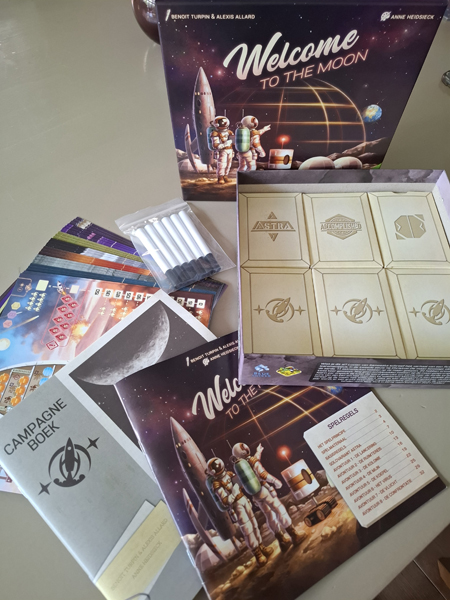
Welcome to the moon is the third game in the ‘Welcome to…’ trilogy. In Welcome to your perfect home, residential areas were built and in Welcome to Las Vegas, casinos were built. In Welcome to the moon, we will colonise the moon. This is necessary, because by now we have single-handedly killed the Earth! Welcome to the moon differs from its 2 predecessors by the fact that you can choose whether to play in adventure mode or in campaign mode. There are 8 different adventures in the box. You can play them all separately, i.e. as 8 different games, or, in the right order, as a campaign. Hereby, decisions at the end of one adventure affect what happens in the next adventure. The game also has a solo version called Astra (not tested by me).
At the start of the game, each player is given 1 adventure sheet and 1 erasable marker. For each adventure, there are a number of mission cards available from which 3 are chosen. These mission cards earn extra points when you complete the missions. There are also 63 rocket cards that have a number (1 to 15) on one side and a symbol on the other. The rocket cards are the same for each adventure and can be categorised according to their symbol. In each adventure, the action associated with the symbol is slightly different. Each adventure has its exceptions to the basic rules or additional game rules. But it would lead me too far to explain them all here for each adventure separately.
The rocket cards are all placed face up, the deck is thoroughly shuffled and 3 stacks, of 21 cards each, are placed side by side. From each pile, the top card is turned over. This creates 3 number-and-symbol combinations. Everyone now simultaneously chooses which number-symbol combination to use. You must compulsorily fill in the number according to the rules for filling in. Filling in numbers is always in ascending order per fill-in zone. You may leave gaps in your number row that you fill in later. However, the same number may never appear twice in the same fill-in zone. If you can’t fill in any of the 3 numbers, you have to indicate a system error. After filling in the number, you are free to perform the corresponding symbol action or not. The different symbols represent the following actions:
robot cards: The robot action allows you to make connections or separations between elements, build something or discover new elements.
energy cards: With the energy action you can reinforce other actions or their point value.
plant cards: Plant cards help you collect resources and earn points or bonuses.
water cards: Water cards help you collect resources and earn points or bonuses.
planning cards: With the planning action, you may always fill in an extra field in the same turn. You may fill in an X in a field of your choice. Sometimes using this action also earns you penalty points or extra bonuses.
astronaut cards: With the astronaut action, you may increase or decrease the number to be filled in by 0, 1 or 2. You may not go below zero, but you may increase to 16 or 17.
Campaign cards:
These cards are not part of the rocket cards, nor are they included in the basic adventure mode. They are meant to accompany the various adventures when you play them as a campaign. You may therefore only view them when the campaign book prompts you to do so. Therefore, in order not to give away any spoilers, I will not elaborate here.
The adventure ends at the end of the round in which 1 of the following occurs: a player has completed all 3 missions or a player has marked all system errors on his adventure sheet or a player has filled in all fields in the play area on his adventure sheet with a number or an X.
The players now add up all their plus and minus points. The player with the highest score wins this adventure. In the case of the adventure mode, this player also immediately wins the game. In the case of the campaign mode, stars are distributed and instructions are read for the end of this adventure and the start of the next adventure. Choices made here by the captain (winner of the adventure) determine what exactly will happen in the next adventure. Thus, in the case of campaign mode, the winner of the game is known only after all 8 adventures have been completed. The 8 adventures in the campaign mode also become increasingly difficult. Of course, you don’t have to play all 8 on the same day. Feel free to put them away and continue next week.
My opinion?
When I learnt about the first 2 games in this trilogy, I was charmed. I do like to play a roll/flip & write game from time to time. But with those 2, I doubted their replayability, because the fill-in sheets are always the same anyway (by now, there are variants on the market). And that is what I liked so much about this last game of the trilogy: the designers made a real campaign game of it! Or 8 separate games if you will! What charmed me even more about this is that, unlike the first two games, they are printed on erasable fill-in sheets, so they can be used over and over again (or mistakes can be erased and rewritten).
And it has to be said: the adventures do indeed get increasingly difficult. For people who don’t know the first 2 games, that’s nice. The first adventure is really to get to know the base game, without a lot of bells and whistles, and with achievable missions. But so it really does get harder. Fun! The first turns, it’s all still easy, because you still have lots of opportunities to fill in numbers to your heart’s content. But once the number of available empty boxes gets smaller, the real thinking starts.
And one adventure clearly suits you better than the other. You can easily win one adventure with a big lead and go down in the next. So it remains exciting until after the last adventure to see who finally won the campaign. It’s very strange to see that only three number-symbol combinations can lead to a completely different outcome for different players. Even though you can only choose from 3 combinations each time, it’s still a matter of weighing things up: sometimes the right number is there, but you don’t like the symbol and sometimes you want a certain symbol, but the number is not optimal. And then you have to row with what you have and still try to fill everything in optimally.
The replayability of this game is a lot greater than with its 2 older brothers because there are 8 different adventures. By the time you have fully played the campaign, you have almost forgotten how the first adventure went and so you can just start all over again. I really like the campaign’s build-up. In the first adventure, the rocket has yet to leave, in the second adventure you are on your way in space, in the third adventure the first lunar colonies are built, and so on. There really is a story in the campaign. Fun again! Once you master the basic rules, each game takes about half an hour. So you can easily play one adventure before going to sleep, for 8 days in a row. For me, a very successful flip & write