Aantal spelers: 1-99
Speelduur: 30-45 minuten
Leeftijd: Vanaf 10 jaar
Auteur: Tobias Hall
Uitgever: All or None Games
Jaar: 2022

Dit is een herpublicatie van een review die ik eerder schreef voor bordspelwereld.nl
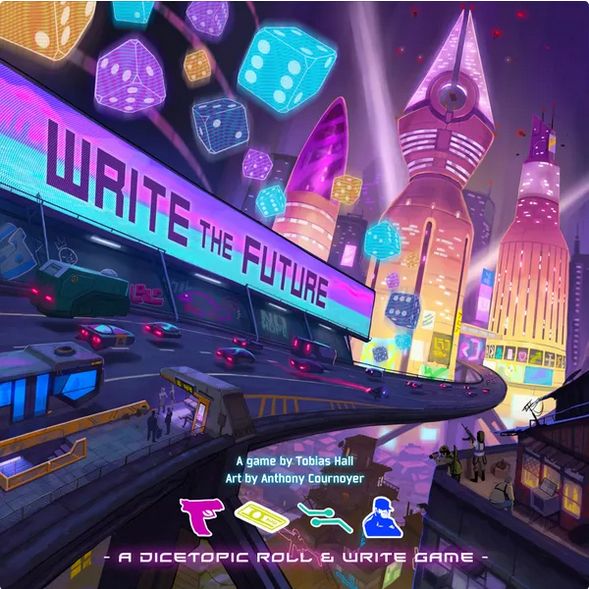
In Write the Future creëer je jouw criminele imperium, in een door misdaad geteisterde cyberpunk-toekomst, door je blad slim te vullen met agenten, informatie, wapens en geld.
Niet alleen neem je verschillende missies aan en speel je verschillende bonussen vrij, je kunt ook de waarde van de grondstoffen op de zwarte markt manipuleren!
Is Write the Future het spelen waard? Lees het in deze review.
Hoe wordt Write the Future gespeeld?
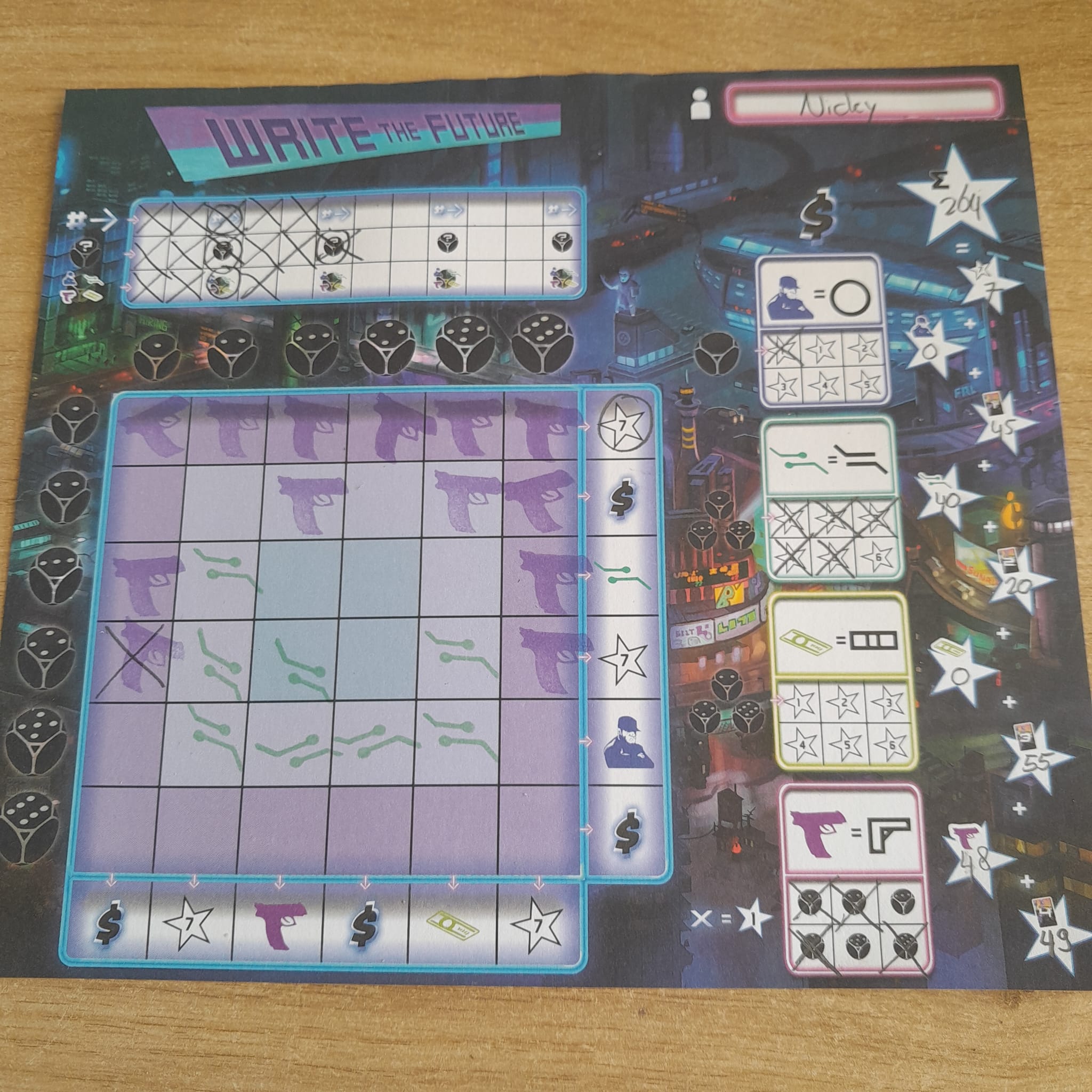
Elke speler krijgt een spelersblad en een potlood. Indien aanwezig; de agent-, informatie-, wapen- en geldstempel. Deze stempels zijn extra’s en zitten niet bij het standaard spel.
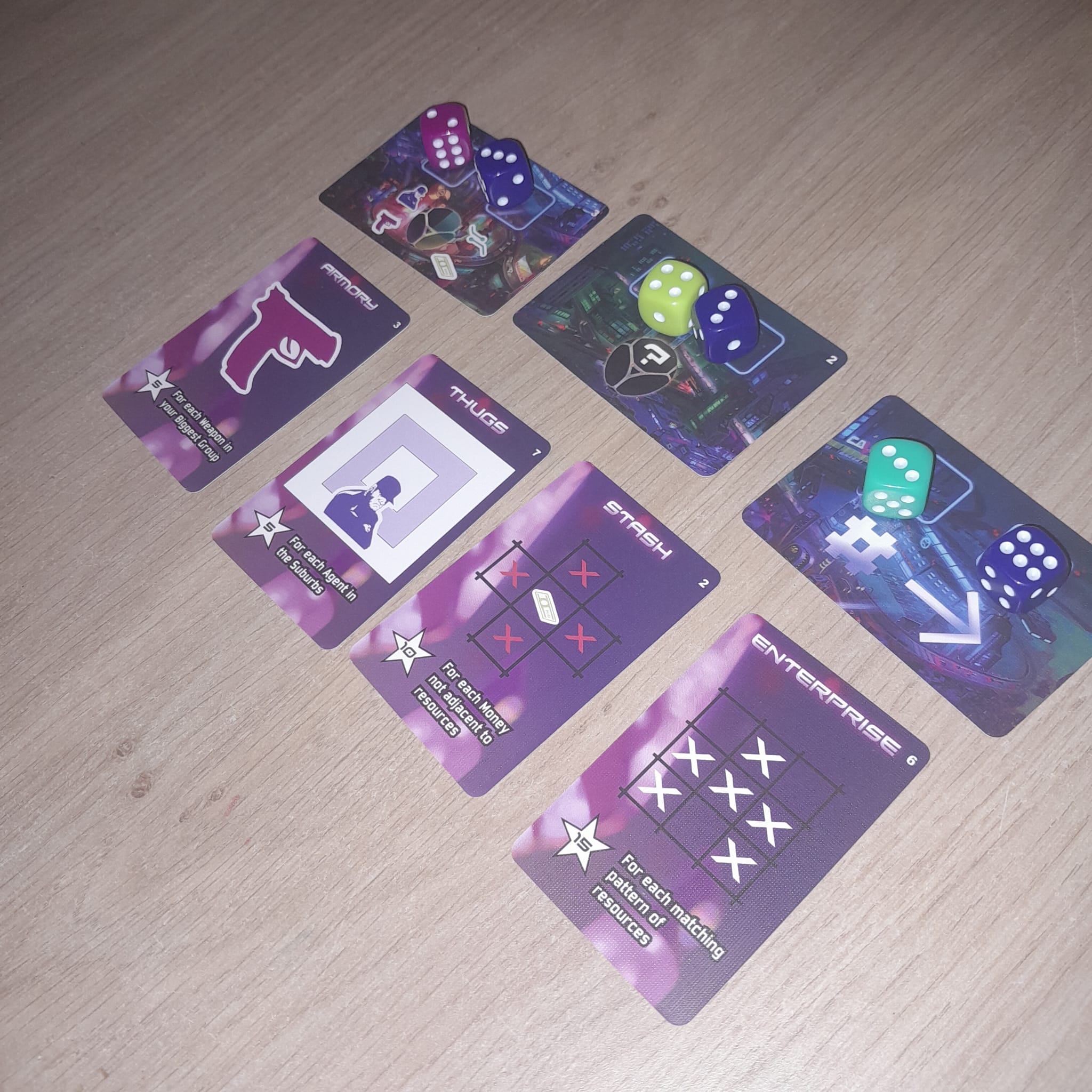
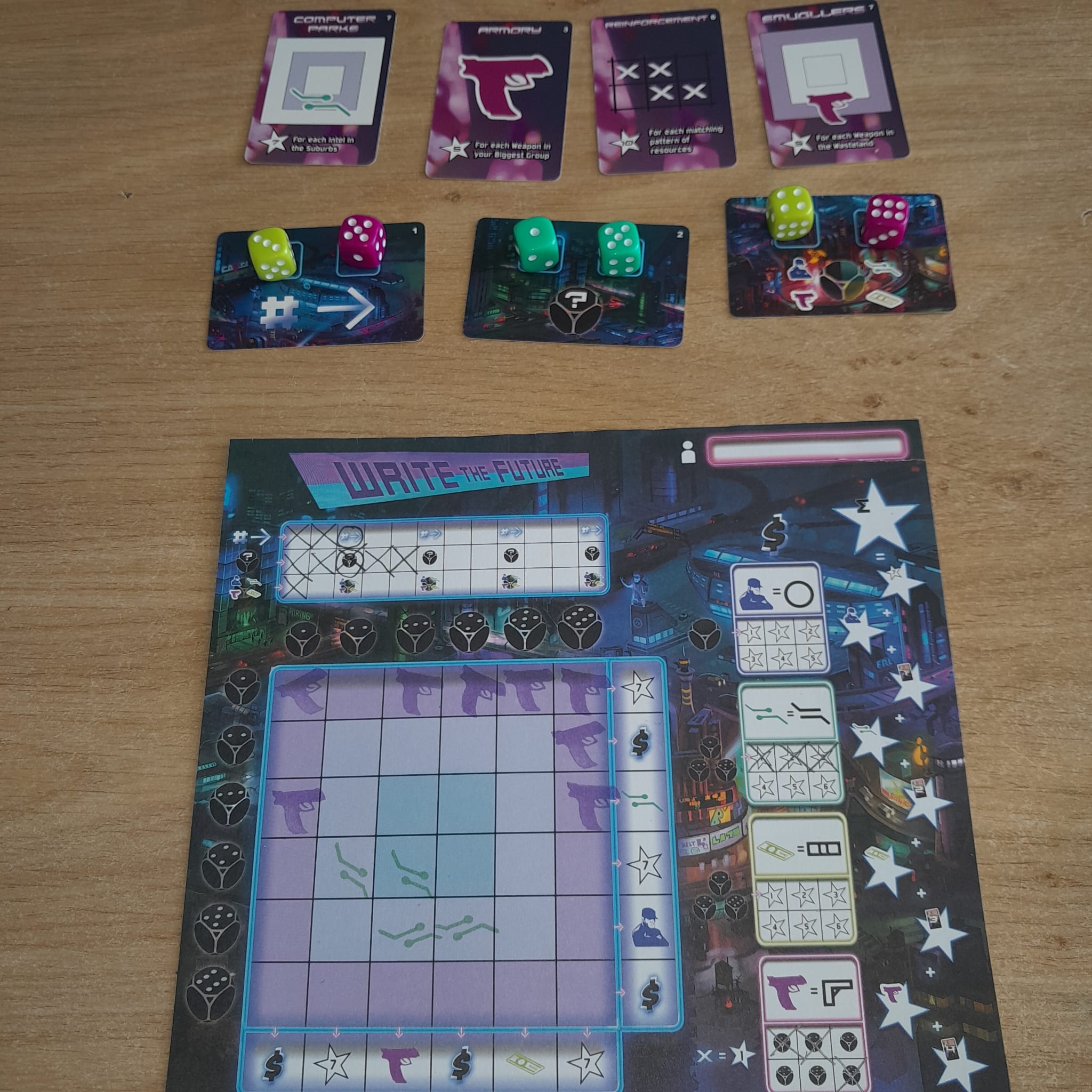
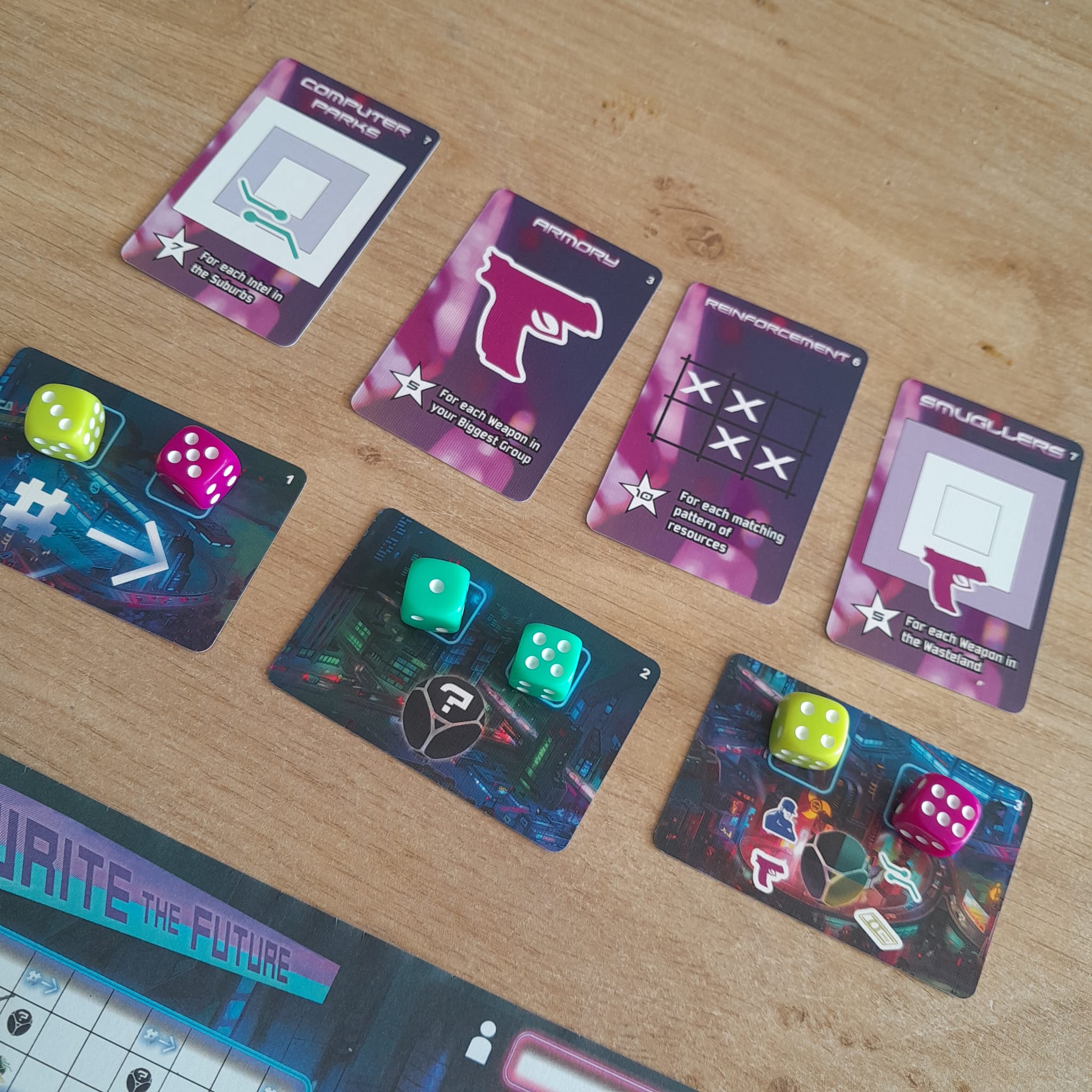
Plaats nu de wijk-kaarten op tafel. (1 t/m 3 in een regulier spel)
Pak nu blind 6 dobbelstenen, werp ze en plaats ze op de wijk-kaarten.
Schud de stapel met missiekaarten en leg er 4 open op tafel.
Nu kan het spel beginnen. Spelers spelen allemaal tegelijk.
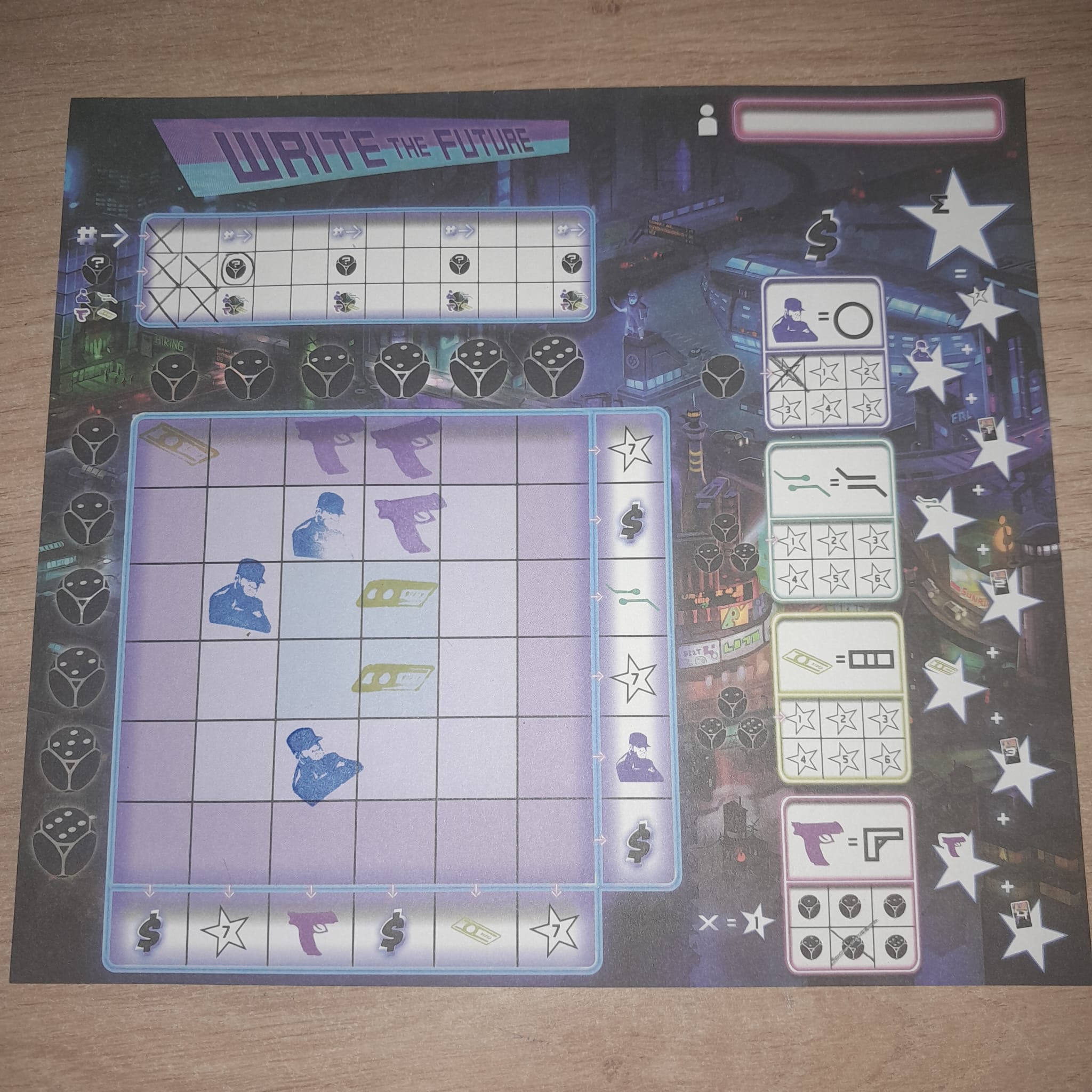
Als speler kies je een wijk-kaart. Onderaan deze wijk-kaart staat een symbool (wijk-vaardigheid). Als eerste actie mag je een vakje in de rij van deze wijk-vaardigheid afstrepen.
Elke 3 vakjes verdien je de bonus uit deze rij. Deze mag je dan omcirkelen en later inzetten.
Bonussen;
– Een eerder ingevuld symbool in je district doorkruizen en het ergens anders plaatsen
– Het nummer van een dobbelsteen veranderen
– De kleur van een dobbelsteen veranderen
Vervolgens mag je de 2 dobbelstenen die op de kaart van Write the Future liggen gebruiken.
Hiervoor heb je 2 opties;
1. De dobbelsteen gebruiken als symbool in je district. Hiervoor bepaald de kleur van de dobbelsteen welk symbool je mag tekenen (of stempelen) en het cijfer van de dobbelsteen bepaald waar je het symbool plaatst.
Bij een blauwe dobbelsteen met het cijfer 5 mag er een agent getekend worden in de vijfde kolom óf de vijfde rij.
Wanneer een speler één rij of kolom helemaal vol heeft, krijgt hij direct de daarbij behorende rij- of kolombonus.
2. De zwarte markt van Write the Future manipuleren;
Je kunt je dobbelsteen ook inzetten om de zwarte markt te manipuleren.
Alleen het cijfer op de dobbelsteen is in dit geval van belang (de kleur wordt genegeerd). Kruis een vakje in de zwarte markt af om de waarde van de symbolen in het district te verhogen.
Hierbij gelden enkele regels, deze staan duidelijk aangegeven op het scoreblad. Zo mag geld op de zwarte markt alleen afgekruist worden met een even dobbelsteen.
Als elke speler zijn wijk-vaardigheid heeft afgestreept en zijn dobbelstenen heeft ingezet, gaan de dobbelstenen terug.
Nu worden er opnieuw 6 dobbelstenen gepakt, gegooid en op de kaarten geplaatst.
Wanneer een speler 4 rijen en/of kolommen heeft voltooid, wordt het eindspel ingeluid; er wordt dan nog één ronde gespeeld.
Variaties in Write the Future
Draft-modus;
Elke speler kiest een kaart, die de andere(n) hierdoor niet meer kunnen kiezen. (Hierbij plaats je aan het begin van het spel één wijk-kaart meer dan dat er spelers zijn)
De spelers spelen nu dus ombeurten, i.p.v. tegelijk en elke ronde is een andere speler de startspeler.
Geheimhouding;
Aan het begin van het spel trekt elke speler één missie-kaart voor zichzelf en houdt deze geheim. Aan het eind van het spel mag de speler beslissen of hij, in plaats van één van de algemene missie-kaarten, wilt scoren op zijn persoonlijke missie-kaart.
Solospel;
Het solospel speelt precies hetzelfde als het standaard spel voor meer spelers (dus zonder draft-modus of geheimhouding).
Alleen wordt dit spel gespeeld over precies 15 rondes.
Puntentelling;
De puntentelling is simpel en staat heel duidelijk uitgesplitst op het spelersblad.
Spelers krijgen punten behorend bij de missiekaarten (4x) en voor de behaalde kolom- of rijbonussen.
Daarnaast kunnen zij punten scoren op de zwarte markt.
Hiervoor wordt per symbool gekeken hoe vaak een speler dit symbool in zijn district heeft, dit wordt vermenigvuldigd met het laatst aangekruiste getal voor dat symbool in de zwarte markt.
(M.u.v. het pistool, hierbij worden het aantal aangekruiste vakjes geteld)
Wat vinden we ervan?
Write the Future is een prima roll en write spel.
De stempels geven een leuke twist aan het spel, maar dit zijn extra’s en zitten niet bij het standaard spel.
Groot voordeel is dat er ontzettend veel geheime missie kaarten zijn, zodat elk spel anders is, en je een andere tactiek kunt (of moet) gebruiken.
Het standaard spel en daarmee ook het solospel zijn niet zo bijzonder, het verhaal is op zich leuk, maar niet extreem goed uitgewerkt.
De keuzes die je in het spel moet maken zijn geen moeilijke of gedwongen keuzes; je krijgt altijd een bonus-vakje, je wijk is groot genoeg om altijd symbolen te plaatsen en als je dat niet wilt, kun je uitwijken naar de zwarte markt.
Het is eigenlijk een puzzeltje waarbij je kijkt op welke manier je de meeste punten kunt scoren, zonder dat er werkelijk iets beperkt.
De draftversie van het spel maakt het spel leuker. Je kunt dan niet dezelfde kaart kiezen als je tegenstander, wat het spel iets meer inhoud geeft. In plaats van uit 3 kaarten met dobbelstenen kun je nog maar uit 2 kaarten met dobbelstenen kiezen. Dit zorgt ervoor dat je iets meer beperking hebt in het spel, wat het ietsje lastiger maakt.
Ander klein minpuntje; om Write the Future neutraal te spelen, wordt er aangeraden de dobbelstenen in een ‘ondoorzichtige container’ te plaatsen. Het had fijn geweest als er bij het spel een stoffen zak(je) was geleverd.
Conclusie; Write the Future is een prima roll en write spel, maar verwacht geen hoogstaande puzzel of moeilijke keuzes.
Gewoon een leuk spelletje om met je (niet spelletjes-spelende) familie te spelen. (Hoewel…. misschien is het thema daarvoor dan weer niet zo heel geschikt?)

Write the Future
Players: 1-99
Time: 30-45 minutes
Age: 10+
Author: Tobias Hall
Publisher: All or None Games
Year: 2022
In Write the Future, you create your criminal empire, in a crime-ridden cyberpunk future, by cleverly filling your sheet with agents, information, weapons and money.
Not only do you take on different missions and unlock different bonuses, you can also manipulate the value of resources on the black market!
Is Write the Future worth playing? Find out in this review.
How is it played?
Each player is given a player sheet and a pencil. If present; the agent, information, weapon and money stamps. These stamps are extras and are not included in the standard game.
Now place the district cards on the table. (1 to 3 in a regular game)
Now blindly take 6 dice, roll them and place them on the district cards.
Shuffle the pile of mission cards and place 4 of them face up on the table.
Now the game can begin. Players all play at the same time.
As a player, you choose a district card. At the bottom of this district card is a symbol (district skill). As your first action, you may check off one square in the row of this district skill.
Every 3 squares you earn the bonus from this row. You may then circle this and use it later.
Bonuses;
– Crossing a previously completed symbol in your district and placing it somewhere else
– Changing the number of a die
– Changing the color of a die
Next you may use the 2 dice lying on the map.
For this you have 2 options;
1. Use the die as a symbol in your district.
For this, the color of the die determines which symbol you may draw (or stamp) and the number of the die determines where you place the symbol.
For a blue die with the number 5, an agent may be drawn in the fifth column or the fifth row.
When a player has one row or column completely full, he immediately receives the corresponding row or column bonus.
2. Manipulate the black market;
You can also use your die to manipulate the black market.
Only the number on the die matters in this case (the color is ignored). Cross off a square in the black market to increase the value of the symbols in the district.
Some rules apply here; these are clearly indicated on the score sheet. For example, money in the black market may only be crossed off with an even die.
When each player has crossed off his district skill and placed his dice, the dice go back.
Now 6 dice are again taken, rolled and placed on the cards.
When a player has completed 4 rows and/or columns, the end game is initiated; one more round is then played.
Variations;
Draft mode;
Each player chooses a card, which this prevents the other(s) from choosing. (Here you place at the beginning of the game one more district card than there are players.)
So the players now play in turns, instead of at the same time and each round a different player is the starting player.
Secrecy;
At the beginning of the game, each player draws one mission card for himself and keeps it secret. At the end of the game, the player may decide if, instead of one of the general mission cards, he wants to score on his personal mission card.
Solo play;
The solo game plays exactly the same as the standard multiplayer game (i.e. without draft mode or secrecy).
Only this game is played over exactly 15 rounds.
Point scoring;
The scoring is simple and is very clearly broken down on the player sheet.
Players receive points belonging to the mission cards (4x) and for the column or row bonuses achieved.
In addition, they can score points on the black market.
For this purpose, the number of times a player has this symbol in his district is checked for each symbol, multiplied by the last ticked number for that symbol in the black market.
(Except for the pistol, here the number of boxes ticked is counted)
What do we think?
Write the Future is an excellent roll and write game.
The stamps give a nice twist to the game, but these are extras and are not included in the standard game.
Big advantage is that there are an awful lot of secret mission cards, so every game is different, and you can (or should) use different tactics.
The standard game and thus the solo game are not that special, the story in itself is fun, but not extremely well developed.
The choices you have to make in the game are not difficult or forced choices; you always get a bonus square, your district is big enough to always place symbols, and if you don’t want to, you can swerve to the black market.
It’s basically a puzzle game where you see which way you can score the most points, without actually restricting anything.
The draft version of the game makes the game more fun. You cannot then choose the same card as your opponent, which gives the game a little more substance. Instead of choosing from 3 cards with dice, you can only choose from 2 cards with dice. This makes you a little more limited in the game, which makes it a little more difficult.
Other small downside; to play the game neutrally, it is recommended to place the dice in an “opaque container. It would have been nice if a cloth bag(s) had been provided with the game.
Conclusion
Write the Future is a fine roll and write game, but don’t expect a high level puzzle or difficult choices.
Just a fun little game to play with your (non-game-playing) family. (Although…. Maybe the theme is not very suitable for that again?)