

Aantal spelers: 1-4
Speelduur: 60-100 minuten
Leeftijd: Vanaf 10 jaar
Auteur: Dani Garcia
Uitgever: Devir
Jaar: 2026
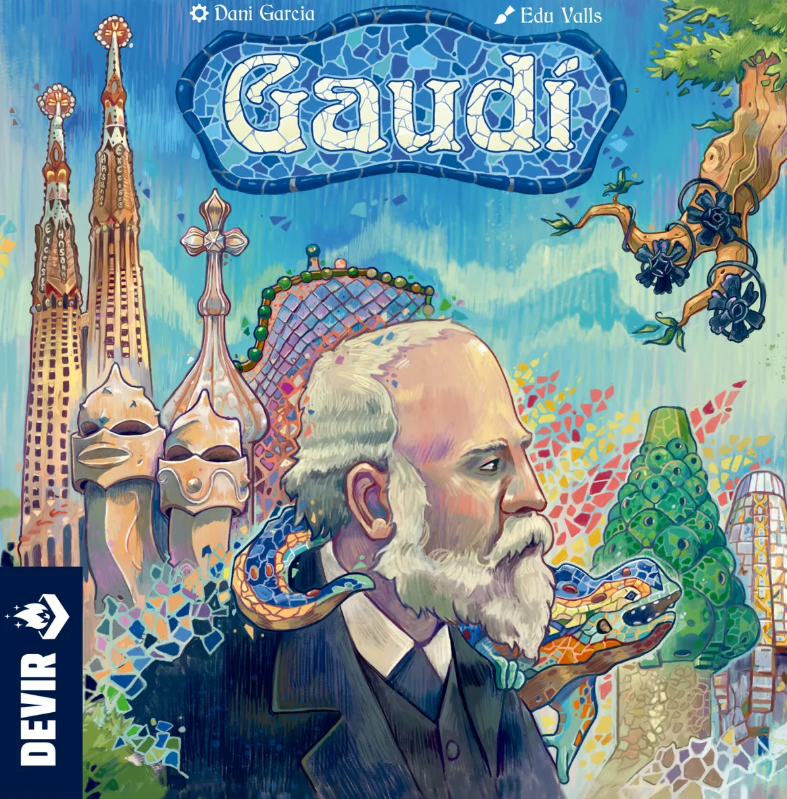

Gaudí. Iedereen die in Barcelona is geweest kent de man. Je komt niet om zijn kunst heen. De Sagrada Familia tornt boven de stad uit. Maar de echte liefhebber, zoals ik mezelf ook durf te noemen, kent ook de prachtige mozaïek-werken in Park Güell (in mening Nederlands huishouden prijkt de hagedis mozaïek (El Drac) al weekplanning-vasthoudend, als magneet op de koelkast ) en de wonderschone schoorstenen op Casa Mila. Een bordspel met dit mooie thema kon niet uitblijven.
Wanneer Dani Garcia in dit thema duikt, klinkt dat bij voorbaat als een gelukkig huwelijk. Nadat Garcia in Barcelona Gaudí bijna ongemoeid liet (vooruit, op de Sagrada tegels na), hoopte ik toch enigszins teleurgesteld op een revanche. Maar die is er nu. Één van mijn favoriete spel-designers die zich waagt aan een van mijn favoriete kunstenaars. Dit maakte mij bij voorbaat een gelukkig mens. Je weet dat het kleurrijk wordt, je weet dat het ingewikkeld wordt.
De vraag is nu. Is het een geslaagde revanche? En blijkt dit huwelijk ook écht een gelukkig huwelijk?!
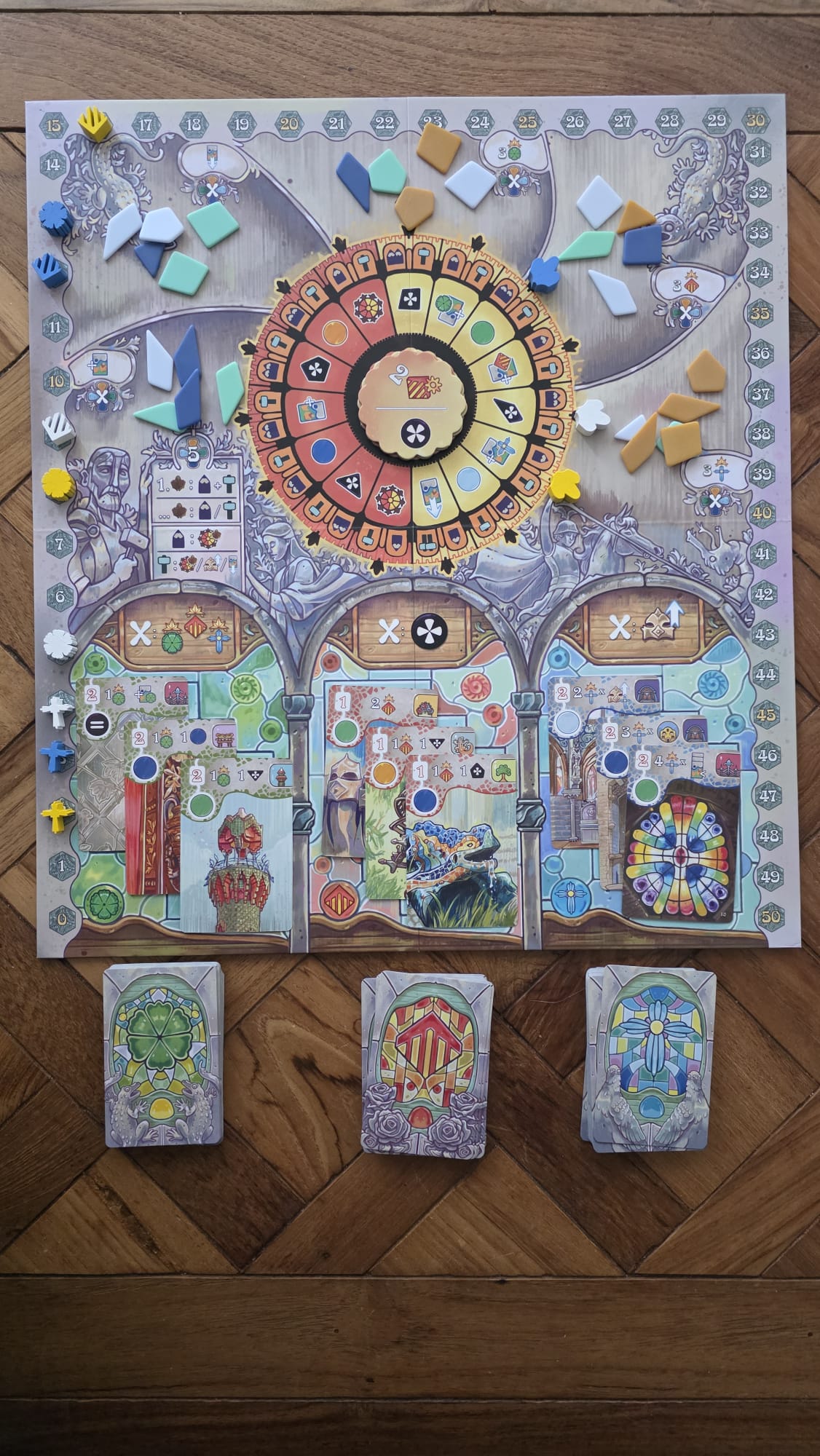
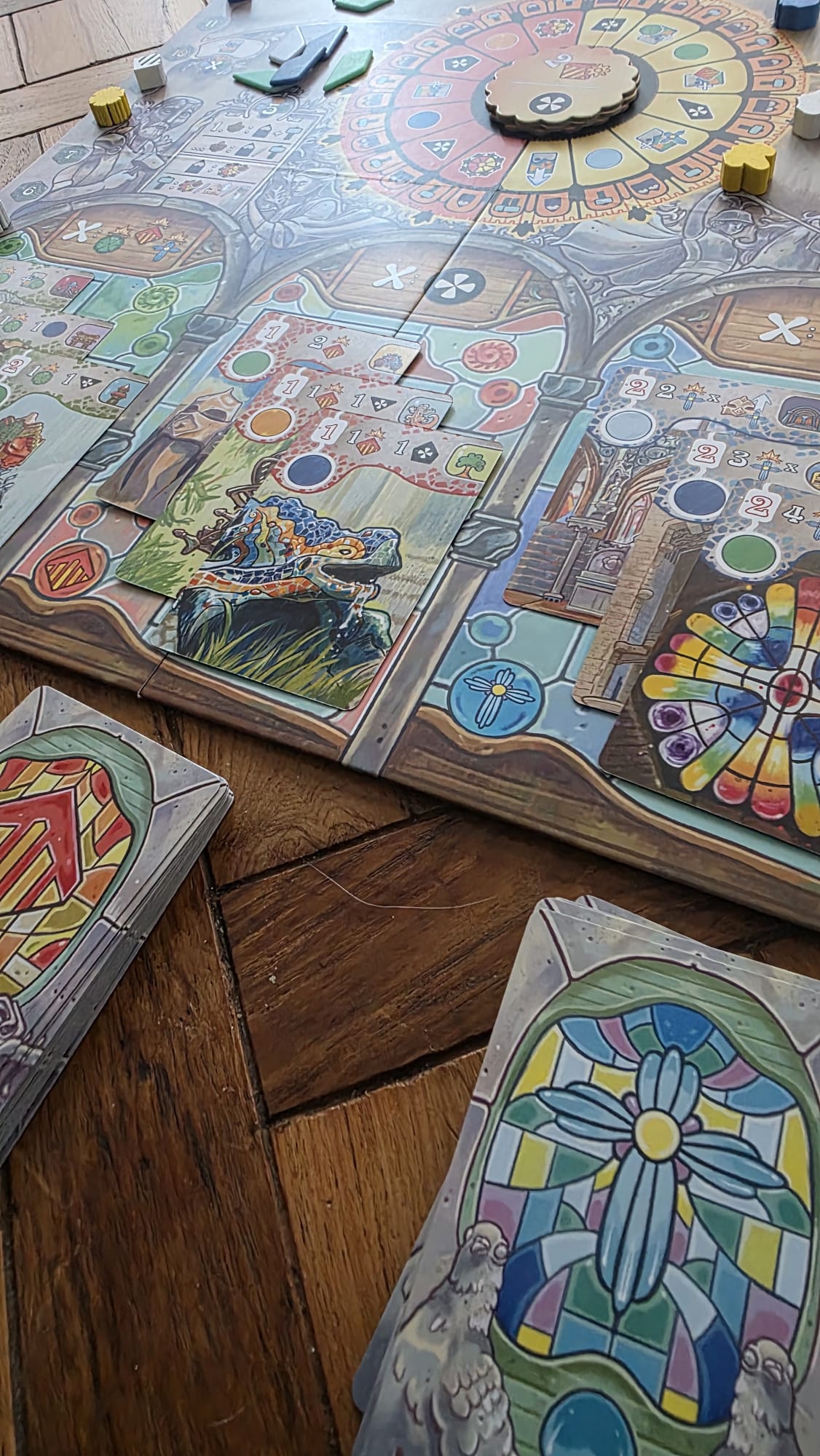
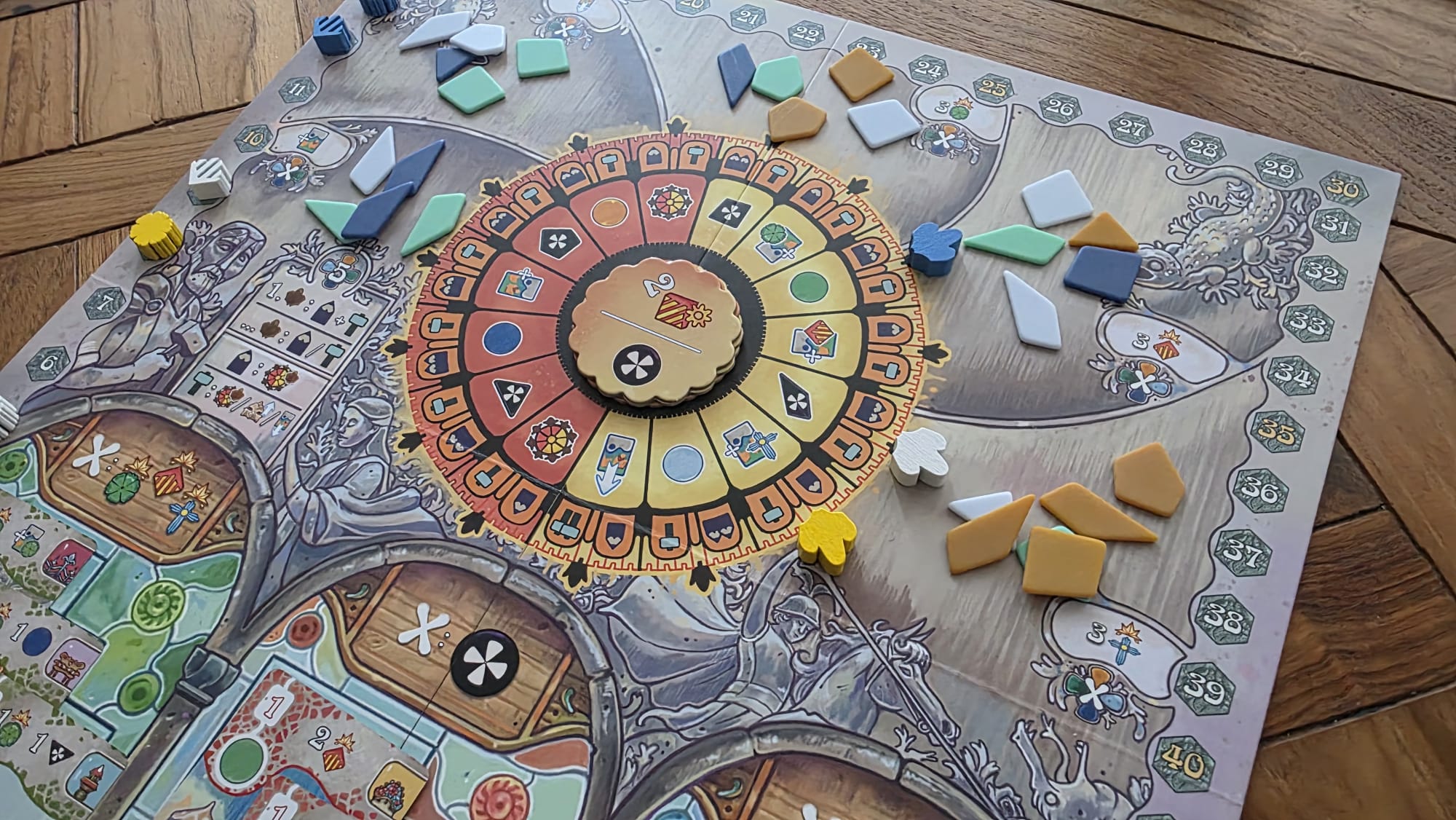
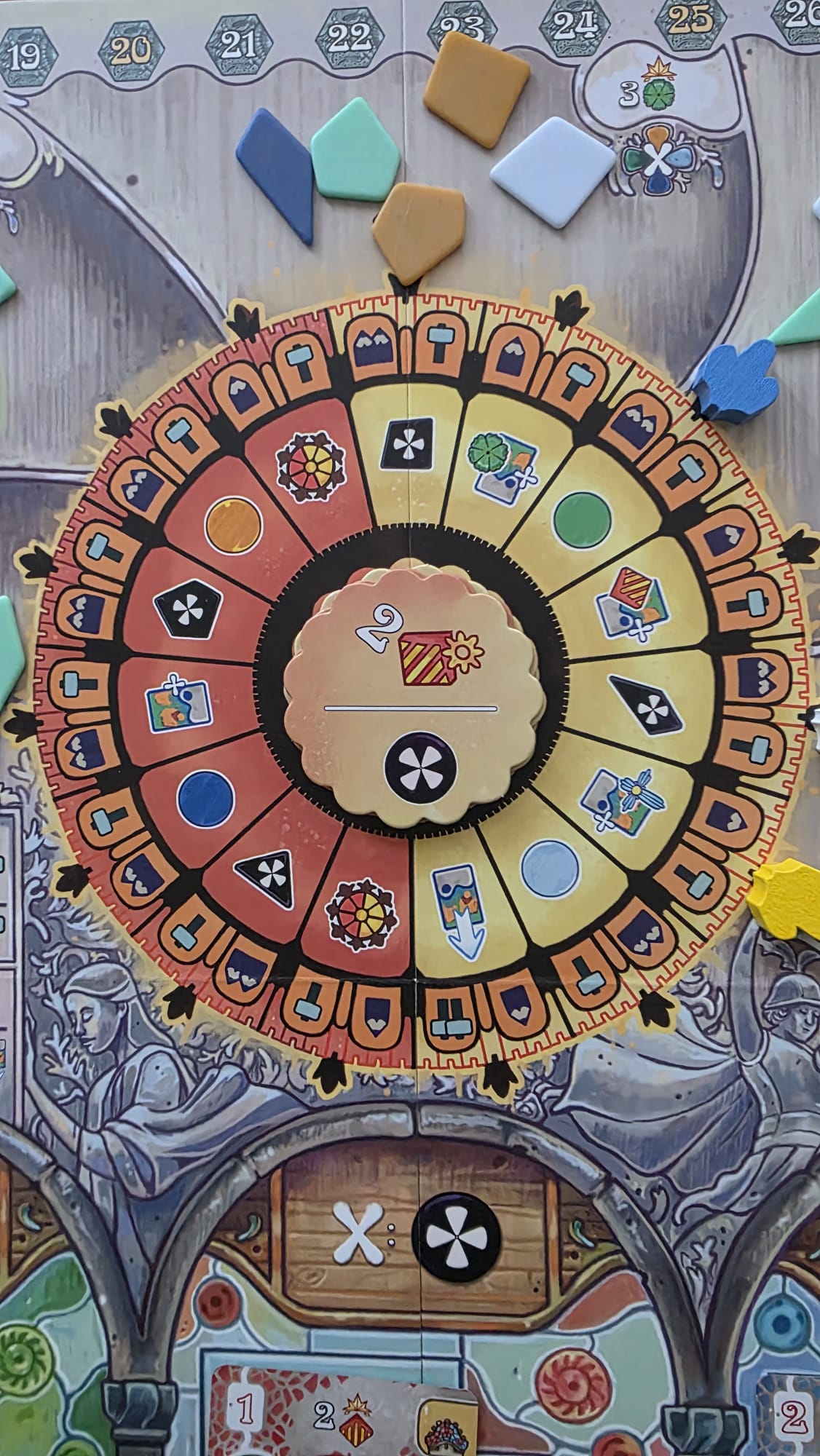
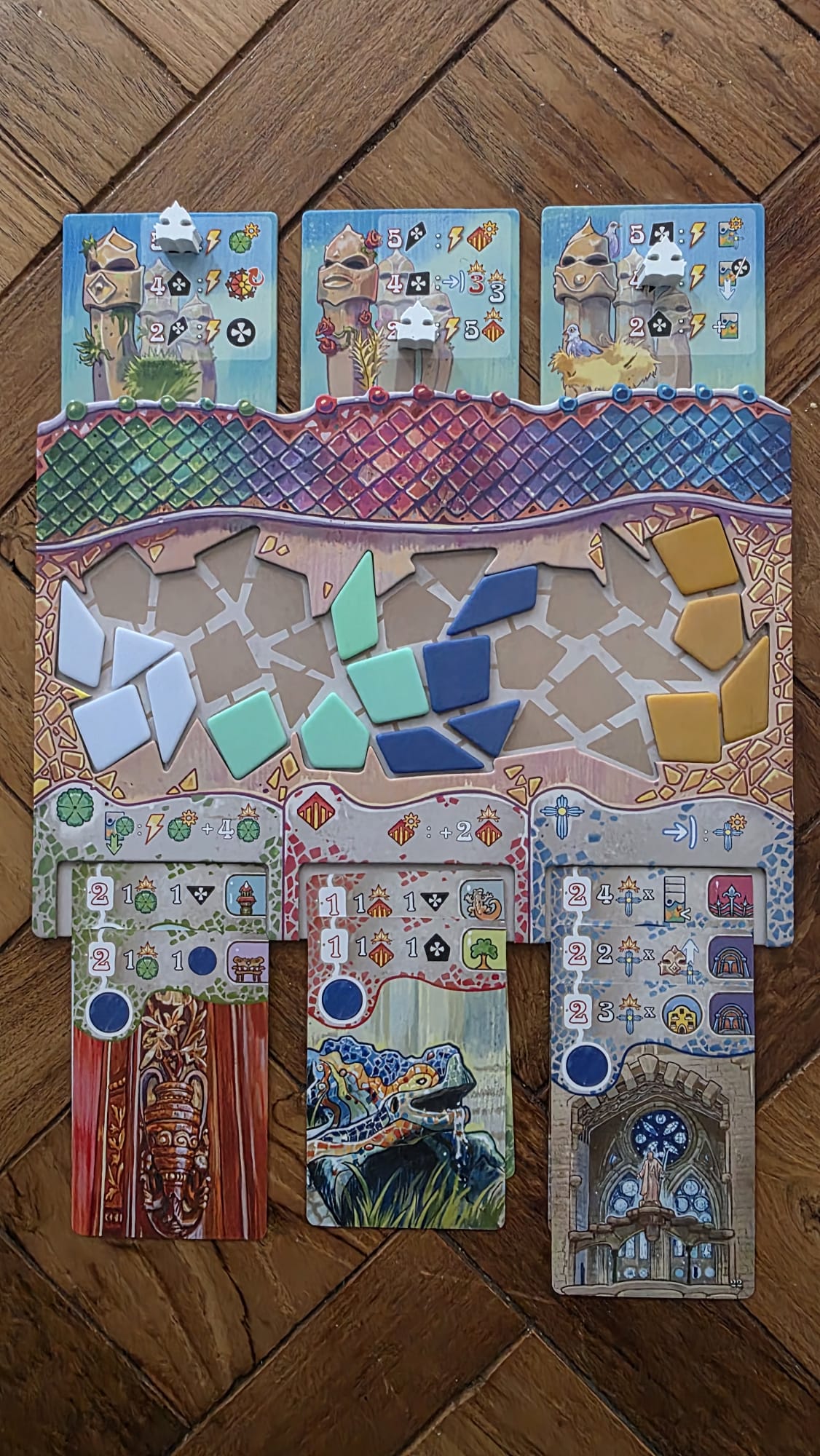
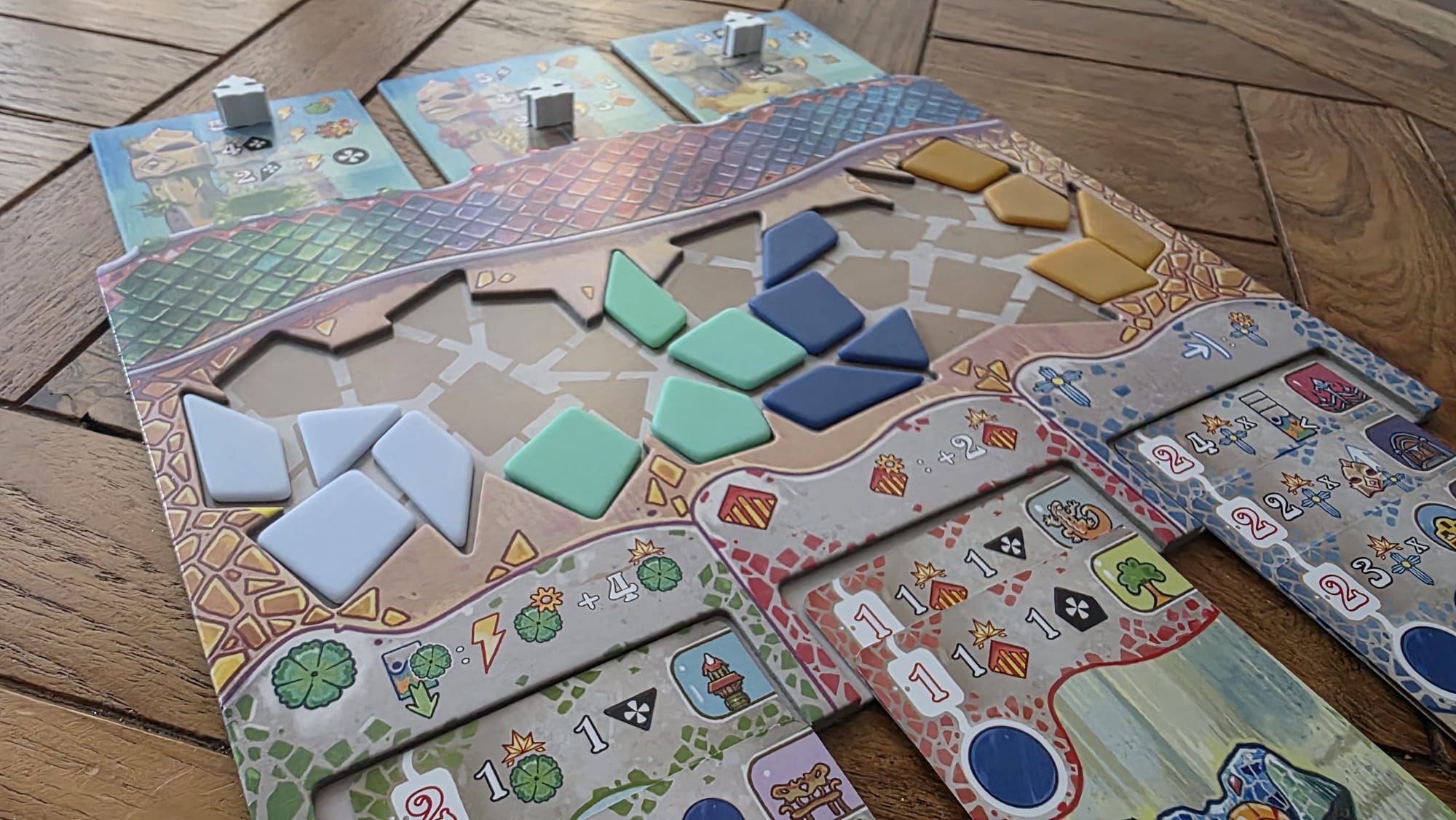
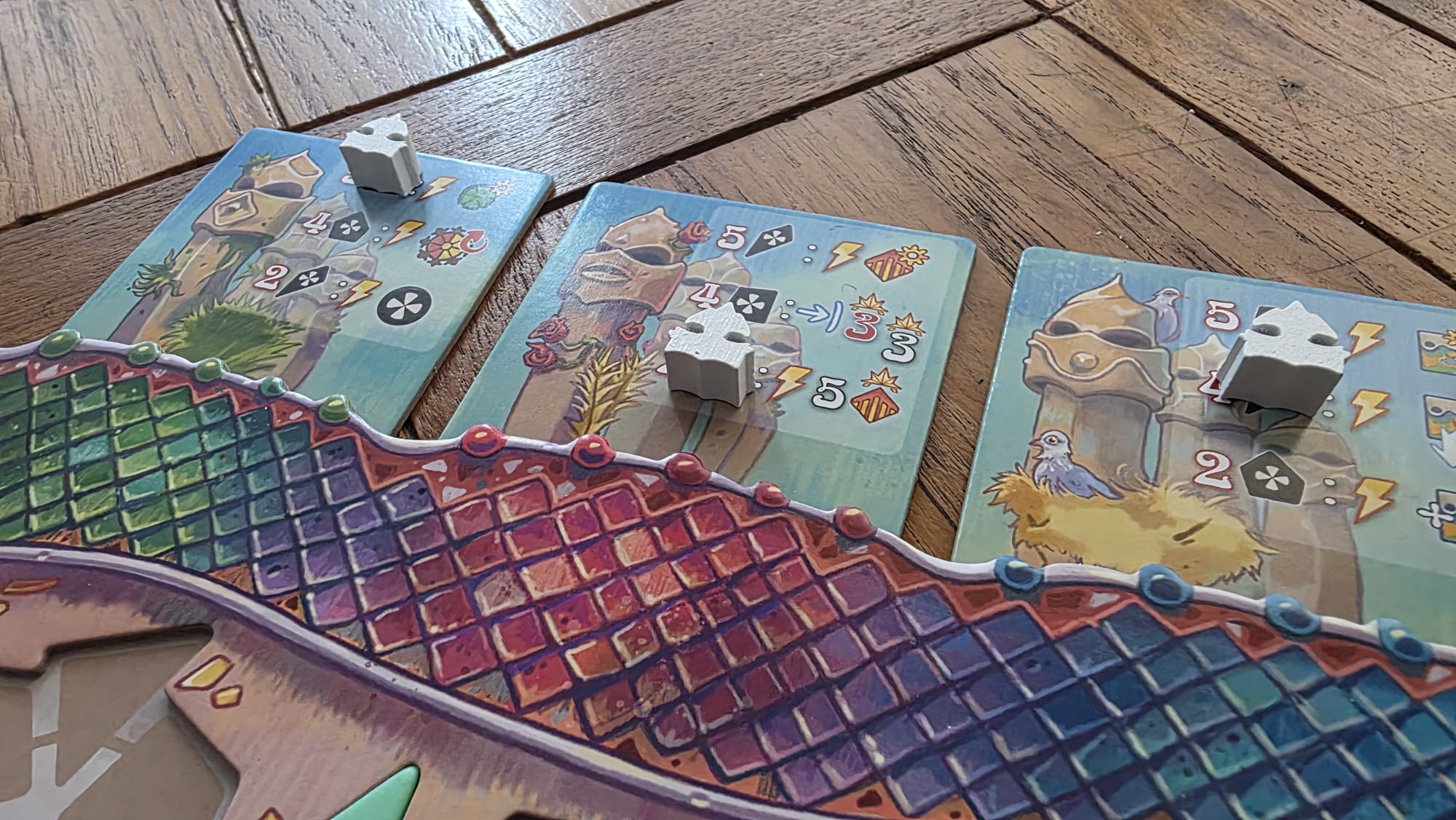
In Gaudí richt je je op drie belangrijke pijlers uit de stad Barcelona: Religion, Catalonia en Nature waarin je door het slim spelen van kaarten punten gaat scoren, iedere pijler op zijn eigen manier. Hiernaast bouw je aan de schoorstenen van Casa Mila, die je kunt zien als track met extra bonussen waarop je op mag klimmen als je die actie kiest en aan de voorwaardes voldoet. Dit alles terwijl je tegels verzamelt uit verschillende gebieden (die wat aanvoelen als de Azul-fabriekjes, maar wat slim is opgelost door het leegspelen van een fabriekje ook een bonus te geven) en die je gebruikt om je eigen mooie mozaïek-werk te maken. Je acties selecteer je door op de kroonluchter (die wat Orloj-achtig aanvoelt, maar vooruit, er is overlap in de thematiek en elk wiel is al eens uitgevonden), je acties te kiezen. Op deze kroonluchter staan meerdere acties. Wanneer je vooraan loopt op het track mag je beide acties doen, anders moet je kiezen. De potlood-actie verwijst naar de afbeelding op de kroonluchter en is altijd een specifieke actie. Denk aan kaarten of stukjes voor je mozaïek pakken of vrije acties. Het hamertje verwijst altijd naar 3 mogelijkheden: naar óf je potloodactie herhalen, óf een kaart spelen, óf vooruitgaan op een van je schoorstenen.
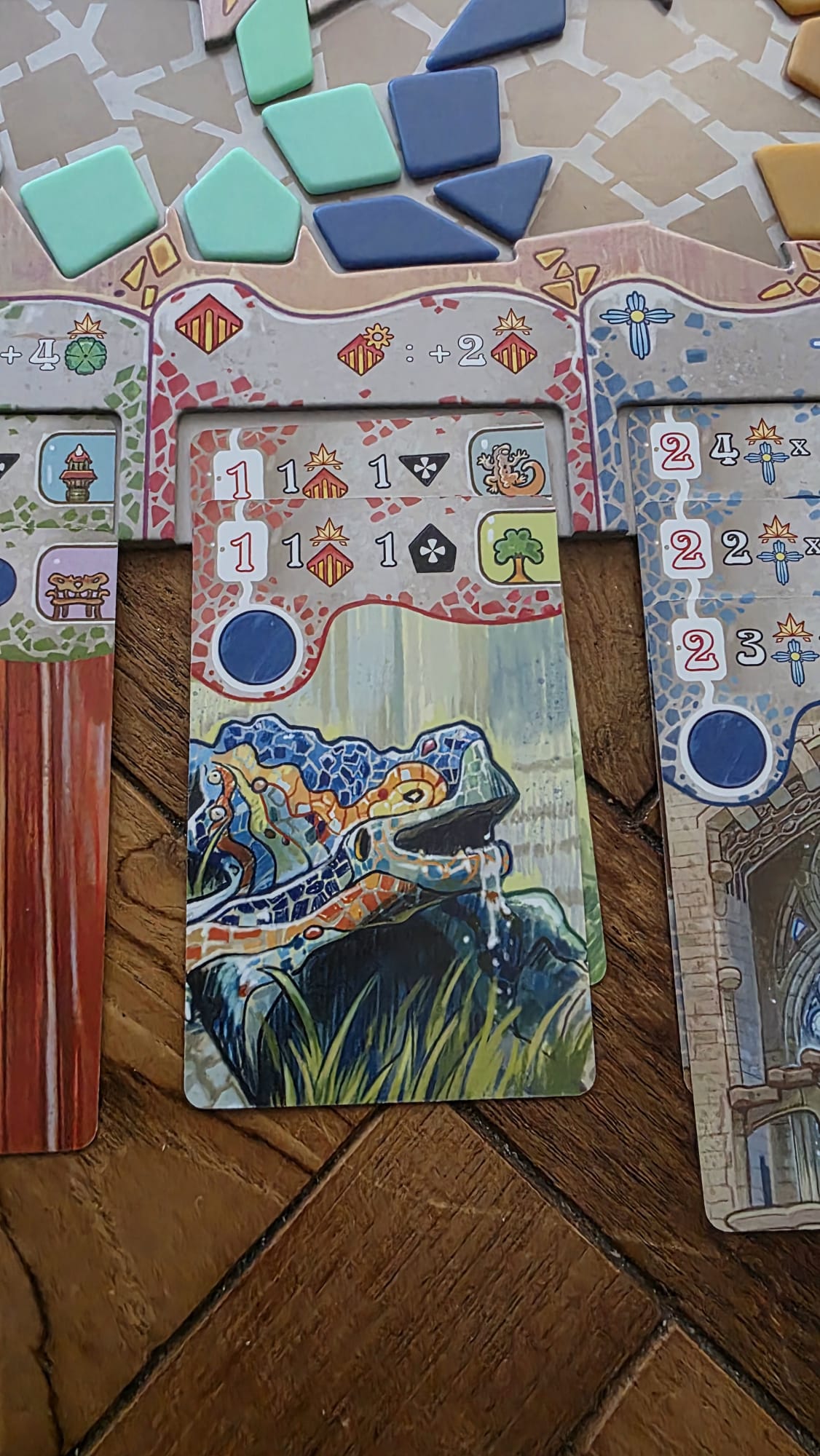
Bij elkaar klinkt dit zowel simpel, als onsamenhangend. Maar natuurlijk zorgt García ervoor dat deze elementen juist slim aan elkaar verbonden zijn. De voorwaardes op je schoorsteen communiceren bijvoorbeeld met de steentjes die je op je mozaïek hebt, evenals de kaarten. En ze in balans houden en goed met elkaar laten corresponderen is een must. Want Garcia haalt hetzelfde trucje uit zijn hoge hoed, die hij bij bijvoorbeeld The Voynich Puzzle al eens deed, namelijk door elke pijler apart te laten scoren. Het is dus weer een drukte van jewelste op het scorespoor, zeker met vier spelers is het een Meeple-file. En hoewel je met je Nature-pijler ver uit de meeste punten scoort, tel je voor de eindtelling de pijlers met de één en twee na beste score bij elkaar op en niet de hoogste. Dus grote stappen snel thuis, of één van de pijlers volledig optimaliseren, brengt je helemaal nergens. De pijlers scoren daarnaast ook nog allemaal op een andere manier. De Nature- pijler scoort altijd direct wanneer je een kaart speelt, je Catalonia-pijler ná elke ronde (mits je die actie selecteert) en de Religion- pijler pas aan het einde van het spel (tenzij een bonus je hiervoor al eerder punten op levert).
Wanneer je een kaart in je Nature-pijler speelt, scoren alle andere reeds gespeelde kaarten in die kolom nogmaals. Deze kun je dus ook zien als je engine builder. Het levert snel veel in-game punten op, maar die doen aan het einde niet veel als het de hoogste pijler is. Let dus vooral ook op de Nature-kaarten die als bonus extra kaarten of tegels voor je mozaïek opleveren in plaats van punten, want die zijn ook interessant voor je andere pijlers, zeker wanneer je ze meerdere malen scoort.
Aan het einde van het spel scoor je ook nog het aantal steentjes van je op één en twee na grootste groep kleuren in je mozaïek. Iets waarvan je zal merken dat het nog tot de laatste beurt in beweging is. Het zal je niet verbazen dat de speler met de meeste punten wint.
Is het een gelukkig huwelijk?
Ja en nee. Hoewel ik elke keer weer verbaasd ben hoe Garcia mechanieken op meesterlijke manier in elkaar weet te verwerven en gebalanceerd en gelaagd laat samenwerken in een vormgeving technisch prachtig spel, kent deze relatie ook wel wat dieptepunten.
Soms beklijft me toch het gevoel dat het thema iets te opgeplakt is (hoewel prachtig verweven in de mechanieken), en onnodig ingewikkeld is, wat me soms uit de belevingswereld en natuurlijke flow van het spel en thema haalt.
Hoewel de beurten en de acties juist enorm simpel en laagdrempelig zijn, word ik soms geremd door de niet altijd duidelijke iconografie en voor meerdere interpretaties mogelijke speluitleg/handleiding, die dus voor discussie en down-time zorgen. En die Meeple-file op dat spoor… die hoeft van mij dus ook niet.
Dat gezegd hebbende, is Gaudí wel ook een duveltje in een doosje en doet het op een voor Garcia-begrippen eenvoudige manier, wat je van hem verwacht. Het is een handzaam klein doosje, waar veel spel in zit en wat je in de basis in vijf minuten hebt uitgelegd. Een groot voordeel ten opzichte van andere Garcia-spellen, die dezelfde diepgang brengen, maar soms veel meer uitleg behoeven. Daardoor breng je het snel op de tafel, en kun je dus ook in relatief korte tijd een gelaagd en gedegen spel doen, zonder dat het de gehele avond kost.
Tegelijkertijd bedient het zowel worker-placement-, enguine builders-, tableau builder- en tile placement-liefhebbers, wat het leuk maakt voor een breed publiek.
Dat maakt het spel eigenlijk een paradox. Want hoewel soms onnodig ingewikkeld, dus ook juist laagdrempelig genoeg om mensen die normaliter niet perse een Garcia zouden willen spelen, over de streep te krijgen. En wil je toch nog ingewikkelder, dan is er een expert-mode.
Let wel op met hoeveel je speelt. Met vier spelers had ik het minste plezier. Veel down time en weinig acties door drukte op de kroonluchter. Met twee of drie is het meest ideaal, waarbij je met twee-spelers een neutrale speler hebt, die áltijd laatste speler is en altijd de positie inneemt vooraan op de kroonluchter en daar verder geen acties doet. Hierdoor houdt je veel keuze op de kroonluchter, maar wel zonder dat één speler altijd steeds de voordeligste keuzes kan maken. Dit is voor mij de Garcia die met twee het leukste is!
Verder niets dan lof voor het art work. Je kan de plank ook flink misslaan en iemands legacy te niet doen. Hoewel van mij het spel meer in dienst van die legacy had mogen staan in plaats van andersom, is het spel een lust voor het oog. Ik kan hier afgezien van de schoorstenen die je moet vast maken aan je spelersbord (en die dus niet blijven zitten) en de soms wat onduidelijke iconografie helemaal niets aan opmerken. Het is werkelijk waar prachtig!
Concluderend heeft dit huwelijk dus zijn nodige hobbels. Maar hé, welk huwelijk heeft dat niet? Zonder wrijving geen glans enzo. Ik zou evengoed volmondig ja zeggen!

Gaudí
Players: 1-4
Time: 60-100 minutes
Age: 10+
Author: Dani Garcia
Publisher: Devir
Year: 2026
Gaudí. Everyone who has been to Barcelona knows the man. You cannot get around his art. The Sagrada Familia towers over the city. But the true enthusiast, as I dare to call myself, also knows the beautiful mosaic works in Park Güell (in many Dutch households, the lizard mosaic (El Drac) proudly sits on the fridge, holding the weekly schedule as a magnet), and the wondrous chimneys at Casa Mila. A board game with this beautiful theme was inevitable.
When Dani Garcia dives into this theme, it sounds like a happy marriage from the start. After Garcia left Gaudí almost untouched in Barcelona (well, except for the Sagrada tiles), I was somewhat disappointed and hoping for a rematch. But now it is here. One of my favorite game designers taking on one of my favorite artists. This made me a happy person in advance. You know it’s going to be colorful, you know it’s going to be complicated. The question now is: Is it a successful rematch? And does this marriage really turn out to be a happy marriage?!
In Gaudi, you focus on three key pillars of Barcelona: Religion, Catalonia, and Nature, where you score points by playing cards smartly, each pillar in its own way. Additionally, you build the chimneys of Casa Mila, which can be viewed as a track with extra bonuses that you can climb if you choose that action and meet the conditions. All this while collecting tiles from various areas (which feel somewhat like the Azul factories, but are cleverly resolved by awarding a bonus for clearing a factory) and using them to create your own beautiful mosaic artwork. You select your actions by choosing them on the chandelier (which feels a bit Orloj-esque, but never mind, there is overlap in the theme and every wheel has been invented before). Multiple actions are displayed on this chandelier. When you are at the front of the track, you may perform both actions; otherwise, you must choose. The pencil action refers to the image on the chandelier and is always a specific action. Think of drawing cards or pieces for your mosaic, or free actions. The little hammer always points to 3 possibilities: either repeat your pencil action, play a card, or advance on one of your chimneys.
Taken together, this sounds both simple and disjointed. But naturally, García ensures that these elements are actually cleverly connected. For example, the conditions on your chimney communicate with the tiles you have on your mosaic, as do the cards. And keeping them in balance and ensuring they correspond well with each other is a must. Garcia pulls the same trick out of his hat that he used before in The Voynich Puzzle, having each pillar scoring separately. So, it is a mad rush on the scoring track again; with four players, it is certainly a Meeple-traffic-jam. And although you score the most points with your Nature pillar, for the final tally, you add up the pillars with the first and second best score, not the highest. So, taking big steps quickly, or fully optimizing one of the pillars, gets you absolutely nowhere. Additionally, the pillars all score in different ways. The Nature pillar always scores immediately when you play a card, your Catalonia pillar after every round (provided you select that action), and the Religion pillar only at the end of the game (unless a bonus awards you points for it earlier).
When you play a card in your Nature pillar, all other previously played cards in that column score again. You can therefore also view this as your engine builder. It quickly yields a lot of in-game points, but these do not amount to much at the end if it is the highest pillar. So pay close attention to the Nature cards that provide extra cards or tiles for your mosaic as a bonus instead of points, because these are also beneficial for your other pillars, especially when you score them multiple times.
At the end of the game, you also score the number of tiles in your mosaic based on your second and third largest group of colors. You will notice that this is still in flux until the very last turn. It will come as no surprise that the player with the most points wins.
Is it a happy marriage?
Yes and no. Although I am amazed every time by how Garcia masterfully manages to weave mechanics together and make them work in a balanced and layered manner within a beautiful designed game, this relationship does have its low points.
Sometimes I am left with the feeling that the theme is a bit too tacked on (although beautifully interwoven into the mechanics), and unnecessarily complicated, which occasionally pulls me out of the immersive experience and the natural flow of the game and theme.
Although the turns and actions are actually incredibly simple and accessible, I am sometimes hampered by the not always clear iconography and the game explanation/manual open to multiple interpretations, which consequently lead to discussion and downtime. And the Meeple-traffic-jam on that track… I could do without that too…
That being said, Gaudí is also quite a handful and does what you expect from him in a simple way by Garcia standards. It is a handy little box containing a lot of gameplay that you can explain in five minutes. This is a major advantage over other Garcia games, which offer the same depth but sometimes require much more explanation. As a result, you can get it to the table quickly, allowing you to play a layered and solid game in a relatively short time without it taking up the entire evening.
At the same time, it caters to worker-placement, engine builder, tableau builder, and tile placement enthusiasts, making it enjoyable for a broad audience.
That actually makes the game a paradox. Although sometimes unnecessarily complicated, it is also accessible enough to win over people who normally wouldn’t necessarily want to play a Garcia. And if you do want something even more complex, there is an expert mode.
Do be mindful of how many players you play with. I had the least fun with four players. A lot of downtime and few actions due to the congestion on the chandelier. Two or three is the most ideal, where with two players you have a neutral player who is always the last player and always takes the position at the front of the chandelier, performing no further actions there. This leaves you with plenty of choice on the chandelier, but without one player always being able to make the most advantageous choices. For me, this is the Garcia that is most fun with two players!
Furthermore, nothing but praise for the artwork. You can also miss the mark badly and destroy someone’s legacy. Although I would have preferred the game to serve that legacy more rather than the other way around, the game is beautiful. Apart from the chimneys that you have to attach to your player board (and which won’t stay in place) and the sometimes somewhat unclear iconography, I can’t fault it at all. It is truly beautiful!
In conclusion, this marriage has its fair share of bumps. But hey, what marriage doesn’t have that? No friction, no shine…. I would say Yes big time!