

Aantal spelers: 2-4
Speelduur: 15-30 minuten
Leeftijd: 6+
Auteur: Fertessa Allyse, Randy Flynn
Uitgever: White Goblin Games
Jaar: 2025
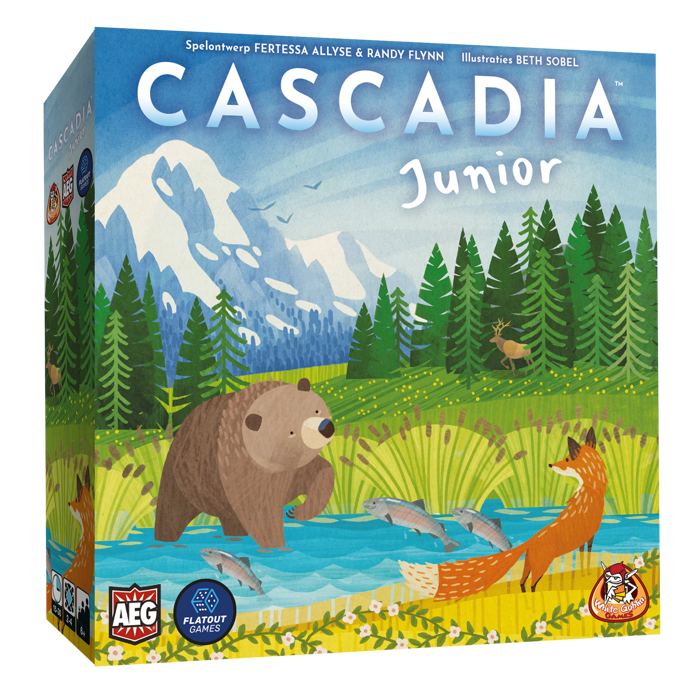

Naast een uitbreiding, de standalone Alpine Lakes en twee roll & writes, is er nu dus ook een Junior-versie van het alomgeprezen Cascadia. Aangezien ik Cascadia een leuk spel vind, jonge kinderen heb én heel het internet en z’n moeder enthousiast lijken over Cascadia Junior, moest ik dus ook een exemplaar in de kast hebben.
Wat wij ervan vinden? Dat lees je in deze review.
Een eerste kennismaking met Cascadia Junior
De doos van Cascadia Junior trekt meteen de aandacht: het bekende artwork van Cascadia, maar dan met een nog hoger schattigheidsgehalte. Voor de inhoud van de doos geldt eigenlijk precies hetzelfde: cuteness overload, op z’n goed Hollands 😉
Na het lezen van het boekje kom ik erachter dat Cascadia Junior makkelijk speelt en in de basis eigenlijk niet veel verschilt van het origineel. Dat doet me ook een beetje twijfelen: Mikolaj (7,5) kan prima de familievariant van Cascadia spelen, maar zou dit spel misschien een goed overgangsspel kunnen zijn voor Leonore (vorige week 6 geworden)?
Hoe wordt het gespeeld?
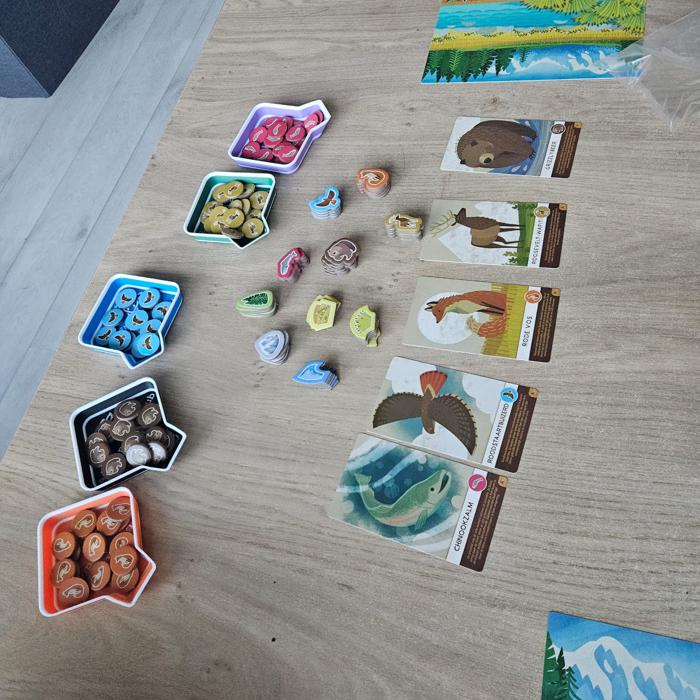
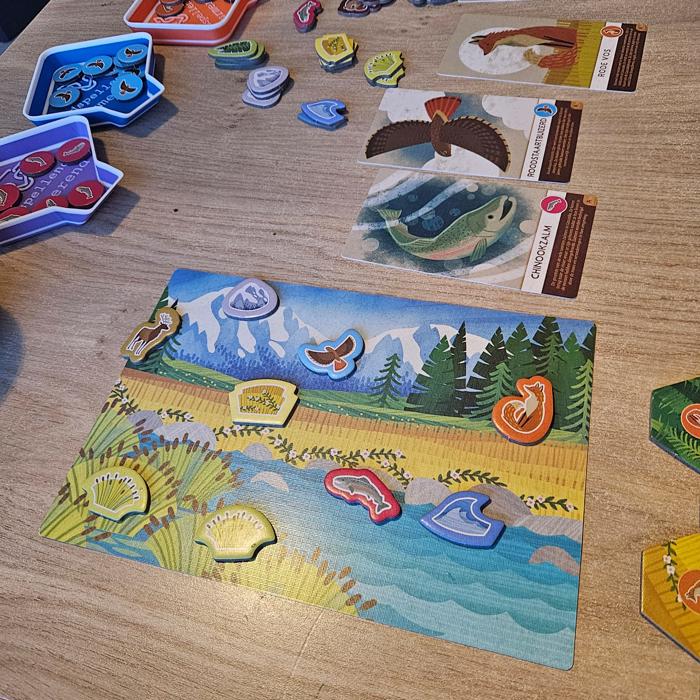
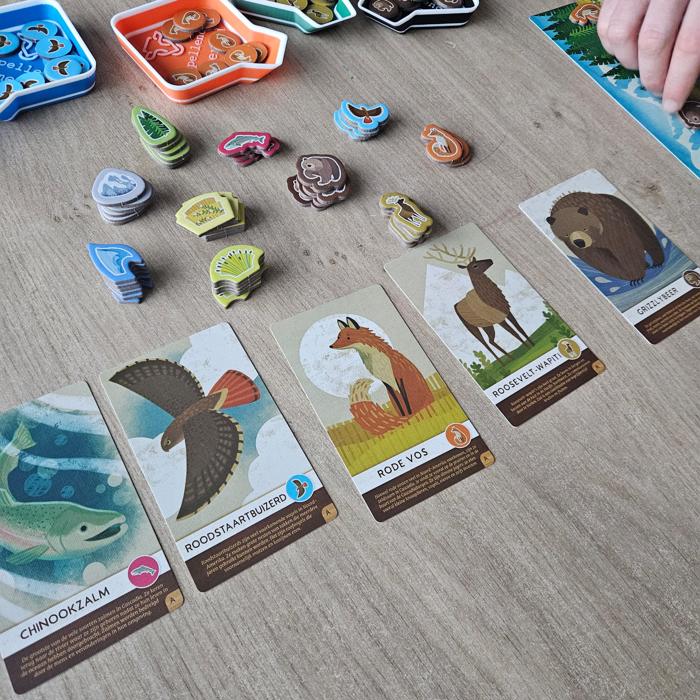
Elke speler krijgt een starttegel en een panoramabord. Verder liggen er op tafel dierkaarten en stapeltjes met dierfiches, dierenfoto’s en leefgebiedfoto’s. Die laatste twee hebben denneappels op de achterzijde afgebeeld. Ze worden geschud en in willekeurige stapeltjes, met de denneappels naar beneden, op tafel gelegd.
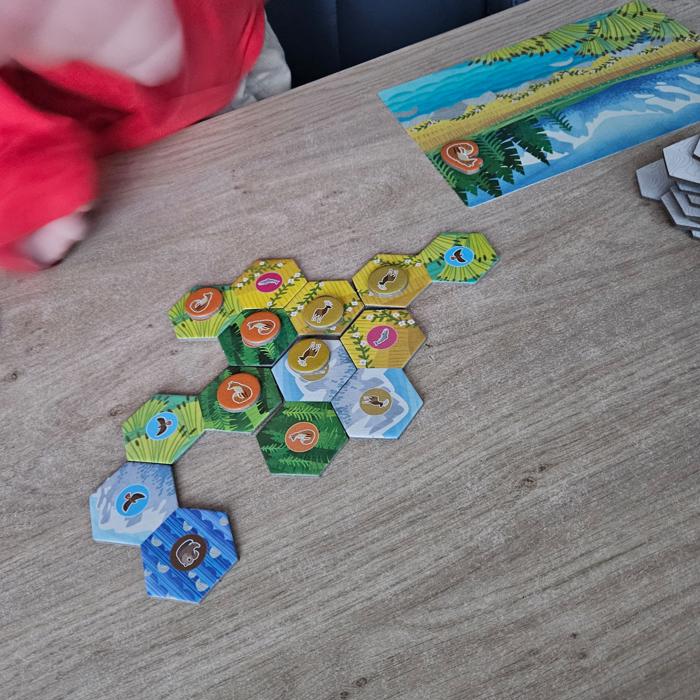
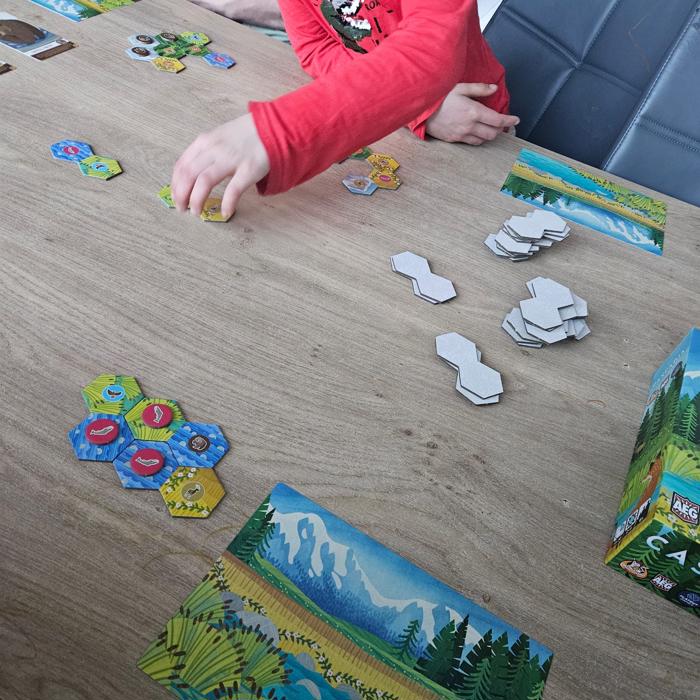
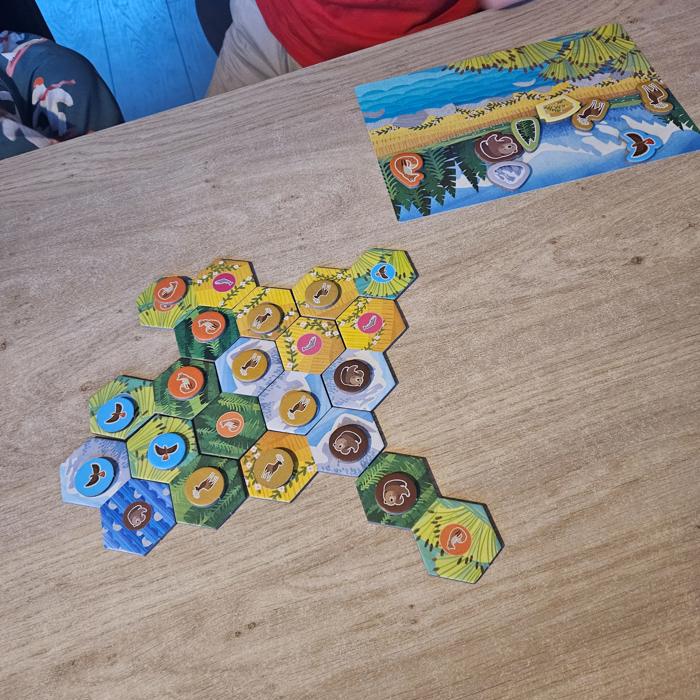
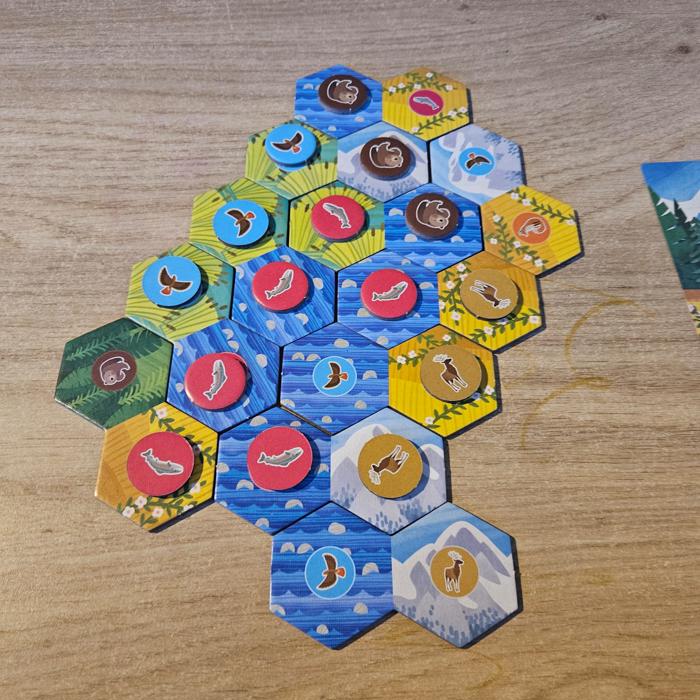
Spelers spelen om beurten. In zijn beurt pakt een speler een tegel uit het aanbod en plaatst die in zijn gebied. Daarbij moet ten minste één zijde aansluiten aan een eerder geplaatste tegel, verder zijn er geen regels. Het is wel handig om te proberen groepjes te maken van dezelfde leefgebieden en/of dieren.
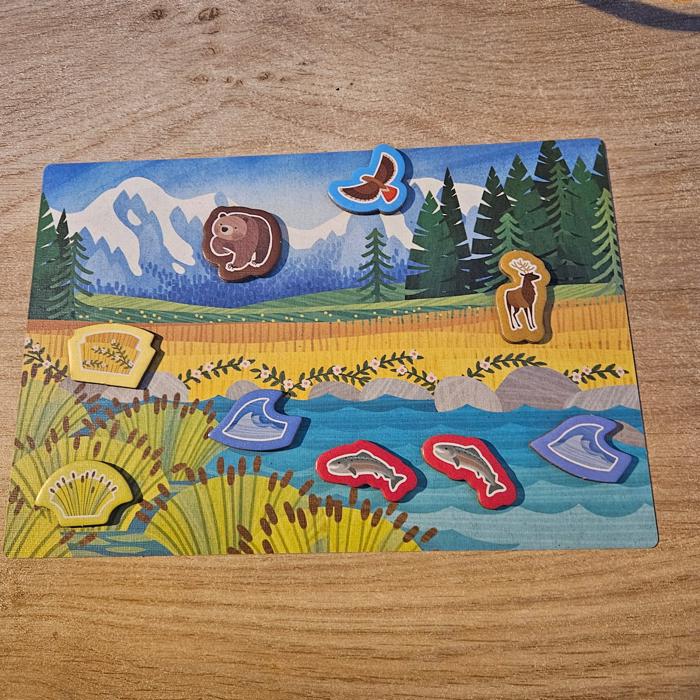
Wanneer de speler de tegel geplaatst heeft, controleert hij of hij een groepje van drie dieren heeft gemaakt. Is dat het geval, dan mag hij drie dierfiches op het groepje leggen én de bovenste dierenfoto pakken en die op zijn panoramabord leggen.
In totaal is elke speler tien keer aan de beurt. Aan het einde van het spel volgt nog de telling van de leefgebieden. Voor elke groep van minimaal drie dezelfde leefgebieden mag de speler een leefgebiedfoto pakken. Wanneer de groep zes of meer aaneengesloten leefgebieden bevat, mag de speler twee leefgebiedfoto’s pakken.
Na de eindtelling draaien alle spelers de fotofiches op hun panoramabord om en tellen ze de denneappels die op de achterzijde staan afgebeeld.
De speler met de meeste denneappels wint.
Wat vinden wij van Cascadia Junior?
Ik vind het eerlijk gezegd lastig om Cascadia Junior precies in te schalen qua doelgroep. Voor Leonore (6) duurde een potje met vier spelers eigenlijk net te lang. Het spel duurt al snel een klein half uur en halverwege verloor ze duidelijk haar interesse. Ze kon het spel overigens prima zonder hulp spelen, maar de spanningsboog van een zesjarige bleek met vier spelers toch niet lang genoeg.
Aan de andere kant heb je Mikolaj (7,5), die eigenlijk al prima de familievariant van Cascadia kan meespelen. Voor hem voelde Cascadia Junior daardoor een beetje als een stapje terug, al moet ik eerlijk zeggen dat hij het nog steeds best leuk vond om te spelen. Ondanks mijn eigen twijfels over het gelukselement vermaakte hij zich er prima mee.
En dat gelukselement is wel iets waar ik zelf moeite mee heb. De score wordt namelijk bepaald door de denneappels op de achterkant van de fotofiches. Je kunt dus een hele stapel fiches verzamelen, maar als daar vooral één denneappel op staat, kun je alsnog verliezen van iemand die minder fiches heeft maar toevallig meer tweepunters pakt. Dat voelt soms wat krom en oneerlijk. Tegelijkertijd snap ik ook waarom daarvoor gekozen is: het zorgt ervoor dat jongere spelers ook kans hebben om te winnen en voorkomt dat spellen vaak in een gelijkspel eindigen.
Wat het spel wél goed doet, is kinderen kennis laten maken met bekende bordspelmechanismen. Tegels plaatsen, patronen herkennen en het opbouwen van leefgebieden: het zit er allemaal al in. In die zin voelt Cascadia Junior echt als Cascadia-light.
Toch denk ik dat de doelgroep vrij specifiek is. Onder de zes jaar kunnen kinderen het meestal nog niet zelfstandig spelen. Met vier spelers duurt het voor veel zesjarigen net te lang. En vanaf een jaar of acht kunnen veel kinderen eigenlijk al prima (mee)spelen met het originele Cascadia. Daardoor voelt het een beetje als een spel voor zes- à zevenjarigen, en dan het liefst met twee of drie spelers.
Dat gezegd hebbende is Cascadia Junior zeker geen slecht spel. Voor een gemiddeld gezin – dat misschien niet heel vaak bordspellen speelt en het originele Cascadia niet in de kast heeft staan – is dit eigenlijk gewoon een heel leuk spel. Het ziet er ontzettend aantrekkelijk uit, de regels zijn duidelijk en het speelt lekker soepel weg.
Bij ons thuis zal het waarschijnlijk geen blijvertje zijn zodra de kinderen wat ouder worden. Dan komt gewoon weer het originele Cascadia op tafel. Maar voor gezinnen die een toegankelijke eerste kennismaking zoeken met dit soort spellen, kan Cascadia Junior precies zijn wat ze nodig hebben.
Kortom: een schattige en toegankelijke kennismaking met tegelplaatsing voor jonge spelers, maar door de beperkte doelgroep en het sterke gelukselement zal hij niet in elk gezin vaak op tafel komen. Eindcijfer: 7/10.

Cascadia Junior
Players: 2-4
Time: 415-30 minutes
Age: 6+
Author: Fertessa Allyse, Randy Flynn
Publisher: AEG/Flatout Games
Year: 2025
Besides an expansion, the standalone Alpine Lakes, and two roll & writes, there is now also a Junior version of the highly acclaimed Cascadia. Since I enjoy Cascadia, have young children, and the entire internet (and their mother) seems enthusiastic about Cascadia Junior, I felt like I had to add a copy to our shelf.
What do we think of it? You’ll find out in this review.
A first look at Cascadia Junior
The box of Cascadia Junior immediately catches your attention: the familiar Cascadia artwork, but with an even higher level of cuteness. The same goes for the contents of the box: cuteness overload, as we would say in Dutch 😉
After reading the rulebook, I quickly realized that Cascadia Junior plays very smoothly and, at its core, isn’t all that different from the original. That did make me wonder a little: Mikolaj (7.5) can already play the family variant of Cascadia just fine, so could this perhaps be a good stepping stone for Leonore (who turned 6 last week)?
How is it played?
Each player receives a starting tile and a panorama board. On the table you place animal cards and stacks of animal tokens, animal photo tiles, and habitat photo tiles. The latter two have pinecones depicted on the back. They are shuffled and placed on the table in random stacks, pinecones facing down.
Players take turns. On their turn, a player takes a tile from the supply and places it in their area. At least one side must connect to a previously placed tile, but apart from that there are no restrictions. It is, however, useful to try and create groups of the same habitats and/or animals.
After placing a tile, the player checks whether they have created a group of three animals. If so, they may place three animal tokens on that group and take the top animal photo tile, placing it on their panorama board.
Each player takes a total of ten turns. At the end of the game, the habitats are scored. For every group of at least three matching habitats, the player may take a habitat photo tile. If a group contains six or more connected habitats, the player may take two habitat photo tiles.
After the final scoring, all players flip the photo tiles on their panorama boards and count the pinecones shown on the back.
The player with the most pinecones wins.
What do we think of Cascadia Junior?
To be honest, I find it a bit difficult to determine the exact target audience for Cascadia Junior. For Leonore (6), a four-player game lasted just a little too long. A game takes close to half an hour, and about halfway through she clearly started to lose interest. She was perfectly capable of playing without help, but the attention span of a six-year-old just isn’t quite long enough for a four-player game.
On the other hand, there’s Mikolaj (7.5), who can already play the family variant of Cascadia. For him, Cascadia Junior felt a bit like a step backwards. That said, he still enjoyed playing it. Despite my own reservations about the luck factor, he had a good time with it.
And that luck factor is something I personally struggle with. The final score is determined by the pinecones on the back of the photo tiles. So you might collect a whole stack of tiles, but if most of them only have one pinecone, you could still lose to someone who has fewer tiles but happens to flip more two-pinecone ones. That can feel a bit odd and unfair.
At the same time, I understand why this choice was made. It gives younger players a chance to win and helps prevent games from ending in a tie too often.
What the game does do very well is introduce children to familiar board game mechanisms. Tile placement, recognizing patterns, and building up habitats are all present. In that sense, Cascadia Junior truly feels like Cascadia-light.
Still, I think the target audience is quite specific. Children under six usually can’t play it independently yet. With four players it tends to take a bit too long for most six-year-olds. And from around eight years old, many kids can already join in with the original Cascadia. As a result, it feels mostly suited for six- or seven-year-olds, preferably with two or three players.
That said, Cascadia Junior certainly isn’t a bad game. For an average family—one that doesn’t play board games very often and doesn’t already own Cascadia—it’s actually a very enjoyable game. It looks fantastic, the rules are clear, and it plays very smoothly.
In our household it will probably not stay in rotation once the kids get a little older. At that point we’ll simply go back to playing the original Cascadia. But for families looking for an accessible first introduction to this type of game, Cascadia Junior might be exactly what they’re looking for.
In short: a cute and accessible introduction to tile-laying games for younger players, but due to its narrow target audience and strong luck factor it won’t hit the table frequently in every household. Final score: 7/10.