

Aantal spelers: 1-4
Speelduur: 15 minuten
Leeftijd: 5+
Auteur: Marco Teubner
Uitgever: 999Games
Jaar: 2026
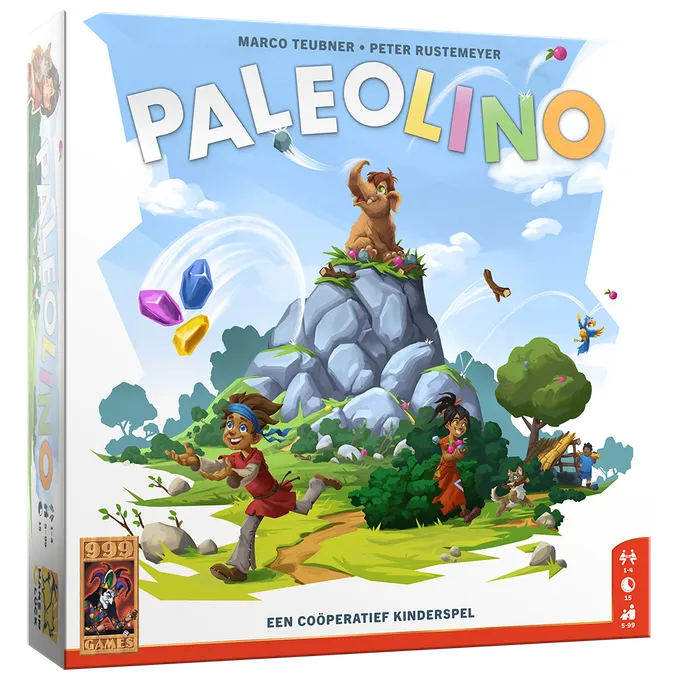

Kijk omhoog! Je vriend Lino de mammoet heeft hout, stenen, bessen en zelfs zeldzame kristallen gevonden! Het rammelt en klettert terwijl hij ze de berg afrolt. Werk samen om een klein dorpje te bouwen voordat Lino moe wordt!
Met Paleolino kunnen kinderen nu duiken in de spannende wereld van Paleo. Paleolino is een coöperatief avontuur voor maximaal 4 kinderen vanaf 5 jaar.
De eerste kennismaking met Paleolino
Paleolino is een kinderspel in de wereld van Paleo. Paleo heb ik een aantal keer gespeeld; ik vond het een prima spel, maar niet (veel) meer dan dat. Desondanks trok Paleolino mij ontzettend aan. Een coöperatief kinderspel met een (pre)historisch thema. De eerlijkheid gebiedt mij dan ook te zeggen dat ik bij Paleolino meteen afging op het uiterlijk. Ik zag het spel voorbij komen en diende direct een verzoek in bij 999Games, enkel en alleen vanwege de boxcover — want ik had er nog niets over gelezen.
Vrij onverwacht kwam Paleolino bij mij thuis aan. Dat maakte dat ik de doos echt zonder voorkennis opende; ik liet me volledig verrassen.
Op de achterkant van de doos zie ik een berg — een fysieke berg. Dit roept bij mij twee gedachten op: Oh nee, die moet ik natuurlijk in elkaar gaan zetten… maar ook: Dodo! Dodo is een spel van 999 Games waar ik enige tijd geleden een review over schreef, omdat mijn kinderen het zo’n fantastisch spel vinden.
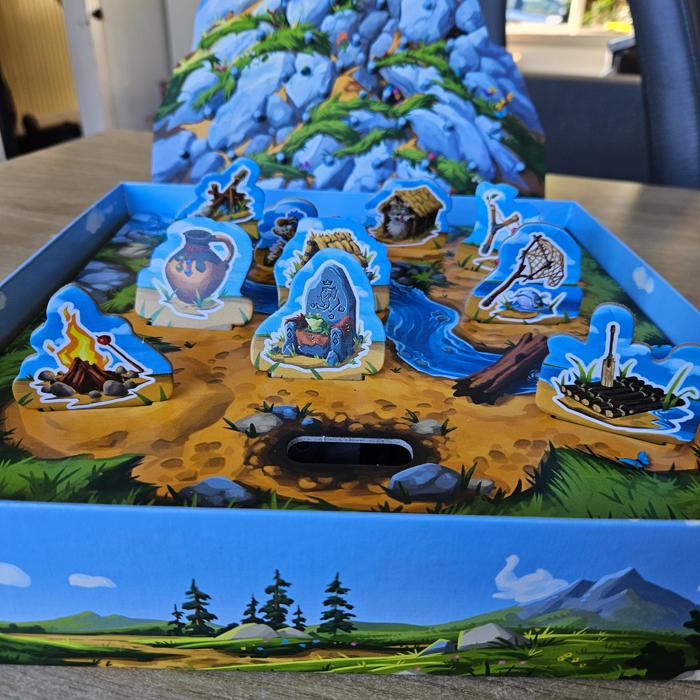
Tijd om de doos open te maken. En inderdaad: er moeten flink wat kartonnen onderdelen in elkaar gezet worden. Maar — en dit is een hele grote maar — de in elkaar gezette delen passen ook in elkaar gezet weer in de doos. Fantastisch! 3D-elementen die je maar één keer hoeft te bouwen: dat zijn pluspunten.
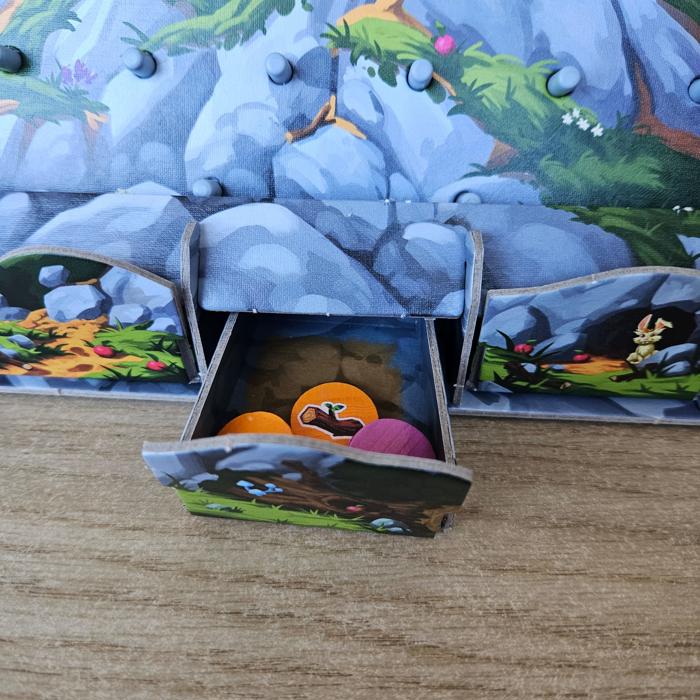
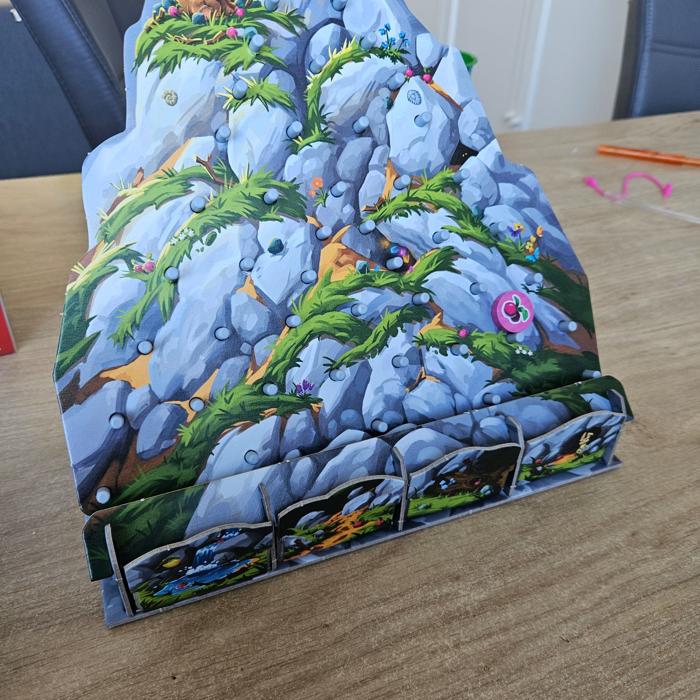
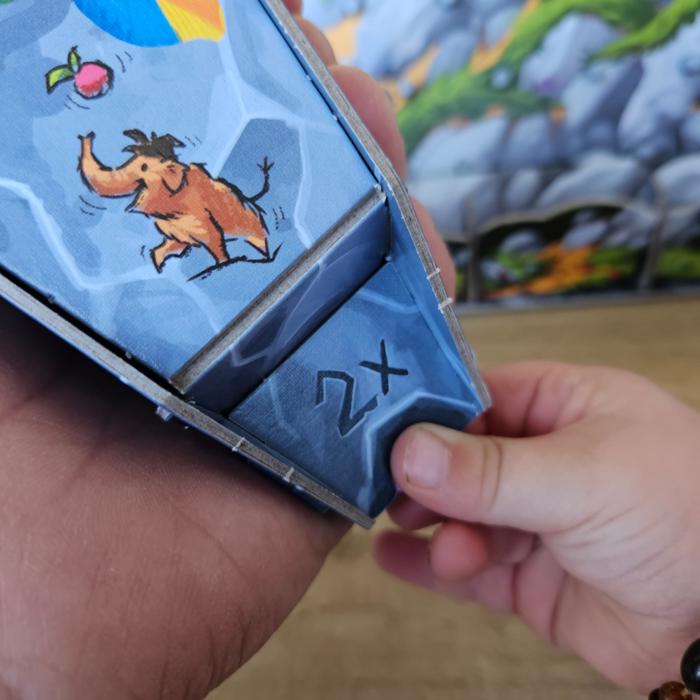
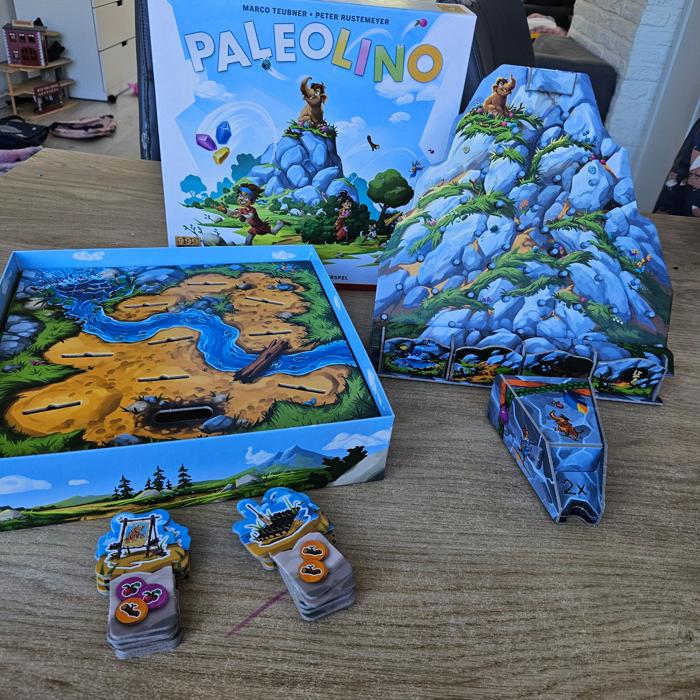
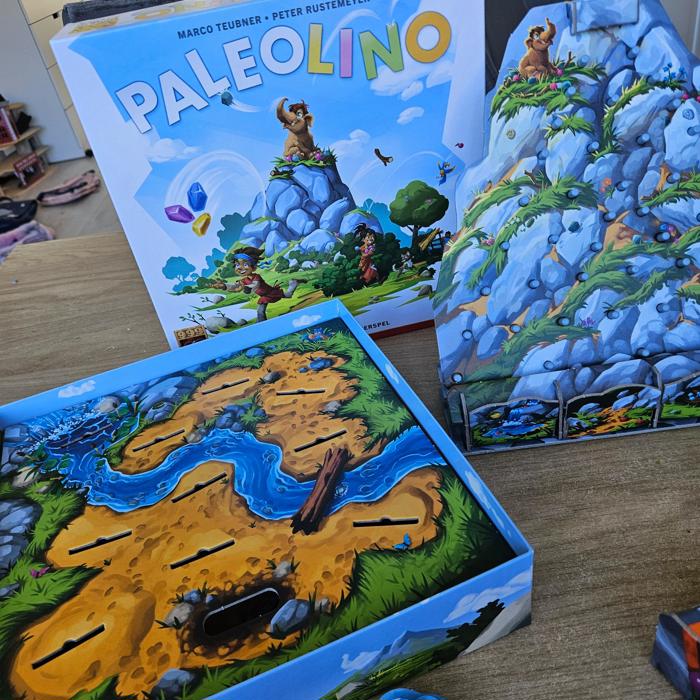
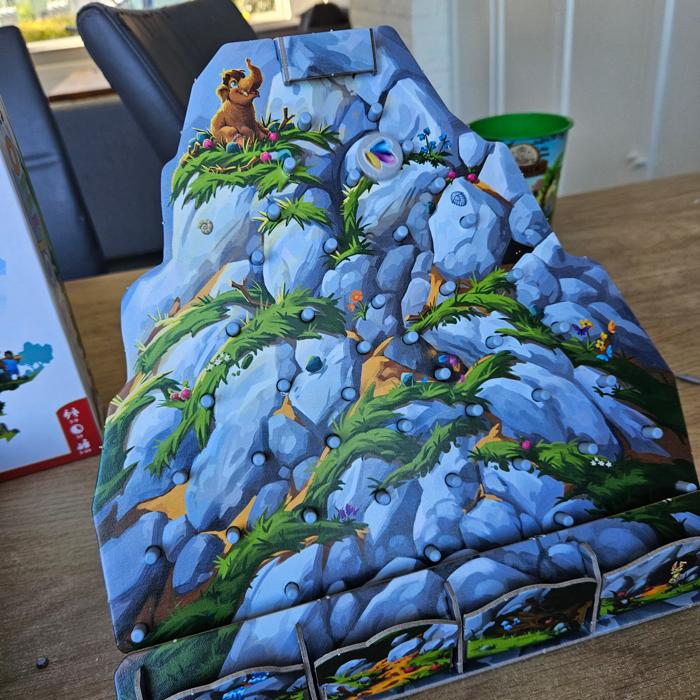
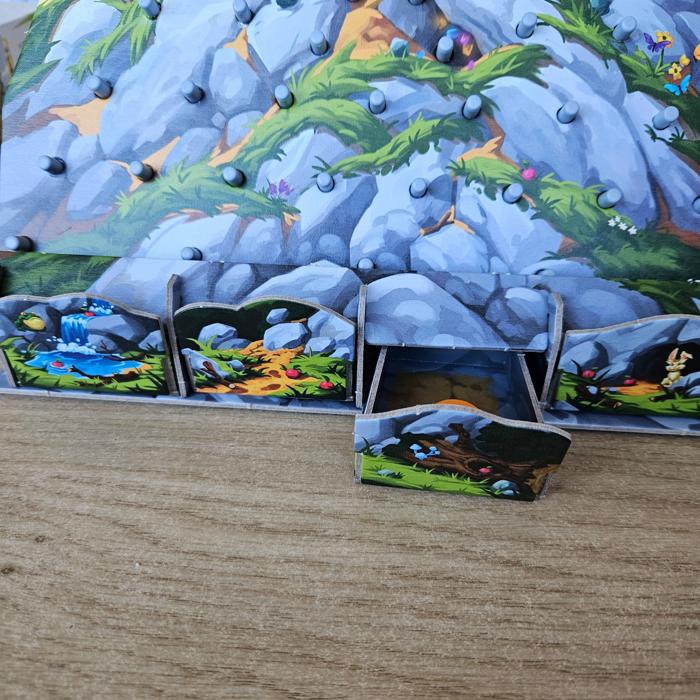
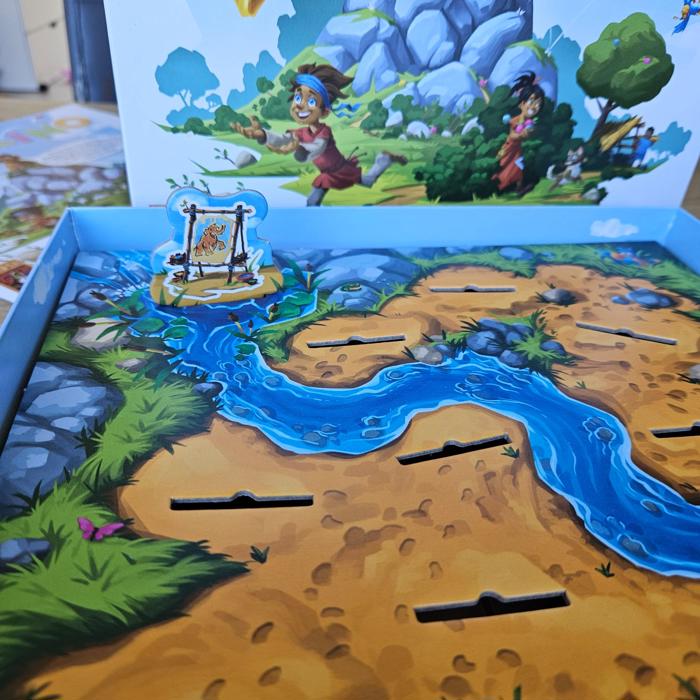
Het geheel ziet er echt heel leuk uit: een 3D-berg met lades (grotten) eronder. Het speelveld wordt in de doos geplaatst, waardoor er een soort 3D-landschap ontstaat. Daarnaast is er een vuistbijl die je vult met gekleurde houten fiches en waarmee je kunt schudden totdat er fiches uitkomen.
Ik heb nog niets gespeeld, maar ik ben nu al enthousiast.
Het regelboekje bevat in eerste instantie vooral informatie over hoe de onderdelen voor het eerste spel in elkaar gezet moeten worden. De spelregels die daarna volgen, zijn eigenlijk erg simpel en duidelijk.
Hoe wordt het gespeeld?
Paleolino is een coöperatief spel. Het doel is om samen tien uitvindingen te doen (te maken) voordat de grondstoffen op zijn.
Spelers spelen om beurten en doen in hun beurt het volgende:
De speler pakt de handbijl en schudt hiermee totdat er een grondstof uitsteekt. Deze trekt hij eruit. Dit doet hij twee keer, zodat hij twee grondstoffen heeft.
Vervolgens stopt hij de twee grondstoffen bovenop de berg in de ingang. Deze gaan, als in een Galtonbord*, naar beneden en komen in één van de vier grotten terecht.
Leuk detail: blijft er een fiche hangen, dan moeten alle spelers op tafel slaan zodat het fiche weer gaat bewegen.
Galtonbord: ik had geen idee dat het zo heette, maar ik denk dat iedereen het wel kent. Zo’n spijkerbord waar je bovenin een balletje of muntje laat vallen, dat via de spijkers naar beneden stuitert en uiteindelijk ergens onderaan terechtkomt.
De speler kiest nu (zonder te kijken) één van de grotten om te openen en legt de fiches die daarin zitten in het midden van de tafel.
(Als er geen fiches in de gekozen grot zitten, heeft de speler pech.)
Daarna kijkt de speler of hij met de verzamelde fiches een uitvinding kan doen. Om een uitvinding te doen mag hij anderen om hulp vragen: elk kind heeft namelijk één plekje in zijn rugtas om een grondstof te bewaren.
Als er een uitvinding wordt gedaan, wordt deze in het spelbord geplaatst. Eventueel kan er ook een tweede uitvinding worden gedaan, als er genoeg grondstoffen zijn.
Als er grondstoffen over zijn, mag de speler één grondstof in zijn rugtas bewaren. De rest wordt afgelegd door ze in de gleuf in het bord te steken.
Daarna is de volgende speler aan de beurt en volgt dezelfde stappen.
Het spel kan op twee manieren eindigen:
1. De vuistbijl is leeg, maar nog niet alle uitsnedes op het bord zijn gevuld met uitvindingen. Helaas, de spelers hebben verloren.
2. Alle uitsnedes op het bord zijn gevuld met uitvindingen, vóór of in de beurt waarin de laatste grondstoffen uit de vuistbijl worden gehaald.
Wat vinden we van Paleolino?
Na het lezen van de regels en het in elkaar zetten van de onderdelen was ik ontzettend enthousiast. Een groot pluspunt: alle onderdelen passen, zelfs in elkaar gezet, gewoon in de doos. Zó goed zelfs dat kinderen het de volgende keer zelf kunnen klaarzetten.
Maar goed, ik was dus zo enthousiast… alleen waren er op dat moment geen kinderen in de buurt. Daarom besloot ik het eerste potje maar solo te spelen. Als volwassene een kinderspel solo spelen? Ach ja, waarom niet. En eerlijk? Ik vond het eigenlijk erg vermakelijk. Ik probeerde bewust te kijken naar dingen waar ik een mening over kon vormen, maar merkte dat ik het vooral gewoon een grappig spel vond om te doen.
Diezelfde avond strikte ik Mikolaj (bijna 8) voor een potje. Hij deelde mijn uitbundige enthousiasme niet helemaal, maar vond het “wel leuk”. Voor hem is dat eigenlijk al best positief.
Door wat door te vragen kwam ik erachter waar dat verschil vandaan kwam. Hij miste vooral wat samenhang. Hij gaat goed op écht abstracte spellen (zoals schaken) of juist op heel verhalende spellen, zoals Toriki. Paleolino zit daar een beetje tussenin. Het thema is leuk en wordt ook netjes doorgevoerd, maar het verhaal erachter voelt wat dun. Zelf zie ik ook niet echt een directe connectie met het originele Paleo, afgezien van het thema.
Later speelde ik het ook met Leonore, met Mikolaj en Leonore samen én met hulp van Kristof (net 2). Ik merkte dat het spel bij Mikolaj begon te groeien; hij begon het steeds leuker te vinden. Met z’n drieën komt het spel ook duidelijk beter tot zijn recht.
Zelf ben ik erg enthousiast over de leuke details in het spel. De vuistbijl is bijvoorbeeld echt heel leuk gevonden. Het geeft kinderen iets in handen, voegt een extra actie toe en voelt gewoon origineel — veel leuker dan simpelweg fiches uit een zakje trekken.
Een andere leuke toevoeging is de ‘aardbeving’. Als één van de fiches op het bord blijft hangen, roepen de spelers “Aardbeving!” en trommelen vervolgens op tafel zodat het fiche weer in beweging komt. Hilariteit gegarandeerd.
Ook de onderdelen verdienen een compliment. Alles is stevig uitgevoerd en het geheel ziet er fantastisch uit.
De spelregels zijn simpel, maar winnen is dat niet per se. Ik ben er zelf nog niet helemaal uit of winnen vooral geluk is, of dat er toch echt tactiek bij komt kijken. Ik heb verschillende manieren geprobeerd, maar weet het nog niet zeker. Misschien zit het spel wel precies in die mooie balans tussen geluk en keuzes maken.
Wat ik persoonlijk wel zou aanraden: speel met twee spelers met drie stapeltjes opdrachten. In het boekje staat dat drie stapeltjes bedoeld zijn voor het solospel of als makkelijkere variant bij meer spelers, maar met twee spelers vind ik het met drie stapeltjes eigenlijk nog steeds behoorlijk lastig.
Ter illustratie: er zijn in totaal 30 fiches. Dat betekent dat je in 15 beurten 10 opdrachten moet voltooien. Omdat de meeste opdrachten twee of drie fiches vragen, “verspeel” je de eerste twee beurten vaak al. Met twee spelers kun je bovendien maar twee grondstoffen bewaren in de rugzakken, wat het extra uitdagend maakt.
Met vier spelers wordt het spel juist weer een stuk makkelijker. In dat geval zou je er bijvoorbeeld voor kunnen kiezen om de simpelste opdrachten (waarvoor maar één grondstof nodig is) uit het spel te halen.
Wat dat betreft biedt het spel genoeg mogelijkheden om het niveau aan te passen aan de spelers. Al blijft er altijd een geluksfactor aanwezig, want je weet nooit in welke grot de fiches uiteindelijk terechtkomen.
Kristof is met zijn net twee jaar eigenlijk nog te jong om echt mee te doen. Toch heeft hij al meerdere potjes meegespeeld. Het is duidelijk hoe leuk hij het vindt om de fiches uit de vuistbijl te halen en ze bovenin de berg te stoppen. En ook de aardbeving doet het goed.
Al met al krijgt Paleolino van mij een 8,5. Want een spel dat hier in vier dagen bijna tien keer op tafel kwam, doet duidelijk iets goed.
Meer bewijs heb je eigenlijk niet nodig.

Paleolino
Players: 1-4
Time: 15 minutes
Age: 5+
Author: Marco Teubner
Publisher: Hans im Glück
Year: 2026
Look up! Your friend Lino the mammoth has found wood, stones, berries, and even rare crystals! It rattles and clatters as he rolls them down the mountain. Work together to build a little village before Lino gets tired!
With Paleolino, children can now dive into the exciting world of Paleo. Paleolino is a cooperative adventure for up to 4 children ages 5 and up.
My first encounter with Paleolino
Paleolino is a children’s game set in the world of Paleo. I’ve played Paleo a few times; I thought it was a fine game, but not (much) more than that. Nevertheless, Paleolino really appealed to me. A cooperative children’s game with a (pre)historic theme. In all honesty, I have to admit that with Paleolino, I was immediately drawn to its appearance. I saw the game come by and immediately submitted a request to 999Games, solely because of the box cover—since I hadn’t read anything about it yet.
Quite unexpectedly, Paleolino arrived at my house. That meant I opened the box with absolutely no prior knowledge; I let myself be completely surprised.
On the back of the box, I see a mountain—a physical mountain. This brings two thoughts to mind: Oh no, of course I’m going to have to assemble that… but also: Dodo! Dodo is a game from 999 Games that I wrote a review about some time ago, because my kids think it’s such a fantastic game.
Time to open the box. And sure enough: there are quite a few cardboard pieces that need to be assembled. But—and this is a huge but—the assembled parts actually fit back into the box. Fantastic! 3D elements that you only have to build once: that’s a major plus.
The whole thing looks really fun: a 3D mountain with drawers (caves) underneath. The playing field is placed inside the box, creating a sort of 3D landscape. There’s also a fist-shaped axe that you fill with colored wooden tokens and shake until tokens come out.
I haven’t played it yet, but I’m already excited.
The rulebook primarily contains information on how to assemble the components for the first game. The rules that follow are actually very simple and clear.
How is it played?
Paleolino is a cooperative game. The goal is to make ten inventions together before the resources run out.
Players take turns, and on their turn, they do the following:
The player picks up the hand axe and shakes it until a resource pops out. They pull it out. They do this twice, so they have two resources.
Next, they place the two resources on top of the pile in the entrance. These slide down, like on a Rube Goldberg machine*, and land in one of the four caves.
Fun fact: if a token gets stuck, all players must tap the table to get it moving again.
Galton board: I had no idea that’s what it was called, but I think everyone knows it. It’s one of those boards with nails where you drop a ball or coin at the top, and it bounces down through the nails until it eventually lands somewhere at the bottom.
The player now chooses (without looking) one of the caves to open and places the tokens inside it in the middle of the table.
(If there are no tokens in the chosen cave, the player is out of luck.)
Then the player checks if they can make an invention with the collected tokens. To make an invention, they may ask others for help: each child has one spot in their backpack to store a resource.
When an invention is made, it is placed on the game board. If there are enough resources, a second invention may also be made.
If there are any resources left over, the player may keep one resource in their backpack. The rest are discarded by placing them in the slot on the board.
Then it is the next player’s turn, and they follow the same steps.
The game can end in two ways:
1. The hand axe is empty, but not all slots on the board have been filled with inventions. Unfortunately, the players have lost.
2. All slots on the board have been filled with inventions, either before or during the turn in which the last resources are taken from the hand axe.
What do we think of Paleolino?
After reading the rules and assembling the pieces, I was incredibly excited. A big plus: all the pieces fit right back into the box, even after being put together. So well, in fact, that kids can set it up themselves next time.
Anyway, I was so excited… but there weren’t any kids around at the time. So I decided to play the first game solo. An adult playing a kids’ game alone? Oh well, why not. And honestly? I actually found it really entertaining. I tried to consciously look for things I could form an opinion about, but I realized I mostly just thought it was a fun game to play.
That same evening, I roped Mikolaj (almost 8) into a game. He didn’t quite share my exuberant enthusiasm, but thought it was “pretty fun.” For him, that’s actually pretty positive.
By asking a few more questions, I figured out where that difference came from. He mainly missed some coherence. He really enjoys truly abstract games (like chess) or, conversely, very narrative games, like Toriki. Paleolino falls somewhere in between. The theme is fun and is executed well, but the story behind it feels a bit thin. Personally, I don’t really see a direct connection to the original Paleo, aside from the theme.
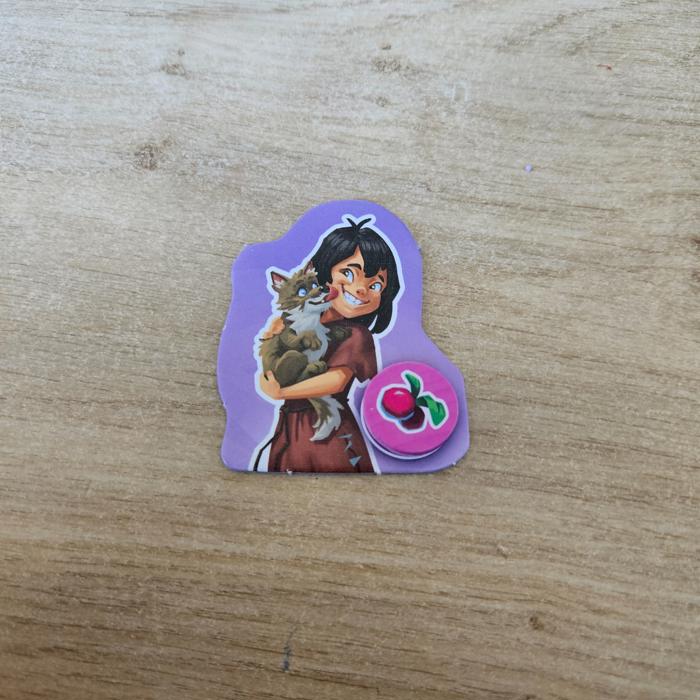
Later, I also played it with Leonore, with Mikolaj and Leonore together, and with Kristof’s help (just 2). I noticed that Mikolaj was really starting to get into the game; he was enjoying it more and more. The game definitely comes into its own better with three players.
Personally, I’m really enthusiastic about the fun details in the game. The fist axe, for example, is a really great idea. It gives kids something to hold, adds an extra action, and just feels original—much more fun than simply pulling tokens out of a bag.
Another fun addition is the “earthquake.” If one of the tokens gets stuck on the board, the players shout “Earthquake!” and then drum on the table to get the token moving again. Hilarity guaranteed.
The components also deserve a compliment. Everything is sturdily made, and the whole thing looks fantastic.
The rules are simple, but winning isn’t necessarily so. I’m not entirely sure myself whether winning is mostly a matter of luck, or if there’s actually some strategy involved. I’ve tried different approaches, but I’m still not sure. Maybe the game strikes that perfect balance between luck and making choices.
What I would personally recommend: play with two players using three stacks of tasks. The booklet states that three stacks are intended for solo play or as an easier variant with more players, but with two players, I actually still find it quite challenging with three stacks.
To illustrate: there are a total of 30 tokens. That means you have to complete 10 tasks in 15 turns. Since most tasks require two or three tokens, you often “waste” your first two turns. With two players, you can also only store two resources in your backpacks, which makes it even more challenging.
With four players, however, the game becomes a lot easier. In that case, you could, for example, choose to remove the simplest tasks (which require only one resource) from the game.
In that regard, the game offers plenty of options to adjust the difficulty level to the players. Still, there’s always an element of luck involved, because you never know which cave the tokens will end up in.
At just two years old, Kristof is actually still too young to really participate. Yet he has already played several rounds. It’s clear how much he enjoys taking the tokens out of the fist axe and placing them on top of the pile. And the earthquake mechanic is a hit, too.
All in all, I give Paleolino an 8.5. Because a game that made it onto the table nearly ten times in four days is clearly doing something right.
You really don’t need any more proof than that.