

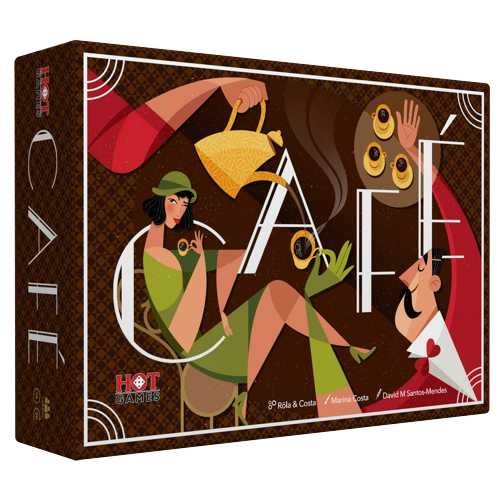

Ik ben een fervent koffiedrinker. Ik leef op koffie. Ik sta ermee op en ga ermee naar bed… Gisteren ging mijn koffiezetapparaat stuk, ik bestelde meteen een nieuwe en besloot maar iets te gaan schrijven over Café.
Een eerste indruk van Café
Eerlijk gezegd stond Café helemaal niet zo hoog op mijn radarlijstje. Maar rond Pasen won ik via Instagram de paaspuzzel van DutchMeeps. Ik mocht toen voor een bepaald bedrag een spel uitzoeken. Ik heb altijd wel een verlanglijstje, maar de meeste spellen die daarop staan zijn óf heel duur, óf slecht verkrijgbaar. Dus zocht ik het internet af naar spellen in de juiste prijscategorie die (ook) solo konden. Ik stuurde een lijstje op en liet hen kiezen; ik hou wel van verrassingen. Het werd dus Café.
Café heeft een bepaalde stijl die mij niet per se aanspreekt, maar waar ik wel aan kan wennen, want het klopt wel.
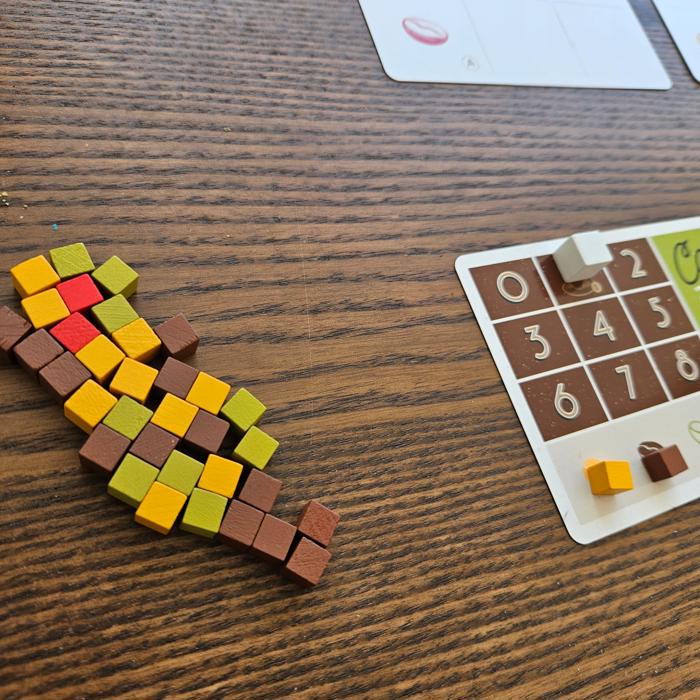
Het doosje is niet groot en ook de inhoud is niet spectaculair: een flinke stapel (relatief grote) kaarten, veel kleine blokjes in vier kleuren en een gouden pion.
Het regelboekje is duidelijk en ik kan snel beginnen met spelen.
Hoe wordt het gespeeld?
In Café volg je het hele proces van de koffieboon.
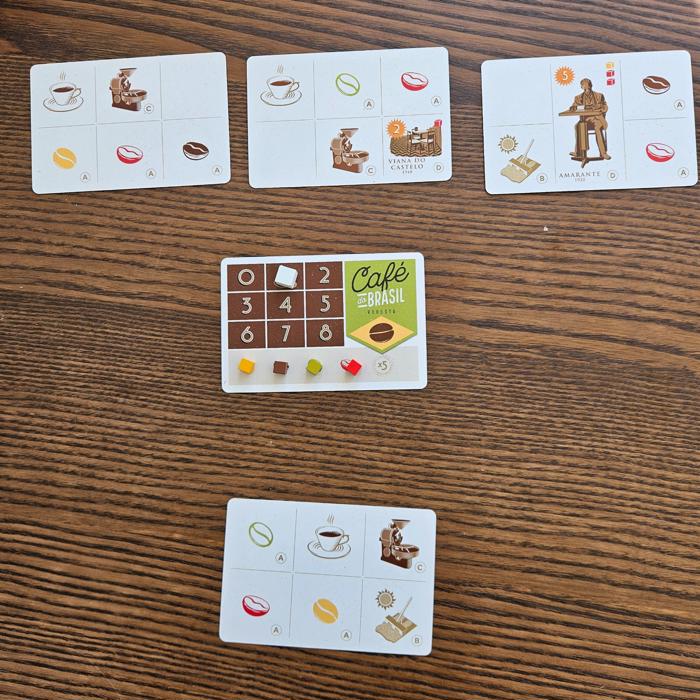
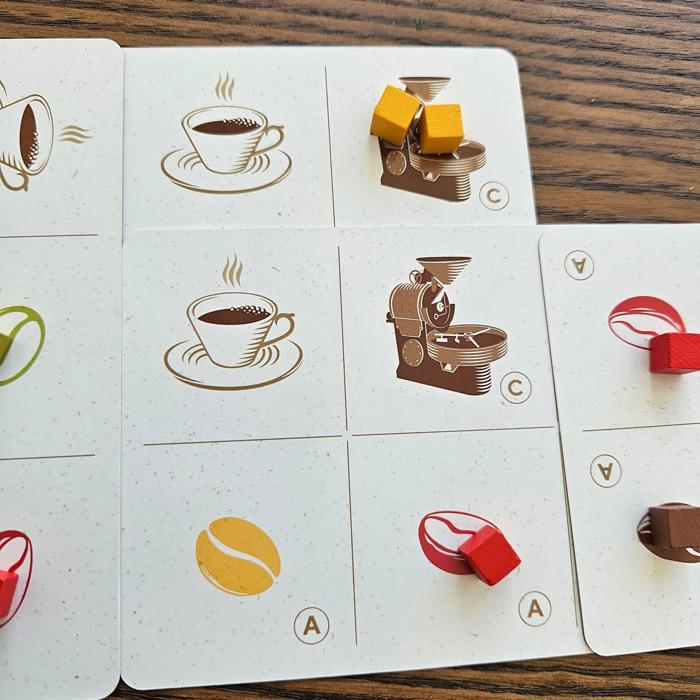
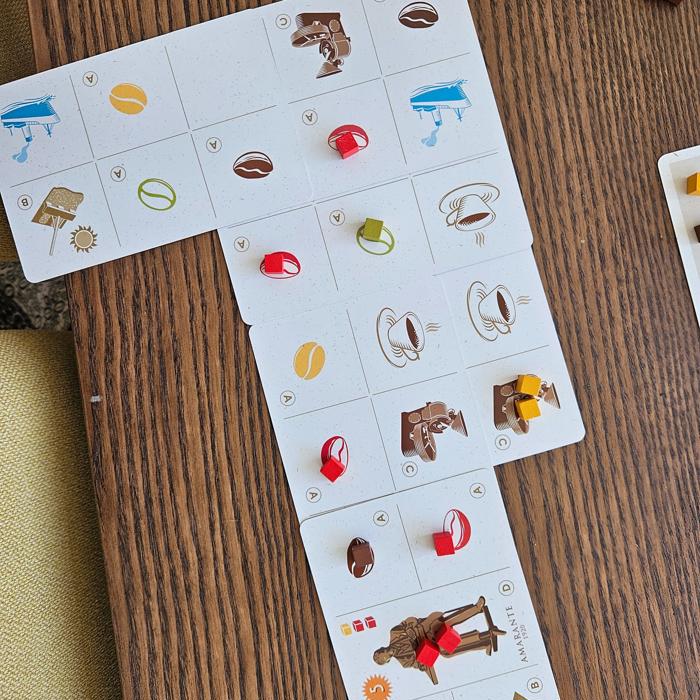
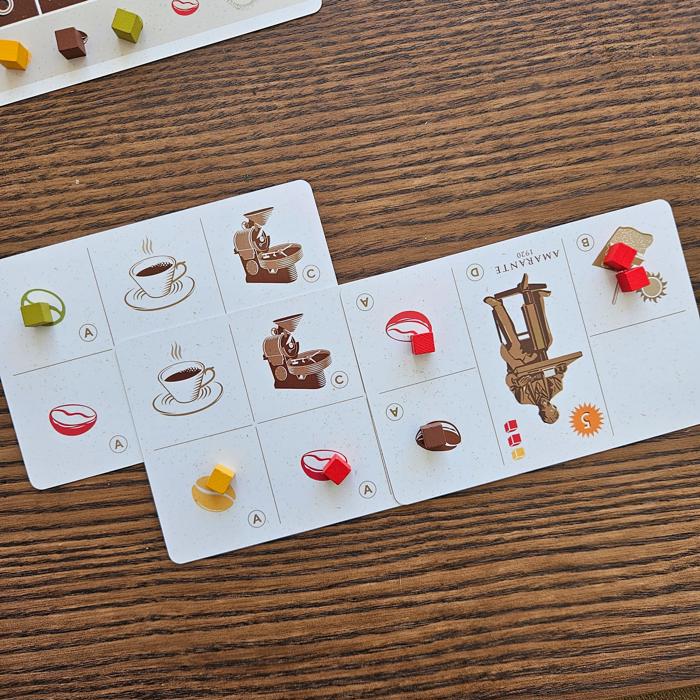
Elke beurt kies je een kaart uit het aanbod (en betaal je deze eventueel) en plaats je die in je gebied. Deze kaart moet overlappen en het is de bedoeling dat je een geoliede machine gaat bouwen voor het produceren van koffie. Dit doe je voornamelijk door ervoor te zorgen dat meerdere vakjes van hetzelfde proces aan elkaar aansluiten.
Vervolgens mag je, afhankelijk van het aantal koffiekopjes in je gebied, een aantal acties uitvoeren.
Er zijn vier verschillende soorten acties: oogsten, drogen, roosteren en leveren.
Bij de eerste actie, oogsten, plaats je blokjes op de betreffende velden. Bij de andere acties verplaats je die blokjes, uiteraard op volgorde. Net geoogste bonen kun je niet leveren 😉 Je boon moet dus eerst drie stappen doorlopen voor je kunt leveren.
Leveren doe je ofwel aan koffietentjes die je in je eigen gebied hebt geplaatst, of aan het pakhuis. Koffietentjes leveren een vast aantal punten op. Bij het pakhuis gaat het om de kleuren waarvan je het minste en een-na-minste hebt.
Wat vind ik van Café?
Laat ik vooropstellen dat ik Café bij uitstek een solospel vind. Je kunt het ook met meerdere mensen spelen, maar er is eigenlijk weinig interactie en je bent vooral in je eigen gebied bezig. Mijn beoordeling en mening zijn dan ook gebaseerd op het solospelen van Café.
Hoewel de vormgeving van Café mij niet per se aanspreekt, klopt het wel. De blokjes, die koffiebonen moeten voorstellen, zijn erg abstract, maar dat mag de pret niet drukken.
Wat wel heel goed gedaan is, is dat alles enorm duidelijk is. De acties, de processen, de kleuren… wat dat betreft hoef je eigenlijk niet te twijfelen of je het goed doet.
Café is eigenlijk gewoon een heel degelijk puzzelspelletje waar goed over nagedacht is.
Wat Café voor mij vooral goed doet, is dat het toegankelijk blijft zonder oppervlakkig te worden. De regels zijn vrij simpel, maar ondertussen ben je constant bezig met optimaliseren, plannen en schuiven. Elke beurt voelt daardoor nuttig.
De grote hoeveelheid kaarten zorgt ervoor dat elk spel anders is en daarmee dus voor een hoge herspeelbaarheid. Tegelijkertijd zorgen ze ook voor enige mate van mazzel (of juist niet) in het spel.
Desondanks moeten er echt wel keuzes gemaakt worden, slim gespeeld worden en vooruit gedacht worden. Het is een hersenkraker die toch licht aanvoelt.
Ik merkte tijdens het spelen ook dat Café zo’n spel is dat steeds nét iets slimmer begint te klikken. In het begin ben je vooral bezig met begrijpen hoe alles loopt, maar na een paar potjes ga je echt combo’s bouwen en vooruit plannen. Dat geeft voldoening zonder dat het zwaar of vermoeiend wordt.
Een spelletje duurt niet lang en vergt niet heel veel speelruimte. Wat mij betreft dus een ideaal spel voor onderweg, op de camping of gewoon voor een relaxmomentje in de avond.
Zeker als solo-ervaring vind ik Café daarom verrassend sterk. Geen enorme tafel vol materiaal, geen urenlange speelsessie, maar gewoon een slimme, compacte puzzel die makkelijk op tafel komt. Daarom krijgt Café van mij een 7.5/10

Café
Players: 1-4
Time: 20 minutes
Age: 10+
Author: Costa, Rôla
Publisher: PYTHAGORAS
Year: 2020
I’m a huge coffee drinker. I basically run on coffee. I wake up with it and go to bed with it… Yesterday my coffee machine broke down, I immediately ordered a new one and decided I might as well write something about Café.
A First Impression of Café
Honestly, Café wasn’t very high on my radar. But around Easter I won the Easter puzzle hosted by DutchMeeps on Instagram. I got to pick a game within a certain budget. I always have a wishlist ready, but most of the games on there are either very expensive or hard to find. So I searched around for games in the right price range that could also be played solo. I sent them a shortlist and let them choose; I do enjoy a good surprise. So Café it was.
Café has a particular art style that doesn’t immediately appeal to me, but one I can definitely get used to, because it fits the game well.
The box itself isn’t very big and the contents aren’t particularly spectacular either: a large stack of relatively big cards, lots of tiny cubes in four colours and a golden pawn.
The rulebook is clear and I was able to start playing pretty quickly.
How does it play?
In Café you follow the entire process of the coffee bean.
Each turn you choose a card from the display (and possibly pay for it) and place it into your area. The card has to overlap with existing cards and the goal is to build a well-oiled machine for producing coffee. You mainly do this by connecting multiple spaces of the same process together.
Depending on the number of coffee cups in your area, you can then perform a number of actions.
There are four different types of actions: harvesting, drying, roasting and delivering.
With the first action, harvesting, you place cubes onto the appropriate spaces. With the other actions you move those cubes along, naturally in the correct order. Freshly harvested beans can’t immediately be delivered 😉 Your beans first have to go through three stages before they’re ready for delivery.
You either deliver coffee to cafés you’ve placed in your own area, or to the warehouse. Cafés give a fixed amount of points, while the warehouse scores based on the colours you have the fewest and second-fewest of.
What do I think of Café?
Let me start by saying that I think Café is, above all else, a solo game. You can play it with more people, but there’s very little interaction and everyone is mostly focused on their own area. Because of that, my opinion and rating are based entirely on the solo experience.
Even though the artwork doesn’t immediately appeal to me, it does fit the game. The cubes, which are supposed to represent coffee beans, are very abstract, but that doesn’t really hurt the experience.
One thing the game does very well is clarity. The actions, the processes, the colours… it’s all very easy to follow and you rarely find yourself questioning whether you’re playing correctly.
Café is simply a very solid little puzzle game that feels well thought out.
What Café does especially well for me is staying accessible without becoming shallow. The rules are fairly simple, but at the same time you’re constantly optimizing, planning and shifting things around. Every turn feels meaningful.
The large variety of cards ensures that every game feels different, which gives Café a lot of replayability. At the same time, there is definitely some luck involved depending on what cards show up.
Even so, you still have to make meaningful decisions, play smart and think ahead. It’s a brain burner that somehow still feels light.
While playing, I also noticed that Café is one of those games that slowly starts to click more and more. At first you’re mainly trying to understand how everything flows together, but after a few games you start building proper combos and planning ahead more efficiently. That feels rewarding without becoming exhausting or overly heavy.
A game doesn’t take very long and doesn’t require much table space either. For me, that makes it an ideal game for travelling, camping or simply relaxing in the evening.
As a solo experience especially, I think Café is surprisingly strong. No giant table full of components, no hours-long play session, just a smart and compact puzzle game that’s easy to get to the table. That’s why Café gets a 7.5/10 from me.