

Aantal spelers: 2-4
Speelduur: 30-60 minuten
Leeftijd: Vanaf 8 jaar
Auteur: Ulrich Blum
Uitgever: Ravensburger
Jaar: 2019
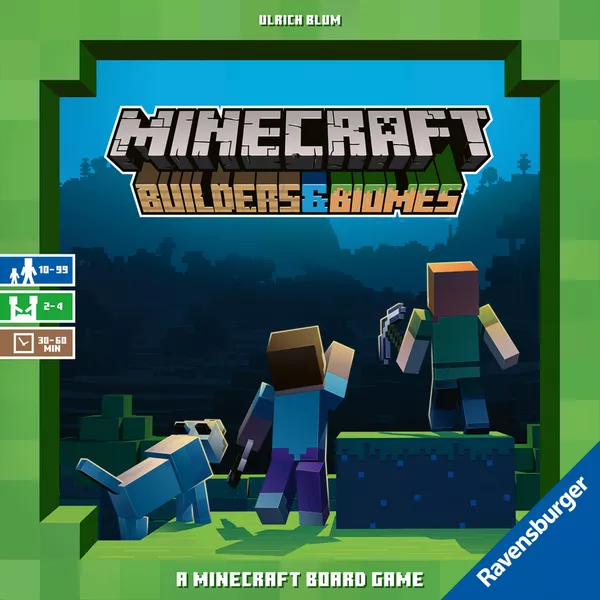

Minecraft; wie kinderen heeft, ontkomt er niet aan. Minecraft is een hit. Vorig jaar spotte ik tweedehands twee Minecraft-spellen. Ik kocht ze meteen; dit leek me een ideale manier om mijn zoon vaker aan het spelen te krijgen.
De eerste kennismaking met Minecraft: Builders & Biomes
Ik zie nu pas dat er 10+ op de doos staat… en Mikolaj heeft dit spel voor zijn zevende verjaardag gekregen. Gelukkig is hij gewend om spellen te spelen en kan hij gemiddeld ook spellen aan met een hogere leeftijdsaanduiding. Op BGG staat 6+, maar ook een zwaarte van 1.99. Na het lezen van de regels lijken beide me niet helemaal terecht. Ik denk dat 10+ te hoog is ingeschat en 6+ juist te laag. 7 of 8+ lijkt me prima. Maar eerst maar eens spelen.
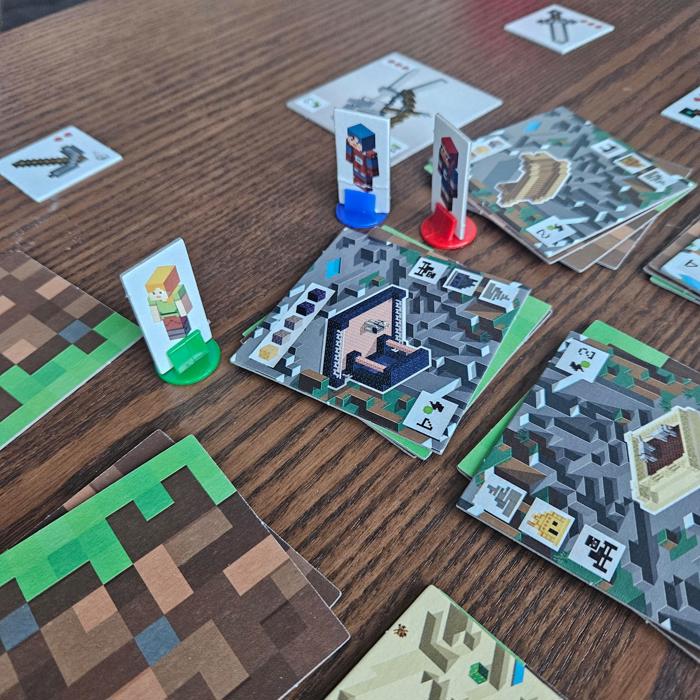
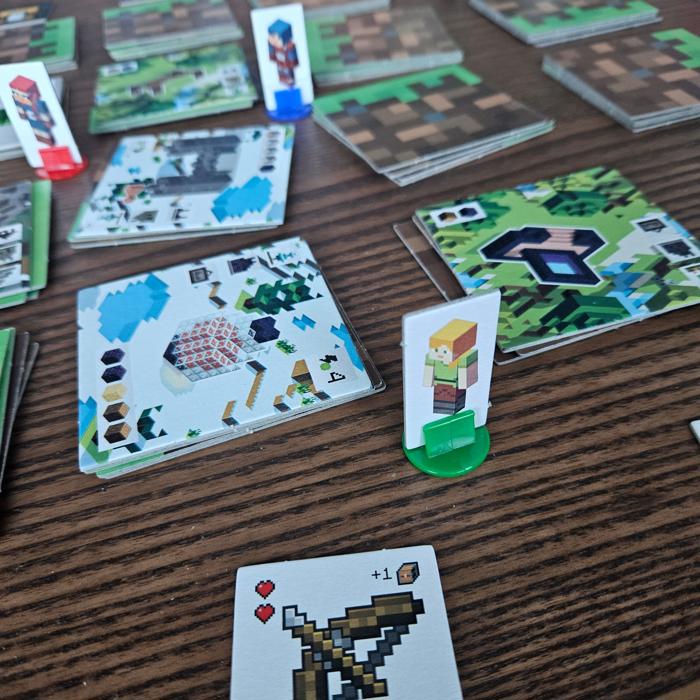
Het spel heeft overduidelijk een Minecraft-thema. Bekende biomes en mobs komen voorbij. Wapens en chests herkennen we ook. Wat dat betreft is het thema prima doorgevoerd.
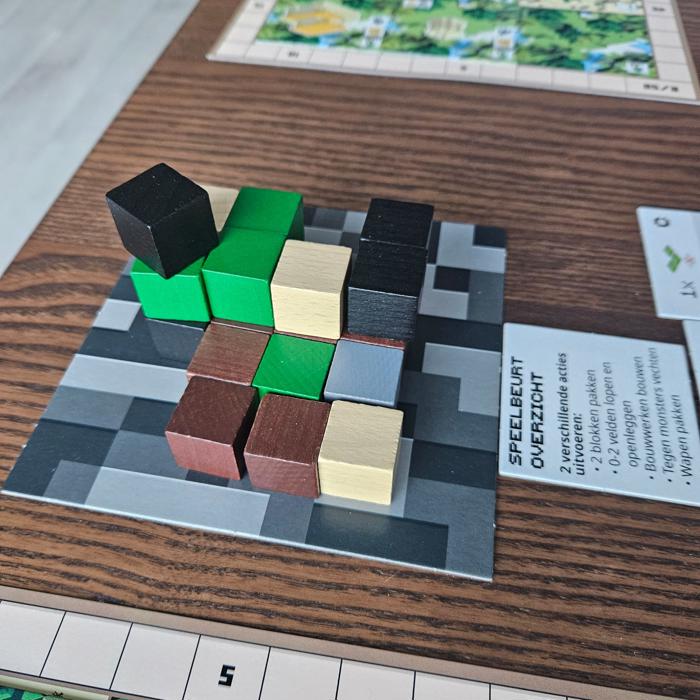
Het geheel doet wat goedkoop aan. Ik kan het niet helemaal duiden, want de onderdelen zijn stevig, het spel heeft relatief veel componenten en de houten blokjes zijn netjes afgewerkt. Toch heeft het geheel een wat middelmatige uitstraling.
Laten we snel gaan spelen om te kijken wat we ervan vinden.
Hoe wordt het gespeeld?
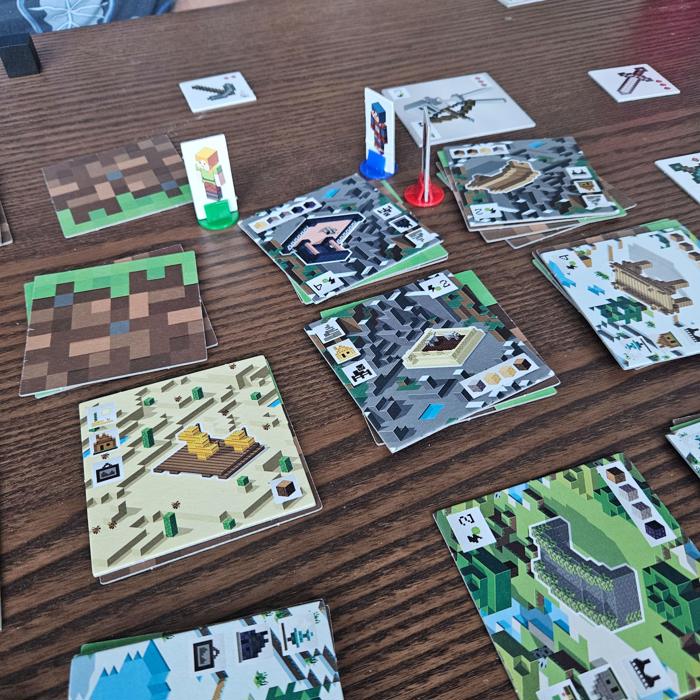
Er is geen speelbord, maar er zijn allerlei verschillende kaarten. De biomes worden geschud en in stapeltjes in een grid van 4×4 gelegd. Daaromheen worden, ook gedekt, de wapens gelegd.
Naast het bord wordt een kubus gemaakt van blokjes. Met behulp van een mal kun je een mooie kubus bouwen.
Elke speler krijgt een spelersbord met biomes, een speelfiguur, een scoresteen en een stapeltje kaartjes met wapens en verrotte aardappels (de wapenuitrusting). Het speelfiguur begint in het midden van het grid.
Minecraft: Builders & Biomes wordt in drie ronden gespeeld. De eerste ronde eindigt als alle blokjes van de eerste laag van de kubus zijn gehaald, de tweede ronde na de tweede laag en de derde ronde na de derde laag. Elke ronde kent een andere telling en aan het eind volgt nog een eindtelling.
In een beurt mag een speler twee verschillende acties uitvoeren.
Daarbij heeft hij keuze uit de volgende acties:
- Verplaatsen (en ontdekken)
De speler mag 0 tot 2 stappen lopen. Daarbij mag hij op de kruising waar hij eindigt de omliggende tegels ontdekken. - Blokjes pakken
De speler mag 2 verschillende blokjes van de kubus pakken. - Een wapen pakken
De speler verzamelt een wapen. Dit mag alleen een wapen zijn dat ligt bij de plek waar zijn speelfiguur staat. Dit wapen wordt toegevoegd aan de wapenuitrusting van de speler. - Bouwen
De speler bouwt een gebouw. Dit moet een gebouw zijn op een van de omliggende plekken van waar zijn speelfiguur staat. De speler betaalt de benodigde blokken en mag vervolgens het gebouw plaatsen op zijn spelersbord. - Tegen monsters (mobs) vechten
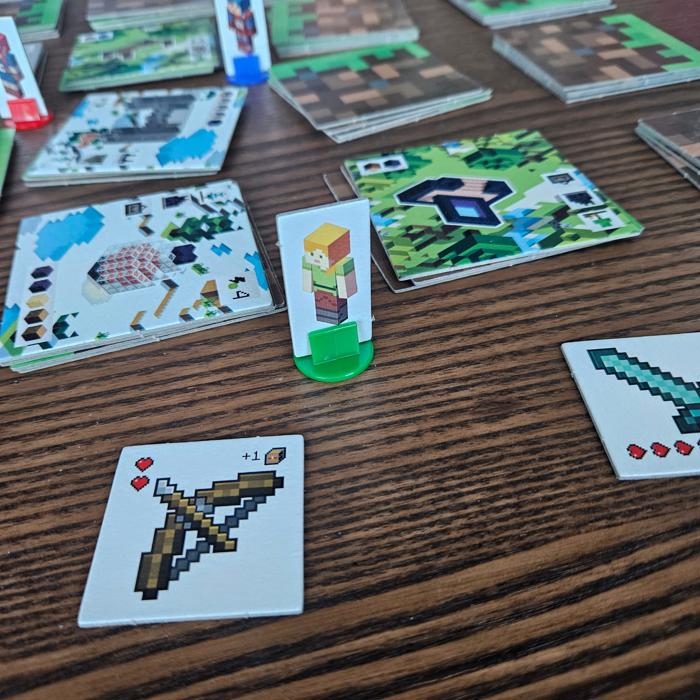
De speler vecht tegen een mob, opnieuw een op een van de omliggende velden. Hiervoor draait hij de bovenste drie tegels van zijn wapenuitrusting om. Als deze samen meer hartjes tonen dan het monster, is het verslagen.
Sommige monsters geven direct punten of een extra beurt; andere leveren punten op aan het eind van het spel.
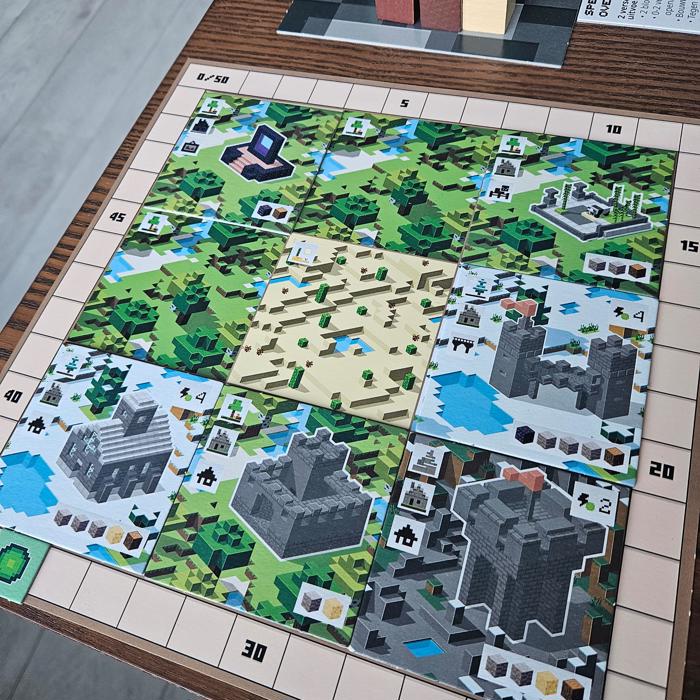
Na de eerste, tweede en derde ronde wordt er gescoord aan de hand van het spelersbord. Het gaat dan om de grootste groepen van gelijke biomes (ronde 1), gebouwsoorten (ronde 2) en decoraties (ronde 3).
Aan het eind kan er nog gescoord worden op verslagen mobs met speciale scoringsvoorwaarden, zoals bijvoorbeeld punten voor het aantal gele gebouwen.
Wat vinden wij van Minecraft: Builders & Biomes?
Bovenstaande uitleg is misschien niet de duidelijkste, maar dat komt voornamelijk doordat je het spel eigenlijk voor je moet zien. De regels zijn erg eenvoudig, maar er is veel keuze.
Je wilt niet te veel op één paard wedden, maar te veel spreiden levert ook niet genoeg op.
Ondanks de middelmatige uitstraling en het thema dat niet iedereen zal aanspreken, zit het spel prima in elkaar.
Het feit dat er geen speelbord is, maar alles uit losse kaartjes bestaat, zorgt ervoor dat het speelveld ieder potje anders is.
Het leuke aan dit spel vind ik dat je met meerdere dingen tegelijk bezig bent, zonder dat het heel complex of onoverzichtelijk wordt. Je kunt wapens verzamelen om mobs te verslaan (deckbuilding), mobs verslaan die soms pas aan het eind scoren (endgame-bonussen), je moet bewegen over het bord (grid movement) om op het juiste moment op de juiste plek te zijn, en je kunt invloed hebben op het einde van een ronde door op het juiste moment blokjes te pakken. Die blokjes heb je natuurlijk ook weer nodig om te bouwen, waarna je gebouwen slim op je spelersbord moet plaatsen (tile placement).
Ondanks de vele elementen en keuzes is het spel ontzettend toegankelijk en kun je het prima met kinderen van een jaar of 8 spelen (of eerder als ze veel spelervaring hebben en/of je bepaalde regels wat aanpast).
Het Minecraft-thema zal vooral jongere spelers aantrekken, en wat dat betreft is dat denk ik precies de juiste doelgroep voor dit spel. Het is te complex voor een echt kinderspel — en duurt daarvoor ook te lang, zo’n 45 minuten — maar het is een erg leuk spel voor jeugdigen waar je je als meespelende volwassene ook zeker niet mee zult vervelen.
Minecraft: Builders & Biomes krijgt van mij een 7/10.

Minecraft: Builders & Biomes
Players: 2-4
Time: 30-60 minutes
Age: 8+
Author: Ulrich Blum
Publisher: Ravensburger
Year: 2019
Minecraft; if you have children, there’s really no escaping it. Minecraft is a huge hit. Last year I spotted two second-hand Minecraft board games and bought them immediately; it seemed like the perfect way to get my son to play board games more often.
A first look at Minecraft: Builders & Biomes
I only just noticed that the box says 10+… and Mikolaj received this game for his seventh birthday. Luckily, he’s used to playing board games and can generally handle games aimed at slightly older children. On BGG it’s listed as 6+, with a weight of 1.99. After reading the rules, neither of those ratings feels entirely accurate to me. I think 10+ is too high, while 6+ is probably too low. Personally, I think 7 or 8+ sounds about right. But first: time to play.
The game very clearly embraces the Minecraft theme. Familiar biomes and mobs make an appearance, and of course we recognize the weapons and chests as well. In that regard, the theme has been implemented very nicely.
Still, the overall presentation feels a bit cheap somehow. I can’t fully explain why, because the components themselves are sturdy, there are quite a lot of them, and the wooden blocks are nicely finished. Yet the game as a whole still gives off a somewhat average impression.
Anyway, let’s get it to the table and see how it plays.
How does it play?
There’s no actual game board. Instead, the game uses a collection of different cards. The biome tiles are shuffled and placed face down in a 4×4 grid. The weapons are then placed face down around the edges.
Next to the play area, players build a cube out of wooden blocks. A plastic frame helps you create a neat-looking cube.
Each player receives a player board with biomes, a player figure, a scoring marker, and a small deck containing weapons and rotten potatoes (their equipment deck). The player figure starts in the middle of the grid.
Minecraft: Builders & Biomes is played over three rounds.
The first round ends when all blocks from the first layer of the cube have been removed, the second round after the second layer, and the third round after the final layer. Each round has its own scoring condition, followed by a final scoring phase at the end of the game.
During a turn, a player may perform two different actions.
The available actions are:
- Move (and explore)
The player may move 0 to 2 spaces. After moving, they may reveal the surrounding tiles at the intersection where they end their movement. - Take blocks
The player may take 2 different blocks from the cube. - Collect a weapon
The player takes a weapon from the location where their figure is standing. This weapon is added to the player’s equipment deck. - Build
The player constructs a building on one of the adjacent spaces. They pay the required blocks and place the building on their player board. - Fight monsters (mobs)
The player fights a mob on one of the surrounding spaces. To do this, they reveal the top three cards of their equipment deck. If the revealed hearts exceed the mob’s strength, the mob is defeated.
Some monsters give immediate points or an extra turn, while others provide bonus points at the end of the game.
After the first, second, and third rounds, players score points based on their player boards. This involves the largest connected groups of matching biomes (round 1), building types (round 2), and decorations (round 3).
At the end of the game, players can also score additional points from defeated mobs with special scoring conditions, such as points for yellow buildings.
What do we think of Minecraft: Builders & Biomes?
The explanation above may not be the clearest, but that’s mainly because this is a game you really need to see on the table. The rules themselves are very straightforward, but the game offers a surprising amount of choice.
You don’t want to focus too heavily on a single strategy, but spreading yourself too thin won’t score enough points either.
Despite the somewhat average presentation and a theme that won’t appeal to everyone, the game itself is very well designed.
The absence of a traditional board, combined with the modular card layout, ensures that the play area feels different every game.
What I especially like is how many different things you’re doing at once without the game ever becoming overwhelming or overly complicated. You can collect weapons to defeat mobs (deckbuilding), fight monsters that may score at the end of the game (endgame bonuses), move across the grid to be in the right place at the right time, and influence the timing of round endings by taking blocks strategically. Those same blocks are also needed for building, after which you still have to place the buildings efficiently on your player board (tile placement).
Despite all these different mechanisms and choices, the game remains very accessible, and I think it works perfectly well with children around 8 years old (or younger if they already have a lot of board game experience and you adjust a few rules here and there).
The Minecraft theme will mainly attract younger players, and honestly, I think that is exactly the right audience for this game. It’s a little too complex to be considered a true children’s game — and at roughly 45 minutes, a bit too long as well — but it’s an excellent game for younger players that adults can genuinely enjoy too.
Minecraft: Builders & Biomes gets a 7/10 from me.