

Aantal spelers: 1-4
Speelduur: 30 minuten
Leeftijd: 8+
Auteur: Shem Phillips
Uitgever: Z-Man Games
Jaar: 2019
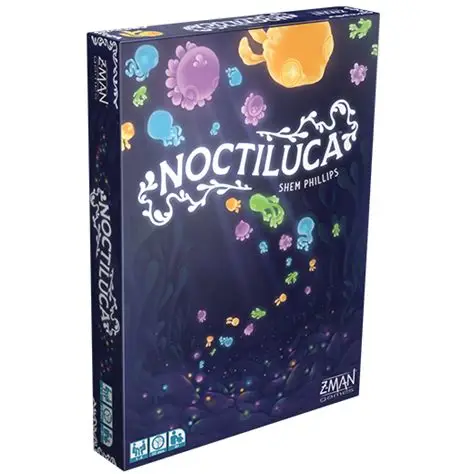

Op de warmste nachten van het jaar worden de anders zo stille wateren gevuld met fonkelende lichtjes wanneer de slapende noctiluca ontwaken. Kun jij de gloed van de zee vangen?
Noctiluca – Een eerste indruk
De doos van Noctiluca trok meteen mijn aandacht. Dit spel moest ik hebben! Ik begin me inmiddels te beseffen dat ik steeds meer spellen met een zeethema in mijn kast heb staan. Helemaal bewust is dat niet, maar de mooie, kleurrijke vissen, de zee… het heeft iets. Noctiluca past wat dat betreft dan ook perfect in mijn kast.
Ik moet meteen toegeven: Noctiluca kocht ik puur op het uiterlijk. Want meer dan dat het een ‘abstract strategiespel’ was, wist ik eigenlijk niet. Ik had geen idee hoe het speelde en wat ik ervan moest verwachten. Het uiterlijk had me in ieder geval al overtuigd.
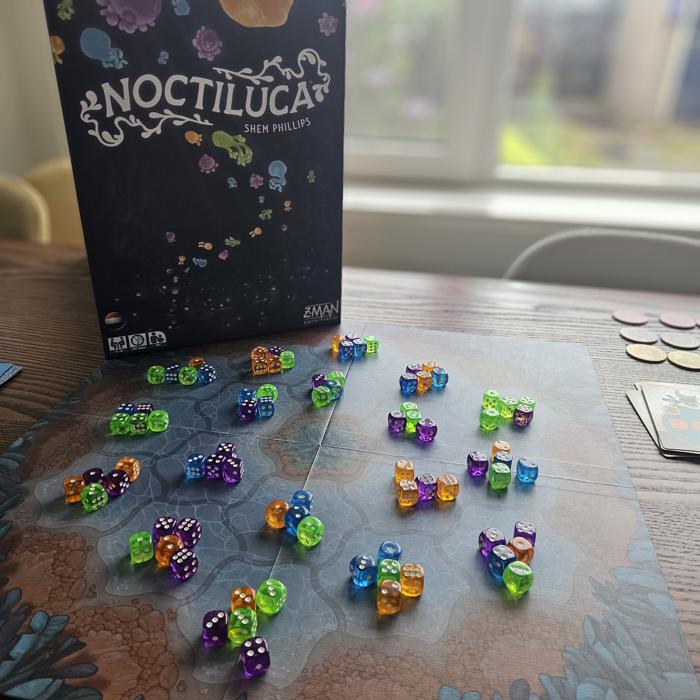
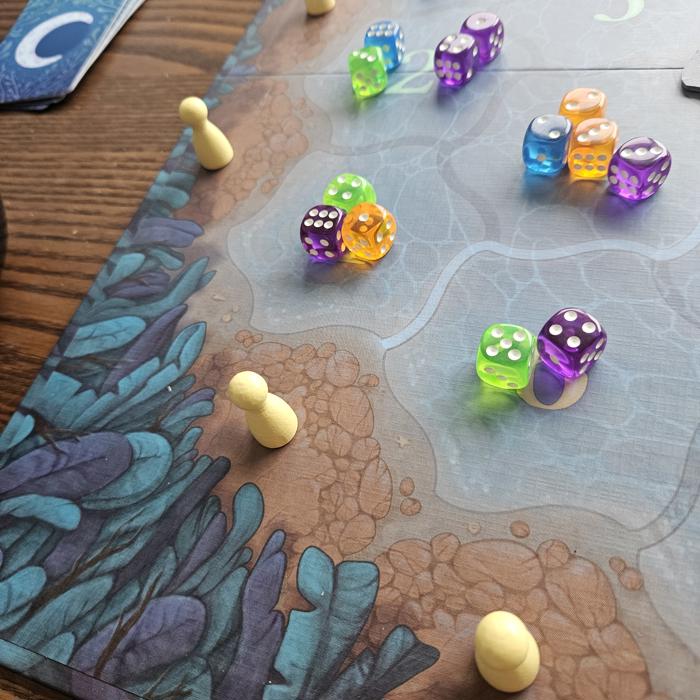
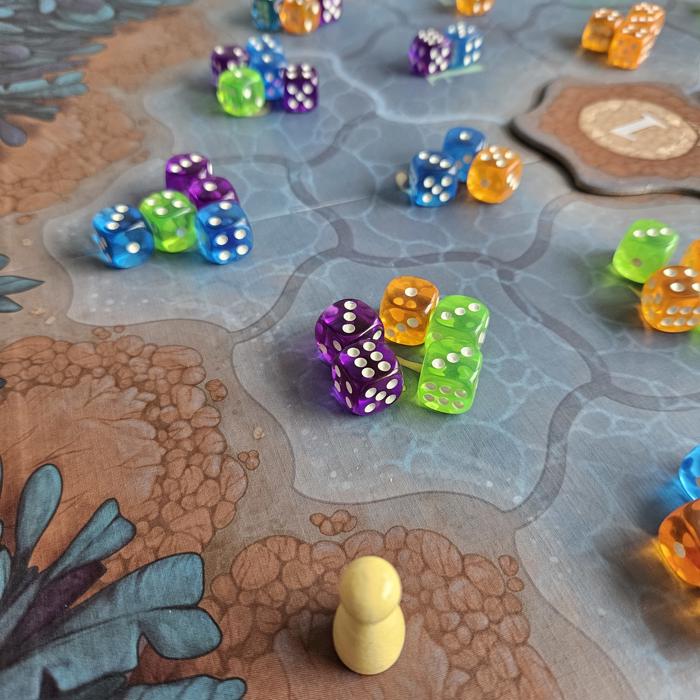
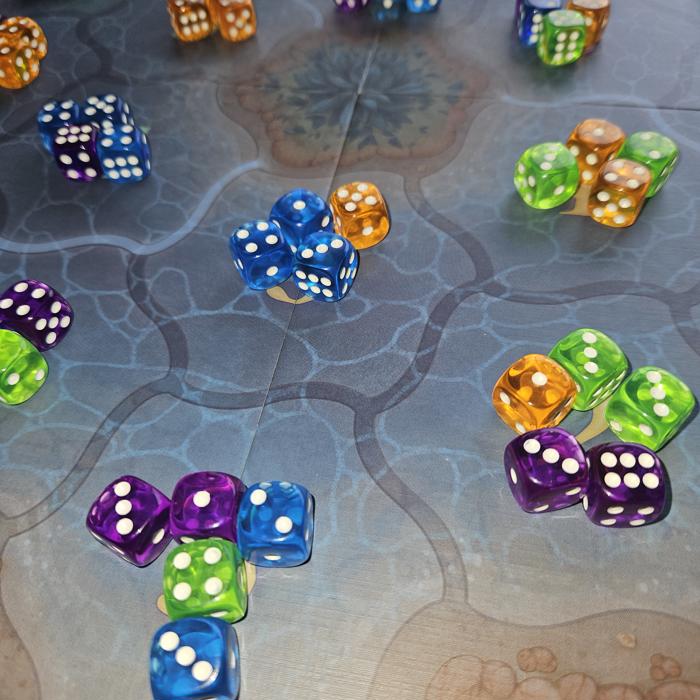
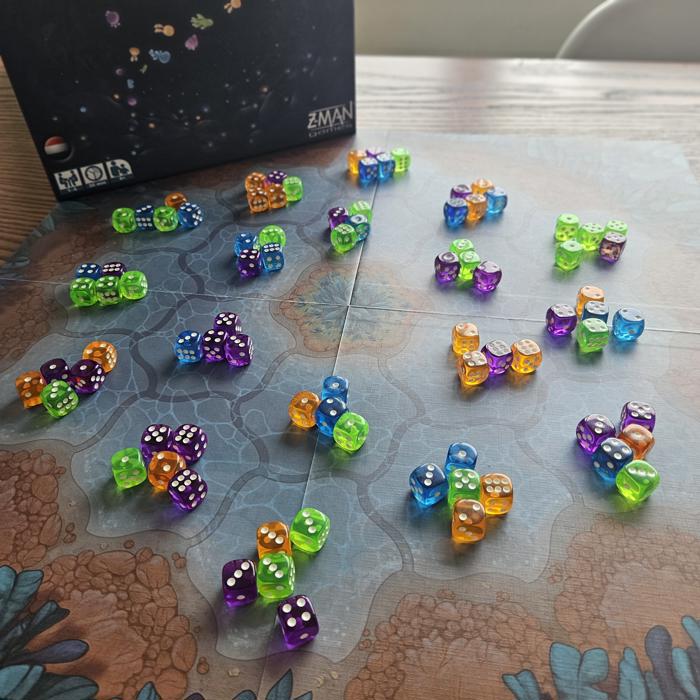
Bij het openen van de doos ben ik zowel enthousiast als een beetje teleurgesteld. Er zitten maar liefst 104 kleine dobbelsteentjes in prachtige kleuren in. Ze zien er geweldig uit en vragen er bijna om om meteen mee gespeeld te worden. De rest van het materiaal doet daarentegen wat ouderwets aan. De houten pionnen doen me bijvoorbeeld denken aan de pionnen uit Mens-erger-je-niet en ook het artwork voelt voor mij net-niet. Waarom precies kan ik niet helemaal uitleggen, maar het weet me simpelweg minder te bekoren dan de kleurrijke dobbelstenen.
Toch heb ik op dat moment ontzettend veel zin om het spel te spelen. De dobbelstenen hebben mijn nieuwsgierigheid in ieder geval gewekt.
Hoe wordt Noctiluca gespeeld?
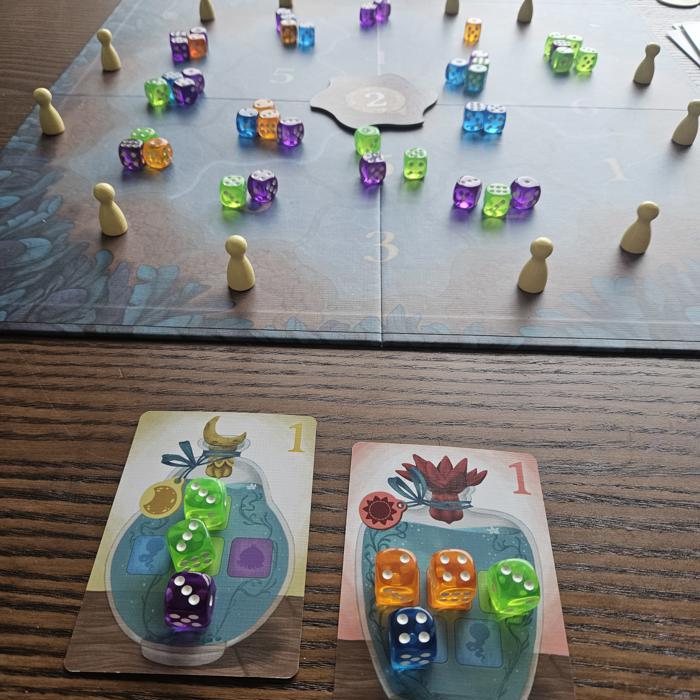
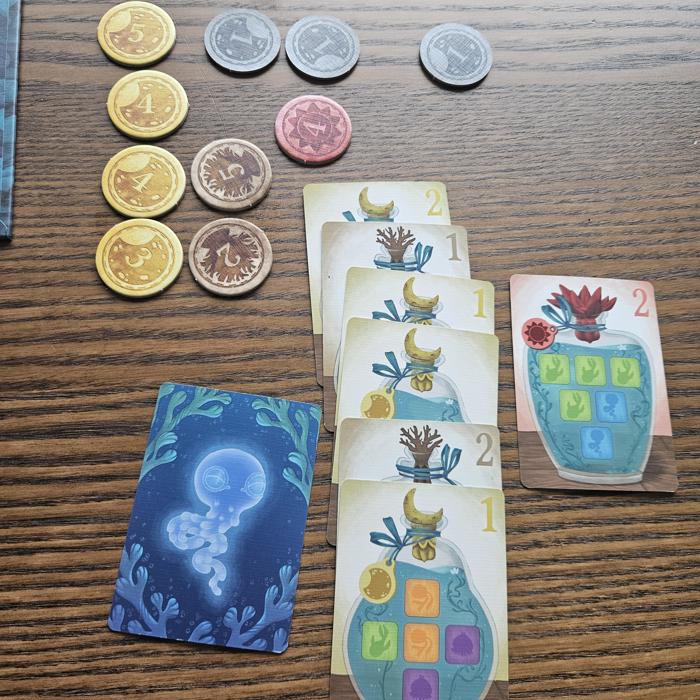
De twaalf pionnen worden eerlijk over de spelers verdeeld. Daarnaast krijgt iedere speler een geheime opdracht en drie flessen, waarvan hij er twee kiest.
Het speelbord wordt vervolgens gevuld met de kleurrijke dobbelstenen. Noctiluca wordt gespeeld over twee ronden, die grotendeels hetzelfde verlopen.
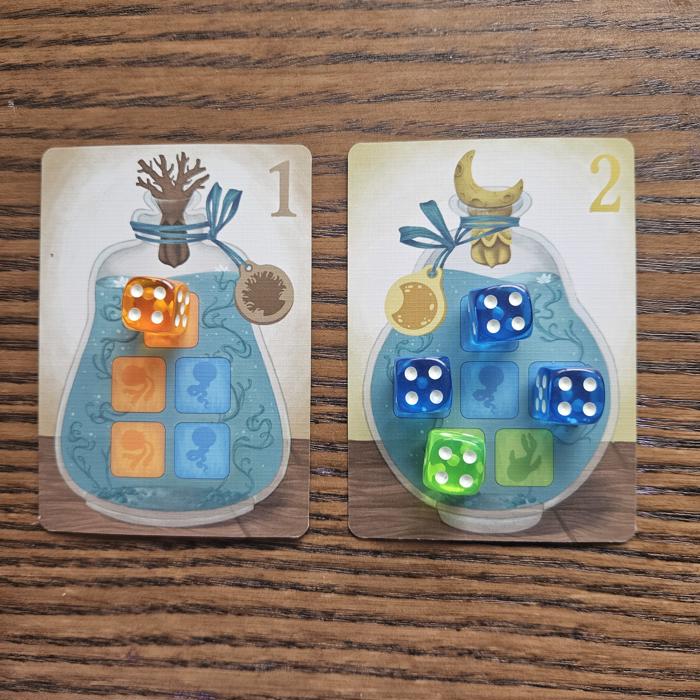
Om de beurt plaatst een speler één van zijn pionnen aan de rand van het bord. Vervolgens kiest hij een getal van 1 tot en met 6. Vanuit de gekozen pion pakt hij in één van de twee richtingen alle dobbelstenen met dat getal. De verzamelde dobbelstenen plaatst hij op zijn fles(sen).
Kan een speler bepaalde dobbelstenen niet plaatsen? Dan worden deze doorgegeven aan de volgende speler. Die kiest er één uit en plaatst deze op zijn eigen fles. Eventuele overgebleven dobbelstenen worden opnieuw doorgegeven, totdat alle dobbelstenen een plekje hebben gevonden.
Wanneer een fles wordt voltooid, pakt de speler de bovenste zegel van de betreffende kleur en neemt hij een nieuwe fles.
Dit gaat door totdat alle pionnen van de spelers zijn geplaatst en daarmee de eerste ronde is afgelopen. De dobbelstenen worden vervolgens verzameld en opnieuw op het bord gelegd. Alleen de dobbelstenen op onvoltooide flessen blijven liggen.
In de tweede ronde wordt in tegengestelde richting gespeeld. Ook de dobbelstenen worden nu in tegengestelde richting doorgegeven.
Aan het einde van het spel wordt eerst gekeken naar de meerderheid per kleur. Per kleur wordt gekeken welke speler de meeste zegels heeft verzameld. Daarbij gaat het om het aantal zegels en niet om de punten die erop staan. De speler met de meerderheid krijgt de overgebleven zegels van die kleur en draait deze om. Deze zijn vervolgens één punt per zegel waard.
Daarna wordt de eindscore berekend:
De punten op de verzamelde zegels worden opgeteld.
Je krijgt punten voor je voltooide flessen.
Iedere noctiluca in jouw geheime kleur op je voltooide flessen is één punt waard.
Voor iedere twee noctiluca op je onvoltooide flessen krijg je één punt.
De speler met de meeste punten wint het spel.
Solospel
Ook Noctiluca kun je solo spelen. Het solospel lijkt behoorlijk veel op het spel met meerdere spelers, maar heeft een aantal aangepaste regels.
Voor het solospel gebruik je de achterkant van het speelbord en een zwarte dobbelsteen. Je speelt je eigen beurt zoals gewoonlijk en scoort ook op dezelfde manier. Je speelt echter tegen ‘de Storm’, die op zijn eigen manier punten verzamelt en dobbelstenen van het bord verwijdert.
De Storm voltooit iedere beurt de bovenste kaart van de flessenstapel. Deze wordt omgedraaid en de Storm ontvangt een zegel in de betreffende kleur. Vervolgens gooi je de zwarte dobbelsteen. Deze bepaalt welke dobbelstenen van het bord worden verwijderd.
Dobbelstenen die jij niet op je flessen kunt plaatsen, gaan naar de Storm. Aan het einde van het spel heeft de Storm dus twaalf zegels en mogelijk een aantal dobbelstenen die hij van jou heeft gekregen.
De meerderheden per kleur worden op dezelfde manier bepaald als in het spel met meerdere spelers. Jij scoort zoals gewoonlijk, terwijl de Storm alleen punten krijgt voor zijn zegels en één punt voor iedere dobbelsteen die hij van jou heeft gekregen.
Wat vinden we van Noctiluca?
Noctiluca is wat mij betreft hét perfecte gateway-spel. Het is een puzzelspel, maar niet eentje waarbij je na iedere beurt het gevoel hebt dat je hersenen overuren draaien. Het puzzelen is relatief licht en vooral relaxed. Je bent voortdurend bezig met de vraag welke dobbelstenen je wilt hebben en hoe je die het beste op je flessen kunt plaatsen, maar het voelt nergens zwaar aan.
Wat ik vooral leuk vind, is dat er eigenlijk maar weinig geluk bij komt kijken. De dobbelstenen bepalen natuurlijk welke mogelijkheden je op het bord krijgt, maar uiteindelijk zijn het vooral jouw keuzes die bepalen wat je ermee doet. Toch kan een andere speler je soms behoorlijk dwarszitten. Niet omdat die speler bewust iets van je afpakt, maar simpelweg doordat hij precies op de plek gaat staan waar jij eigenlijk had willen staan. Ineens kun je niet meer bij de dobbelstenen die je nodig had. Dat voelt soms als pech, maar zorgt tegelijkertijd voor een leuke vorm van interactie.
Het doorgeven van de dobbelstenen vind ik misschien wel het leukste onderdeel van Noctiluca. De dobbelstenen die jij niet kunt gebruiken, gaan naar de volgende speler, die er vervolgens één mag kiezen. Daardoor ben je niet alleen met je eigen beurt bezig, maar houd je ook in de gaten wat de andere spelers mogelijk kunnen gebruiken. Het is een kleine toevoeging, maar het geeft het spel net dat beetje extra.
Juist dat element mis je in het solospel. Toch vind ik de solovariant zeker de moeite waard. De Storm zorgt ervoor dat er voldoende gebeurt en je blijft tijdens het spelen lekker puzzelen. Het voelt alleen anders dan een potje met meerdere spelers, omdat juist die leuke interactie rondom het doorgeven van de dobbelstenen ontbreekt.
Ook de speelduur draagt voor mij bij aan de toegankelijkheid van Noctiluca. Een potje duurt ongeveer een half uur, waardoor het spel gemakkelijk op tafel komt en ook heel geschikt is voor jongere spelers. Je hoeft er geen hele avond voor uit te trekken en toch heb je na afloop het gevoel dat je een compleet spel hebt gespeeld.
Daarmee is Noctiluca voor mij een spel dat geschikt is voor een behoorlijk breed publiek. Beginnende spelers kunnen dankzij de eenvoudige regels snel meedoen, terwijl er voor meer ervaren spelers genoeg keuzes en tactiek in zitten om interessant te blijven. Het spel is rustig genoeg voor een ontspannen spelavond, maar heeft door de interactie en het kiezen van je posities toch voldoende spanning.
Er is wel één belangrijk aandachtspunt: Noctiluca is naar mijn mening niet echt geschikt voor mensen met kleurenblindheid. De kleuren van de dobbelstenen en andere spelelementen spelen een belangrijke rol in het spel en kunnen daardoor een probleem vormen.
Mijn eerste indruk van Noctiluca is dan ook erg positief. Ik kocht het spel in eerste instantie puur vanwege het uiterlijk, maar uiteindelijk blijkt er onder die kleurrijke dobbelstenen een verrassend leuk en toegankelijk puzzelspel te zitten. De regels zijn eenvoudig, een potje duurt niet te lang, geluk speelt nauwelijks een rol en het doorgeven van de dobbelstenen zorgt voor precies genoeg interactie.
Het enige wat ik jammer vind, is dat het regelboekje het spel onnodig ingewikkeld laat lijken* en dat de rest van de uitvoering wat mij betreft niet helemaal kan tippen aan de prachtige dobbelstenen. Maar eenmaal door die eerste hobbel heen, staat er een heerlijk ontspannen puzzelspel op tafel dat ik inmiddels al meerdere keren gespeeld heb en zeker nog vaker op tafel zal komen.
* Op Boardgamegeek vond ik een (Nederlandstalige) samenvatting van de spelregels die ineens heel veel duidelijk maakte!
Daarom krijgt Noctiluca van mij een 7,5/10.

Naam van het Spel
Players: 1-4
Time: 30 minutes
Age: 8+
Author: Shem Phillips
Publisher: Z-Man Games
Year: 2019
On the warmest nights of the year, the otherwise quiet waters come alive with twinkling lights as the sleeping noctiluca awaken. Can you capture the glow of the sea?
Noctiluca – A First Impression
The box of Noctiluca immediately caught my attention. I had to have this game! I’m starting to realize that I have more and more ocean-themed games in my collection. It’s not something I consciously set out to do, but there’s just something about beautiful, colorful fish and the sea that appeals to me. In that respect, Noctiluca fits perfectly into my collection.
I have to admit right away: I bought Noctiluca purely because of its looks. Apart from knowing that it was an ‘abstract strategy game’, I didn’t really know anything about it. I had no idea how it played or what to expect. The artwork had already convinced me, though.
When I opened the box, I was both excited and a little disappointed. There are no fewer than 104 small dice in beautiful colors. They look fantastic and practically beg to be played with. The rest of the components, however, feel a little old-fashioned. The wooden pawns, for example, remind me of the pawns from games like Ludo, while the artwork itself feels just a little… off. I can’t quite explain why, but it simply doesn’t appeal to me as much as the colorful dice do.
Even so, I was really eager to play. At the very least, those dice had definitely sparked my curiosity.
How do you play Noctiluca?
The twelve pawns are divided equally among the players. Each player also receives a secret objective and three bottles, of which they choose two.
The game board is then filled with the colorful dice. Noctiluca is played over two rounds, which are largely played in the same way.
On their turn, a player places one of their pawns along the edge of the board. They then choose a number from 1 to 6. Starting from the chosen pawn, they select one of the two directions and take all the dice showing that number along that line. The collected dice are placed on their bottle(s).
What happens if a player can’t place all of the dice? Those dice are passed to the next player, who chooses one and places it on one of their bottles. Any remaining dice are passed on again, and so on, until all the dice have found a place.
When a player completes a bottle, they take the top seal of the corresponding color and draw a new bottle.
This continues until all the players’ pawns have been placed, bringing the first round to an end. The dice are then collected and placed back on the board. The only dice that remain where they are are those on unfinished bottles.
The second round is played in the opposite direction. The dice are also passed around in the opposite direction.
At the end of the game, the majority in each color is determined first. For each color, players check who has collected the most seals. It’s the number of seals that matters here, not the number of points on them. The player with the majority takes the remaining seals of that color and flips them over. These are then worth one point each.
After that, the final score is calculated:
Add up the points on your collected seals.
Score points for your completed bottles.
Each noctiluca in your secret color on your completed bottles is worth one point.
Every two noctiluca remaining on your unfinished bottles are worth one point.
The player with the most points wins the game.
Solo Mode
Noctiluca can also be played solo. The solo game is quite similar to the multiplayer version, although there are a few changes to the rules.
For the solo game, you use the back of the game board and a black die. You take your turns as normal and score in the same way, but you are playing against ‘the Storm’, which collects points in its own way and removes dice from the board.
On each turn, the Storm completes the top card from the bottle deck. The card is flipped over and the Storm takes a seal of the corresponding color. You then roll the black die, which determines which dice are removed from the board.
Any dice you can’t place on your bottles are given to the Storm. At the end of the game, the Storm therefore has twelve seals and possibly a number of dice that it received from you.
The majorities for each color are determined in the same way as in the multiplayer game. You score as normal, while the Storm only scores points from its seals and one point for every die it received from you.
What do we think of Noctiluca?
For me, Noctiluca is the perfect gateway game. It’s a puzzle game, but not one that leaves you feeling like your brain is working overtime after every turn. The puzzle is relatively light and, above all, relaxing. You’re constantly thinking about which dice you want and how best to place them on your bottles, but it never feels too demanding.
What I particularly like is that there is very little luck involved. The dice naturally determine which options are available on the board, but ultimately, it’s your decisions that determine what you do with them. Another player can still get in your way, though. Not because they are deliberately taking something away from you, but simply because they happen to place their pawn exactly where you wanted to go. Suddenly, you can no longer reach the dice you needed. It can feel like bad luck, but at the same time, it creates a fun form of interaction.
Passing the dice along is probably my favorite part of Noctiluca. Dice you can’t use are passed to the next player, who gets to choose one of them. This means you’re not only thinking about your own turn, but also keeping an eye on what the other players might be able to use. It’s a small addition, but it gives the game that little bit extra.
That is exactly the element you miss in the solo game. Even so, I think the solo mode is definitely worth playing. The Storm keeps things moving, and you still get to enjoy the puzzle. It simply feels different from a multiplayer game, because that fun interaction created by passing the dice is missing.
The playtime also contributes to Noctiluca’s accessibility. A game takes around half an hour, making it easy to get to the table and also making it very suitable for younger players. You don’t have to set aside an entire evening, yet you still feel like you’ve played a complete game when you’re done.
For me, that makes Noctiluca a game that works well for a fairly wide range of players. New players can get involved quickly thanks to the simple rules, while more experienced players still have enough choices and tactics to keep things interesting. The game is relaxed enough for a casual game night, but the interaction and positioning choices still provide enough tension.
There is one important thing to keep in mind, though: in my opinion, Noctiluca is not particularly suitable for people with color vision deficiencies. The colors of the dice and other game elements play an important role in the game, which could make it difficult to play.
My first impression of Noctiluca is therefore very positive. I initially bought the game purely because of its appearance, but it turned out that there is a surprisingly fun and accessible puzzle game hiding underneath those colorful dice. The rules are simple, the game doesn’t take too long, luck plays only a very small role, and passing the dice provides just the right amount of interaction.
The only things I find disappointing are the rulebook, which makes the game seem unnecessarily complicated at first, and the fact that the rest of the production doesn’t quite live up to the beautiful dice. But once you get past that initial hurdle, you’re left with a wonderfully relaxing puzzle game that I’ve already played several times and will certainly be bringing to the table again.
That’s why I give Noctiluca a 7.5/10.