

Aantal spelers: 2-4
Speelduur: 15 minuten
Leeftijd: 5+ (4+)
Auteur: Florian Sirieix, Benoit Turpin
Uitgever: Ravensburger
Jaar: 2022
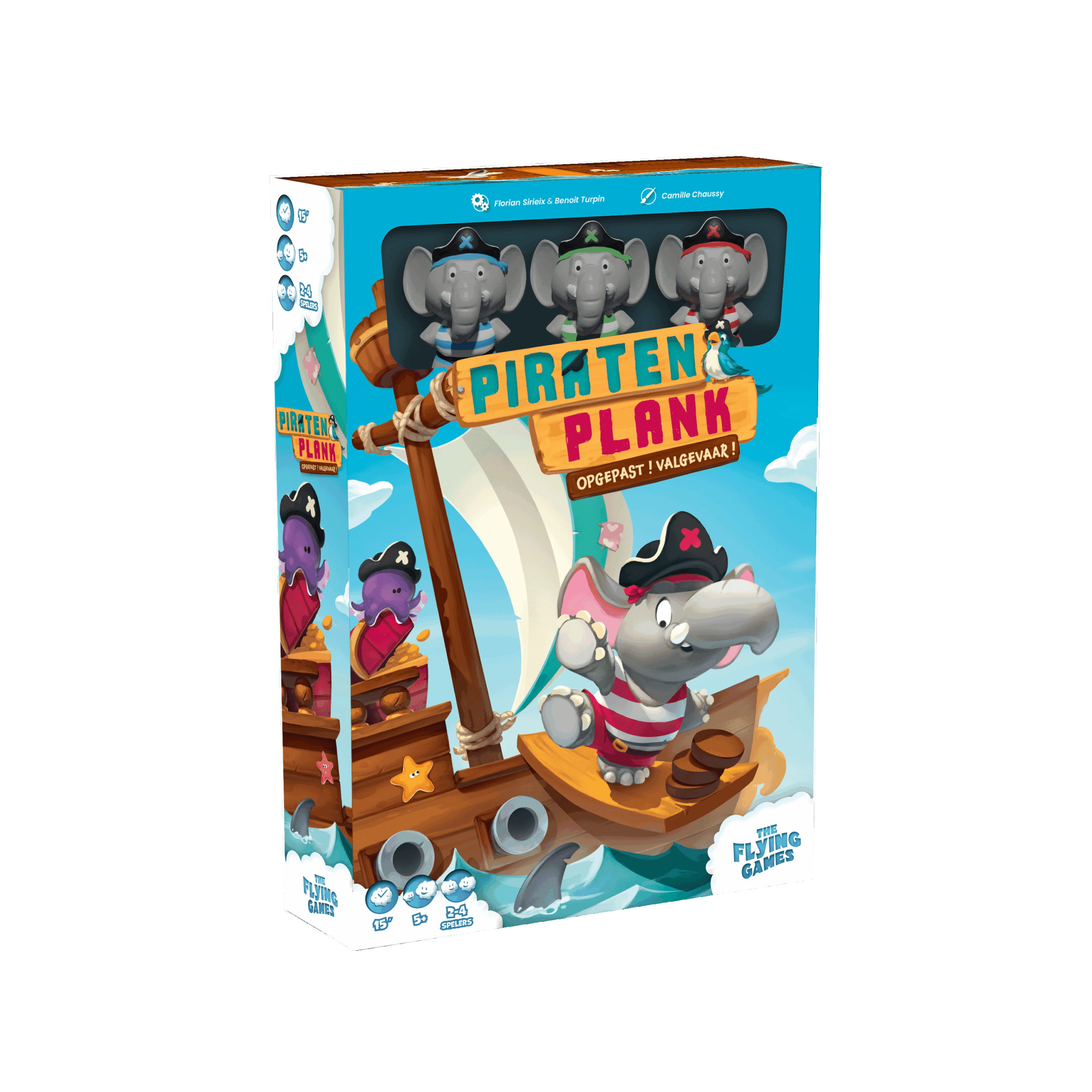

Opgepast, valgevaar! Doorzoek de schatkist van de kapitein en probeer als eerste de schat te plunderen, óf ervoor te zorgen dat je tegenstander(s) in zee vallen.
Piratenplank is een spel voor kinderen vanaf 5 jaar. Wat wij ervan vinden? Dat lees je in deze review.
Piratenplank – Een eerste kennismaking
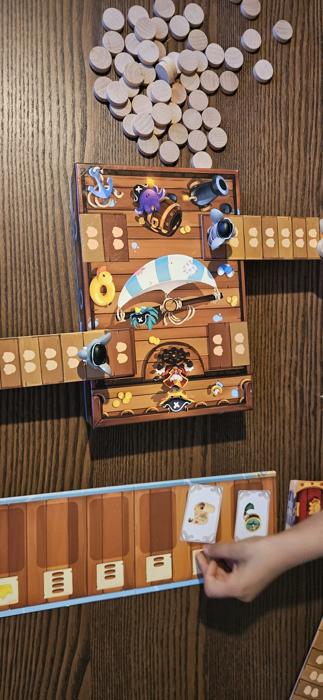
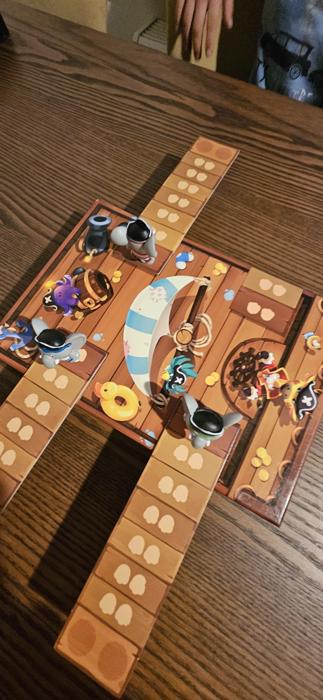
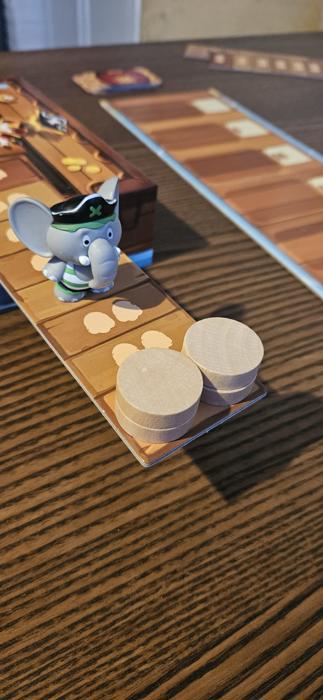
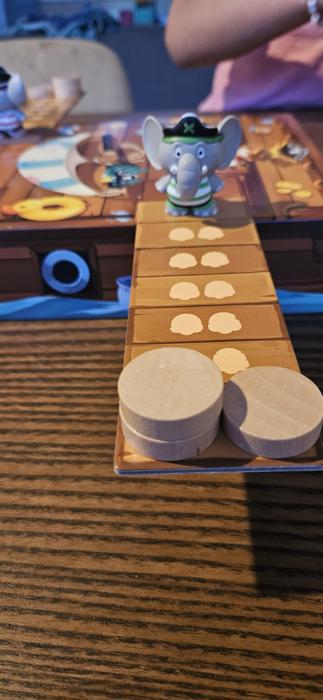
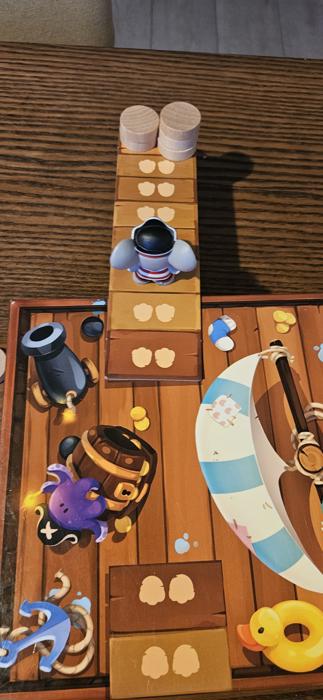
Piratenplank ziet er fantastisch uit. De doos heeft prachtig artwork én is onderdeel van het spel. Wanneer je de onderkant van de doos omdraait, heb je namelijk meteen de boot waarop gespeeld wordt. De olifanten, oftewel de spelfiguren, zijn gemaakt van stevig materiaal en zeer gedetailleerd uitgevoerd. Ook de loopplanken zijn stevig en voorzien van magneten. Daarover later meer. Gezien de fantastische uitvoering van het spel vallen de houten schijfjes een beetje op door hun ‘simpelheid’. Toch is dat wat mij betreft geen probleem en zeker geen punt om over te vallen.
De spelregels zijn extreem eenvoudig. Op de doos staat 5+, maar ik denk dat je dit spel prima met 4-jarigen kunt spelen. Heb je een pientere 3-jarige? Dan kan die misschien ook wel meespelen. Ook het klaarzetten is zo gebeurd, dus na nog geen 5 minuten voorbereiden kun je beginnen met spelen.
Hoe wordt het gespeeld?
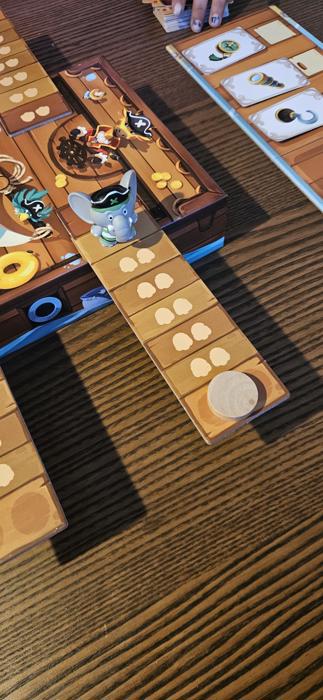
Ter voorbereiding haal je de insert uit de doos en plaats je de doos ondersteboven op tafel. Vervolgens worden alle loopplanken aan de boot ‘bevestigd’. Ze zitten niet daadwerkelijk vast; zowel de loopplanken als de boot bevatten magneetjes, waardoor ze netjes op hun plek blijven.
Iedere speler kiest een olifant naar keuze en plaatst deze aan het begin van één van de loopplanken.
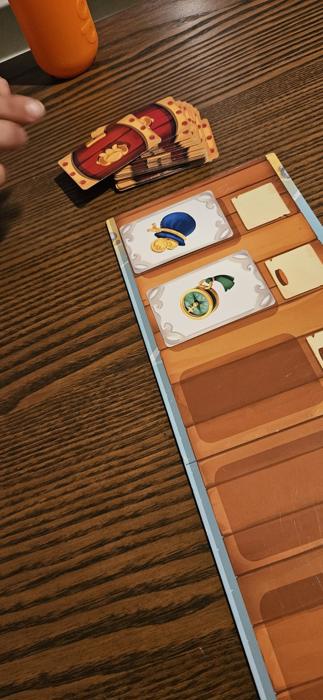
Op een plek waar iedereen er goed bij kan, wordt vervolgens het pontonbord geplaatst, met daarnaast de schatkaarten.
De speler die aan de beurt is, mag nu één voor één schatkaarten omdraaien en op het pontonbord leggen. Na iedere kaart mag de speler beslissen: stop ik, of ga ik door?
Besluit je te stoppen, dan staat boven de laatst gedraaide kaart aangegeven hoeveel houten schijfjes de andere spelers op hun loopplank moeten leggen. Maar let op: wanneer een speler twee dezelfde schatten achter elkaar omdraait, is hij betrapt! Zijn eigen olifant moet dan een stapje naar voren op de loopplank.
In het uitzonderlijke geval dat het een speler lukt om zes verschillende schatten op het pontonbord open te draaien, wint hij onmiddellijk.
Maar uiteindelijk draait alles om één ding: zorg dat jouw olifant niet in zee valt. Want zodra dat gebeurt, heb je verloren.
Wat vinden wij van Piratenplank?
Wat mij betreft is Piratenplank een perfect kleuterspel. Zoals eerder gezegd, kun je dit spel prima vanaf een jaar of 4 spelen. Toch is het absoluut niet zo’n spel dat alleen voor kinderen leuk is. Ook volwassenen spelen graag mee.
Een potje duurt ongeveer 10 minuten, wat gezien de korte spanningsboog van jonge kinderen ideaal is. En dankzij het prachtige artwork voelt het ook echt alsof je met elkaar op een boot op zee zit, met een stel olifant-piraten. Dat werkt bij kinderen ontzettend goed.
Hier thuis wordt Piratenplank dan ook erg graag gespeeld. Het is bovendien een spel dat gemakkelijk uit de kast wordt gehaald om bijvoorbeeld met oma of een vriendinnetje te spelen. De regels zijn namelijk zo eenvoudig dat iedereen ze begrijpt, ook mensen die (bijna) nooit spellen spelen.
En dat zorgt voor de nodige hilariteit. Een olifant die van de plank valt, levert steevast gelach op. Tegelijkertijd is er de frustratie wanneer je tweede kaart meteen dezelfde schat laat zien als de eerste. Piratenplank weet daarmee precies de juiste snaar te raken bij jonge spelers.
Er is echter één ding dat ik jammer vind aan Piratenplank: het is eigenlijk een ‘Single Loser Game’. Dat wil zeggen dat één speler verliest en de rest wint.
Hoewel ik persoonlijk ook niet per se fan ben van eliminatie, kan het bij Piratenplank prima. Het spel is daar namelijk kort genoeg voor. Thuis spelen we daarom meestal gewoon door totdat er nog één olifant over is. Die speler is dan de winnaar.
Conclusie
Piratenplank krijgt van mij een 8/10. Simpelweg omdat het eigenlijk (bijna) alles goed doet: prachtig artwork, origineel gebruik van de materialen, eenvoudige spelregels, snel te spelen en geschikt voor vrijwel iedereen.
Het is een écht kinderspel, maar tegelijkertijd eentje waar volwassenen met plezier aan meedoen. En dat vind ik misschien wel de grootste kracht van Piratenplank.

Stomp the Plank
Players: 2-4
Time: 15 minutes
Age: 5+ (4+)
Author: Florian Sirieix, Benoit Turpin
Publisher: The Flying Games
Year: 2022
Watch out, falling hazard! Search the captain’s treasure chest and try to be the first to plunder the treasure, or make sure your opponent(s) fall into the sea.
Stomp the Plank is a game for children aged 5 and up. What do we think of it? You can read it in this review.
Stomp the Plank – A First Look
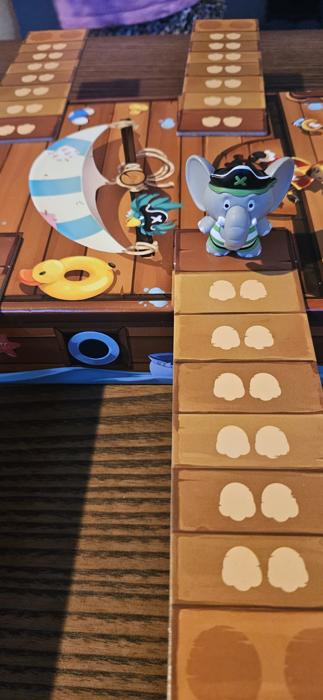
Stomp the Plank looks fantastic. The box features beautiful artwork and is also part of the game itself. When you turn the bottom of the box upside down, you immediately have the boat on which the game is played. The elephants, which serve as the playing pieces, are made of sturdy material and are very detailed. The planks are also sturdy and equipped with magnets. More on that later. Considering the fantastic production quality of the game, the wooden discs stand out a little because of their ‘simplicity’. Still, I don’t see that as a problem, and it’s certainly nothing to fall over.
The rules are extremely simple. The box says 5+, but I think you can easily play this game with 4-year-olds. Have you got a clever 3-year-old? They might even be able to join in. Setting up the game is also incredibly quick, so you can start playing after less than 5 minutes of preparation.
How is it played?
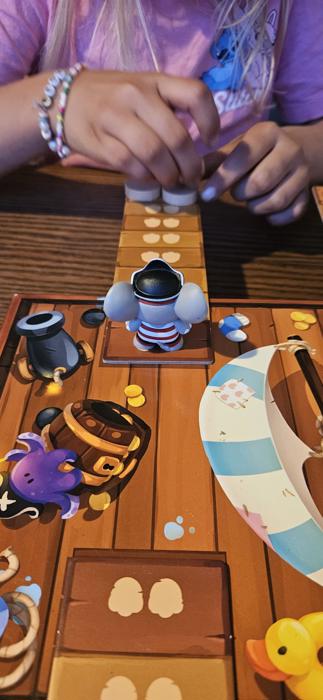
To set up the game, remove the insert from the box and place the box upside down on the table. Next, all the planks are ‘attached’ to the boat. They aren’t actually fixed in place; both the planks and the boat contain magnets, which keep them neatly in position.
Each player chooses an elephant and places it at the beginning of one of the planks.
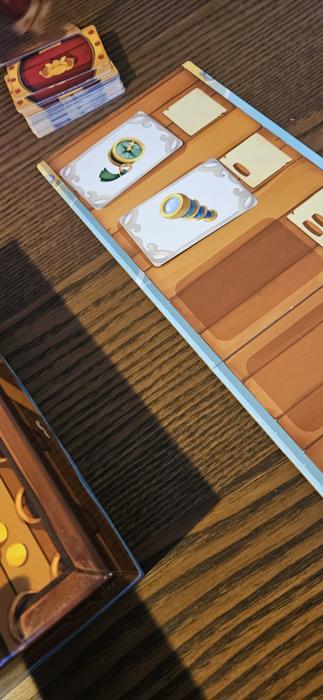
The pontoon board is then placed somewhere within easy reach of everyone, with the treasure cards next to it.
The player whose turn it is may now turn over treasure cards one at a time and place them on the pontoon board. After each card, the player gets to decide: do I stop, or do I keep going?
If you decide to stop, the number above the last card you turned over indicates how many wooden discs the other players have to place on their planks. But watch out: if a player turns over two identical treasures in a row, they have been caught! Their own elephant must then move one step forward on the plank.
In the unlikely event that a player manages to reveal six different treasures on the pontoon board, they win immediately.
But ultimately, it all comes down to one thing: make sure your elephant doesn’t fall into the sea. Because as soon as that happens, you lose.
What do we think of Stomp the Plank?
In my opinion, Stomp the Plank is the perfect preschool game. As mentioned earlier, you can easily play this game from around the age of 4. Yet it is definitely not the kind of game that is only fun for children. Adults are happy to join in as well.
A game takes about 10 minutes, which is ideal considering the short attention span of young children. And thanks to the beautiful artwork, it really feels like you’re on a boat at sea together, surrounded by a bunch of elephant pirates. That works incredibly well with children.
Stomp the Plank is a game that gets played a lot in our home. It’s also a game that can easily be brought out to play with grandma or a friend. The rules are so simple that everyone understands them, including people who rarely or never play games.
And that leads to plenty of hilarity. An elephant falling off the plank consistently results in laughter. At the same time, there’s the frustration when your second card immediately shows the same treasure as the first. Stomp the Plank really knows how to hit the right note with young players.
There is one thing I do find unfortunate about Stomp the Plank: it is essentially a ‘Single Loser Game’. In other words, one player loses and everyone else wins.
Although I’m personally not a big fan of elimination either, it works perfectly well in Stomp the Plank. The game is simply short enough for it not to be a problem. At home, we usually just keep playing until there is only one elephant left. That player is then the winner.
Conclusion
Stomp the Plank gets an 8/10 from me. Simply because it gets (almost) everything right: beautiful artwork, creative use of the components, simple rules, quick to play, and suitable for almost everyone.
It’s a genuine children’s game, while at the same time being one that adults are happy to play along with. And that might just be Stomp the Plank’s greatest strength.