

Aantal spelers: 2-5
Speelduur: 60-90 minuten
Leeftijd: 12+
Uitgever: Phoenix Forge Press
Jaar: 2026
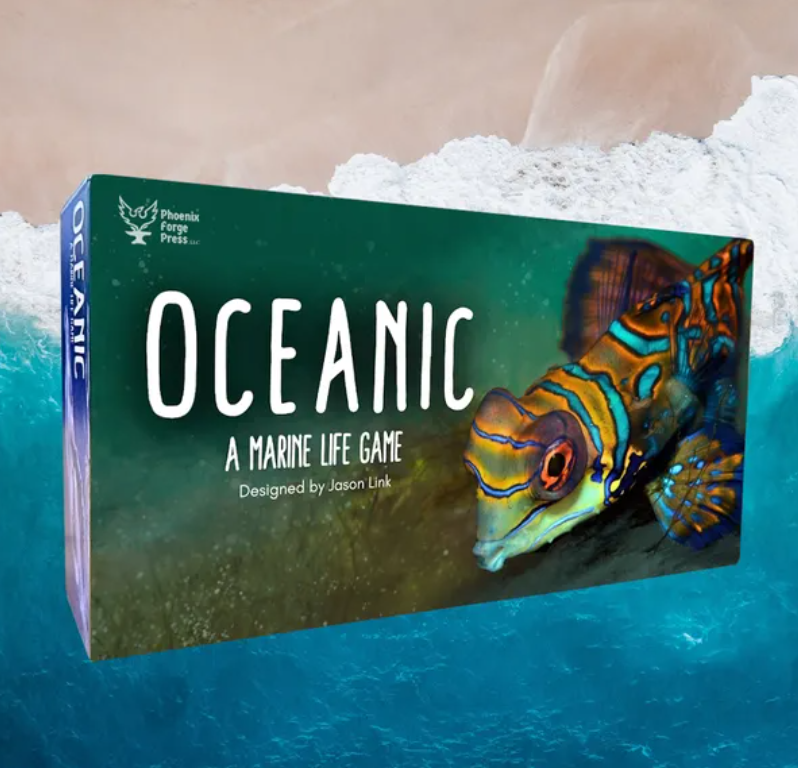

We kennen allemaal wel het gevoel waarbij je weet dat je potentieel een enorm leuk spel hebt gekickstart of gecrowdfund en je verwachtingsvol je brievenbus of je mailbox in de gaten houdt voor verzendupdates. Maar soms, heel soms, heb je het geluk dat wachten niet hoeft. Wanneer het bloed kruipt wanneer het niet gaan kan en een uitgever het je gunt om een spel uit te proberen, vind je jezelf zomaar achter een snijmachine om een print en play exemplaar te maken van een spel waar je hoge verwachtingen van hebt! Zo geschiedde bij Oceanic. Een spel dat zichzelf omschrijft als: ”A cozy-but-crunchy Euro-style tabletop game about exploring and preserving”. Aan mij de eer om na al mijn knip en plakwerk eens te gaan bekijken of het dit ook echt is! Zin in!
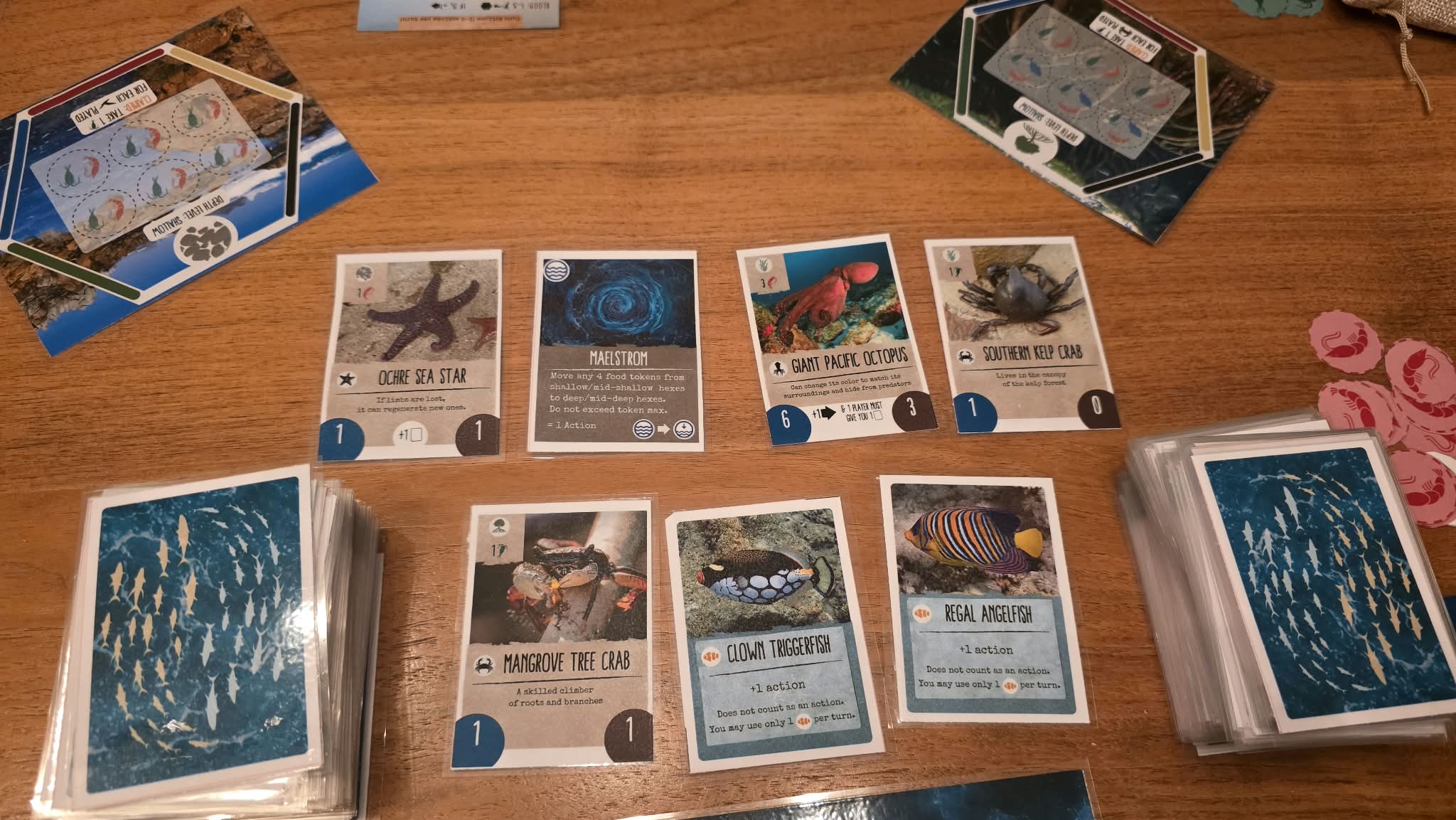
Over cozy zijn we het zo eens. Lees: het maken van 200 kaarten werd me erg leuk gemaakt door de prachtige vissen en waterdieren die mij tegemoet kwamen. De vormgeving is een feestje voor dierenliefhebbers, fans van natuurspellen en tableau builders. Want al deze pracht komt straks op tafel te liggen! Voor de vormgeving hoef je het dus zeker niet te laten wanneer je dit spel straks op de kickstart-platforms en in de winkels ziet verschijnen.
Maar, is het dan ook crunchy vragen we ons af? Jazeker! Niet te meer omdat ik na het spelen kan concluderen dat je elkaar bij dit spel lekker in de weg kan zitten: lees, grondstoffen zijn gezamenlijk bezit en kunnen dus zomaar naar een andere locatie of speler gaan en de kaarten die je speelt kunnen zomaar vooral voordelig zijn voor je medespelers. Zo liefelijk als het er uit ziet, is het spel dus allerminst.
Maaaar, door het wisselende getij ben je soms ook enorm beperkt in mogelijke acties, waardoor het spel ook crunchy te noemen is. Ik en mijn testpersonen kwamen er niet goed uit of dit nou een goed iets is en dit het ogenschijnlijk eenvoudige spel een breinbreker maakt, of dat het wisselende getij een te grote rem is op acties en het spel hierdoor lam legt. Oordeel zelf:
Hoe wordt het gespeeld?
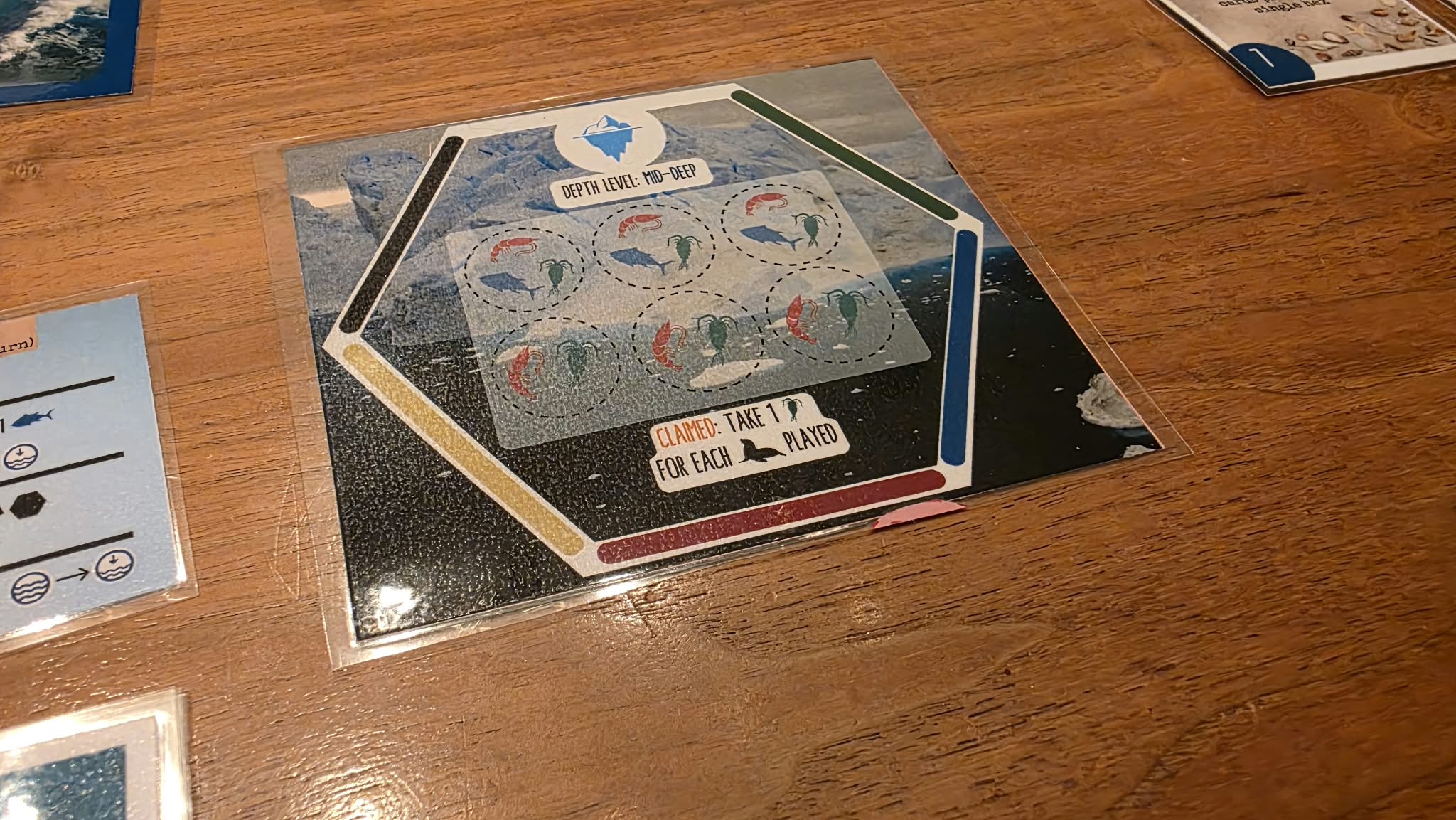
De basis is simpel het spel bestaat uit een zevental biomes die de diepte van de zee representeren. In elke diepte leven andere soorten dieren. De biomes zijn hexagonvormig waarbij elke speler een zijde krijgt om kaarten te spelen die bij dat biome horen. In de hexagon is ruimte voor voedsel van verschillende waardes, die je in je acties gaat verzamelen, opwaarderen, verplaatsen. Je begrijpt, dit voedsel heb je nodig om je kaarten te kunnen spelen.
De kaarten die je speelt hebben verschillende waardes, en kunnen extra acties opleveren. Ook probeer je biomes te bezitten/domineren zodat je aan het einde van het spel ook punten kan scoren met de kaarten die je medespelers hier hebben gespeeld.
Tegelijkertijd werk je aan gemeenschappelijke doelen (die je wel eerst moet unlocken) en heb je persoonlijke doelen in je hand, die je gedurende het spel ook nog kunt bijkopen.
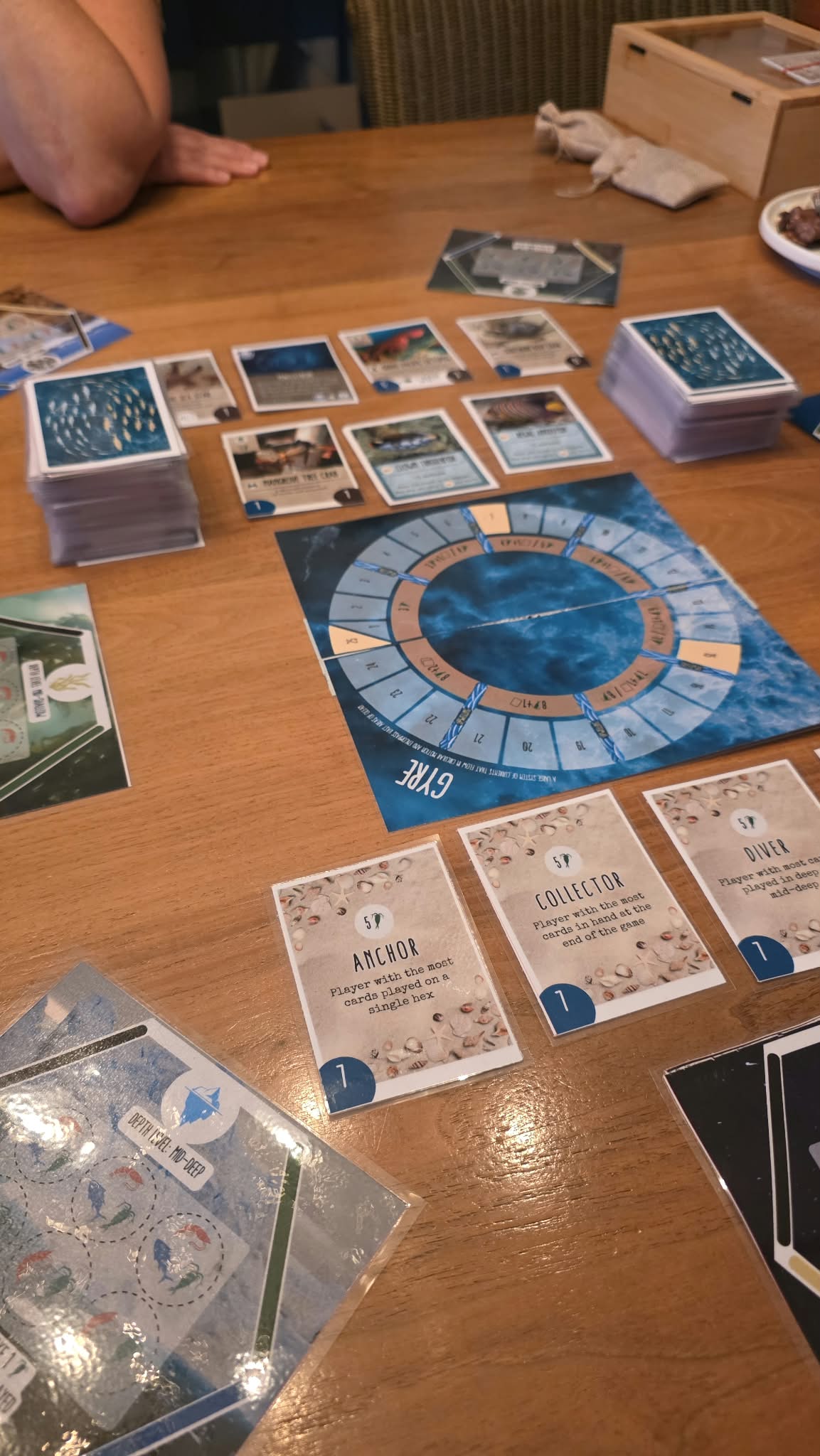
Tijdens het spel leveren sommige acties je stapjes op het zogeheten Gyre-track op, die bij rondewissels zorgt voor nieuwe handkaarten en inkomsten. Een ronde is afgelopen wanneer alle spelers zijn gepast en die ronde geen beurten meer kunnen doen.
Dat je soms moet passen en geen beurten meer kan doen, komt simpelweg omdat bijvoorbeeld je persoonlijke voedselvoorraad op is, je geen handkaarten meer hebt, of je getij niet op de juiste zijde ligt.
In je beurt mag je twee van de beschikbare acties spelen.
Bloom: Plankton vanuit je persoonlijke voorraad naar een van de biomes verplaatsen
Feed: Voedseltokens op de hexagons converteren. Plankton wordt krill of krill wordt vis (optioneel mag je 1 plaats vooruit op de Gyre track, maar moet je getij kaart naar eb.)
Relocate: Voedseltokens wisselen van biome (Je getij kaart moet naar eb).
Fission: Je mag plankton uit de voorraad pakken voor je eigen supply. (Je getij kaart moet naar eb).
Play a card: Speel een kaart in een biome (mits het juiste voedsel in het biome aanwezig is)
Draw a card: Betaal twee plankton voor een kaart of drie plankton voor een Objective card
Discover: Betaal om een gezamenlijk doel te unlocken (er liggen meer doelen dan er unlocked mogen worden en alleen unlockte delen worden geteld).
Wanneer een nieuwe ronde start mag je getijkaart weer van eb naar vloed. Wanneer iemand het einde van die gyre-track heeft bereikt in zijn beurt is het spel afgelopen. De ronde wordt nog wel afgemaakt. De speler met de meeste punten wint.
Wat vind ik er van?
Dit spel heeft álle elementen om helemaal een spel in mijn straatje te kunnen zijn. Veel spellen waar er gebouwd wordt aan biomes zijn individueletableau builders die erg gericht zijn op je eigen spel en je eigen tableau, met maar weinig spelersinteractie. De crunchy-ness zit in dit spel echt in de gezamenlijke noemer. Je bouwt dan wel aan je eigen punten maar in gezamenlijk biomes en dús hebben jouw acties consequenties (en punten!) voor anderen. Persoonlijk vind ik dat erg leuk!
Er lijkt wel wat disbalans te zitten in de acties. In de basis mag je maar twee acties doen per beurt, zo lang als de ronde loopt. Tijdens die beurten is er een vrij grote kans dat één van je acties je getij van vloed naar eb laat veranderen. Iets wat een aantal belangrijke acties die je in elke ronde wel een keer wilt doen uitsluit. Dit maakt het spel soms wat traag, het haalt de vaart er uit en voelt als onevenwichtig veel weerstand. De kaarten die als actie hebben om tijdens je ronde je getij weer naar vloed te krijgen zijn beperkt.
Daarnaast zijn de leukste acties een soort drietrapsraket. Voedsel plaatsen, deze laten upgraden naar het juiste voedsel dat je nodig hébt en dan daarmee een kaart spelen. Doordat je in de basis maar twee acties mag doen, lukt dit bijna nooit en kun je er vergif op innemen dat een medespeler tijdens jouw beurt je geüpgrade voedsel gebruikt voor zijn of haar kaarten. Het enige wat hier tegen bestand is, is het spelen van een tropische vis, de je een extra actie geeft, maar ook deze zijn beperkt. Je moet dan dus maar hopen dat een medespeler ook leuk voedsel voor jou in de biomes achter laat.
Voor de mensen die wat minder van de push you luck spellen zijn, kunnen de pest-acties op kaarten ook zorgen voor te veel weerstand. Een aantal potjes was het steeds één speler die de kaarten bemachtigde die zorgden dat er voedsel gestolen kon worden bij medespelers, danwel hen dwong voedsel af te leggen, wat hen voor die ronde zo goed als lam legde. De enige optie als je voedsel nodig hebt is dan de Fission actie, maar ja, dat legt dat ook meteen weer je getijkaart op eb.
Al met al bekroop mij daardoor steeds het gevoel dat het spel soms wat uit balans is. Je moet echt van de weerstand en pestacties houden om van dit spel te kunnen genieten. Wanneer weerstand je teveel frustreert en je liever gewoon vredig aan je eigen biome bouwt, dan is dit spel niet voor jou.
Ik ben wel een beetje bevooroordeeld, want ik hou wel van een beetje pesten en dat beetje crunch, maar was dan ook de gene die alle potjes steeds op alle pestkaarten jaagde, waardoor het een vrij aanvallend spel werd. Dat moet je echt liggen. Ik heb menig medespeler hier enorm mee gefrustreerd.
Voor mijzelf blijft dan enkel de getij-kaart over als struikelblok. Dit spel had van mij een hele vette 8 gehad, wanneer deze minder beperkend of als rem had gewerkt. Dit spel leent zich in de toekomst prima voor uitbreidingen, dus ik stel voor dat die de balans een beetje rechttrekt.

Oceanic
Players: 2-5
Time: 60-90 minutes
Age: 12+
Publisher: Phoenix Forge Press
Year: 2026
We all know that feeling when you know you’ve potentially backed an incredibly fun game on Kickstarter or another crowdfunding platform, and you keep an eager eye on your mailbox or inbox for shipping updates. But sometimes—just sometimes—you’re lucky enough not to have to wait. When you simply can’t resist and a publisher is kind enough to let you try a game early, you may suddenly find yourself behind a paper cutter, putting together a print-and-play copy of a game you have high expectations for! And that’s exactly what happened with Oceanic. A game that describes itself as “A cozy-but-crunchy Euro-style tabletop game about exploring and preserving.” After all my cutting and gluing, I had the honor of finding out whether it really lives up to that description. I was excited!
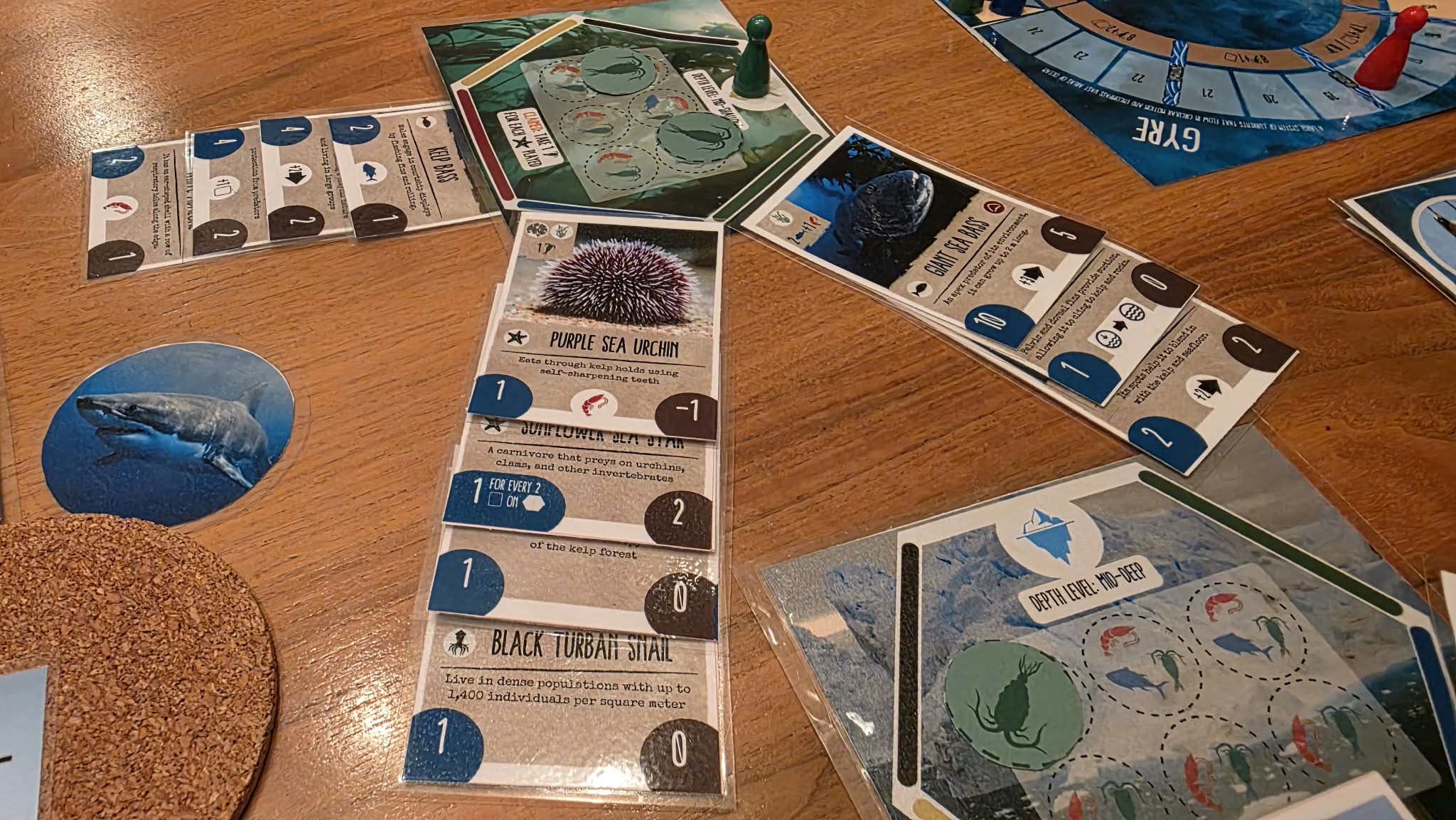
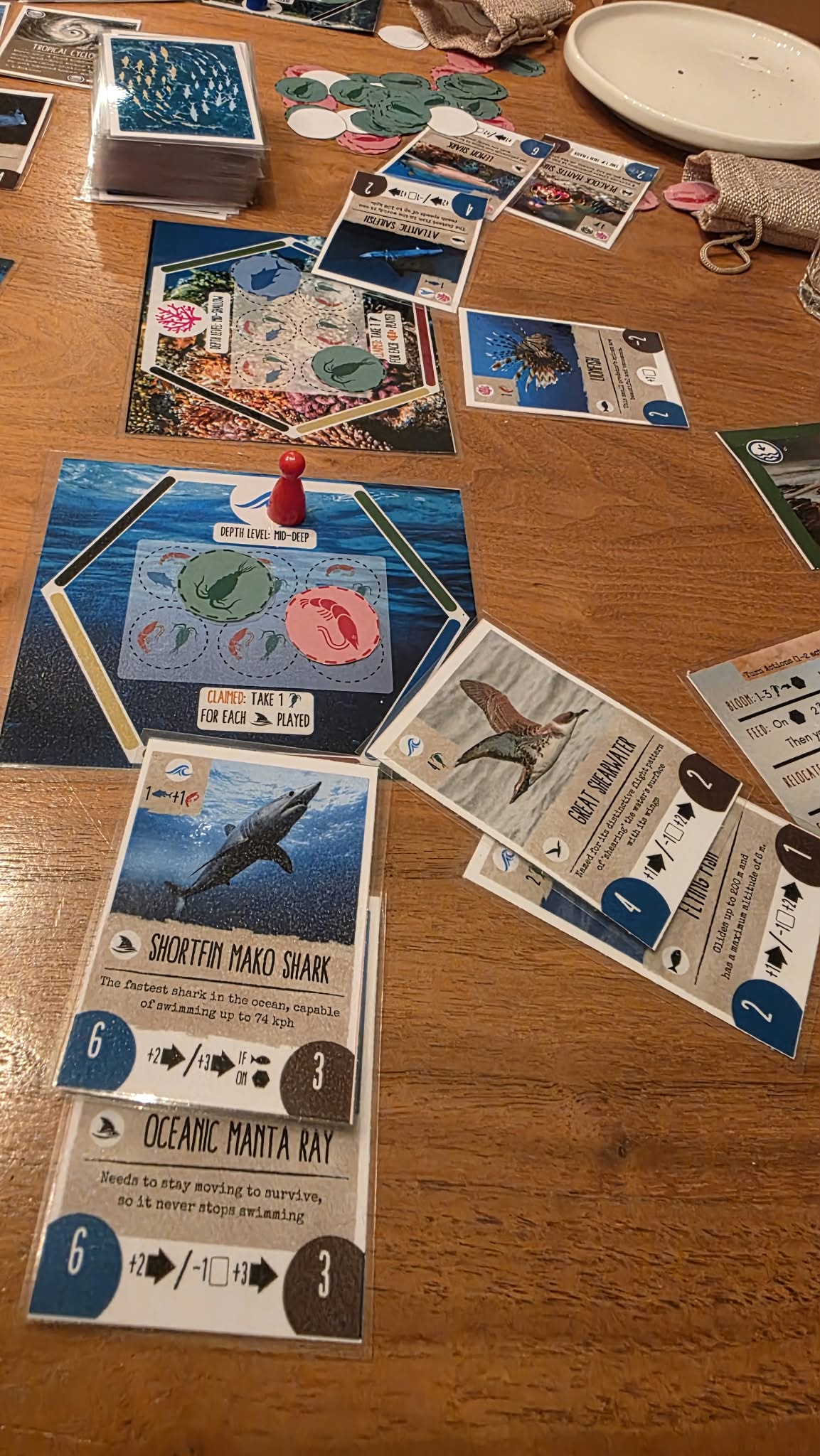
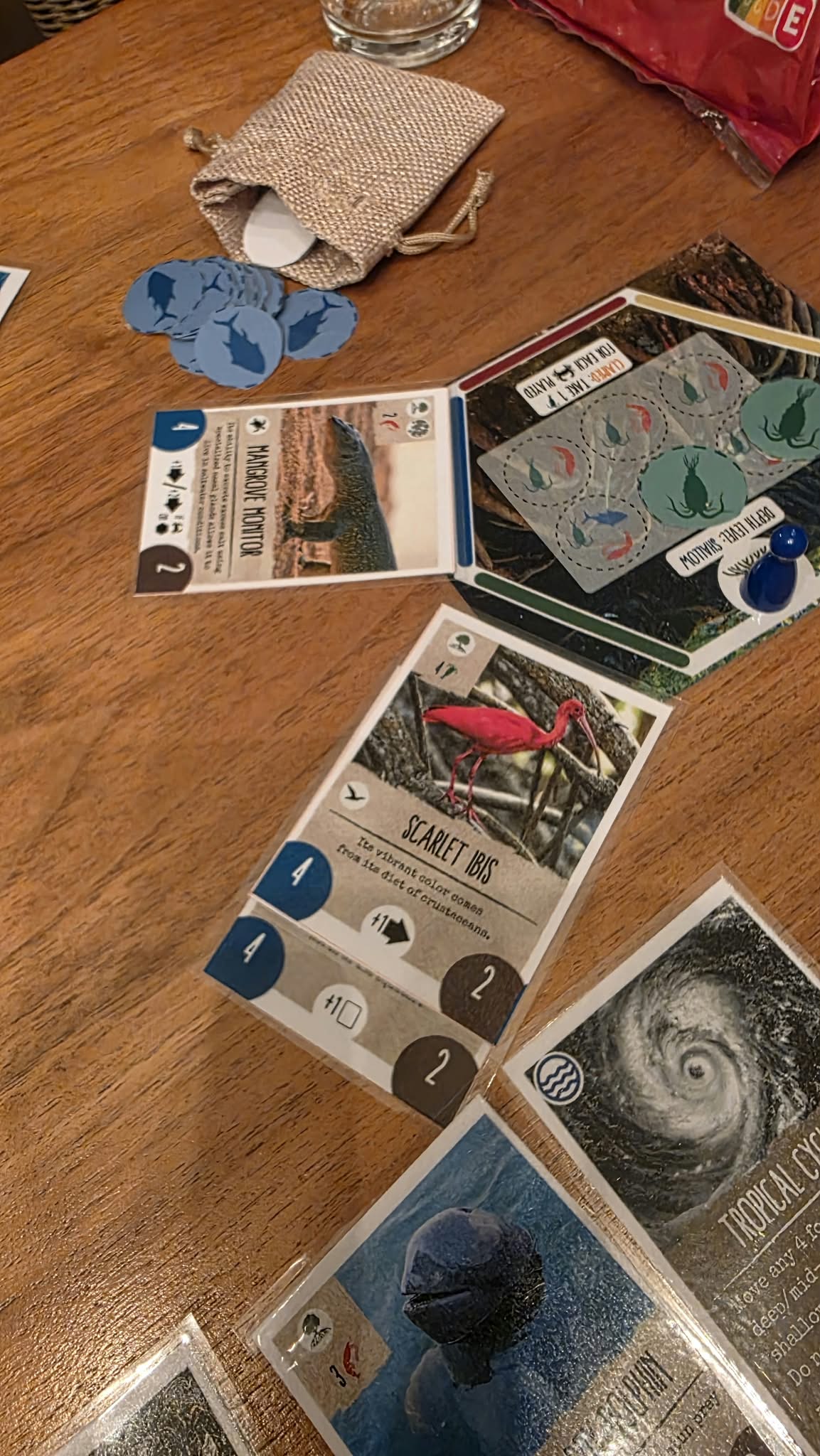
We can agree on the cozy part right away. Case in point: making 200 cards was actually made surprisingly enjoyable by all the gorgeous fish and aquatic animals staring back at me. The artwork is a treat for animal lovers, fans of nature-themed games, and tableau builders. After all, all of this beauty will eventually end up on your table! So the artwork certainly won’t be a reason to pass on this game once it starts appearing on crowdfunding platforms and in stores.
But is it crunchy too, you ask? Absolutely! Not least because, after playing it, I can conclude that you can really get in each other’s way. Resources are shared, which means they can suddenly move to another location or player, and the cards you play may sometimes benefit your opponents more than they benefit you. So despite its sweet and charming appearance, the game itself is anything but gentle.
But the changing tide can also severely limit your possible actions, which adds another kind of crunch. My playtesters and I couldn’t quite decide whether that’s a good thing—turning an apparently straightforward game into a real brain burner—or whether the changing tide puts too much of a brake on your actions and causes the game to grind to a halt. Judge for yourself:
How does it play?
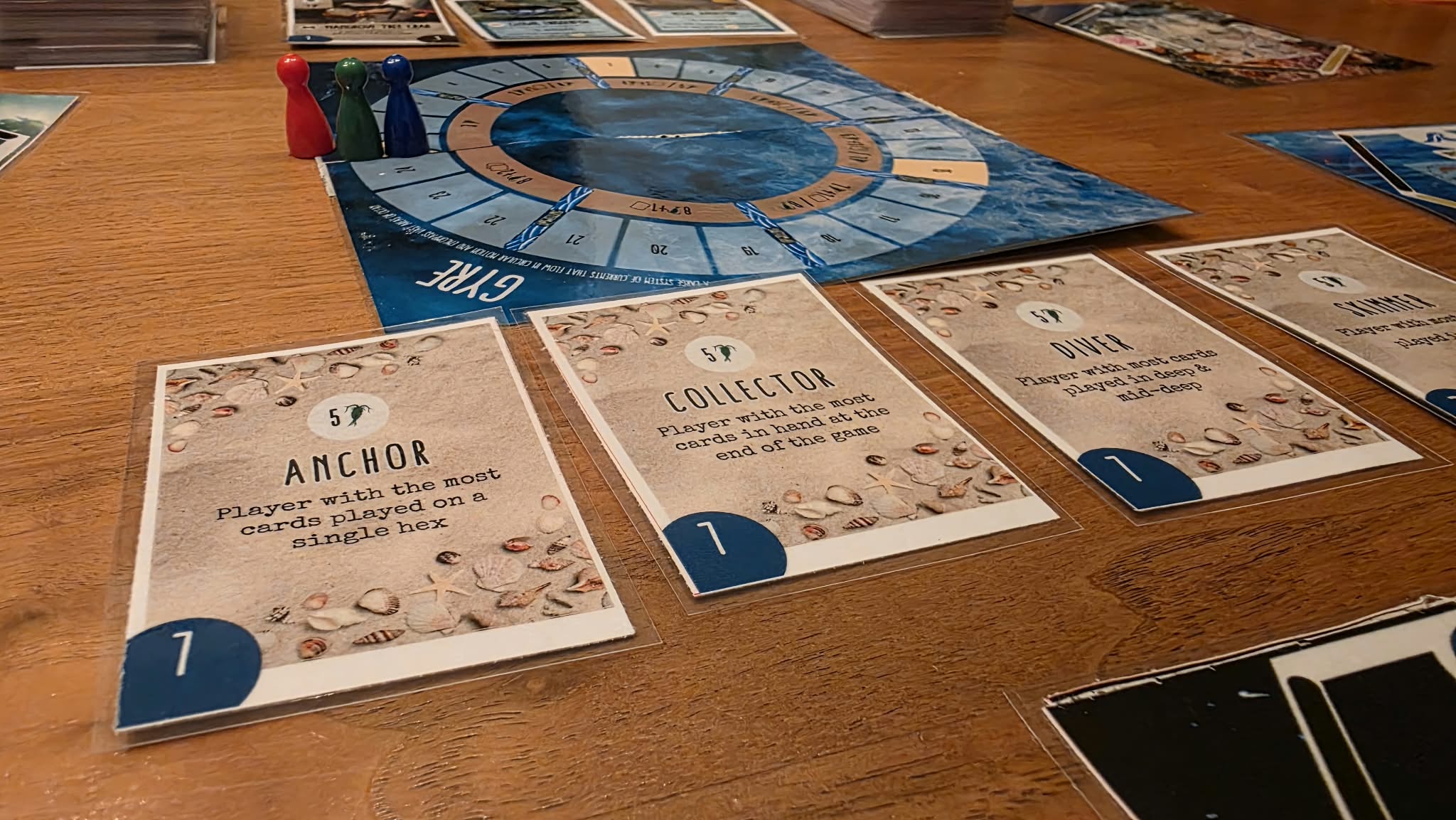
The basic concept is simple. The game consists of seven biomes representing different depths of the ocean. Different types of animals live at each depth. The biomes are hexagonal, with each player assigned one side where they can play cards belonging to that biome. Inside each hexagon is space for food of different values, which you’ll collect, upgrade, and move through your actions. As you can probably guess, you need this food to play your cards.
The cards you play have different values and can provide additional actions. You’ll also try to control or dominate biomes so that, at the end of the game, you can score points from cards your opponents have played there as well.
At the same time, you’ll work toward shared objectives—which first have to be unlocked—and you’ll have personal objectives in your hand, with opportunities to acquire additional ones during the game.
During play, some actions move you forward on the so-called Gyre track, which provides new cards and income between rounds. A round ends once all players have passed and can no longer take turns during that round.
Sometimes you’ll be forced to pass because, for example, your personal food supply is empty, you have no cards left in your hand, or your tide card isn’t showing the correct side.
On your turn, you may take two of the available actions.
Bloom → Move plankton from your personal supply to one of the biomes.
Feed → Convert food tokens on the hexagons. Plankton becomes krill, or krill becomes fish. Optionally, you may move one space forward on the Gyre track, but you must turn your tide card to low tide.
Relocate → Move food tokens from one biome to another. Your tide card must be turned to low tide.
Fission → Take plankton from the general supply and add it to your personal supply. Your tide card must be turned to low tide.
Play a Card → Play a card into a biome, provided the required food is present in that biome.
Draw a Card → Pay two plankton to draw a card, or three plankton to draw an Objective card.
Discover → Pay to unlock a shared objective. There are more objectives available than can actually be unlocked, and only unlocked objectives count toward scoring.
When a new round begins, you may flip your tide card from low tide back to high tide. When someone reaches the end of the Gyre track during their turn, the end of the game is triggered. The current round is still completed, after which the player with the most points wins.
What do I think?
This game has all the ingredients to be exactly my kind of game. Many games in which you build biomes are individual tableau builders that focus heavily on your own game and your own tableau, with very little player interaction. In Oceanic, the crunchiness really comes from the shared elements. You may be building toward your own points, but you’re doing so in shared biomes, which means your actions have consequences—and can score points—for other players too. Personally, I really enjoy that!
There does seem to be some imbalance between the actions. At its core, you can only take two actions per turn for as long as the round continues. During those turns, there’s a fairly high chance that one of your actions will force your tide from high tide to low tide. This then locks you out of several important actions that you’ll probably want to take at least once every round. At times, this makes the game feel slow, takes away its momentum, and creates what feels like a disproportionate amount of resistance. There are only a limited number of cards that allow you to flip your tide back to high tide during a round.
On top of that, the most satisfying actions are essentially a three-step process: place food, upgrade it into the type of food you actually need, and then use it to play a card. Since you normally only have two actions on your turn, you can almost never complete the entire sequence at once. And you can practically guarantee that one of your opponents will use your freshly upgraded food for one of their own cards before your next turn. The only real way around this is to play a tropical fish that gives you an extra action, but those are limited too. So you’re left hoping that your opponents will also be kind enough to leave some useful food behind in the biomes for you.
For players who are less fond of push-your-luck games, the take-that effects on the cards may create too much resistance as well. In several of our games, one player repeatedly managed to acquire the cards that allowed them either to steal food from other players or force them to discard food, effectively crippling those players for the rest of the round. If you need food, your only option at that point is the Fission action—but, of course, that immediately turns your tide card back to low tide again.
All in all, this repeatedly left me with the feeling that the game can be somewhat unbalanced. You really have to enjoy resistance and take-that mechanics to get the most out of this game. If that kind of interference frustrates you and you’d rather peacefully build your own biome, this probably isn’t the game for you.
I’m a little biased, though, because I do enjoy messing with my opponents and I like a bit of crunch. In fact, I was the one who spent every game hunting down all the take-that cards, which turned our sessions into fairly aggressive affairs. You really have to enjoy that style of play. I managed to frustrate quite a few of my fellow players with it.
For me personally, that leaves the tide card as the main stumbling block. I would have happily given this game a big, enthusiastic 8 if the tide mechanism had been less restrictive and hadn’t acted as such a brake on the gameplay. Oceanic seems like a game with plenty of room for expansions in the future, so my suggestion would be to use one of those to smooth out the balance a little.