

Aantal spelers: 2-4
Speelduur: 20-30 minuten
Leeftijd: Vanaf 8 jaar
Auteur: Johannes Goupy
Uitgever: Funnyfox
Jaar: 2022


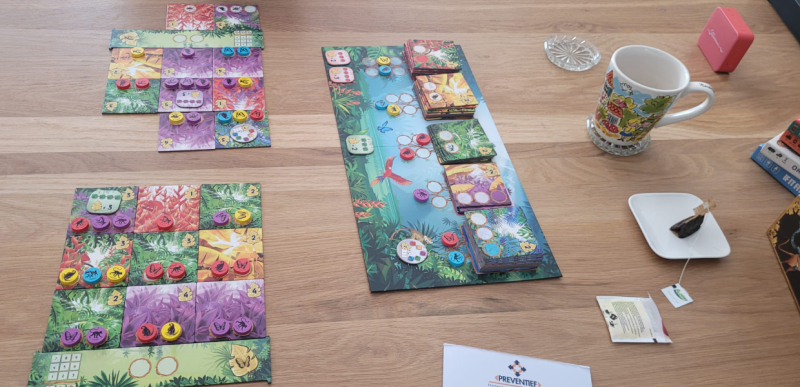
In Rainforest verzamelen je vierkante jungletegels in verschillende kleuren die je in een grid van 3×3 neer moet zien te leggen. Je speelt dus in totaal 9 tegels. Dit kan wanneer je de tegels voorziet van genoeg én de juiste dierenfiches. Door het bouwen van dat grid scoor je ook nog punten wanneer je bepaalde reeksen met je jungletegels weet te maken en wanneer je alle kleuren weet te verzamelen. Ook krijg je extra punten voor elk dierenfiche waar jouw bonusdier op staat. Deze wordt vooraf bepaald. Wanneer iemand zijn grid vol heeft weten te leggen, stopt het spel niet direct. De ronde wordt afgemaakt zodat iedereen evenveel beurten heeft gehad. De speler met de meeste punten wint. Dit is niet per se de speler die als eerste zijn grid vol heeft, want hier krijg je geen bonus voor. Wanneer je buurman betere reeksen heeft gemaakt met duurdere jungletegels en meer fiches van zijn bonusdier, kun je ondanks dat je al eerste klaar was, toch nog het nakijken hebben. Houd je tegenstander dus ook in de gaten.
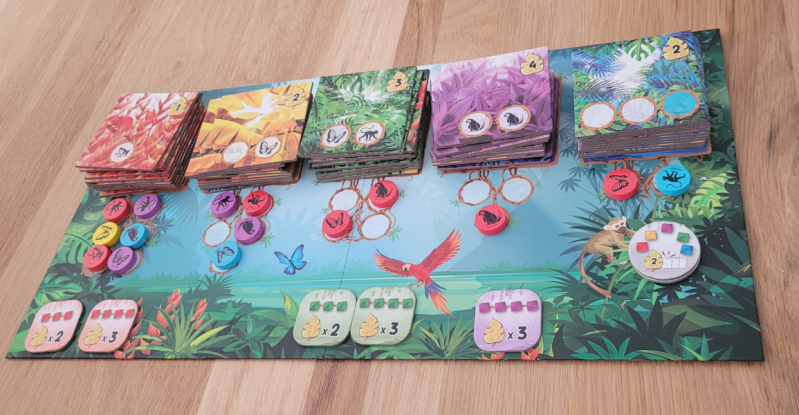
Klinkt simpel, nietwaar? Echter, er zijn wat addertjes onder het gras, waardoor je goed moet nadenken en plannen. Er bestaan jungletegels in de kleuren Rood, Geel, Groen, Paars en Blauw. Deze tegels liggen in een open stapel gesorteerd per kleur naast elkaar klaar. De bovenste tegel van de stapel is de tegel die beschikbaar is om te pakken. Sommige tegels bestaan uit meerdere kleuren jungle. In het spel tellen die voor beide kleuren, wat het makkelijker maakt om sneller en meer reeksen te maken. Elke beurt pak je de bovenste tegel van de kleur naar keuze. Deze tegel verplaats je niet meteen naar het grid. Je moet de tegel eerst in je voorraad leggen. Dit kan met maximaal 3 tegels, dus je moet zorgen dat je in je derde beurt een jungletegel af hebt om naar het grid te verplaatsen om in de volgende beurt je gekozen tegel niet weg te hoeven gooien wegens plaatsgebrek. Je mág ook, en wanneer je al 3 tegels in je voorraad hebt móet dit dus, je kaart weer onderop de stapel leggen van de betreffende kleur. Dit mag maar drie keer per persoon per potje. In beide gevallen mag je wel kiezen uit de dierenfiches die bij de stapel liggen en die je nodig hebt om de jungletegels te vullen, zodat je ze naar het grid mag verplaatsen.
Op alle jungletegels staan namelijk een aantal rondjes. Op de rondjes moeten dierenfiches komen te liggen. Deze dierenfiches liggen in voorraad bij elke stapel jungletegels. Je mag dierenfiches pakken uit de voorraad bij de stapel jungletegels waaruit je zojuist hebt gekozen. Je zult zien dat bij elke stapel een ander aantal fiches ligt. Alle kleuren liggen door elkaar. Bij elke stapel kunnen dus fiches liggen van alle kleuren en diersoorten. Deze fiches worden random vanuit de voorraad klaargelegd en op specifieke momenten aangevuld. Bij het pakken van de fiches geldt: je pakt alle fiches van één kleur of alle fiches met hetzelfde diertje. De fiches hebben de kleuren van de jungletegels en hebben daarnaast een Papegaai, Kikker, Aap of Vlinder als afbeelding.
De voorgedrukte jungletegels kunnen op een aantal manieren gevuld worden. Op een open rondje, mag elk soort fiche, het maakt niet uit van welke kleur of welk dier. Op een gekleurd rondje, mag alleen een fiche met de betreffende kleur komen te liggen, maar deze mag wel elk soort dier bevatten. Op een rondje met daarin een voorgedrukt diertje mag alleen dit diertje komen te liggen, maar wel in iedere kleur. Je pakt dus niet alle fiches uit de voorraad en je zult zien dat je dus ook geregeld niet alle fiches kwijt kunt op je tegels in je voorraad. Gelukkig heb je ook nog twee open voorraad plekken, waar je twee fiches neer mag leggen. Alle fiches die je in je beurt pakt die niet op een van je tegels passen in je voorraad of in je losse fichevoorraad, gaan terug in het zakje. Het gebeurt zelden dat je in één beurt alle fiches wegpakt bij een stapel of dat je ze allemaal kwijt kunt op je tegels. De voorraad fiches bij de tegelstapels wordt pas weer bijgevuld wanneer een laatste fiche bij een stapel is weggenomen. De speler die dat doet mag als bonus zijn fiche/ één van de laatste fiches ook omruilen met één fiche van de andere stapels om zo aan de gewilde kleur of het gewilde symbool te komen en zo meer punten te scoren. Wanneer er bijgevuld wordt, wordt de voorraad bij alle andere kleuren bijgevuld, ook al is de voorraad daar nog niet op. Wanneer er fiches op jungletegels in je voorraad liggen, dan mag je deze niet meer verplaatsen. Fiches in je losse voorraad mag je nog wel afleggen en vervangen door fiches uit je huidige beurt.
Wanneer je in je beurt je tegel weet te vullen met de benodigde fiches, dan moet je hem verplaatsen van je voorraad naar je grid. Deze bouw je in een vaste volgorde. Je begint in de linker benedenhoek en werkt vervolgens elke rij van links naar rechts af. Je vierde tegel komt dus boven de 1, de 7e boven de 4, etc. Je mag niet van deze volgorde afwijken. Wanneer je reeksen wilt maken moet je dus goed kijken in welke volgorde je je tegels vol legt met fiches. Een volle tegel moet je namelijk verplaatsen van je voorraad naar het grid en mag je niet laten liggen voor een betere of gunstigere plek of moment. Enkel wanneer je in één beurt meerdere tegels weet vol te maken, kun je kiezen welke je als eerste in je grid legt. Een tegel die in je grid ligt verandert nooit meer van plek.
Bovenstaande klinkt vrij abstract en ingewikkeld, maar eigenlijk is een beurt heel simpel.
- Een jungle tegel kiezen en deze in je voorraad leggen of onderop de stapel.
- Dierenfiches pakken uit de voorraad van de stapel waar je zojuist een tegel van gekozen hebt. Dan wel alles van 1 kleur of alles van 1 symbool.
- Fiches spelen: fiches neerleggen op de jungletegels in voorraad en/of op de losse 2 voorraadplekken.
- Alle gepakte fiches die je niet hebt gebruikt stop je terug in de zak.
- Indien volle tegel, volle jungletegel naar volgende open plek in het grid verplaatsen.
- Indien fiches op zijn, fiches aanvullen bij alle stapels.
Er zijn echter nog 2 belangrijke extra bonustappen.
1. Bonustegels:
Voor het spel begint trek je uit een zakje met bonustegels 5 bonustegels. Deze tegels laten zien welke combinaties van tegels in het potje extra punten zullen opleveren. Deze tegels bestaan altijd uit een bonus voor een reeks van 3 of 4 jungletegels van dezelfde kleur. Er zijn dus 10 verschillende bonustegels. Het verschilt per spel welke reeks een bonus op zal leveren. Iets is een reeks wanneer de tegels van de betreffende kleur aan elkaar geschakeld zijn. Het maakt niet uit hoe, als ze maar aan elkaar verbonden zijn met een zijde. Een reeks van 3 levert een verdubbeling van punten van één van de tegels in de reeks op. Je mag zelf kiezen welke. Wanneer je een schakel weet te maken van 4, dan mag je zelf een tegel kiezen waarvan de waarde x3 gaat. Er is echter een addertje onder het gras. Zijn er aan het begin van het spel van één kleur beide bonustegels getrokken, dan sta je voor een keuze. Zodra je als eerste een reeks van 3 hebt gemaakt van de juiste kleur en je kiest ervoor om de bonustegel hiervoor niet te pakken, omdat je wilt gokken op die van 4, dan neem je een risico. Wanneer je deze aan je voorbij laat gaan, kun je deze later niet alsnog claimen en is deze voor jou niet meer beschikbaar. Pak je de bonus voor een reeks van 3 wel, mag je later niet ook die van 4 claimen. Het laten gaan van de bonustegel voor de reeks van 3 kan dus duur komen te staan. Wanneer je tegenstander namelijk eerder een reeks van 4 weet te maken, heb je dus mooi het nakijken en geen bonus, terwijl je wel als eerste aan de reeks van 3 had voldaan. Maar pak je die van 3, dan laat je een potentieel hele rijke tegel voor een tegenstander liggen. Keuzes, keuzes, lieve mensen.
2. Kleurenbonus
Zodra je in je grid alle kleuren hebt liggen (wat dus met de jungle tegels met dubbele kleuren al na 3 tegels zo zou kunnen zijn), activeer je de kleurenbonus. Elke tegel die je dáárna nog weet te leggen in je grid, levert 2 extra punten per tegel op. Dit kan dus oplopen tot een bonus van 12 punten.
Bij de eindtelling tel je dus een viertal zaken.
- De waarde van de jungletegels.
- De extra punten die de jungletegels hebben opgeleverd door bonustegels.
- De extra punten voor de gelegde tegels gehaald na de kleurenbonus.
- 1 punt voor elk fiche in het grid dat gelijk is aan jouw bonusdiertje.
De vrolijke olijke vormgeving doet vermoeden dat wij te maken hebben met een relatief simpel spelletje. De eenvoudige jungletegels, de dierenfiches met simplistische doch doeltreffende en herkenbare dierensymbooltjes zetten je op het verkeerde been. Want wie denkt dat dit enkel een kwestie is van de juiste tegeltjes pakken, komt bedrogen uit. Nee, nee, hier hebben de makers goed over nagedacht; die waren niet voor één gat te vangen.
Je zult zien dat de tegels die het meeste waard zijn de meeste fiches nodig hebben, maar dat de stapels waarin zij liggen, de kleinste voorraad hebben. Dan zul je lang moeten sparen. De tegels die daarentegen het minste waard zijn, hebben juist de grootste voorraad. Maar wat heb je daaraan? De tegels met de minste waarde, hebben vaak maar één specifiek fiche nodig, waardoor een groot deel van de fiches weer terug in de zak belandt omdat je ze niet nodig hebt. Tenzij, en daar zit de strategie, je al een hoge tegel in je voorraad hebt liggen, die je kan vullen met de fiches die je verzamelt met het trekken van de volgende tegel. Het is dus plannen en uitdenken geblazen. Helemaal als de fiches die je nodig hebt bij een tegel liggen die je reeks en dus bonus in de war gaan schoppen. Dat is nou dus zo’n tegel die je vrijwillig weer naar onder de stapel kan bonjouren. Doe dit alleen niet te vaak, want voor je het weet heeft je tegenstander het grid al vol en heb je niets meer aan de onvoltooide tegels in je voorraad.
En zo zit er verrassend meer strategie in dit spel dan je in eerste instantie zou denken. Want wanneer je ziet dat je tegenstander aast op grote dure tegels, die moeilijk te vullen zijn, kun jij als een malle met laag scorende tegels snel de kleurenbonus halen, het grid vol leggen en het spel stoppen, waardoor je alsnog kan winnen. Of juist niet. Dan denk je snel klaar te zijn, maar heb je nog verloren door de hoge punten van de tegels van je tegenstander.
Dit doet me overigens een beetje denken aan de vogelscoring bij Wingspan. Soms heb je je hele volière vol met vogels van 1 punt, en heeft je buurman maar 5 vogels omdat deze zeer moeilijk te behalen waren, maar alsnog meer punten voor zijn vogels omdat deze allemaal 5 punten of meer waren. Het is een kwestie van uitbalanceren, je tegenstander in de gaten houden en je niet te laten intimideren door de hoeveelheid tegels of de hoogte van de punten van de tegels. Ook kun je elkaar lekker pesten. Zeker wanneer een speler op zoek is naar fiches met specifieke symbolen, en het voor jouw tegels niet uit maakt welke dierensymbolen je speelt. Je kunt er bijvoorbeeld voor kiezen om niet zozeer de tegel te kiezen die je wilt, die leg je desnoods toch onderop, maar om de fiches voor de neus van je tegenstander weg te halen, zodat die zijn jungletegels niet vol krijgt. Maak dus niet de fout om je alleen te focussen op je eigen jungle, want dan zou het zomaar kunnen dat je je tegenstander faciliteert in dat wat hij nodig heeft of dat je tegenstander er eerder vandoor gaat met de bonus waar jij ook op aast.
Rainforest kan mij zeer bekoren. Het is qua mechanisme niet bijster ingewikkeld. Het heeft een overzichtelijk aantal hoeveelheid keuzes en de manieren om punten te halen zijn beperkt. Ik kan me voorstellen dat expert-spelers dit saai en te simpel vinden. Ik ben zelf echter een type speler met een hele brede smaak. Ik ben verliefd op Marrakesh en kan dat de hele dag spelen, maar kan me ook verliezen in een potje Regenwormen. Wanneer je meer op het spectrum van Marrakesh zit, moet je deze zeker laten gaan. Maar wanneer een snel puzzelspelletje op een zondagmiddag je kan bekoren en voor jou een vrolijke kleurrijke vormgeving ook bijdraagt aan je spelplezier, dan is dit zeker een aanrader. Helemaal wanneer je fan bent van de verzamel en planningselementen die spellen als bijvoorbeeld Azul, Eriantys, Mandala Stones en Chakra ook hebben. Dan is deze zeker een leuke aanvulling op jouw spellenkast!

Rainforest
Players: 2-4
Time: 20-30 minutes
Age: 8+
Author: Johannes Goupy
Publisher: Funnyfox
Year: 2022
In Rainforest, you collect square jungle tiles in various colors that you must place in a 3×3 grid. You therefore play a total of 9 tiles. This is possible when you provide the tiles with enough *and* the correct animal tokens. By building that grid, you also score points when you manage to create certain sequences with your jungle tiles and when you manage to collect all the colors. You also receive extra points for every animal token featuring your bonus animal. This is determined in advance. When someone manages to complete their grid, the game does not stop immediately. The round is finished so that everyone has had an equal number of turns. The player with the most points wins. This is not necessarily the player who completes their grid first, as you do not receive a bonus for this. If your neighbor has made better sequences with more expensive jungle tiles and more tokens of their bonus animal, you may still be left behind, even though you finished first. So keep an eye on your opponent as well.
Sounds simple, doesn’t it? However, there are a few catches, requiring you to think and plan carefully. Jungle tiles exist in the colors Red, Yellow, Green, Purple, and Blue. These tiles are placed side by side in an open stack, sorted by color. The top tile of the stack is the one available to take. Some tiles consist of multiple jungle colors. In the game, these count for both colors, making it easier to create more sequences faster. Each turn, you take the top tile of your chosen color. You do not move this tile to the grid immediately. You must first place the tile in your supply. You can do this with a maximum of 3 tiles, so you must ensure that you complete a jungle tile on your third turn to move to the grid, so you don’t have to discard your chosen tile due to lack of space in the next turn. You may also—and when you already have 3 tiles in your supply, this is mandatory—place your card back at the bottom of the stack of the corresponding color. This is allowed only three times per person per game. In both cases, you may choose from the animal tokens lying with the stack that you need to fill the jungle tiles, so that you may move them to the grid.
There are a number of circles on all jungle tiles. Animal tokens must be placed on the circles. These animal tokens are kept in stock with every stack of jungle tiles. You may take animal tokens from the stock with the stack of jungle tiles you just selected. You will see that there is a different number of tokens in each stack. All colors are mixed together. Therefore, tokens of all colors and animal species can be found in every stack. These tokens are placed randomly from the stock and replenished at specific moments. When taking the tokens, the rule is: you take all tokens of one color or all tokens with the same animal. The tokens have the colors of the jungle tiles and also feature a Parrot, Frog, Monkey, or Butterfly.
The pre-printed jungle tiles can be filled in a number of ways. On an open circle, any type of token may be placed, regardless of color or animal. On a colored circle, only a token of that specific color may be placed, but it may contain any type of animal. On a circle containing a pre-printed animal, only that animal may be placed, but it may be any color. Therefore, you do not take all tokens from the supply, and you will find that you regularly cannot place all tokens on the tiles in your supply. Fortunately, you also have two open supply spaces where you may place two tokens. All tokens you take during your turn that do not fit on one of your tiles in your supply or in your loose token supply go back into the bag. It rarely happens that you take all tokens from a stack in a single turn or that you can place them all on your tiles. The token supply at the tile stacks is only refilled when the last token has been taken from a stack. The player who does this may, as a bonus, also exchange their token/one of the last tokens for one token from the other stacks to obtain the desired color or symbol and thus score more points. When replenishment occurs, the supply for all other colors is replenished, even if the supply there is not yet depleted. If there are tokens on jungle tiles in your supply, you may no longer move them. You may, however, still discard tokens in your loose supply and replace them with tokens from your current turn.
When you manage to fill your tile with the required tokens during your turn, you must move it from your supply to your grid. You build this in a fixed order. You start in the bottom left corner and then work your way through each row from left to right. Your fourth tile therefore goes above the 1, the 7th above the 4, etc. You may not deviate from this order. When you want to create sequences, you must therefore look closely at which order you fill your tiles with tokens. You must move a full tile from your supply to the grid and may not leave it there for a better or more favorable spot or moment. Only when you manage to fill multiple tiles in a single turn can you choose which one to place in your grid first. A tile in your grid never changes position again.
The above sounds quite abstract and complicated, but a turn is actually very simple.
Choose a jungle tile and place it in your supply or at the bottom of the stack.
Take animal tokens from the supply of the stack from which you just chose a tile. Either all of one color or all of one symbol.
Play tokens: place tokens on the jungle tiles in the supply and/or on the 2 separate supply spots.
Put all tokens taken that you did not use back into the bag.
If a tile is full, move the full jungle tile to the next open spot in the grid.
If you run out of tokens, replenish tokens in all stacks. However, there are 2 important extra bonus tiles.
1. Bonus tiles:
Before the game starts, you draw 5 bonus tiles from a bag of bonus tiles. These tiles show which combinations of tiles in the game will yield extra points. These tiles always consist of a bonus for a sequence of 3 or 4 jungle tiles of the same color. There are therefore 10 different bonus tiles. Which sequence yields a bonus varies per game. Something is a sequence when the tiles of the relevant color are linked together. It doesn’t matter how, as long as they are connected by a side. A sequence of 3 yields a doubling of points for one of the tiles in the sequence. You may choose which one yourself. If you manage to make a link of 4, you may choose a tile yourself whose value increases by x3. However, there is a catch. If both bonus tiles of one color have been drawn at the start of the game, you are faced with a choice. As soon as you are the first to make a sequence of 3 of the correct color and you choose not to take the bonus tile for it, because you want to gamble on the one for 4, you are taking a risk. If you let this pass you by, you cannot claim it later and it is no longer available to you. If you do take the bonus for a sequence of 3, you are not allowed to claim the one for 4 later. Letting go of the bonus tile for the sequence of 3 can therefore be costly. After all, if your opponent manages to make a sequence of 4 first, you are left empty-handed and without a bonus, even though you were the first to meet the sequence of 3. But if you take the one for 3, you leave a potentially very rich tile for an opponent. Choices, choices, dear people.
2. Color Bonus
As soon as you have all colors in your grid (which, with the jungle tiles with double colors, could happen after just 3 tiles), you activate the color bonus. Every tile you manage to place in your grid after that yields 2 extra points per tile. This can therefore add up to a bonus of 12 points.
So, for the final scoring, you count four factors:
The value of the jungle tiles.
The extra points the jungle tiles yielded through bonus tiles.
The extra points for the tiles placed after the color bonus.
1 point for every token in the grid that matches your bonus animal.
The cheerful, playful design suggests that we are dealing with a relatively simple game. The simple jungle tiles and the animal tokens with simplistic yet effective and recognizable animal symbols mislead you. Because anyone who thinks this is simply a matter of picking the right tiles is mistaken. No, no, the creators have thought this through carefully; they were not easily fooled. You will see that the tiles with the highest value require the most tokens, but the stacks containing them have the smallest supply. In that case, you will have to save for a long time. The tiles with the lowest value, on the other hand, actually have the largest supply. But what good is that? The tiles with the lowest value often require only one specific token, meaning a large portion of the tokens ends up back in the bag because you don’t need them. Unless—and that is where the strategy lies—you already have a high-value tile in your supply that you can fill with the tokens you collect by drawing the next tile. So, it is all about planning and strategizing. Especially if the tokens you need are located near a tile that will mess up your sequence and thus your bonus. That is exactly the kind of tile you can voluntarily send back to the bottom of the stack. Just don’t do this too often, because before you know it, your opponent will have already filled the grid and the unfinished tiles in your supply will be of no use to you. And so, there is surprisingly more strategy in this game than you might initially think. If you want to, you can go crazy quickly using low-scoring tiles to get the color bonus, fill the grid, and stop the game, allowing you to win after all. Or maybe not. You might think you’re done quickly, but you’ve actually lost because of your opponent’s high-point tiles.
Rainforest, for planners and collectors (in the game)Rainforest, for planners and collectors (in the game)
Incidentally, this reminds me a bit of the bird scoring in Wingspan. Sometimes you have your entire aviary full of 1-point birds, while your neighbor only has 5 birds because they were very difficult to obtain, but still more points for his birds because they were all 5 points or more. It is a matter of balancing, keeping an eye on your opponent, and not letting yourself be intimidated by the quantity of tiles or the point value of the tiles. You can also really tease each other. Especially when a player is looking for tokens with specific symbols, and it doesn’t matter for your tiles which animal symbols you play. For example, you can choose not so much to pick the tile you want—you can put that on the bottom anyway if necessary—but to take the tokens right from under your opponent’s nose so that they don’t fill their jungle tiles. So don’t make the mistake of focusing solely on your own jungle, because then you might very well facilitate what your opponent needs, or your opponent might run off with the bonus you are also after.
Rainforest appeals to me greatly. In terms of mechanics, it is not particularly complicated. It has a manageable number of choices, and the ways to score points are limited. I can imagine that expert players might find this boring and too simple. However, I am the type of player with a very broad taste. I am in love with Marrakesh and can play that all day long, but I can also lose myself in a game of Regenwormen. If you lean more towards the Marrakesh spectrum, you should definitely pass on this one. But if a quick puzzle game on a Sunday afternoon appeals to you, and you also appreciate cheerful, colorful design for your enjoyment, then this is definitely recommended. Especially if you are a fan of the collecting and planning elements found in games like Azul, Eriantys, Mandala Stones, and Chakra. In that case, this is certainly a fun addition to your game collection!