Aantal spelers: 1-4
Speelduur: 60-120 minuten
Leeftijd: Vanaf 14 jaar
Auteur:
Uitgever: Department of Lore
Jaar: 2026

Bekijk Trials of Maya op Gamefound
MeepleTales heeft een prototype ontvangen voordat de Gamefound van start is gegaan. Sommige onderdelen kunnen veranderd zijn na productie.
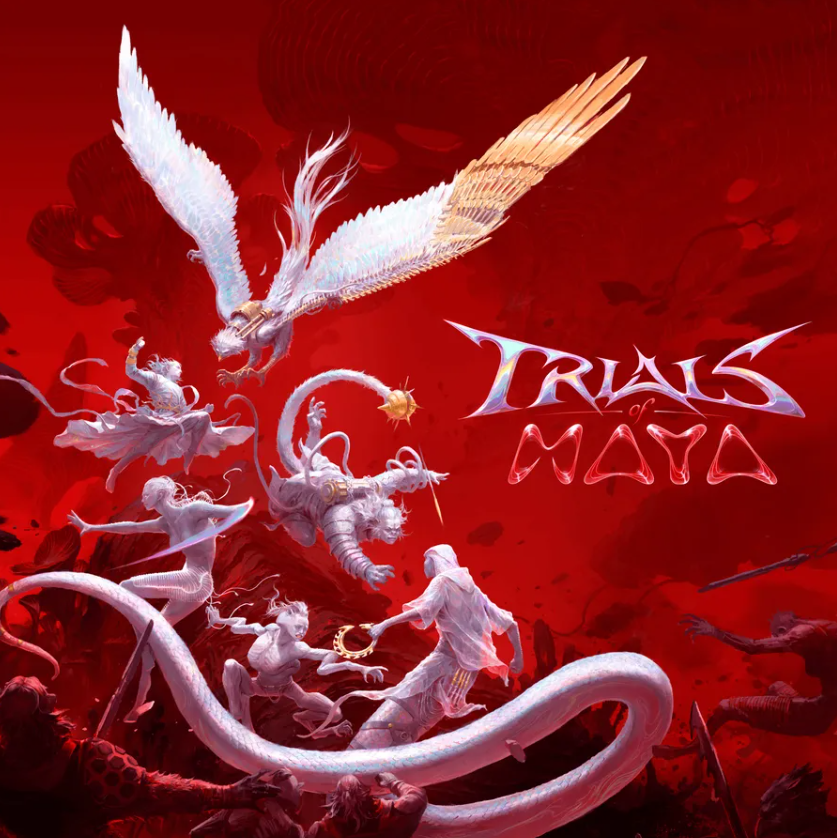
Maya is een universum met films, boeken en speelgoed. En nu is er ook het bordspel: Trials of Maya.
In Trials of Maya vecht je in een arena tegen je tegenstander. Gebruik je karakter en hulpjes op het bord om de toren van een tegenstander uit te schakelen.
Opzet en componenten
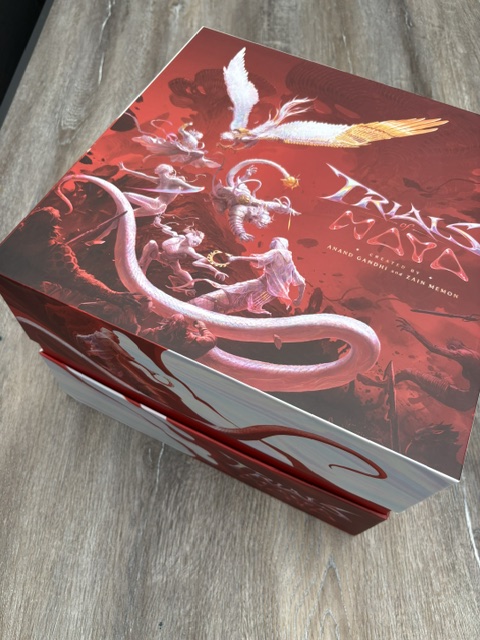
De componenten zijn er veel. We hebben een grote doos gekregen en die is echt groot. Veel lagen in de doos met allerlei borden, miniaturen, kaarten, tokens, etc. Veel te veel om op te noemen. Je kan ook veel kanten op met Trails of Maya. Er zijn meerde spel mogelijkheden.
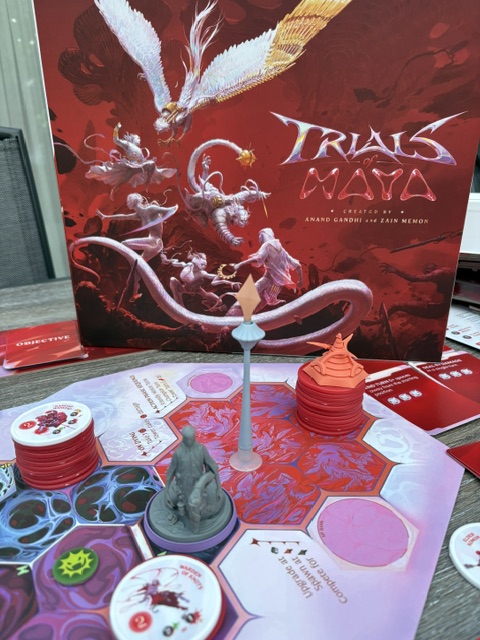
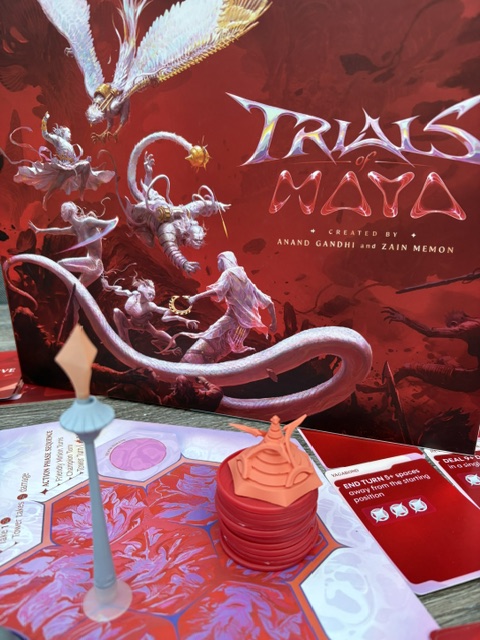
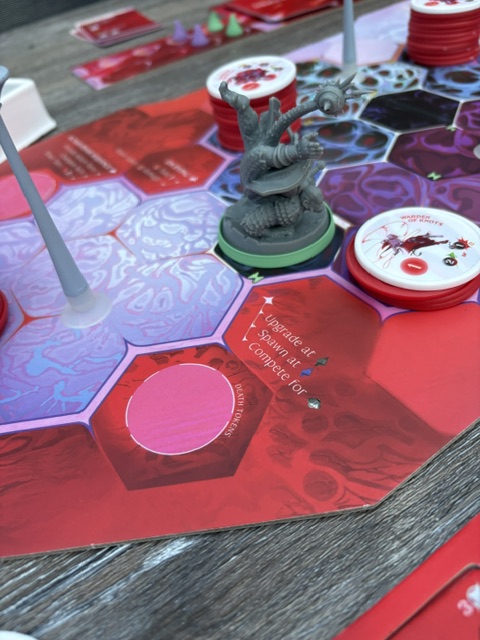
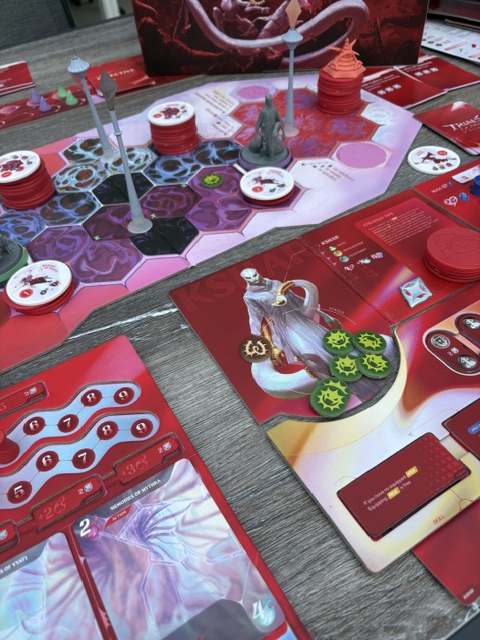
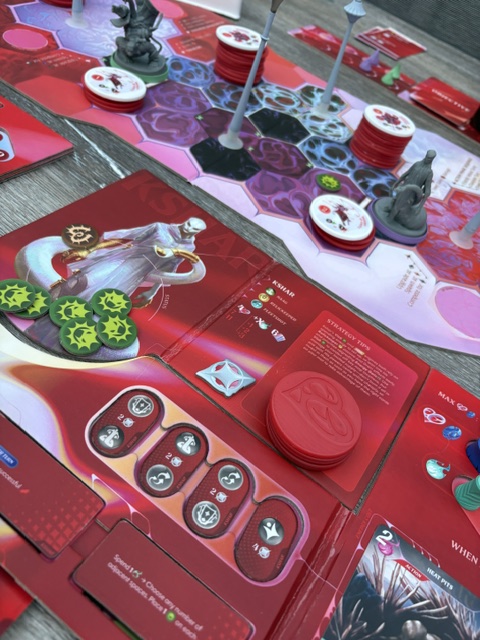
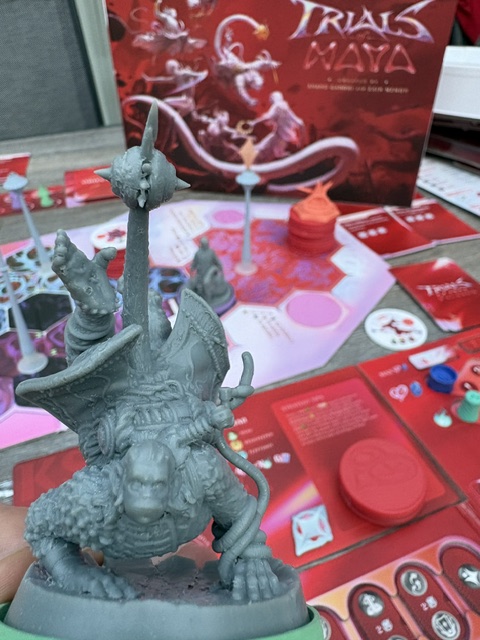
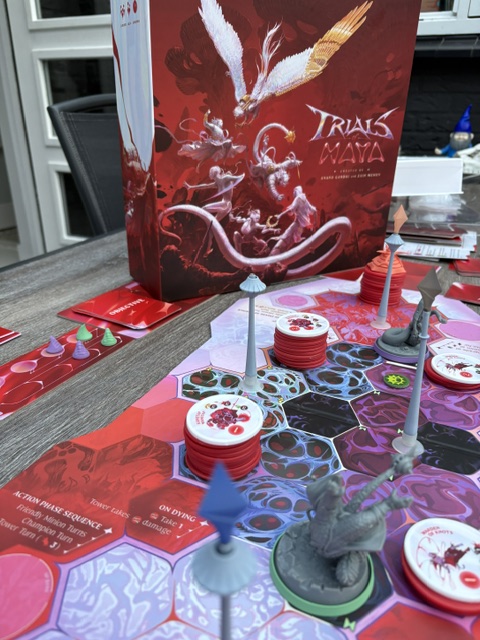
De onderdelen zelf zijn van mooie kwaliteit. Dikke speelborden, mooie miniaturen en alles past erg goed in de mooie doos.
De spelregels bestaan uit 2 boeken: het algemene spelregel boek en een boek die de verschillende spel mogelijkheden uitlegt. Voor het gemak is er nog een Reference boek, maar er zijn ook reference kaarten voor de spelers.
De spel mogelijkheden zijn:
- 2 tegen 2
- 1 tegen 1
- Ieder voor zich (free for all)
Deze spel modussen staan beschreven in het spel mogelijkheden boek, maar in de basis volgen ze allemaal het algemene spelregel boek. Daar begin je dus mee met lezen.
Het algemene spelregelboek staat vol met prachtige illustraties en is maar liefst 48 pagina’s. Dat komt vooral omdat er per pagina niet heel veel tekst staat maar veel afbeeldingen en/of witte ruimte. Het had een stuk korter gekund, maar ik begrijp ook dat er gekozen is voor deze prachtige layout. Je bladert dus wat meer.
Trails of Maya is bedacht in India en misschien dat ze daar de opbouw van regels wat anders doen…want de ronde structuur (stappen in het spel) wordt pas op pagina 40 beschreven. Daarvoor zit ik dus allerlei regels te lezen waarvan ik nog niet weet of ik ze zelf uitvoer of dat ze in een soort van actiefase zitten.
Hoe wordt het spel gespeeld
Het spel bestaat uit rondes van telkens 4 fases. Fase 1 tot en met 3 is wat ververs, opmaak en klaarleggen. Fase 4 is de actiefase waarin de spelers.
In Trails of Maya speel een gevecht tegen je tegenstander(s). Je wint als je als jouw toren als enige overblijft. Dat is simpel. Je gaat elkaar schade aanbrengen en probeert schade bij jezelf te blokken of voorkomen.
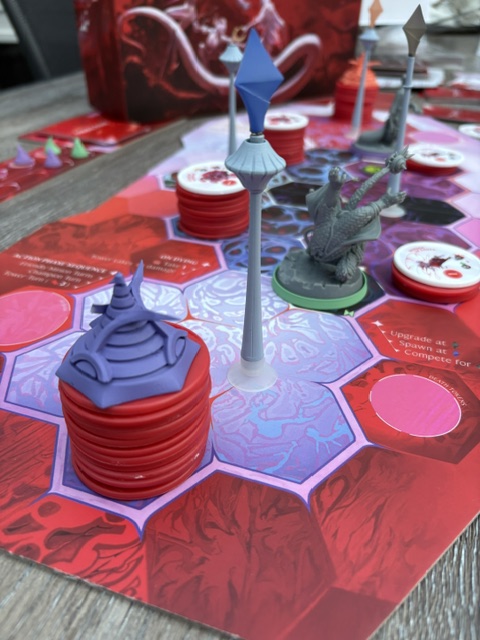
Dit doe je met je eigen miniatuur met unieke eigenschappen. Elke speler heeft unieke eigenschappen. In het strijdveld zijn hulpjes te veroveren, die heten Minions. Eenmaal verovert, horen ze bij jou en heb je dus veel meer stootkracht. Ze zijn niet in een keer te veroveren, dat kost wat acties. Tussendoor worden die minions agressief naar jou toe omdat je ze probeert te veroveren. Ze vallen je ook echt aan.
Dat was het doel van het spel. Even terug naar de fases:
Fase 1 bestaat uit het verversen van doelkaarten, pakken van kaarten van je eigen dek en terugzetten van uitgeputte kaarten van je acties.
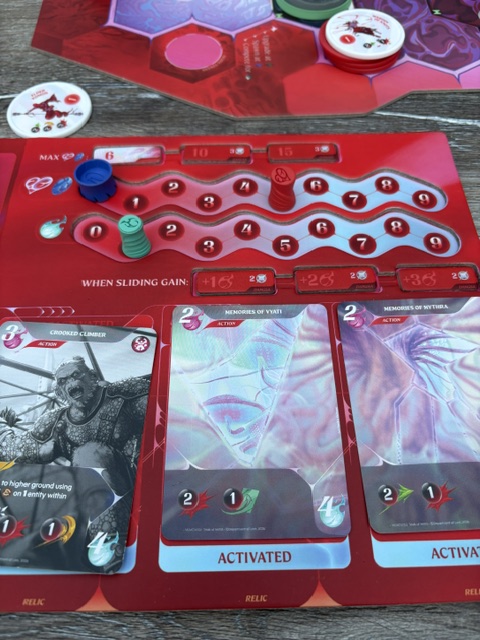
Fase 2 bestaat uit inkomen (energie) en een nieuwe kaart spelen. Je hebt op je spelersbord ruimte voor 3 actiekaarten. Dit zijn kaarten met acties die je kan uitvoeren. Je moet de acties betalen met energie. Aan het begin van Fase 2 schuif je je meest rechts kaart (van de 3) van je spelersbord af. Je krijgt dan de energie die erop staat als inkomen om te besteden tijdens de actiefase (Fase 4). De andere 2 kaarten schuif je ook naar rechts en links is er een plekje vrijgekomen voor een nieuwe kaart. Die kies je uit je hand en leg je daar neer.
Fase 3 Bepaal de beurtvolgorde. Degene die op zijn nieuwe kaart de laagste energie inkomsten heeft, mag beginnen.
Fase 4 De actiefase. Hier begint het echte werk. Als je aan de beurt bent, gaan je je eigen Minions eerst aan het werk. Je kan hun vaste actie uitvoeren en alvast hier en daar wat schade aanbrengen
Dan komt je karakter. Je mag je zoveel mogelijk acties van je 3 open actiekaarten uitvoeren als je kan betalen met energie. Op een kaart staan meerdere acties en als je een kaart kan betalen, mag je al die acties in gekozen volgorde uitvoeren. Je moet wel eerst een kaart afronden voordat je aan een nieuwe kaart begint.
Er zijn best wel wat acties waarvan de meeste erg logisch zijn:
- Bewegen
- Aanvallen
- Verdediging verhogen
- Kaart van je stapel pakken
- Tegenstander naar je toe trekken
- Tegenstander van je af duwen
Bij deze acties zijn er vaak nog wat speciale effecten mogelijk, zoals aanvallen rechtdoor iemand heen of aanvallen om een hoek, etc.
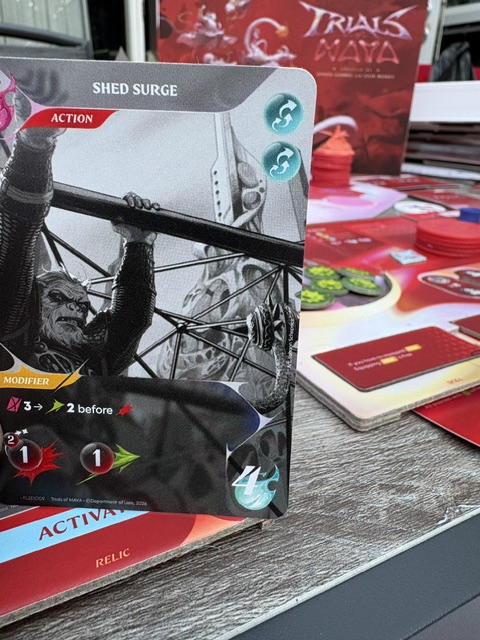
Naast de 3 actiekaarten op de spelersbord kan je ook nog speciale actiekaarten uit je hand direct spelen. Uiteraard moet je ook daarvoor energie betalen. Dit zijn Relickaarten en Spels (spreuken). Relickaarten leg je onder een actiekaart op je bord zodat deze actiekaart sterker wordt. Spells zijn eenmalig effecten.
Als je bij een speciale locatie staat, kan je je karakter upgraden door tokens te betalen. Er zijn meerdere soorten upgrades mogelijk en ook zeer aan te raden. De tokens verdien je door een openliggende doel te halen. Doelkaarten klinken doorgaans als lastig te halen en meestal op het einde. Maar hier niet. Ze zijn goed te doen en de beloning van het upgraden is erg goed.
Nadat je je acties gedaan hebt, komen de agressieve minions naar jou toe om jou aan te vallen. Deze agressieve minions vallen jou aan omdat je ze eerder zelf aangevallen hebt maar niet verslagen. Oef, pijnlijk.
Dit waren in hoofdlijnen de regels voor spelmogelijkheid 1v1 en 2v2. Voor de “Ieder voor zich / Free for all” is de winconditie anders. Je hebt geen toren en probeert zoveel mogelijk Minions te veroveren waar je punten voor krijgt. Degene die als eerste 8 punten heeft is de winnaar.
Wat vind ik van het spel
Toen ik Trails of Maya zag en ook na het spelen, dacht ik meteen aan Unmatched. Daar zijn veel gelijkenissen mee. Karakters met unieke eigenschappen die in een arena tegen elkaar gaan vechten. Elk karakter heeft een eigen deck. Dit is hier ook zo. Trails of Maya gaat wel wat verder met meer verschillende soorten acties en upgrades van je karakter.
Het veroveren van neutrale minions en daarmee mee extra aanvalskracht maken is een mooie toevoeging. Het verdedigen van je karakter is best lastig en je gaat tijdens een spel meerdere keren dood. Dat is helemaal niet erg. Volgende ronde spawn je gewoon weer terug bij een spawnpunt.
In het begin lijkt de toren van de tegenstander enorm hoog en vrijwel onmogelijk om binnen een normale tijd af te breken. Dit is in tegenstelling tot je karakter. Maar als je het karakter van je tegenstander vermoord, gaat zijn toren ook in levens achteruit. Dit gaat steeds sneller: de eerste keer dat karakter doodgaat, gaat toren 1 leven achteruit. Bij de tweede keer gaat de toren twee levens achteruit. Dit gaat zo door en gaat dus steeds sneller. Het komt dus wat trager op gang maar later gaat het een stuk sneller. Uiteraard kan je de toren ook direct aanvallen maar die ligt doorgaans wel ver in vijandelijk gebied. Door de upgrades die je tijdens het spel unlockt, doe je ook steeds meer schade aan een karakter en gaat dit dus ook sneller.
De eerste potjes wordt je wat overspoelt door alle mogelijke upgrades en mogelijkheden van je karakter. Je gaat er best wel wat vergeten. Dat is even oefenen en dus als beginner spelen tegen een ervaren speler, wordt een oneerlijke strijd.
Kortom, het is een soort Unmatched 2.0 Een uitgebreide versie met meer soorten acties, upgrades, doelkaarten en upgrades. De verschillende spel mogelijkheden voegen ook meer variatie toe.
De liefhebbers van Unmatched gaan dit zeker leuk vinden. De eerste keer ben je vooral de symbolen wat aan het uitzoeken, maar eenmaal op gang, loopt het spel vrij logisch. En het ziet er prachtig uit. De art is erg mooi gedaan en het heeft een mooie uitstraling op tafel. Het trekt meteen de aandacht.
Bekijk Trials of Maya op Gamefound

Trials of Maya
Players: 1-4
Time: 60-120 minutes
Age: 14+
Author:
Publisher: Department of Lore
Year: 2026
Trials of Maya is available on Gamefound
MeepleTales received a prototype before the Gamefound started. Some parts may have changed after production.
Maya is a universe with films, books, and toys. And now there is also the board game: Trials of Maya.
In Trials of Maya, you fight against your opponent in an arena. Use your character and sidekicks on the board to take out an opponent’s tower.
Setup and components
There are many components. We received a large box, and it is truly huge. There are many layers in the box with all kinds of boards, miniatures, cards, tokens, etc. Far too many to list. You can also go in many directions with Trials of Maya. There are multiple gameplay options.
The components themselves are of nice quality. Thick game boards, beautiful miniatures, and everything fits very well in the nice box.
The game rules consist of 2 books: the general rulebook and a book that explains the different gameplay options. For convenience, there is also a Reference book, but there are also reference cards for the players. The game options are:
– 2 vs 2
– 1 vs 1
– Free for all
These game modes are described in the game options book, but basically they all follow the general rulebook. So that is where you start reading.
The general rulebook is full of beautiful illustrations and is no less than 48 pages long. This is mainly because there isn’t a lot of text per page, but rather many images and/or white space. It could have been a lot shorter, but I also understand that this beautiful layout was chosen. So you end up flipping through pages a bit more.
Trails of Maya was conceived in India, and perhaps they structure the rules a bit differently there… because the round structure (steps in the game) is only described on page 40. Before that, I am reading all kinds of rules that I don’t yet know if I will execute myself or if they are in some kind of active phase.
How is the game played
The game consists of rounds of 4 phases each. Phases 1 through 3 involve refreshing, formatting, and setting up. Phase 4 is the active phase in which the players…
In Trails of Maya, you play a battle against your opponent(s). You win if you are the only one left standing as your tower. That is simple. You deal damage to each other and try to block or prevent damage to yourself.
You do this with your own miniature with unique abilities. Every player has unique abilities. There are helpers to capture on the battlefield, called Minions. Once captured, they belong to you, giving you much more striking power. They cannot be captured all at once; that takes a few actions. In between, those minions become aggressive towards you because you are trying to capture them. They actually attack you.
That was the goal of the game. Back to the phases:
Phase 1 consists of refreshing objective cards, drawing cards from your own deck, and returning exhausted cards from your actions.
Phase 2 consists of income (energy) and playing a new card. You have space for 3 action cards on your player board. These are cards with actions you can perform. You must pay for the actions with energy. At the start of Phase 2, you slide your rightmost card (of the 3) off your player board. You then receive the energy shown on it as income to spend during the action phase (Phase 4). You slide the other 2 cards to the right as well, and a spot has become available on the left for a new card. You choose this card from your hand and place it there.
Phase 3 Determine the turn order. The player with the lowest energy income on their new card gets to start.
Phase 4 The action phase. This is where the real work begins. When it is your turn, your own Minions get to work first. You can perform their fixed action and already inflict some damage here and there.
Then comes your character. You may perform as many actions from your 3 open action cards as you can pay for with energy. A card contains multiple actions, and if you can pay for a card, you may perform all those actions in the chosen order. You must complete a card before starting a new one.
There are quite a few actions, most of which are very logical:
– Move
– Attack
– Increase defense
– Draw a card from your deck
– Pull an opponent towards you
– Push an opponent away from you
With these actions, there are often some special effects possible, such as attacking straight through someone or attacking around a corner, etc.
In addition to the 3 action cards on the player board, you can also play special action cards directly from your hand. Naturally, you must pay energy for these as well. These are Relic cards and Spells. You place Relic cards under an action card on your board so that the action card becomes stronger. Spells are one-time effects.
When you are at a special location, you can upgrade your character by paying tokens. There are several types of upgrades possible and highly recommended. You earn the tokens by completing an open objective. Objective cards generally known as difficult to obtain and usually at the end. But not here. They are quite doable and the reward for upgrading is very good.
After you have performed your actions, the aggressive minions come towards you to attack you. These aggressive minions attack you because you attacked them earlier but did not defeat them. Ouch, painful.
These were the main rules for 1v1 and 2v2 gameplay. For “Free for all,” the win condition is different. You do not have a tower and try to capture as many Minions as possible, for which you receive points. The first person to reach 8 points is the winner.
What do I think of the game?
When I saw Trails of Maya, and also after playing it, I immediately thought of Unmatched. There are many similarities to it. Characters with unique abilities fighting each other in an arena. Each character has their own deck. This is the case here as well. Trails of Maya does go a bit further, however, with more different types of actions and upgrades for your character.
Capturing neutral minions to generate extra attack power is a nice addition. Defending your character is quite difficult, and you will die multiple times during a game. That is not a problem at all. You simply respawn at a spawn point in the next round.
In the beginning, the opponent’s tower seems enormously high and virtually impossible to destroy within a normal time. This is in contrast to your character. But if you kill your opponent’s character, their tower also loses health. This happens increasingly faster: the first time a character dies, the tower loses 1 life. The second time, the tower loses two lives. This continues, so it gets faster and faster. It starts off a bit slowly, but later on it speeds up considerably. Of course, you can also attack the tower directly, but it is usually located deep in enemy territory. Due to the upgrades you unlock during the game, you also deal more and more damage to a character, so this also goes faster.
During the first few matches, you are somewhat overwhelmed by all the possible upgrades and capabilities of your character. You are bound to forget quite a few of them. That takes some practice, so playing as a beginner against an experienced player becomes an unfair fight.
In short, it is a kind of Unmatched 2.0. An expanded version with more types of actions, upgrades, objective cards, and upgrades. The different gameplay options also add more variety.
Fans of Unmatched will definitely enjoy this. The first time you play, you are mainly figuring out the symbols, but once you get going, the game flows quite logically. And it looks beautiful. The art is very nicely done and it has a beautiful presence on the table. It immediately catches the eye.
Trials of Maya is available on Gamefound