

Aantal spelers: 2-4
Speelduur: 15 minuten
Leeftijd: Vanaf 10 jaar
Auteur: Jérémy Ducret, Johannes Goupy
Uitgever: CMON Global Limited
Jaar: 2026
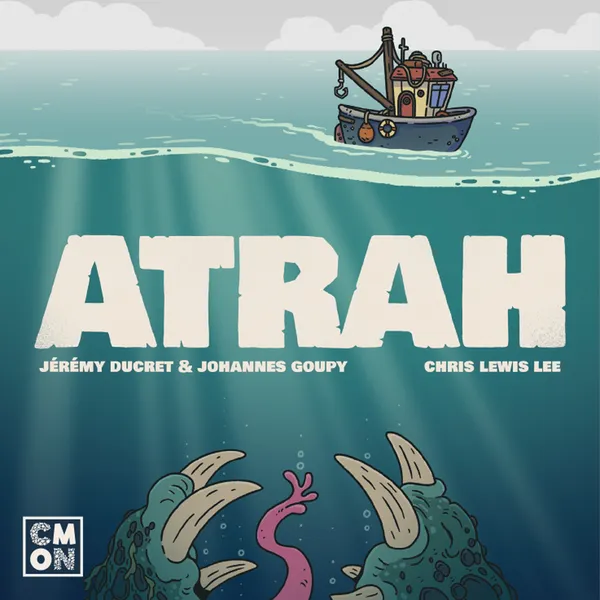

Heb je interesse om eens de diepe zee in te gaan en allerlei gevreesde monsters tegen te komen? Verzamel zeemonsters en zorg dat deze monsters zoveel mogelijk punten opleveren, want voor je het weet ben je visvoer.
Spelverloop
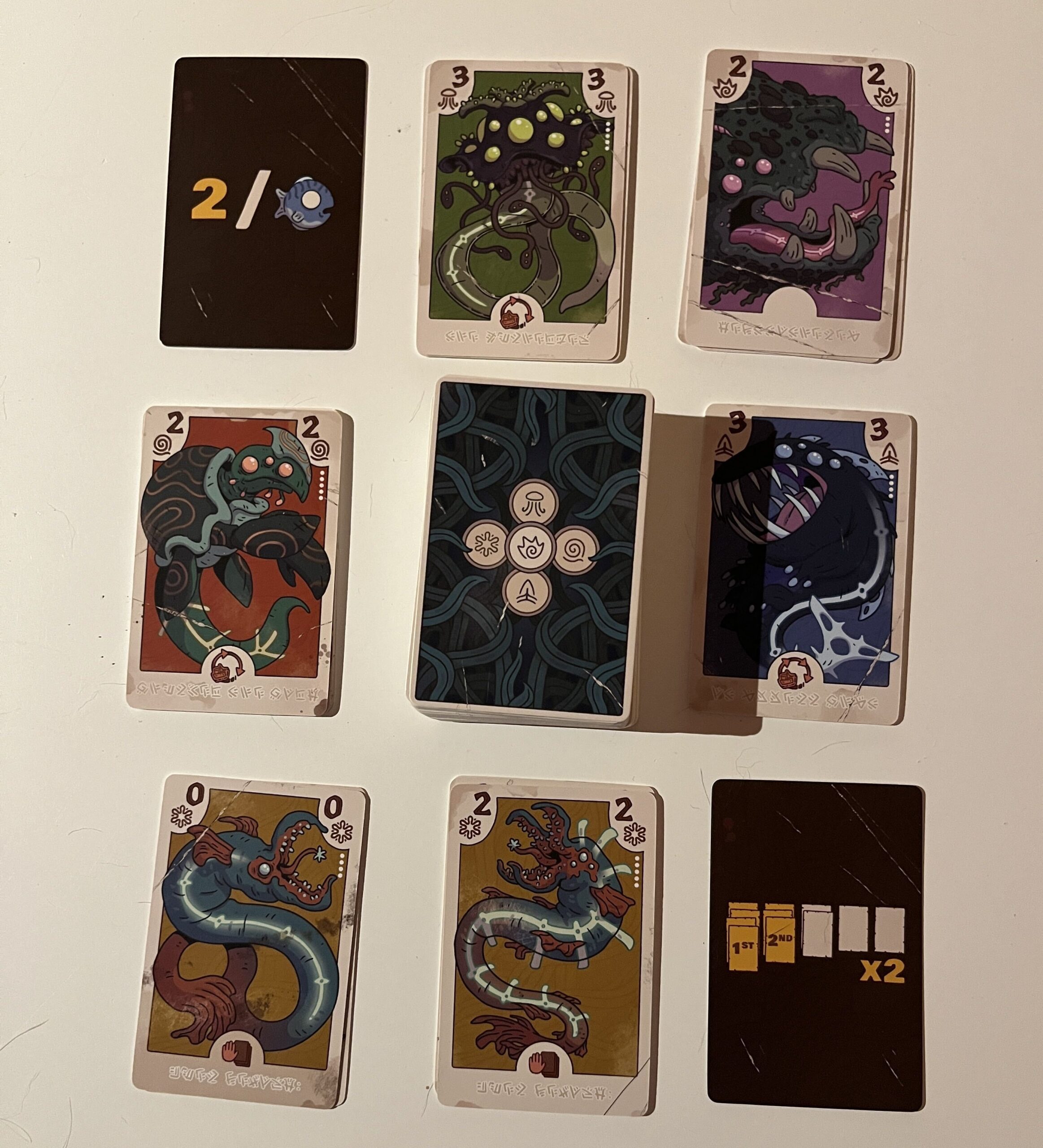
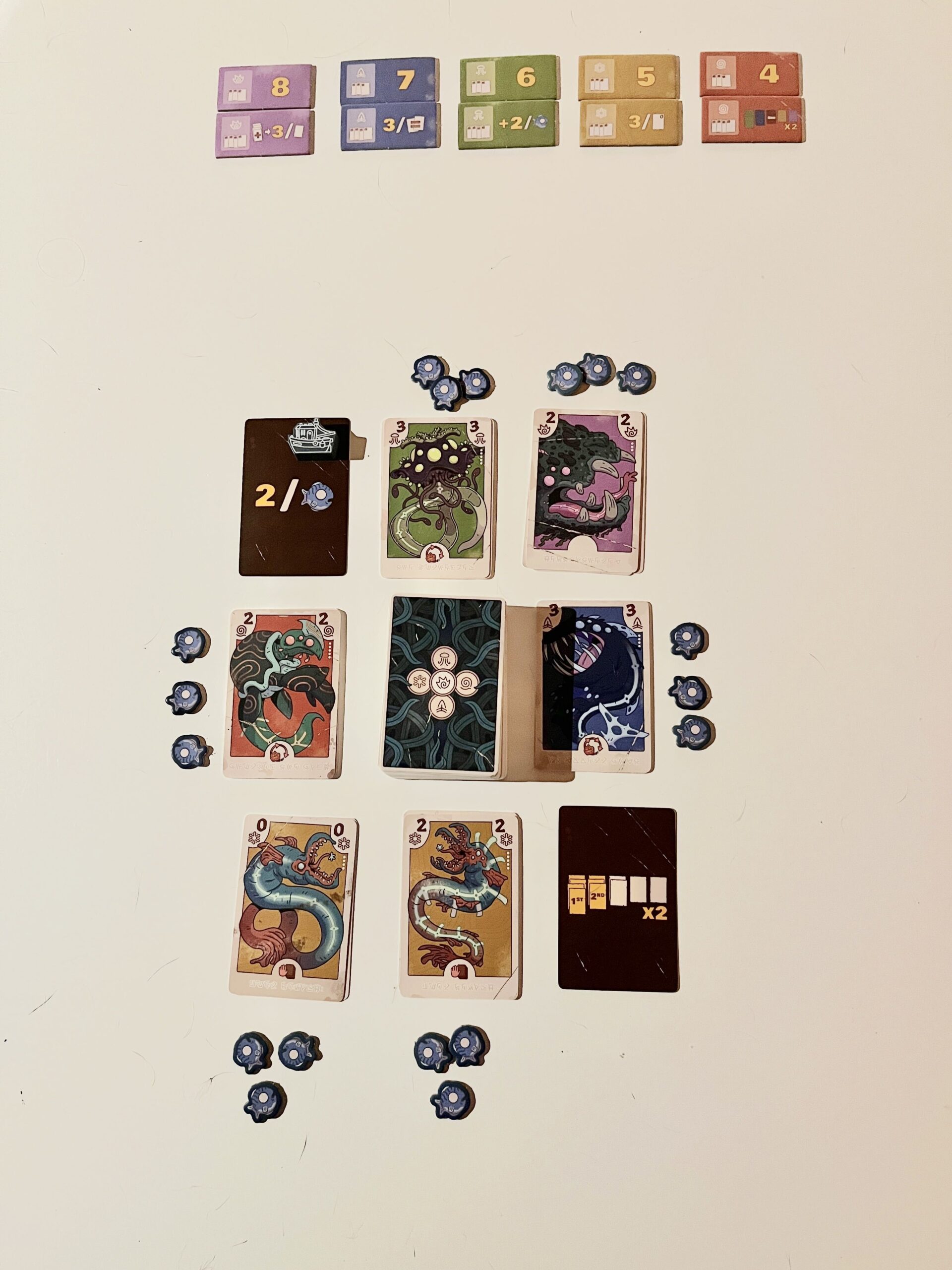
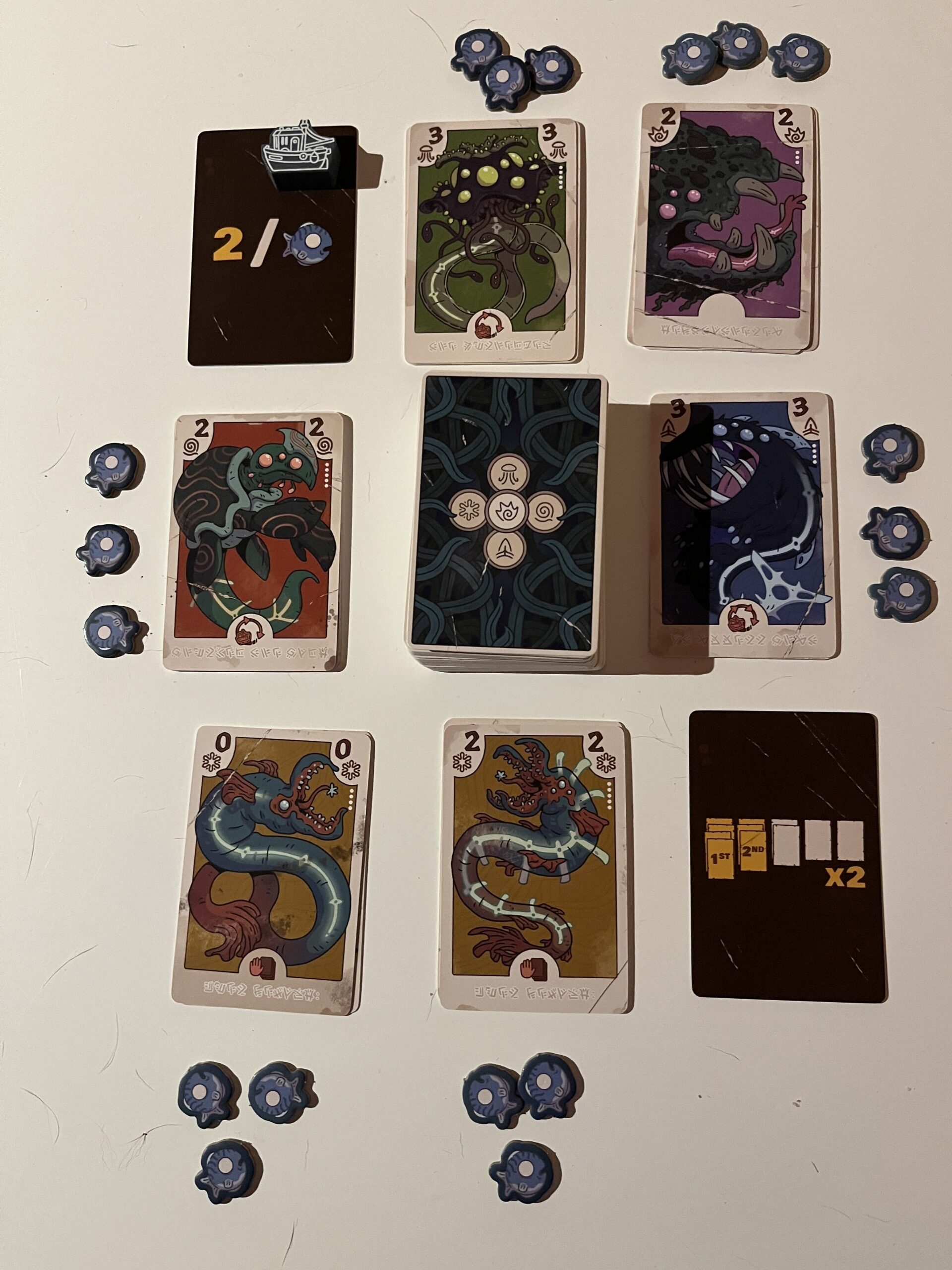
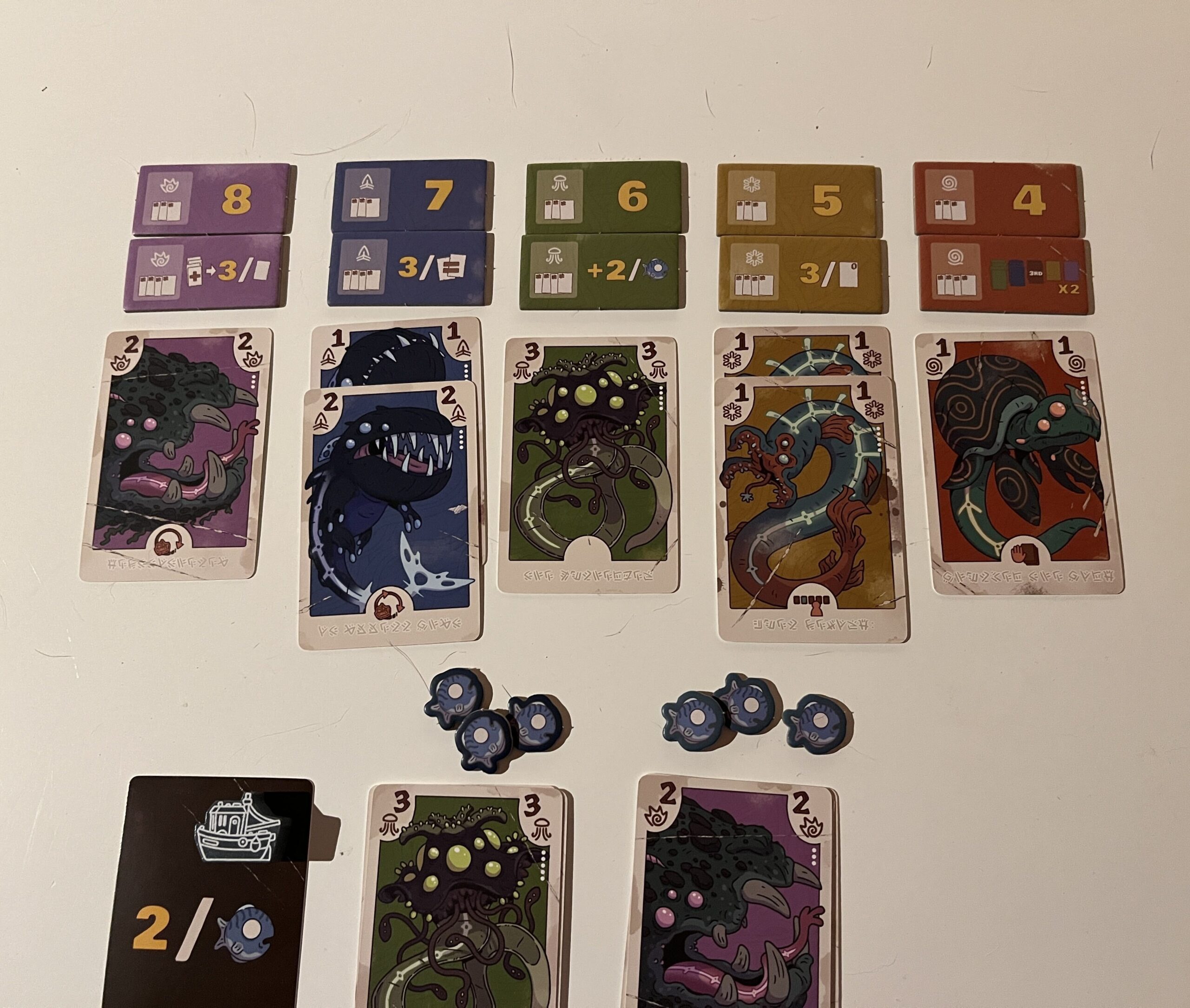
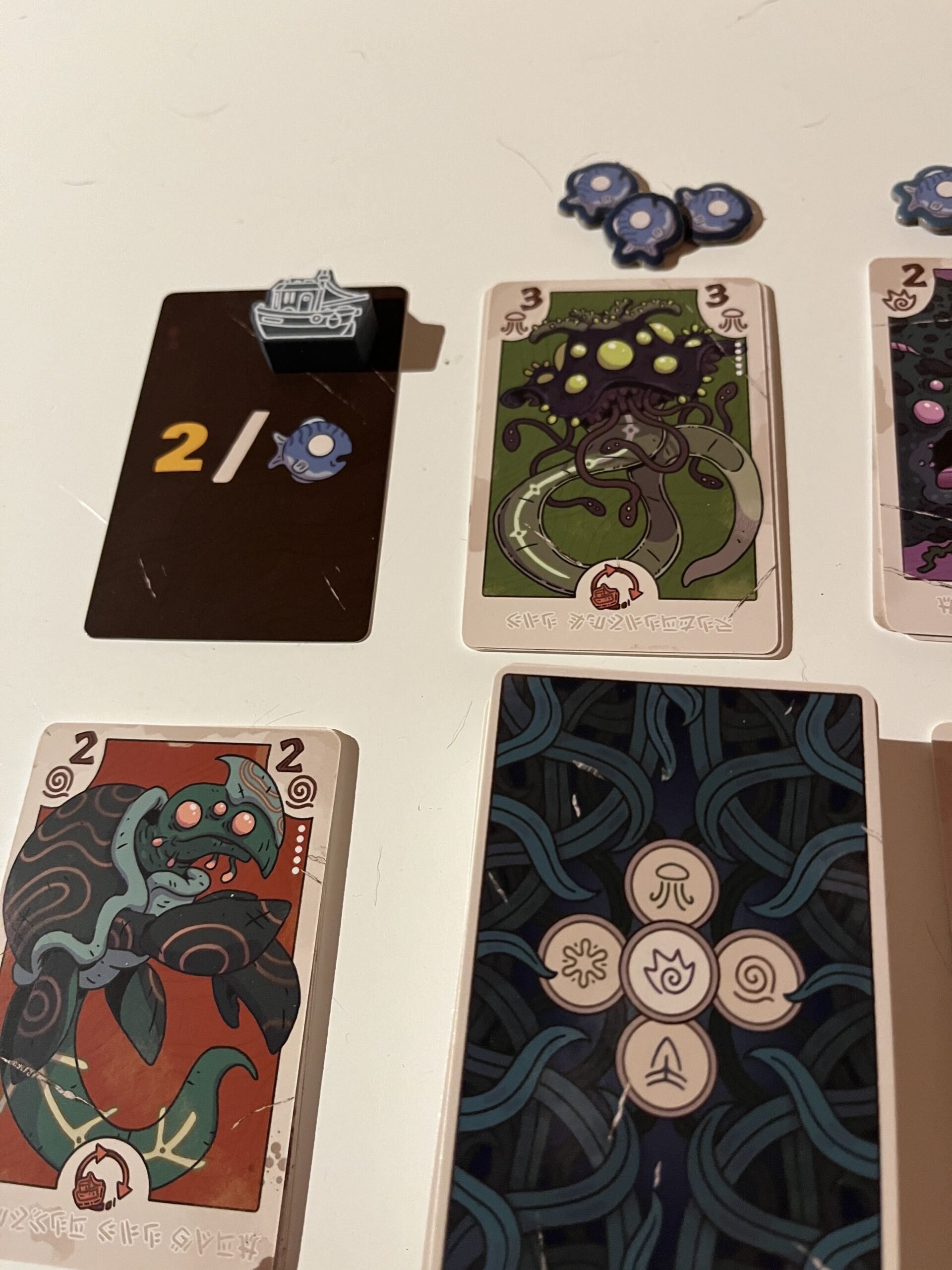
In ATRAH ga je als visser aan de slag om te vissen in de zee van kaarten dat in een grid van 3×3 waarbij de linker-boven- en rechter-onderhoek de scoringsoverzicht kaarten liggen. De vissersboot start op de overzichtskaart in de linker-bovenhoek die aangeeft dat je per vis 2 punten krijgt. De monsterkaarten vullen de rest van het grid (behalve het centrale veld) en naast elke monsterkaart liggen een aantal vistokens, die je later kan verzamelen. Deze monsterkaarten worden met de tekening zichtbaar geplaatst en vormen kleine stapeltjes van een aantal kaarten afhankelijk van het aantal spelers. De monsterkaarten die in het midden van het rooster worden gelegd vormen de gedekte trekstapel. Boven dit rooster liggen de kaarten van de meerderheidskaarten in 5 kolommen per kleur, waarbij de volgorde van links naar rechts belangrijk is: paars, blauw, groen, geel, rood. Dit zijn scoringskaarten die je kan verzamelen als je hiervoor snel genoeg bent.
Na die setup kan je beginnen spelen. Eerst neemt de startspeler een kaarten van het rooster, maar je hebt keuze uit een van de 3 rijen van 2 open kaarten. Je neemt elke kaart die open ligt (en waar geen boot op staat) en legt deze kaarten voor je neer. (Soms heb je maar 1 kaart als een stapel leeg geraakt.) Hierna moet je de kaarteffecten oplossen in gelijk welke volgorde. Er zijn 5 verschillende soorten effecten die ik later even overloop. Nadat je de effecten hebt afgehandeld kies je 1 kaart van deze kaarten en verplaats je al de kaarten van deze familie in de selectie naar jouw persoonlijke voorraad, de andere kaart/kaarten in de meerderheidskolom van de juiste kleur.
De meerderheidskolommen bepalen of de waarde van de kaarten in jouw persoonlijke voorraad verdubbelt worden of niet. De kleuren met de meeste meerderheidskaarten krijgen dubbele waardes, maar dit kan dus snel veranderen. Houd hier rekening mee, zodat je niet voor verrassingen komt te staan. Als meerdere kolommen hetzelfde aantal kaarten hebben liggen worden de kleuren met hogere prioriteit verdubbeld.
Nu zal ik even de kaarteffecten overlopen:
- De speler moet verplicht een extra kaart van de gedekte stapel trekken zonder dit effect te activeren.
- De speler moet elke kaart die voor zich ligt in zijn voorraad leggen.
- De speler kiest een zichtbare kaart uit het rooster en legt die meteen bij de meerderheidskaarten zonder het effect te activeren.
- De speler moet de laatste kaart van een van de meerderheidskolommen nemen en die bij de eigen voorraad leggen.
- De speler moet de boot 1, 2 of 3 stapjes doorschuiven en als de boot eindigt op een kaart waar nog vissen bijliggen, krijgt die speler een vis in zijn voorraad.
Als laatste (optionele) stap tijdens je beurt kan je een speciale tegel verzamelen. Als je 3 kaarten van verschillende waardes in dezelfde familie verzameld hebt, krijg je de overeenkomstige tegel. Als je reeds een tegel hebt verzameld van een bepaalde kleur, kan je nadien echter niet de tweede tegel van die kleur verzamelen dus houd hiermee rekening voor je die beslissing maakt. Als je 4 kaarten met verschillende waarde van dezelfde kleur verzameld hebt, krijg je de andere speciale tegel van diezelfde kleur. Pas op: je kan enkel een tegel claimen als je die beurt een kaart van die kleur in jouw voorraad hebt verzameld. Deze speciale tegels leveren je extra punten op (soms met een voorwaarde en soms gewoon directe punten).
Tenslotte komen we bij het einde van het spel als 3 stapels uit het grid leeggeroofd zijn. Nu gaan we over naar het bepalen van de scores. Kijk dus eerst naar welke kleuren hun waardes verdubbeld zullen zien en tel dan alle punten op bij elkaar op. Hier tel je de waarde van elke kaart bij elkaar op (waarbij sommige waardes dus verdubbeld zullen worden). Daarna tel je de verzamelde vissen erbij en de punten van de speciale tegels.
De speler(s) met de meeste punten zal de winnaar zijn van dit spel.
Spelmechanisme
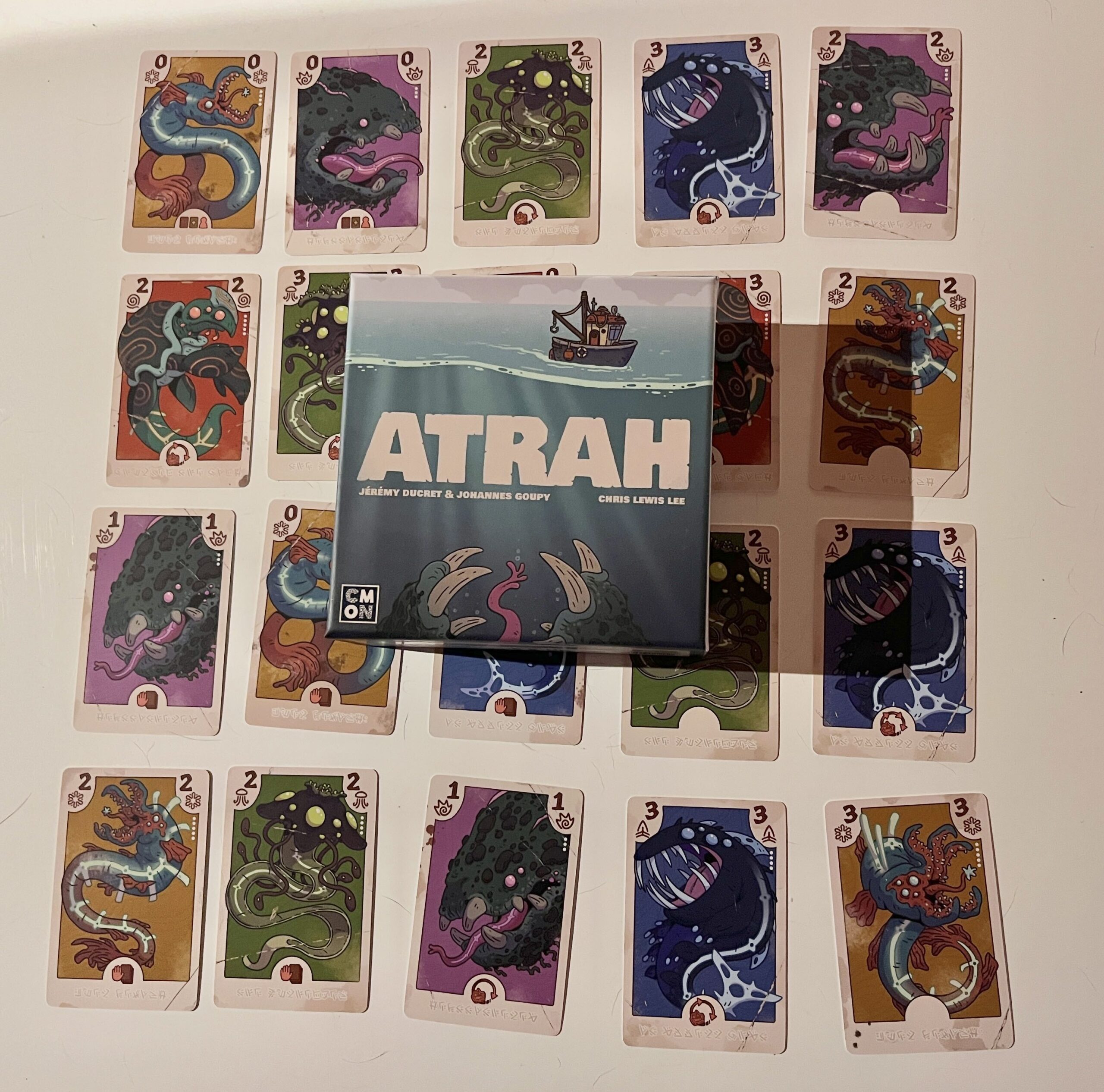
In eerste instantie is ATRAH een Set collectie spel omdat je probeert een zo goed mogelijke set te creëren om zoveel mogelijk punten te verdienen. Verder is het jullie ondertussen al duidelijk dat er ook een Area Majority aspect in dit spel zit, niet op de klassieke manier zoals bij typische oorlogsspellen. Tenslotte is er een markt waaruit je gaat moeten kiezen en dit mechanisme vormt de basis van een beurt.
Mijn bescheiden mening
Ik vind dat het spel vlot en snel gespeeld kan worden en het net genoeg punch heeft om er strategie in te zoeken en er wat over na te denken. De tekenstijl zet een grimmige sfeer op die toch een wat gezellig kantje heeft. De leuke vorm van area majority via de kaarten en de effecten die je kan activeren waren voor mij een verademing omdat dit echt luchtig aanvoelt en toch heel wat tactiek verbergt.
Wat maakt het spel zo sterk?
- Leuke tekenstijl die wel wat van de sfeer bepalen. Je kan dit spel zelfs in het donker spelen omdat de kaarten glow in the dark effect hebben.
- Verschillende elementen die allemaal apart voor diepgang zorgen. Zo is er de boot die bepaalt of je een vis kan krijgen en welke kaarten niet beschikbaar zijn om te nemen, maar ook de meerderheden die waardes kunnen verdubbelen, waardoor je het heel tactisch kan aanpakken.
- Snel en vlot gespeeld. De uitleg kan heel snel gebeuren en het spel zelf speelt ook heel erg vlot, waardoor je het makkelijk op tafel krijgt.
- Speelt ook heel leuk op BoardgameArena.
Is het alleen maar positief?
Soms voelt het alsof het spel snel gedaan is, waardoor je niet jouw strategie optimaal hebt kunnen uitrollen want op 15 minuten is het gemiddeld gedaan. Dit is een voordeel omdat het dan snel en makkelijk op tafel komt, maar ook een nadeel omdat je zo misschien minder goed in de sfeer en strategie van het spel geraakt.
Conclusie
ATRAH is een mooi (glow in the dark) spel dat een leuke sfeer en wat tactiek of strategisch inzicht bundelt in een klein doosje met een korte tijdsduur. Van mij krijgt het spel een mooie 7/10 omdat ik me er zeker mee amuseer en de keuzes genoeg waarde hebben.

ATRAH
Players: 2-4
Time: 15 minutes
Age: 10+
Author: Jérémy Ducret, Johannes Goupy
Publisher: CMON Global Limited
Year: 2026
Are you interested in venturing into the deep sea and encountering all sorts of fearsome monsters? Collect sea monsters and ensure they earn you as many points as possible—because before you know it, you’ll be fish food.
Gameplay
In ATRAH, you take on the role of a fisherman, casting your line into a “sea” of cards arranged in a 3×3 grid. The top-left and bottom-right corners of this grid contain scoring reference cards; the one in the top-left, for instance, indicates that each fish is worth 2 points. The remaining spaces in the grid (excluding the center) are occupied by stacks of monster cards—the number of cards per stack depends on the total number of players—placed face-up. The center space of the grid serves as the face-down draw pile. Above the grid, there are “majority” cards arranged in five columns, one for each color—specifically, from left to right: purple, blue, green, yellow, and red. These are scoring cards that you can claim if you are quick enough.
Once the setup is complete, the game begins. The starting player selects a set of cards from the grid, choosing from one of the three rows that each contain two face-up cards. You take all the face-up cards available in that row (provided no boat is currently occupying that space) and place them in front of you. (Note: sometimes you may only take a single card if a stack has been depleted.) Next, you must resolve the effects of these cards in any order you choose. There are five distinct types of effects, which I will explain shortly. After resolving the effects, you select one of the cards you took and move all cards of that same “family” (color/type) from your current selection into your personal supply; the remaining card(s) are then placed into the corresponding majority column of that color. The majority columns determine whether the value of the cards in your personal collection is doubled. The colors with the most majority cards have their values doubled, but this can change quickly—keep this in mind so you aren’t caught off guard. If multiple columns have the same number of cards, the colors with higher priority are the ones that get doubled.
Now, let’s go over the card effects:
- The player must draw an additional card from the face-down deck, without triggering its effect.
- The player must move every card currently in front of them into their personal collection.
- The player chooses one face-up card from the grid and immediately adds it to the majority columns, without triggering its effect.
- The player must take the last card from one of the majority columns and add it to their own collection.
- The player must move the boat forward by 1, 2, or 3 spaces; if the boat ends on a card that still has fish tokens on it, the player adds one fish to their collection.
As a final (optional) step during your turn, you may collect a special tile. If you have collected 3 cards of different values within the same color family, you receive the corresponding tile. Note that you cannot collect a second tile of a color for which you have already claimed one, so plan accordingly. If you have collected 4 cards of different values within the same color family, you receive the other special tile for that color. Be careful: you can only claim a tile if you have added a card of that color to your collection during the current turn. These special tiles grant you extra points (sometimes subject to a condition, and sometimes simply as immediate points).
The game ends once 3 stacks from the grid have been completely depleted. At this point, you proceed to calculate the scores. First, determine which colors will have their values doubled, then add up all your points. This involves totaling the values of all your cards—applying the doubling effect where applicable—and then adding the points from any collected fish and special tiles.
The player(s) with the most points is the winner of the game.
Game Mechanics
First and foremost, ATRAH is a set-collection game, as you strive to create the best possible sets to earn as many points as you can. Furthermore, it should be clear by now that the game also incorporates an “area majority” element—though not in the traditional sense found in typical war games. Finally, there is a market from which you must make selections, and this mechanism forms the core of each turn.
My Humble Opinion
I find that the game plays smoothly and quickly, with just enough punch to allow for some strategic depth and thoughtful decision-making. The art style establishes a grim atmosphere that still manages to feel somewhat cozy. The clever take on area majority, implemented through cards and the effects you trigger, was a breath of fresh air for me; it feels genuinely lighthearted while concealing a surprising amount of tactical substance.
What makes the game so strong?
- An appealing art style that really helps set the mood. You can even play this game in the dark, as the cards feature a glow-in-the-dark effect.
- Various elements that each add depth to the gameplay. For instance, there’s the boat, which determines whether you can catch a fish and which cards are unavailable to take; there are also majority-based mechanics that can double the value of your cards, allowing for a highly tactical approach.
- Fast-paced and smooth. The rules can be explained very quickly, and the game itself flows seamlessly, making it easy to get to the table.
- It’s also great fun to play on Board Game Arena.
Is it all just positive?
Sometimes it feels as though the game ends too quickly, preventing you from fully executing your strategy—after all, it typically wraps up in about 15 minutes. This is an advantage, as it makes the game quick and easy to bring to the table, but it’s also a drawback, as it can be harder to truly immerse yourself in the game’s atmosphere and strategic depth.
Conclusion
ATRAH is a lovely (glow-in-the-dark) game that combines a fun atmosphere with a touch of tactical or strategic insight—all packed into a small box and offering a short playtime. I’d give it a solid 7/10; I certainly enjoy playing it, and the choices involved offer plenty of substance.