

Aantal spelers: 3-6
Speelduur: 45-90 minuten
Leeftijd: Vanaf 10 jaar
Auteur: Joseph Frederick
Uitgever: Lucky Duck Games
Jaar: 2025
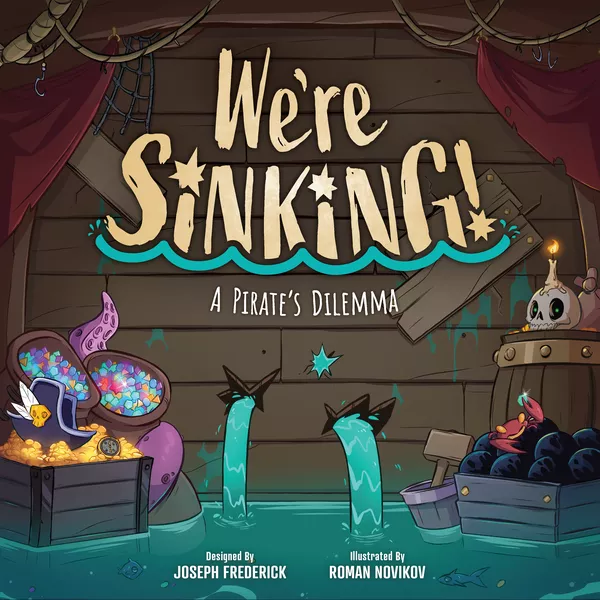

Yarrr, mi hearties! Ken je het gevoel dat je op een zinkend schip zit dat wordt aangevallen door een of ander zeemonster? Ja? Wel, dan kan je me hier waarschijnlijk helpen. Sta je achter je crew en probeer je de gaten in je schip te herstellen of steek je hen een mes in de rug om zo snel mogelijk te ontsnappen? In We’re Sinking! kan je deze keuzes zelf aan den lijve ondervinden.
Spelverloop
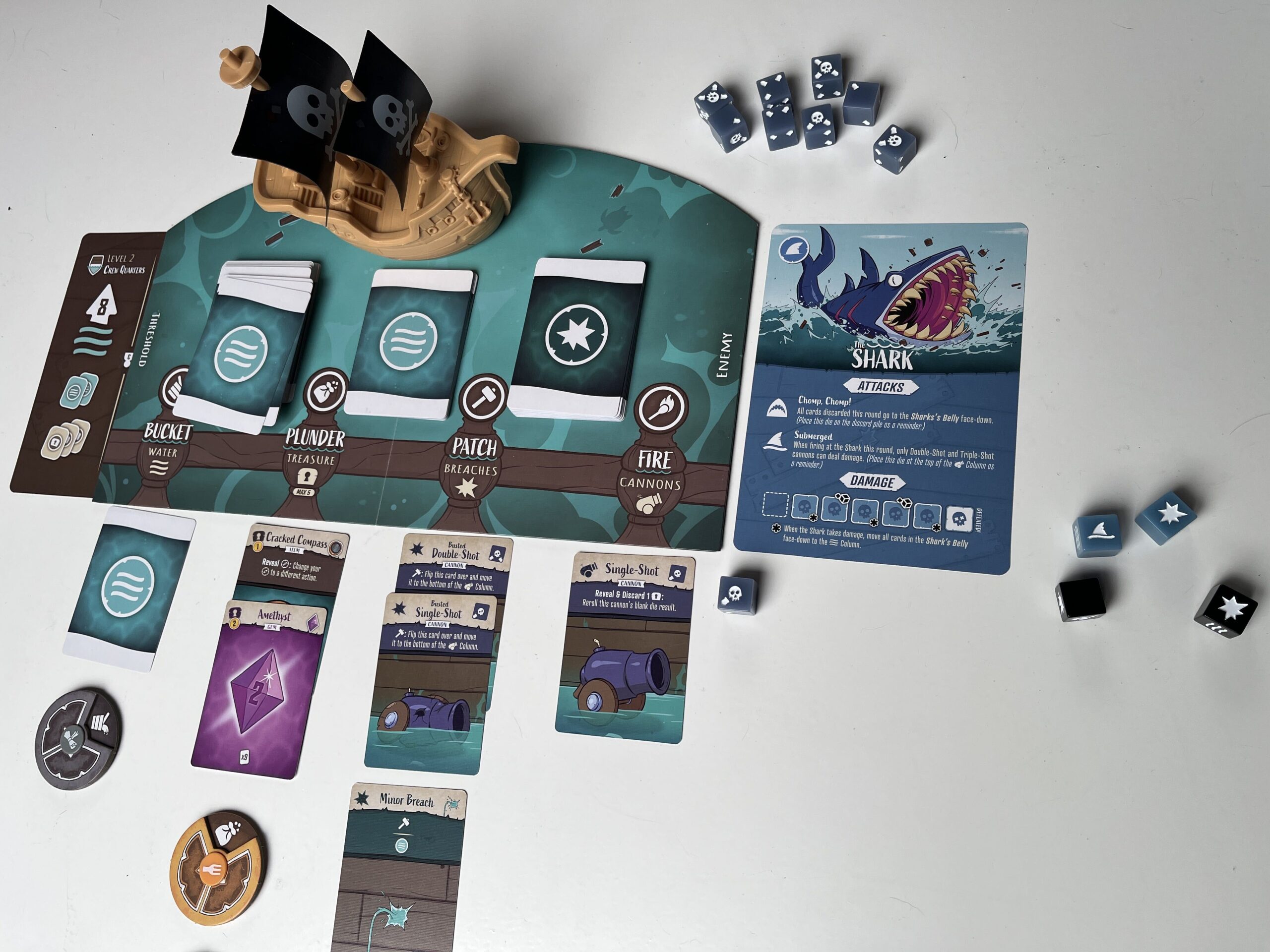
Voordat het spel begint moeten de spelers beslissen tegen welke monsterlijke vijand ze het met hun zinkende schip zullen opnemen. Elke vijand heeft zijn eigen specifieke krachten en dobbelstenen zodat je uit 4 verschillende ervaringen kunt kiezen.
De beurten van alle spelers lopen om te beginnen simultaan. De “First mate” of startspeler volgt steeds de verschillende stappen op zijn/haar checklist om te zien wat er vervolgens moet gebeuren.
Allereerst is er de inspecteer fase waarbij de first mate kijkt of er breuken zitten in het schip (in de breuken kolom) om dan ditzelfde aantal waterkaarten toe te voegen aan de waterkolom. Dit moet je dan zien als water dat in je schip sijpelt waardoor je schip dus gaat zinken als er te veel water is binnengelopen. Als er meer waterkaarten in de waterkolom zitten dan de limiet voor je schip aankan ga je door naar procedures om te zinken op de achterkant van je checklist. (Die zullen we straks nog even overlopen, wees maar niet ongerust 😉)
Vervolgens komen we bij de dreigingsfase waarbij er kaarten aan je water- en schatkolom worden toegevoegd op basis van het huidige level van je schip. Nadat je de kaarten hebt toegevoegd aan de juiste kolom, is het tijd om te zien wat je gekozen vijand gaat doen met jullie schip. Hiervoor rol je de 4 basisdobbelstenen en de dobbelstenen voor de specifieke vijand om te kijken of er nieuwe breuken in je schip komen, kanonnen kapot worden geslagen of water op het dek wordt gespoeld. Elke vijand heeft dan nog een eigen kracht waardoor er nog een heel aantal andere zaken kunnen gebeuren.
De taak fase is de fase waarin spelers gaan discussiëren en beslissen welke actie ze gaan doen. De verschillende acties die je kan doen zijn: water scheppen, plunderen, repareren of schieten.
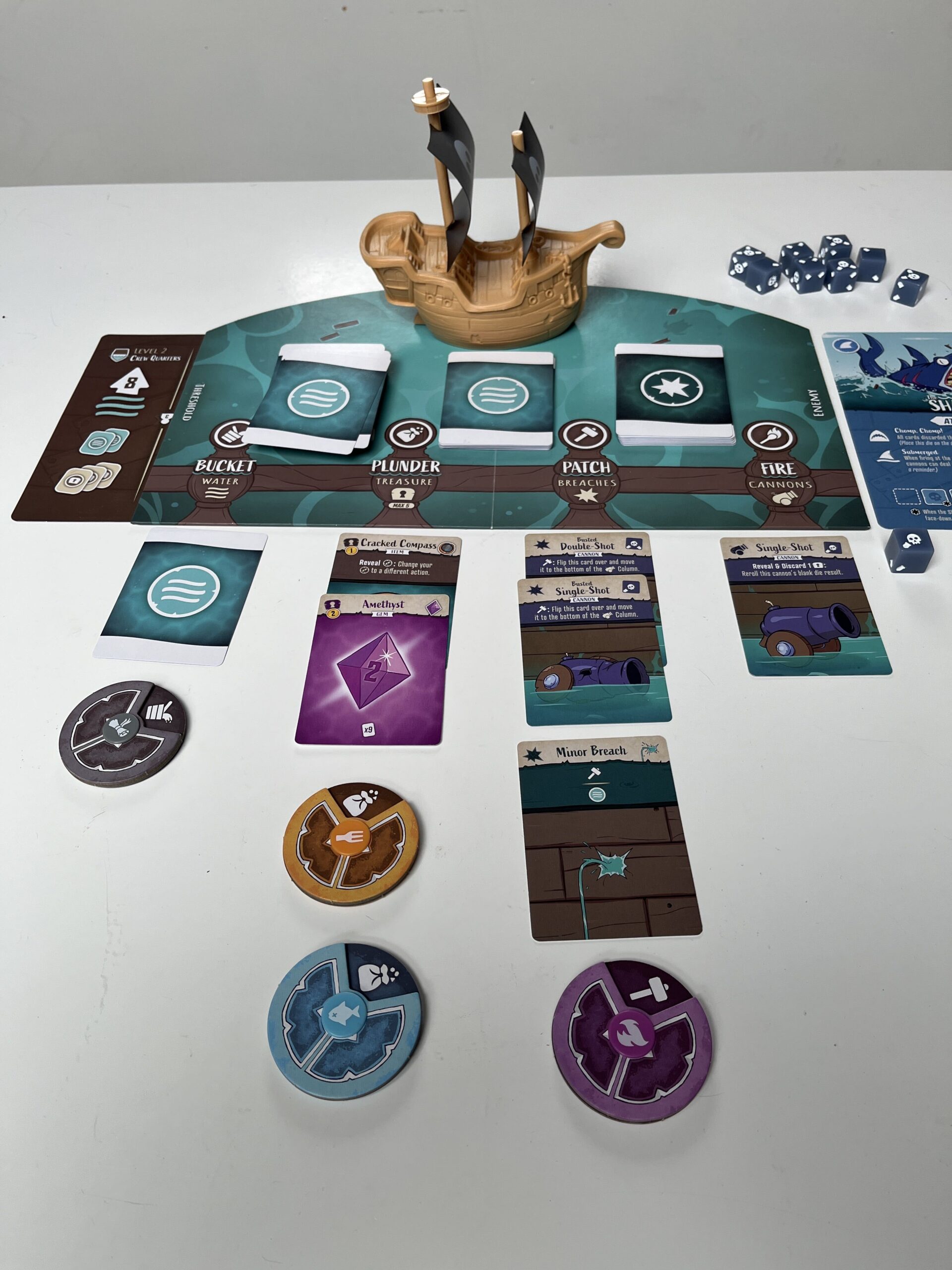
Eerst start de “First mate” de discussie om te kijken of iedereen samen kan werken aan een bepaald plan, waarna de spelers afzonderlijk in het geheim gaan bepalen wat ze effectief gaan doen. Er kan bijvoorbeeld afgesproken zijn om samen de kanonnen te repareren, maar de spelers zelf hebben de eindbeslissing voor hun eigen actie en kunnen dus kiezen om toch iets anders te doen. De spelers kunnen dus bluffen of gewoon staalhard liegen over wat ze gaan doen, want soms is een actie goed voor het team, maar minder goed voor de speler in kwestie. Dit zorgt voor een heel fijne dynamiek in het spel. Om te beslissen welke actie de spelers gaan uitvoeren draaien de spelers hun persoonlijk actieschijfje naar de gekozen actie, maar – en hier komt de twist – ze leggen dit schijfje bij de actie die ze zeggen te gaan doen. Dit gebeurt in de spelersvolgorde te starten bij de startspeler van die ronde, waardoor je andere dingen kan doen door wat iemand anders voor jou kiest. Je legt het schijfje dus bij de bepaalde kolom om aan te geven dat je die actie gaat doen, maar als iedereen dit heeft gedaan worden de schijfjes omgedraaid en worden de schijfjes die niet juist liggen omdat de speler bijvoorbeeld gelogen heeft naar de nieuwe overeenkomende kolom gelegd. Hierdoor verandert de volgorde van de schijfjes omdat de schijfjes die verplaatsen onderaan de rij per kolom aansluiten. Hierdoor kan je tactische keuzes maken want die volgorde is ook de volgorde waarin de acties gaan worden uitgevoerd.
Zodra alle acties op hun (nieuwe) juiste plek liggen, worden de acties uitgevoerd van links naar rechts telkens van boven naar onder. Eerst wordt er dus water geschept en als laatste wordt er geschoten. Hieronder leg ik de verschillende acties kort uit.
- Water scheppen: trek 1 kaart van de water kolom en leg een kaart uit je hand af. Zo kan je onverwachte mooie schatten trekken uit de waterkolom, maar je moet er dus telkens ook eentje afleggen. Als je de laatste (of enige) bent die water schept mag je 2 kaarten trekken en 2 kaarten afleggen. Met deze actie maak je de waterkolom (het water dat je boot is ingesijpeld) kleiner en verklein je de kans op zinken.
- Plunderen: Als 1 speler plundert, mag die speler alle schatkaarten uit de schatkolom nemen. Als er meerdere spelers plunderen, wordt de buit verdeeld volgens de volgorde van de schijfjes.
- Repareren: Met deze actie kan je een kanon repareren of een breuk in je schip dichten. Houd hierbij rekening met het feit dat sommige breuken meerdere mensen nodig hebben om gerepareerd te worden. Je kan met deze actie ook een schatkist openbreken die bepaalde voordelen kunnen opleveren, maar die komen er pas als het schip minstens 1 niveau gezonken is.
- Schieten: Rol de dobbelstenen van elk kanon in deze kolom (dit zijn alle nieuwe kanonnen of herstelde kanonnen). Sommige kanonnen hebben betere kansen om te raken dan andere en het is deze actie die ervoor zorgt dat de vijand levens kan verliezen.
Tenslotte is er de laatste fase die de onderhoudsfase genoemd wordt omdat je hierbij kijkt of je meer of minder dan de handkaartenlimiet hebt. Nadien wordt de “First mate-token” doorgegeven naar de volgende speler.
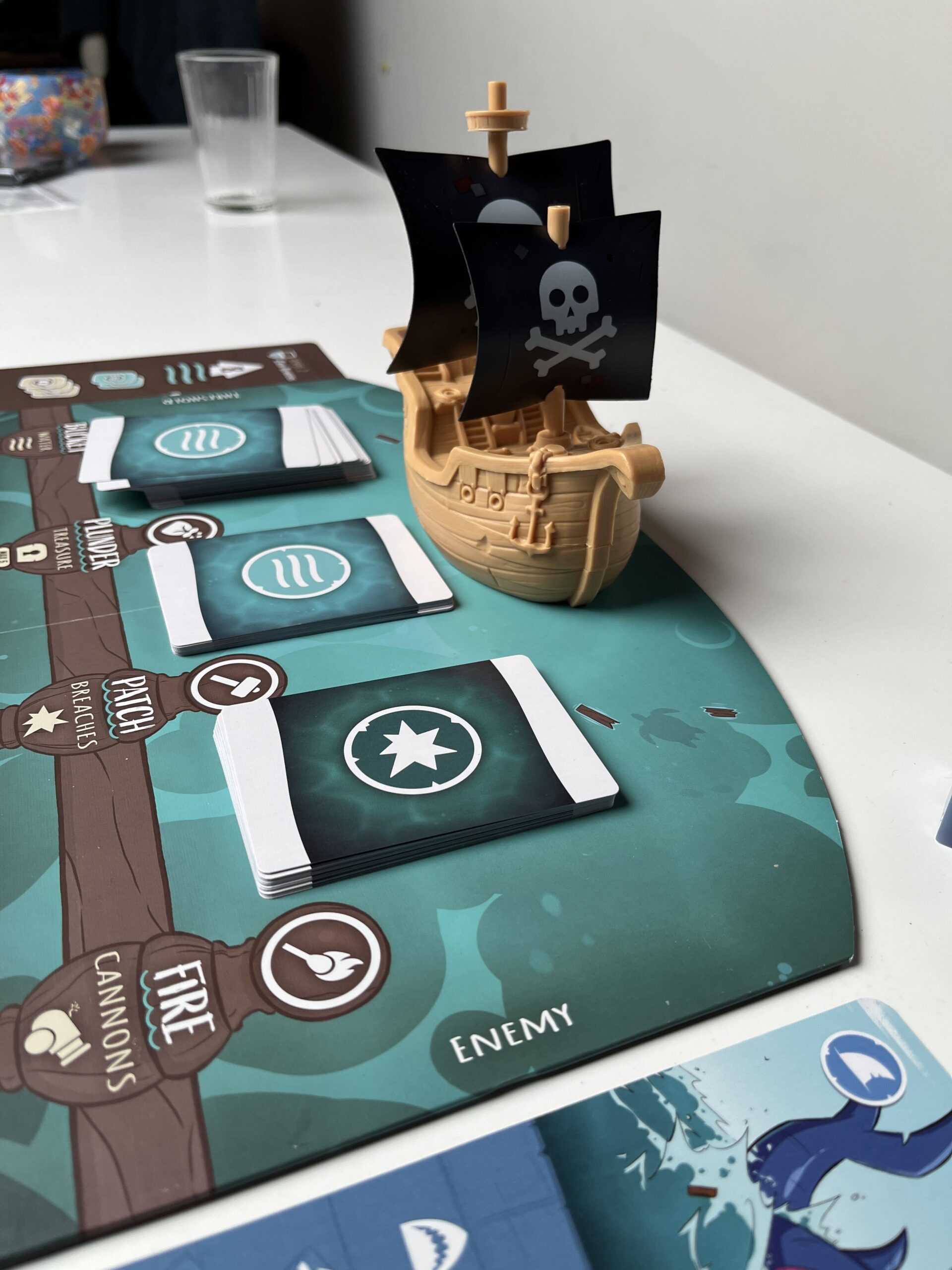
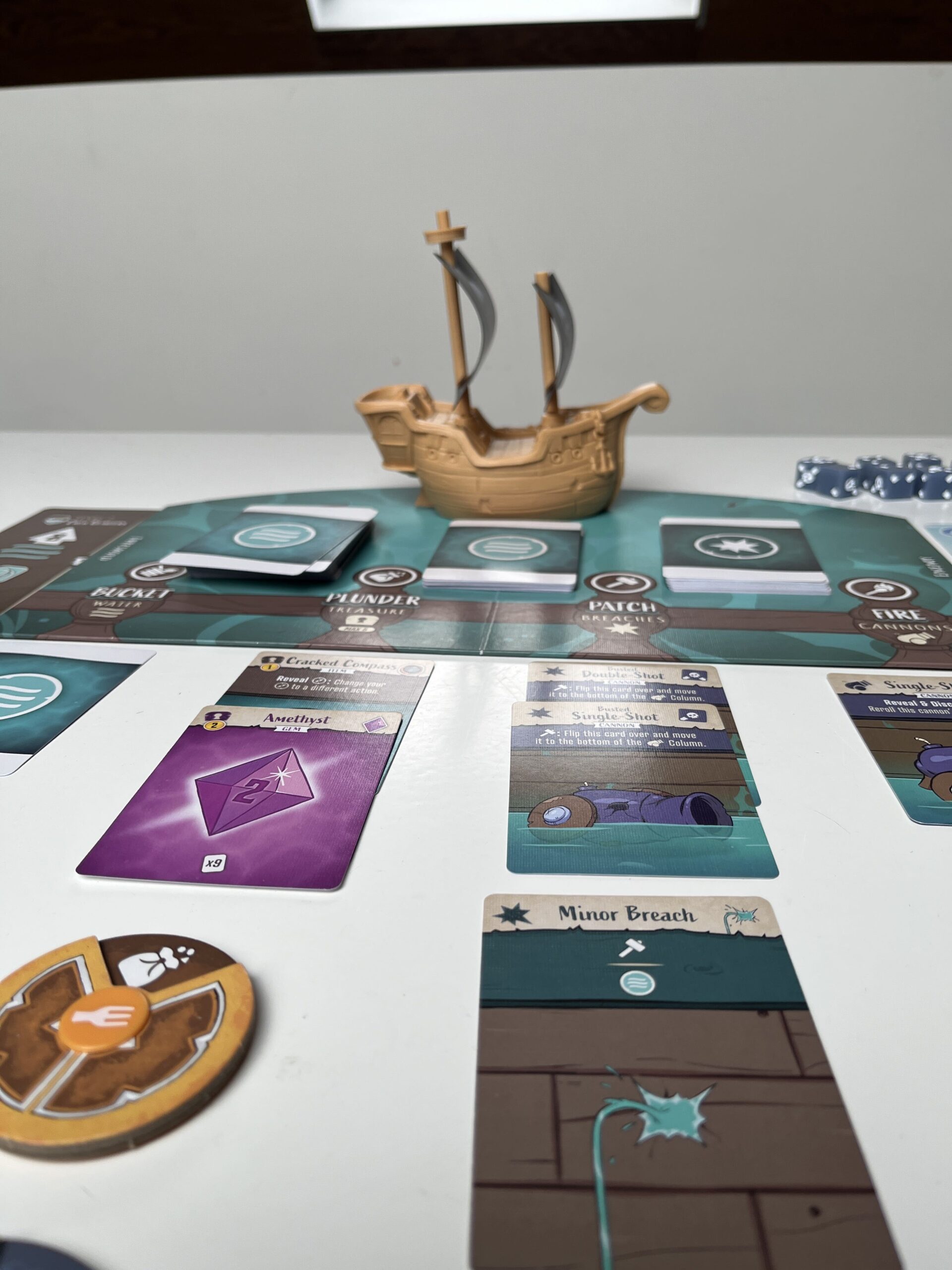
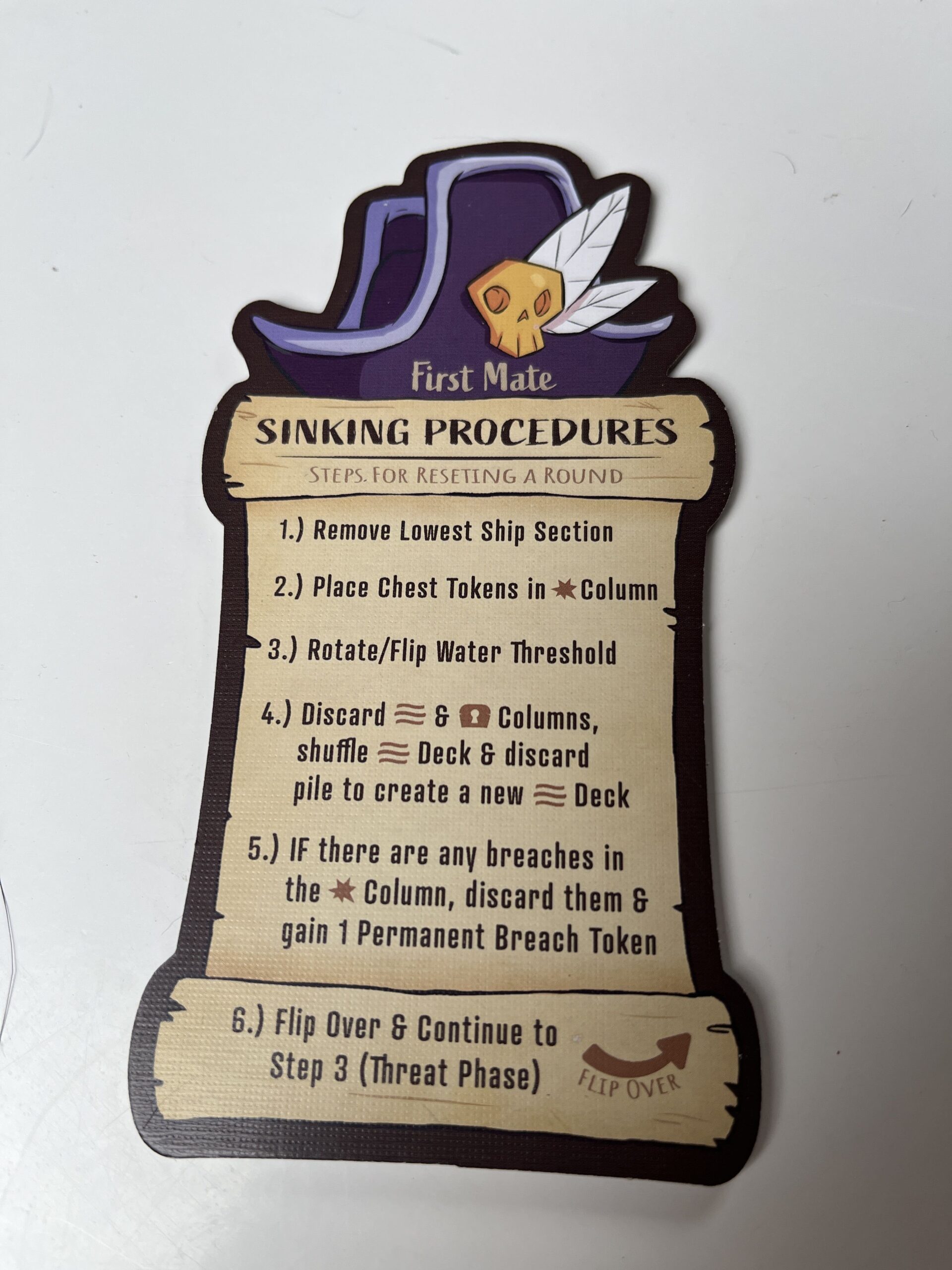
Ik had jullie beloofd om ook even de zink procedure te overlopen: hier volgt die in het kort. Eerst verwijder je het laagste deel van het schip. Ja, het schip bestaat uit verschillende uit elkaar te halen niveaus en dit is erg leuk vormgegeven om aan te geven dat het schip dieper het water in zakt. De kisttokens die op die laag liggen leg je in de breuken kolom. Nadien draai je de threshold kaart naar het volgende niveau en schud je alle waterkaarten en schatkaarten uit zowel de trekstapel, als de aflegstapel en je schudt de kaarten in de water- en schatkolom hieronder zodat je met een propere lei kan starten aan je volgende niveau. Als er breuken in je schip zitten, haal je die uit de breukenkolom en leg je een permanente breuk in de plaats. Dit zorgt ervoor dat je goed moet nadenken of je de breuken laat zitten of niet.
Tenslotte geef je de first mate token door en ga je verder met de dreigingsfase.
Wanneer is het spel dan gedaan vraag je?
Er zijn 2 mogelijke eindsituaties voor het spel:
- De vijand is verslagen: Alle spelers checken hun handkaarten, tellen de waardes op en de speler met de meeste punten is de eindwinnaar.
- Het schip is gezonken: Alle spelers tellen hun aantal handkaarten en de speler met de minste handkaarten is de eindwinnaar. Het idee is hier dat je met minder schatten makkelijker tot aan land kan zwemmen. Dit vond ik een fijn detail. 😉
Spelmechanisme
Er zijn een aantal verschillende mechanismes in dit spel. Hand management en onderhandelen lijken hierbij de meest voor de hand liggende. Je hebt namelijk je eigen kaarten en moet die bijhouden en niet te veel over de limiet gaan omdat je dan kaarten moet afleggen. Onderhandelen is een groot deel van het spel en ook een groot deel van het plezier dat dit spel met zich mee brengt naar mijn mening. Je kan namelijk gezamenlijk proberen te beslissen wat er moet gebeuren om het schip te redden zonder dat iemand zich hieraan moet houden.
Er is een leuk mechanisme in dit spel dat over het algemeen het prisoner’s dilemma wordt genoemd omdat de speler de keuze heeft om samen te werken, maar ook om te saboteren en dit zorgt voor een zekere spanning tijdens het spel.
Mijn bescheiden mening
Mijn mening sijpelt hier en daar al door in de vorige paragrafen, maar ik vond dat het spel een heel erg leuke dynamiek met zich meebrengt en dat dit de sfeer aan tafel ten goede komt. De mechanismes werken zeer goed samen en maken het spel tot een aangename ervaring. De leuke tekenstijl voelt voor mij erg charmant en zorgt er ook voor dat het spel niet al te zwaar aanvoelt. Met een zwaardere/realistischere en donkerdere tekenstijl zou ik dit spel vermoedelijk niet hebben gekozen.
Ik heb erg veel gelachen tijdens het spelen van dit spel en vond de sfeer altijd fantastisch. Iedereen zit direct in een goede piratenstemming omdat je lekker “ja” kan knikken terwijl je “nee” denkt en nadien ook doet. Het backstabben moet je er hierdoor wel kunnen bijnemen.
Wat maakt het spel zo sterk?
- De mechanismes werken fantastisch bij elkaar.
- De sfeer is elke keer opnieuw top en dit zorgt voor een goede ervaring bij het spelen.
- De leuke tekenstijl maakt dat het spel niet te zwaar aanvoelt en zorgt voor een luchthartige spelervaring.
- De vormgeving van het schip dat je steeds dieper het water in kan doen zinken is fantastisch gedaan en zorgt voor een extra touch.
- Er zit variatie in door de verschillende mogelijke vijanden, maar het spel blijft an sich hetzelfde.
- Ik ben niet onverschillig voor een thema in een spel en zeker niet als het thema perfect past bij hoe het spel speelt en voelt. Bovendien ben ik een enorme fan van piraten thema’s dus dit gaf het spel al meteen een voordeel.
Is het alleen maar positief?
Naast deze erg positieve ervaring die ik tijdens het spel had, heb ik wel enkele minpunten. Deze zijn natuurlijk subjectief, maar naar mijn mening heeft het spel een net te lange spelduur voor het party-achtige gevoel. Niet dat het erg stoort maar ik kan me voorstellen dat het spel voor sommige mensen repetitief aanvoelt door de vele overgangen van fase naar fase, waarin je steeds dezelfde checklist moet volgen.
Als je dit spel vaak speelt, kan het handig zijn om ook de uitbreiding Swords & Souls erbij te nemen omdat dit weer nieuwe vijanden introduceert om nog meer variatie in te bouwen.
Conclusie
Overall vond ik dat het spel dus een hilarische en plezante dynamiek creëerde onder de spelers omdat ze zowel samenwerken als concurreren. Het spel duurt misschien nét een beetje te lang, maar al bij al stoorde dit me niet al te hard omdat ik tijdens dit spel telkens weer een fijne tijd heb. De vormgeving en mechanismes zijn on point en ik herhaal dat het ook vooral door de gecreëerde sfeer is dat ik dit spel fantastisch vond. Ik heb lang getwijfeld tussen 7 en 7.5, maar het plezier dat ik heb gehad met dit spel zorgt toch voor het definitieve eindoordeel van 7.5/10.

We're Sinking!
Players: 3-6
Time: 45-90 minutes
Age: 10+
Author: Joseph Frederick
Publisher: Lucky Duck Games
Year: 2025
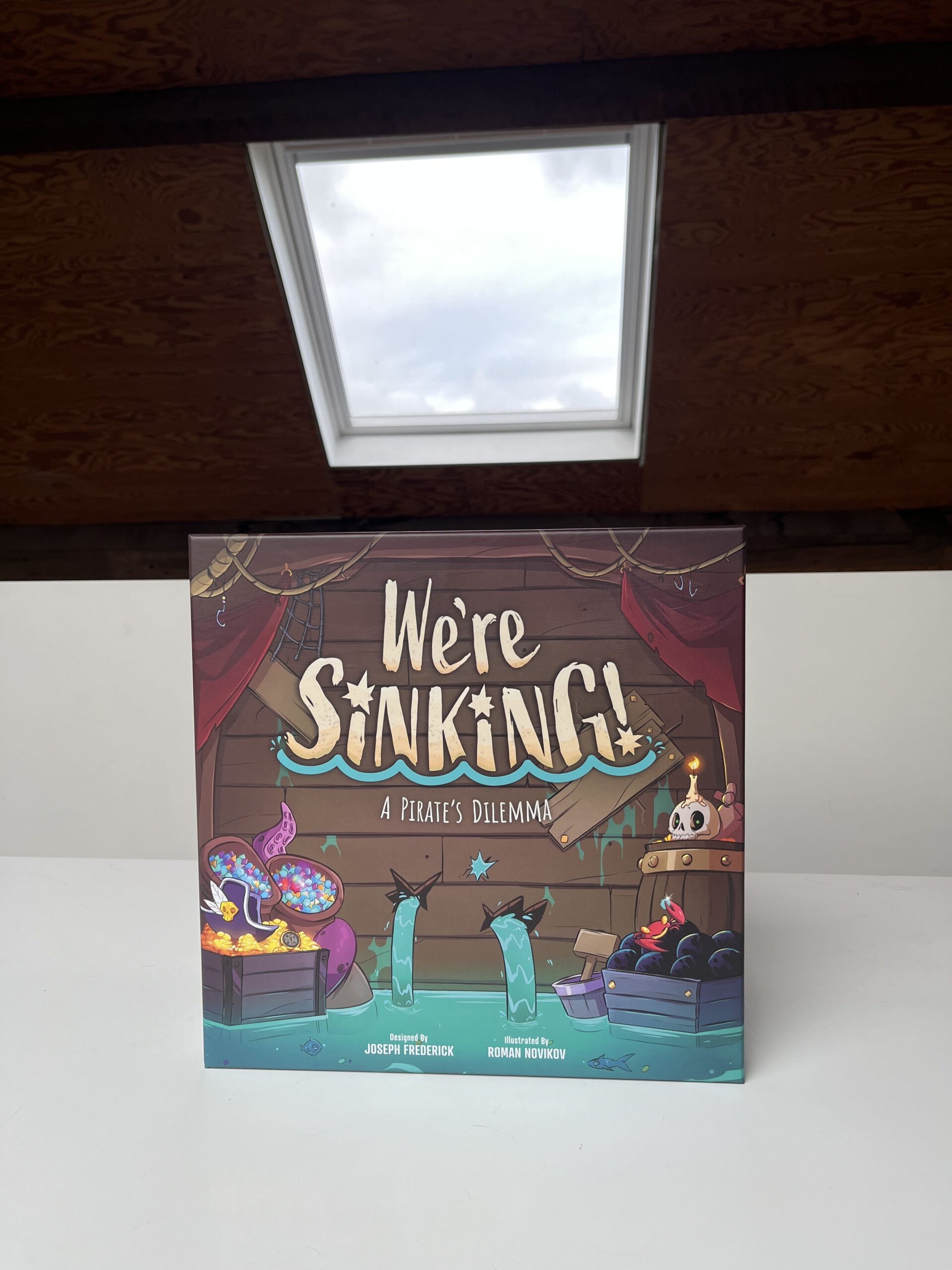
Yarrr, me hearties! Do you know the feeling of being on a sinking ship, under attack by some sea monster or other? You do? Well, then perhaps you can help me out here. Do you stand by your crew and try to patch the holes in your ship, or do you stab them in the back to make your escape as quickly as possible? In We’re Sinking!, you get to experience these choices firsthand.
Gameplay
Before the game begins, players must decide which monstrous enemy they will face while aboard their sinking ship. Each enemy possesses unique powers and specific dice, offering four distinct gameplay experiences.
Initially, all players take their turns simultaneously. The “First Mate”—or starting player—follows the steps on their checklist to determine what happens next.
First is the “Inspect” phase, during which the First Mate checks for breaches in the ship (indicated in the “Breaches” column) and adds an equal number of water cards to the “Water” column. Think of this as water seeping into your vessel; if too much water enters, the ship will sink. If the number of water cards in the column exceeds your ship’s limit, you must proceed to the sinking procedures found on the back of your checklist. (Don’t worry—we’ll go over those shortly! 😉)
Next is the “Threat” phase, where cards are added to your “Water” and “Treasure” columns based on your ship’s current level. Once these cards have been placed in the appropriate columns, it’s time to see what your chosen enemy has in store for your ship. You’ll roll the four standard dice along with the enemy-specific dice to determine if new breaches occur, cannons are destroyed, or water washes onto the deck. Each enemy also has a unique ability that can trigger various other events.
Finally, there is the “Task” phase, during which players discuss and decide on the actions they will take. The various actions you can take include: bailing out water, plundering, repairing, or firing cannons.
The “First Mate” begins by initiating a discussion to see if everyone can agree on a plan; however, each player then secretly decides what they will actually do. For instance, the group might agree to work together on repairing the cannons, but since players have the final say over their own actions, they could choose to do something else entirely. Players can bluff or even lie outright about their intentions—sometimes an action benefits the team but is less advantageous for the individual player, which creates a fantastic dynamic within the game. To commit to an action, players rotate their personal action disc to the chosen option—but here’s the twist: they place the disc in the column corresponding to the action they claim they will take. This happens in turn order, starting with the round’s lead player, meaning your own options may be influenced by the choices made by those before you. Once everyone has placed their discs, they are flipped over; if a player lied, their disc is moved to the column that actually matches the action they performed. This shifts the order of the discs, as any moved discs are placed at the bottom of their new column. This allows for tactical decision-making, as the final arrangement of the discs determines the sequence in which the actions are executed.
Once all actions are in their (corrected) positions, they are carried out from left to right, and from top to bottom within each column. First, water is bailed out, and finally, shots are fired. Below, I briefly explain the various actions:
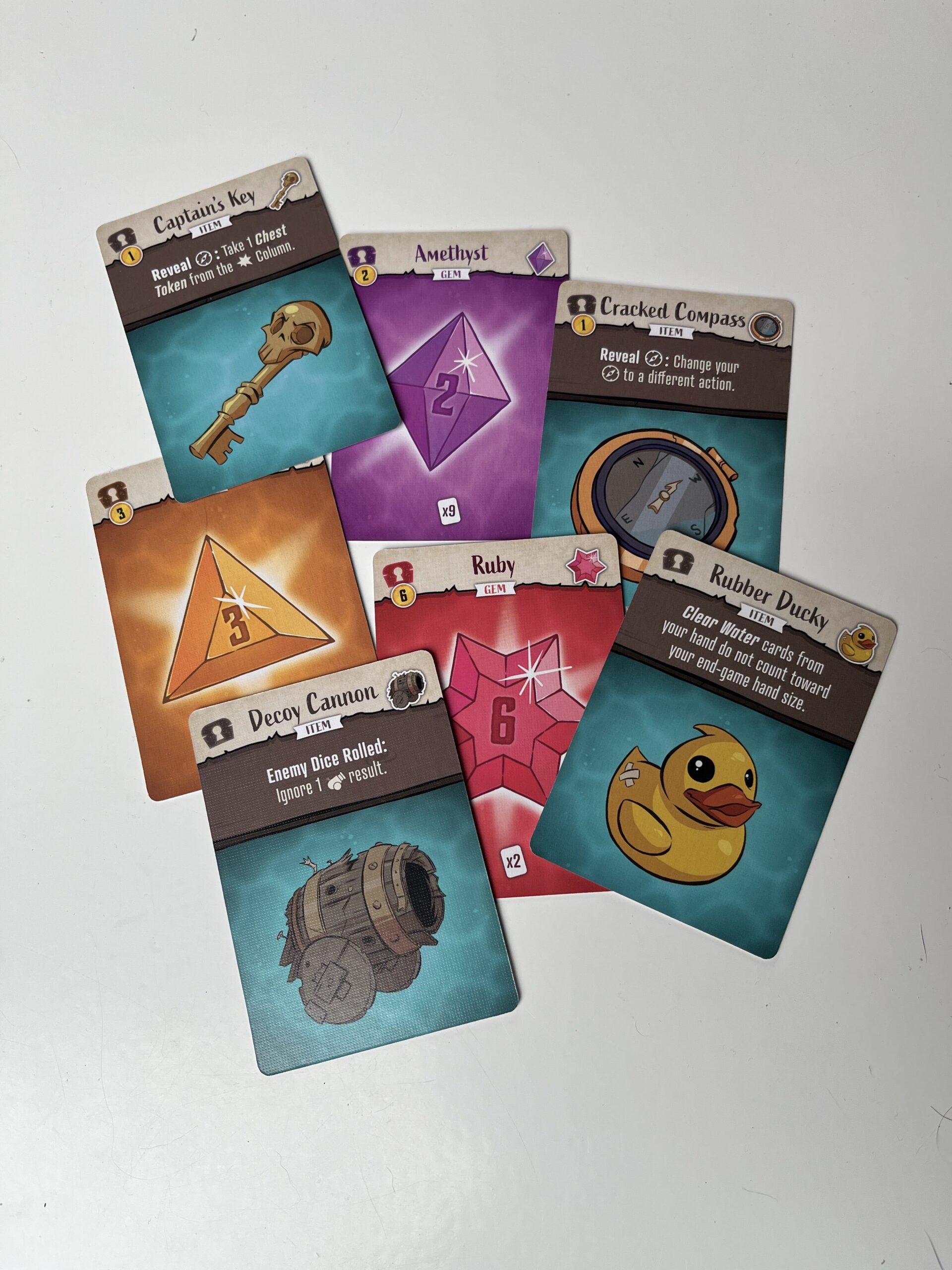
- Bucket: Draw 1 card from the water column and discard a card from your hand. This allows you to potentially draw valuable, unexpected treasures from the water column, but you must always discard one card in return. If you are the last (or only) player to bail water, you may draw 2 cards and discard 2. This action reduces the water column—the water that has seeped into your ship—thereby lowering the risk of sinking.
- Plundering: If one player chooses to plunder, they may take all the treasure cards from the treasure column. If multiple players plunder, the loot is divided according to the order of the player tokens.
- Repairing: Use this action to repair a cannon or patch a breach in your ship. Keep in mind that some breaches require multiple people to repair. You can also use this action to break open a treasure chest, which may provide certain benefits—though these only become available once the ship has sunk by at least one level.
- Firing: Roll the dice for each cannon in this column (this includes all new or repaired cannons). Some cannons have a better chance of hitting than others; this is the action that causes the enemy to lose health.
Finally, there is the maintenance phase, during which you check whether you have more or fewer cards than the hand limit allows. Afterward, the “First Mate” token is passed to the next player.
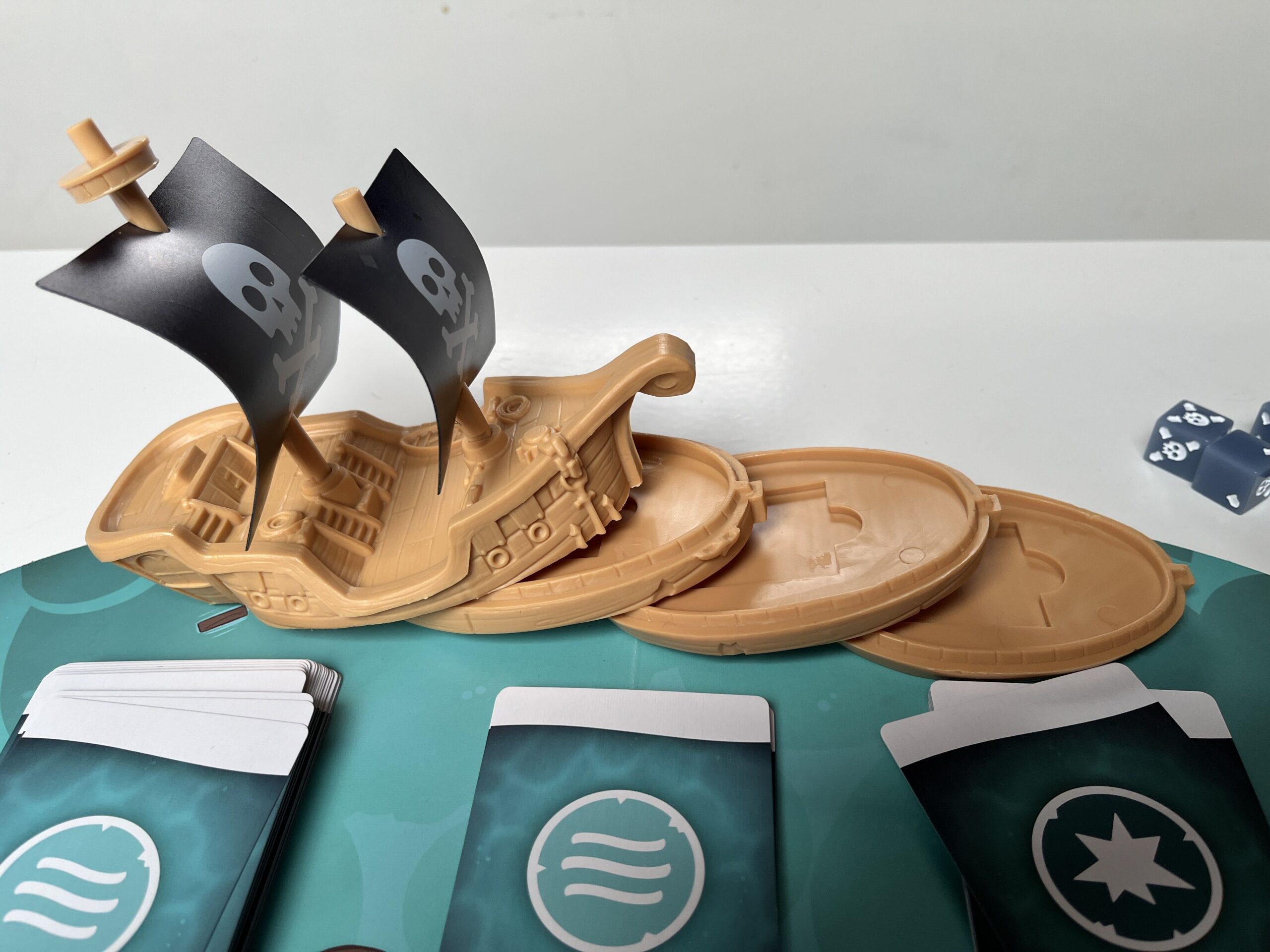
I promised to walk you through the sinking procedure—here it is, in brief. First, you remove the lowest section of the ship. The ship is actually made up of several detachable levels; it’s a clever design that visually represents the vessel sinking deeper into the water. Any crate tokens located on that section are moved to the “breaches” column. Next, you flip the threshold card to the next level, then shuffle all the water and treasure cards—from both the draw and discard piles, as well as those currently in the water and treasure columns—so that you can start the new level with a clean slate. If there are any breaches in your ship, you remove them from the breaches column and replace them with a permanent breach marker. This forces you to carefully consider whether or not you want to leave those breaches unrepaired.
Finally, pass the “first mate” token to the next player and proceed to the threat phase.
So, when does the game end, you ask?
There are two possible end-game scenarios:
- The enemy is defeated: All players reveal the cards in their hand, add up their values, and the player with the highest total is declared the winner.
- The ship has sunk: All players count the number of cards in their hand, and the player with the fewest cards wins. The idea here is that carrying fewer treasures makes it easier to swim to shore—a nice little detail, I thought! 😉
Game Mechanics
There are several different mechanisms in this game. Hand management and negotiation appear to be the most prominent ones. You have your own set of cards that you must keep track of; you need to be careful not to exceed the hand limit, as doing so forces you to discard cards. In my opinion, negotiation is a major part of the game—and a significant source of the fun it offers. You can collectively try to decide on the best course of action to save the ship, though no one is actually bound to follow through on those agreements.
The game also features an interesting mechanic—often referred to as the “prisoner’s dilemma”—where players must choose between cooperating or sabotaging. This adds a distinct layer of tension to the gameplay.
My Humble Opinion
My opinion has already begun to surface in the previous paragraphs, but I found that the game introduces a really fun dynamic, which enhances the atmosphere at the table. The mechanics work together very well, making for an enjoyable gaming experience. I find the delightful art style truly charming; it keeps the game from feeling too heavy. Had the art style been darker, more realistic, or more serious, I likely wouldn’t have chosen to play this game.
I laughed a great deal while playing, and the atmosphere was consistently fantastic. It’s easy to get into the pirate spirit—you can happily nod “yes” while thinking “no,” only to act accordingly later on. Of course, you have to be prepared for a bit of backstabbing!
What makes the game so strong?
- The mechanisms work together fantastically.
- The atmosphere is excellent every single time, which makes for a great playing experience.
- The charming art style keeps the game from feeling too heavy, ensuring a lighthearted experience.
- The design of the ship—which you can sink deeper and deeper into the water—is brilliantly executed and adds a nice extra touch.
- There is some variety thanks to the different types of enemies you might encounter, though the core gameplay remains the same.
- I’m not indifferent to a game’s theme—especially when it fits the gameplay and overall feel perfectly. Furthermore, I’m a huge fan of pirate themes, which gave this game an immediate advantage.
Is it all just positive?
Despite the very positive experience I had while playing, there are a few drawbacks. These are, of course, subjective, but in my opinion, the game’s duration is a bit too long for a title with a “party game” feel. It’s not a major issue, but I can imagine that for some, the game might feel repetitive due to the frequent transitions between phases, each requiring you to go through the same checklist.
If you play this game often, it might be worth picking up the *Swords & Souls* expansion, as it introduces new enemies that add a greater degree of variety.
Conclusion
Overall, I found that the game created a hilarious and enjoyable dynamic among the players, as they are required to both collaborate and compete. While the game might run just a little bit too long, it didn’t really bother me, as I always have a great time playing it. The design and mechanics are spot on, and I want to reiterate that it is largely due to the atmosphere created that I found this game fantastic. I wavered for a while between a 7 and a 7.5, but the enjoyment I experienced with this game ultimately leads me to a final rating of 7.5/10.