
Aantal spelers: 2-6
Speelduur: 20 minuten
Leeftijd: Vanaf 8 jaar
Auteur: Sicco Faase, Julian Geelhoed, Ralf Heersma
Uitgever: Spellenwinkel.nl
Jaar: 2026
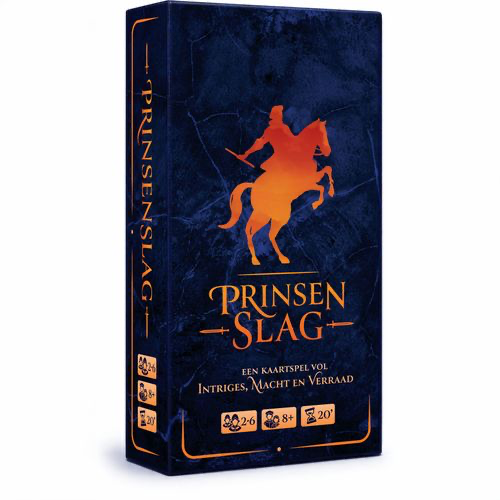

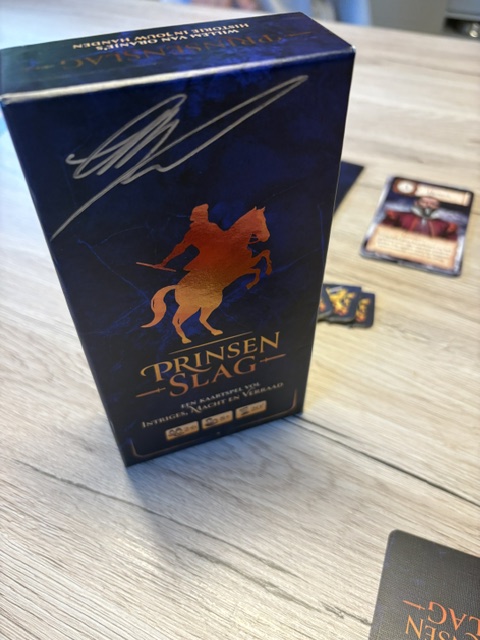
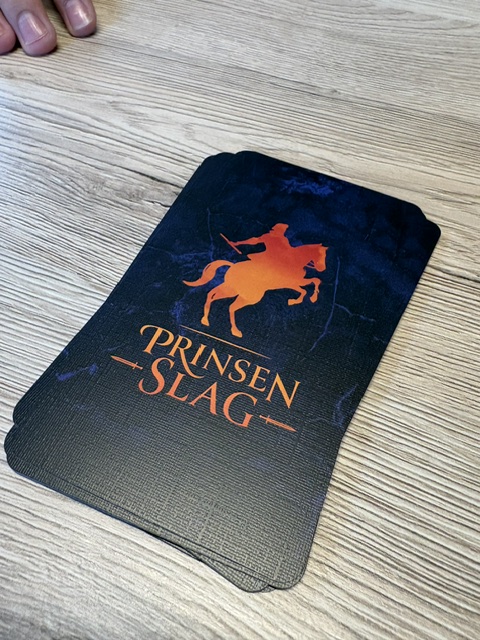
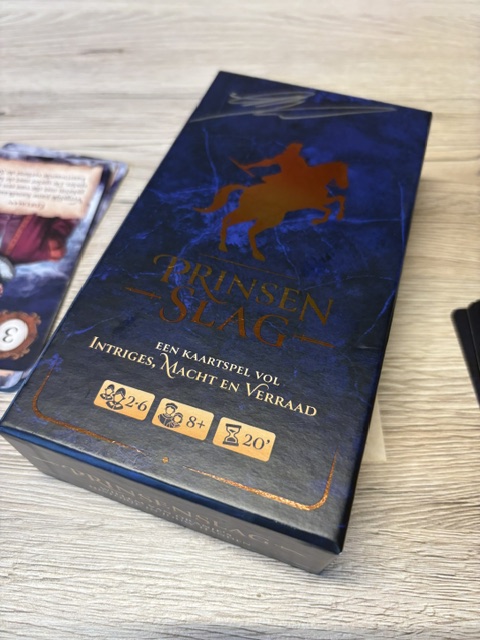
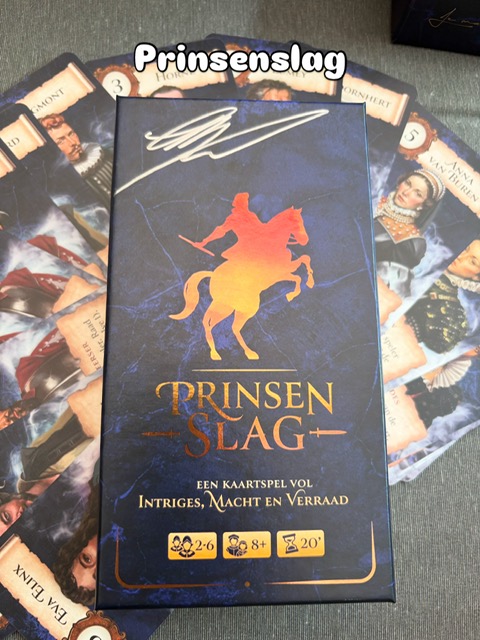

Prinsenslag
Players: 2-6
Time: 20 minutes
Age: 8+
Author: Sicco Faase, Julian Geelhoed, Ralf Heersma
Publisher: Spellenwinkel.nl
Year: 2026
Who was the greatest Dutchman of all time? That question was put to a public vote during a 2004 television program. The program initially declared Pim Fortuyn the winner, but it later emerged that a large number of votes had not been counted due to a slow security system. Had all votes been included, William of Orange would have won by a wide margin—a fact confirmed by research conducted by Maurice de Hond a few days later.
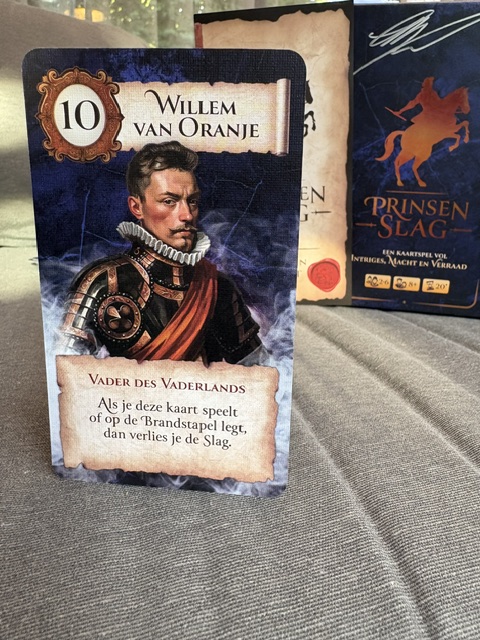
In the game Prinsenslag, William of Orange is described as follows:
The man who challenged a world power and nearly got away with it. Clever, strategic, and charismatic, he managed to win over allies, outsmart opponents, and sustain a rebellion that made Europe tremble. He was declared an outlaw, survived multiple assassination attempts, and kept fighting long after others had given up—until Balthasar Gerards saw his chance in 1584. His death shocked Europe, but the rebellion he had started was unstoppable.
July 10th marked the anniversary of William of Orange’s death. The game Prinsenslag was launched on that day, following a performance of the musical Willem van Oranje.
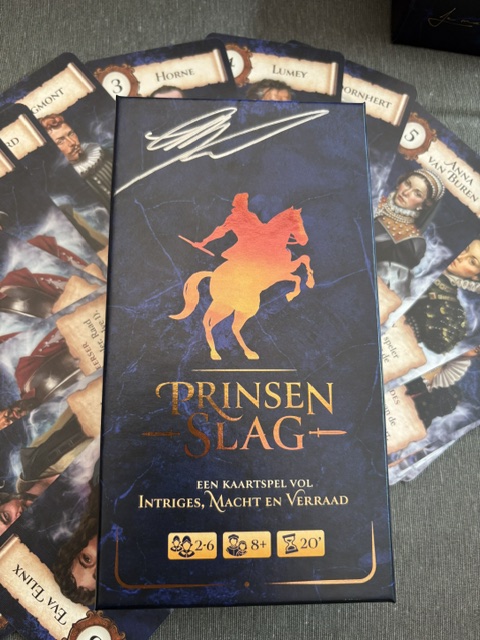
Prinsenslag is based on the game Love Letter, but features actual characters from the musical—and thus real historical figures. Add a few unique character traits and event cards to the mix, and you have Prinsenslag.
Prinsenslag was not released by a major game publisher, but by the online shop Spellenwinkel.nl.
Setup and components
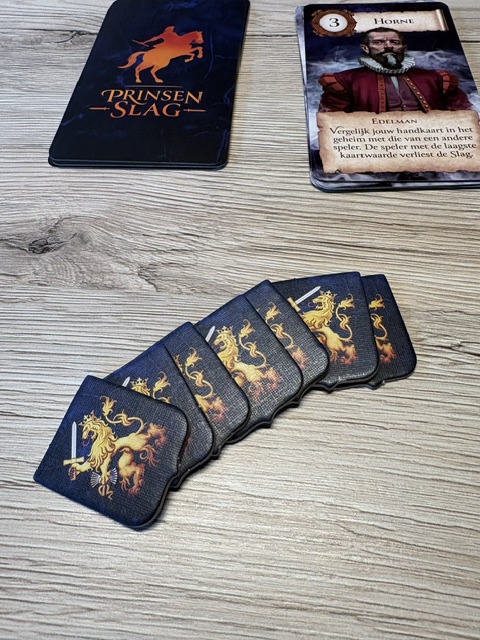
Prinsenslag is a fairly simple game, so it does not have many components: 21 character cards, 5 event cards, and 7 triumph shields (tokens).
The illustrations are beautifully executed, and the historical details are accurate.
To start, shuffle the character cards and set the top one aside. This is the “banished” card; it does not participate in the game. Deal a character card to each player, and you are ready to start.
How the game is played
Prinsenslag is played over a series of rounds. These rounds are called “Battles.” If you win a round (a Battle), you receive a triumph shield. You win the game once you have collected 2 triumph shields (for 4–6 players) or 3 triumph shields (for 2–3 players).
In a round (a Battle), players take turns in clockwise order. Play continues until only one active player remains; that player receives the triumph shield. The other players will have been eliminated earlier in the Battle.
At the start of your turn, you always hold one character card. When it is your turn, draw a character card from the central draw pile. You then have two cards in your hand. Choose one of the two to play. Resolve its effect and place it face-up on the central discard pile. That concludes your turn; you are left with one card in your hand again.
Specific terms have been assigned to the piles: the draw pile is the “Inn,” and the discard pile is the “Bonfire.”
By playing a card, you attempt to eliminate another player from the round. There are 12 types of character cards, each with a different effect. Every character card type bears a number between 0 and 10.
A few examples of character cards:
– The Spanish Soldier (number 1): You may guess the number on another player’s card. If you guess correctly, that player is eliminated from the Battle. – The Nobleman (number 3): compare the number on the card in your hand with that of another player. If yours is higher, the loser is eliminated from the Battle. The reverse applies as well.
– King of Spain (number 9): swap your hand card with that of a chosen player.
You’ll notice there is a lot of interaction. That is necessary, of course, because you want to eliminate other players from the Battle.
If the draw pile is empty and multiple players are still active in the Battle, a *Resolution* follows. This marks the forced end of the Battle. Each active player reveals their card, and the person with the highest number wins. William of Orange holds the 10—the highest number. However… if Balthasar (number 0) is involved in the Resolution alongside William of Orange, Balthasar wins. After all, Balthasar was the assassin of William of Orange.
From the second round (Battle) onwards, an event card is added to the draw pile. This introduces an additional effect. A new, different event card appears in every subsequent round.
What do I think of the game?
Prinsenslag clearly bears a strong resemblance to Love Letter: draw a card, play a card. The addition of event cards provides a fun twist. Like the characters, the events are based on historical facts—very well done.
Naturally, the game revolves around the card effects. These foster significant interaction and can lead to some tricky choices. The effects are well-designed and mesh together perfectly. During a clash, you are actively trying to knock another player out of the round. This is the fun part of the game, and it’s well-implemented in Love Letter. Figuring out how to eliminate another player is quite exciting. Does the other player likely hold a high card for the showdown? Then you go for an effect allowing you to swap cards or redeal. You can’t be certain about this, which keeps things exciting.
I’ve played this with 4 and 5 players, and it works very well; it should be just as good with 6. I think it works particularly well with larger groups, as that’s when surprises often crop up—like a player quietly holding a high card for the showdown or knocking out their last remaining opponent.
Prinsenslag is very easy to explain, yet offers enough depth to allow for clever play. It’s a great game for a quick session.
By the way, the musical is highly recommended, too; it’s spectacular, featuring stunning sets and great acting.